Quick Verdict: The Compact EV That Punches Above Its Price
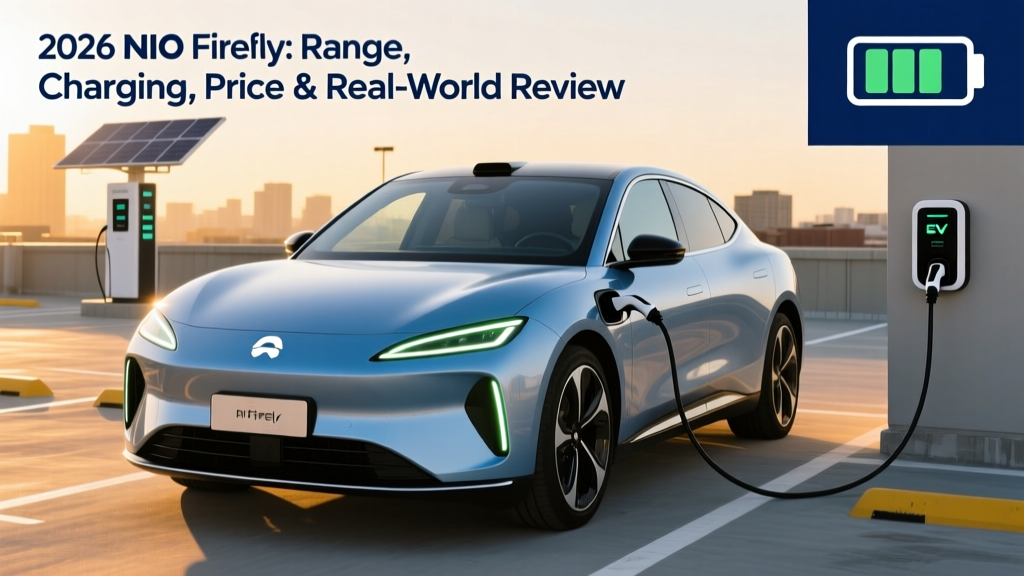
The 2026 NIO Firefly is the Chinese automaker's most accessible vehicle yet — a subcompact electric hatchback aimed squarely at urban commuters and young buyers who want premium build quality without the premium price tag. Slotting below the NIO ET5 and the midsize Onvo L60 (formerly the sub-brand's EL8), the Firefly enters a segment crowded with strong contenders like the Chevrolet Bolt EV, the Volvo EX30, and the Mini Cooper Electric. What sets it apart is NIO's signature battery-swap architecture, a surprisingly refined interior for the class, and a starting price that undercuts most European rivals.
But the Firefly's story in the U.S. market remains complicated. As of early 2026, NIO has not confirmed a stateside launch, meaning American buyers cannot purchase this vehicle domestically. For European and Chinese-market shoppers — and for U.S. readers tracking the global EV landscape — here's a comprehensive, data-driven breakdown of what the Firefly offers.
| Spec | Value |
|---|---|
| EPA-Equivalent Range | ~186 mi (WLTP: 260 mi / 420 km) |
| Battery Capacity | 42.9 kWh (usable), LFP chemistry |
| Drivetrain | Rear-wheel drive (single motor) |
| Horsepower | 143 hp (105 kW) |
| 0-62 mph (0-100 km/h) | ~8.2 seconds |
| Max DC Fast Charge | ~100 kW (peak) |
| 10-80% DC Charge Time | ~30 minutes (estimated) |
| Level 2 AC Charge Rate | 7 kW (onboard charger) |
| Length / Width / Height | ~157.5 in / 69.7 in / 62.6 in |
| Cargo Volume | ~12.7 cu ft (rear seats up) |
| Base MSRP (Europe, est.) | ~€30,000 (~$32,500 USD equivalent) |
| Battery/Powertrain Warranty | 8 years / 100,000 mi (160,000 km) |
Range & Efficiency: WLTP vs. Real-World Expectations
EPA-Equivalent Range: ~186 miles (estimated, based on WLTP-to-EPA conversion factor)
Real-World Expectation: Plan for ~150–165 miles on mixed highway driving at 70 mph, and as low as ~130 miles in sustained cold weather (below 32°F / 0°C) without preconditioning. City driving with regenerative braking can push closer to the 186-mile figure.
NIO quotes a WLTP range of approximately 260 miles (420 km) for the Firefly's 42.9 kWh LFP battery pack. However, WLTP testing is notably more generous than the EPA cycle used in the United States. Applying a typical 0.72 conversion ratio — consistent with how other compact EVs translate between the two standards — yields an EPA-equivalent estimate of roughly 186 miles.
For context, that places the Firefly below the Chevrolet Bolt EV's EPA-rated 259 miles but in the neighborhood of the base Mini Cooper Electric's ~114-mile EPA figure (the Firefly sits between these two in range). Efficiency is estimated at around 105 MPGe combined, or roughly 32 kWh per 100 miles — reasonable for a compact hatchback with a relatively small battery.
The LFP (lithium iron phosphate) chemistry is a deliberate choice. LFP cells sacrifice some energy density compared to NMC (nickel manganese cobalt) but offer superior cycle life, thermal stability, and the ability to charge to 100% state of charge regularly without accelerating degradation. For daily commuters who charge at home every night, that's a meaningful longevity advantage.
Charging Speed: DC Fast, Level 2, and Battery Swap
| Charging Level | Power / Rate | Miles Added per Hour | Notes |
|---|---|---|---|
| Level 1 (120V household) | ~1.4 kW | ~4–5 mi/hr | Emergency/trickle only |
| Level 2 (240V home/public) | 7 kW (max onboard) | ~22–25 mi/hr | Full charge in ~6 hours |
| DC Fast Charging | ~100 kW peak | N/A (session-based) | 10–80% in ~30 min |
| NIO Battery Swap (Gen 4) | N/A | Full pack in ~3 min | Station-dependent; not available in U.S. |
The Firefly supports DC fast charging at up to approximately 100 kW peak. That's modest by 2026 standards — competitors like the Hyundai Ioniq 5 can pull 240 kW on 800V architecture — but acceptable for a 42.9 kWh battery. A smaller battery simply doesn't need ultra-high charge rates to achieve reasonable session times, since the charge curve (the rate at which power tapers as the battery fills) remains manageable. Expect the 10–80% session to take roughly 30 minutes at a capable DC fast charger, with power tapering noticeably above 70% state of charge to protect the LFP cells.
At home on a Level 2 connection, the 7 kW onboard charger means a full 0–100% charge takes about six hours — easily achievable with overnight charging on a standard 240V / 32A home setup. Installation of a Level 2 home charger in the U.S. typically costs between $800 and $2,000 depending on panel capacity and run length, though again, NIO's U.S. availability remains the larger question.
NIO's signature feature — battery swapping at proprietary stations — is supported on the Firefly. At a Gen 4 swap station, a depleted pack can be exchanged for a fully charged one in approximately three minutes. However, NIO's swap network is concentrated in China and parts of Europe (notably Norway and Germany). There are no NIO swap stations in the United States, and none are planned as of this writing.
Performance & Driving Dynamics
The Firefly uses a single rear-mounted electric motor producing 143 horsepower (105 kW) and an estimated 162 lb-ft of torque. Acceleration to 62 mph (100 km/h) takes approximately 8.2 seconds — leisurely by EV standards but perfectly adequate for urban and suburban driving. There is no dual-motor or all-wheel-drive variant at launch.
Ride quality benefits from the Firefly's relatively low center of gravity (the battery pack sits beneath the floor) and NIO's tuning philosophy, which leans toward comfort over sportiness. The compact dimensions (~157.5 inches long) make it exceptionally easy to park in tight city spaces, while the turning radius is tight enough for U-turns on narrow streets.
Regenerative braking offers adjustable levels through the infotainment system, though the Firefly does not offer true one-pedal driving with a full stop — you'll still need the friction brakes for final halts. This is a common compromise in the subcompact EV segment.
Interior, Cargo & Technology
NIO has positioned the Firefly's interior as a step above its price class. The dashboard features a 10.25-inch digital instrument cluster and a centrally mounted 12.3-inch touchscreen running NIO's latest Banyan infotainment system. Wireless Apple CarPlay and Android Auto are standard, along with a wireless phone charging pad, ambient lighting, and a panoramic glass roof (on higher trims).
Passenger space is competitive for the segment:
- Front legroom: ~41.3 inches
- Rear legroom: ~34.6 inches (tight for tall adults on long trips)
- Cargo volume (rear seats up): ~12.7 cu ft
- Cargo volume (rear seats folded): ~36.5 cu ft (estimated)
For comparison, the Chevrolet Bolt EV offers 16.6 cu ft of cargo space behind the rear seats, so the Firefly gives up some practicality in exchange for its tighter footprint. A small front trunk (frunk) is not available — the space is occupied by HVAC and power electronics.
On the driver-assistance front, the Firefly comes equipped with NIO's NOP (Navigate on Pilot) suite, which includes adaptive cruise control, lane-centering assist, automatic emergency braking, and blind-spot monitoring. This is an SAE Level 2 system — meaning the driver must remain fully engaged and keep hands on the steering wheel at all times. It is not self-driving. The system performs competently on well-marked highways but can struggle with construction zones and faded lane markings, as is typical for Level 2 ADAS across the industry.
Pricing, Trims & Tax Credit Eligibility
| Trim | MSRP (EUR est.) | USD Equivalent |
|---|---|---|
| Base (Standard Range) | ~€30,000 | ~$32,500 |
| Premium (added tech, pano roof) | ~€34,000 | ~$36,800 |
| BaaS (Battery-as-a-Service, vehicle only) | ~€22,000 | ~$23,900 |
NIO offers the Firefly with an innovative Battery-as-a-Service (BaaS) option in select markets. Buyers can purchase the vehicle without the battery pack at a significantly lower price and subscribe to a monthly battery lease (roughly €80–100/month depending on the market). This reduces the upfront purchase barrier and guarantees access to NIO's swap network where available. However, BaaS is not offered outside NIO's direct markets, and U.S. buyers would face import hurdles regardless.
Does the NIO Firefly Qualify for the U.S. Federal EV Tax Credit?
Short answer: No — because the Firefly is not sold in the United States.
Even if NIO were to import the Firefly to the U.S., it would almost certainly fail to qualify for the IRS §30D Clean Vehicle Credit (up to $7,500) due to multiple disqualifying factors:
- Final assembly requirement: §30D requires final assembly in North America. NIO manufactures the Firefly in China.
- Battery sourcing rules: The battery components and critical minerals must meet phased-in domestic-content and FEOC (Foreign Entity of Concern) thresholds. Chinese-sourced LFP cells would likely fail these requirements.
- MSRP caps: The credit applies to vehicles with an MSRP at or below $55,000 (sedans/hatchbacks) — the Firefly's price would clear this bar, but the assembly and sourcing rules are the binding constraint.
- Buyer income caps: Adjusted gross income must not exceed $150,000 (single) / $300,000 (joint) — applicable to any qualifying vehicle.
For the latest eligibility rules, consult IRS.gov or a qualified tax professional. State and local incentives vary by jurisdiction and may have different requirements — check your state's energy office for details.
How the Firefly Stacks Up Against Competitors
| Spec | NIO Firefly | Chevrolet Bolt EV | Volvo EX30 | Mini Cooper Electric (SE) |
|---|---|---|---|---|
| EPA-Equiv. Range | ~186 mi | 259 mi | ~265 mi | ~212 mi |
| Battery (kWh) | 42.9 (LFP) | 65 (NMC) | 69 (NMC) | 54.2 (NMC) |
| DC Fast Charge (peak kW) | ~100 kW | ~115 kW | ~153 kW | ~95 kW |
| 0-60 mph | ~8.2 sec | ~7.0 sec | ~6.2 sec | ~7.3 sec |
| Horsepower | 143 hp | 200 hp | 272 hp | 218 hp |
| Base Price (USD) | ~$32,500* | ~$28,000 | ~$36,000 | ~$34,000 |
| U.S. Availability | Not available | Yes | Yes | Yes |
| Federal Tax Credit | No | Likely eligible† | No (assembled in China) | No (assembled in Germany) |
*Price is EUR-to-USD conversion; not a U.S. MSRP. †Verify current-year eligibility on IRS.gov.
The Firefly's range is its most obvious weakness against the Bolt EV and EX30, both of which exceed 250 miles EPA. However, the Firefly compensates with a lower starting price (in markets where it's sold), premium interior materials, and the unique battery-swap ecosystem. For urban drivers who charge at home nightly and rarely exceed 100 miles per day, the 186-mile range is more than sufficient — and the LFP chemistry means you can charge to 100% every night without guilt.
Warranty & Long-Term Ownership
NIO provides an 8-year / 100,000-mile (160,000 km) warranty on the battery pack and powertrain, consistent with industry norms. The LFP chemistry should deliver excellent long-term capacity retention — industry data suggests LFP cells typically retain 90%+ of original capacity after 2,000 full charge cycles, which translates to well over 300,000 miles of driving before meaningful degradation occurs.
Vehicle-level warranty details vary by market, but NIO typically offers a 5-year / 60,000-mile bumper-to-bumper coverage in Europe. U.S. warranty specifics cannot be confirmed given the vehicle's non-availability stateside.
Pros & Cons
Pros
- Competitive pricing with premium interior quality
- LFP battery supports daily 100% charging without degradation concerns
- Battery-swap capability (in supported markets) eliminates charging wait times
- Compact dimensions ideal for tight urban parking
- Low operating costs (~$0.04–0.06/mile on home electricity)
Cons
- Not available in the United States
- Range (~186 mi EPA-equiv.) trails Bolt EV and EX30 significantly
- Modest 100 kW DC fast charging — slower than 800V competitors
- No AWD or higher-power variant offered
- Rear seat and cargo space are tight for families
- BaaS model adds ongoing monthly cost vs. outright battery ownership
Who Should Consider the NIO Firefly?
Choose the NIO Firefly if:
- You live in a market where it's sold (Europe, China) and want a compact, affordable EV with premium touches
- Your daily commute is under 80 miles round-trip and you have reliable home charging
- You value NIO's battery-swap ecosystem and live near swap stations
- You prefer LFP chemistry for its longevity and 100% charge tolerance
Look elsewhere if:
- You need an EV available in the United States — the Bolt EV or Mini Cooper Electric are strong alternatives
- You regularly drive more than 150 miles between charges or take frequent road trips
- You need AWD for snow-belt climates
- You want the fastest possible DC charging for highway corridor travel
Frequently Asked Questions
What is the real-world range of the NIO Firefly?
While NIO quotes ~260 miles WLTP, the EPA-equivalent figure is approximately 186 miles. In real-world mixed highway driving at 70 mph, expect roughly 150–165 miles. In cold weather (below freezing), that can drop to around 130 miles without battery preconditioning. City driving with regenerative braking recovers more energy and can approach the full EPA-equivalent estimate.
How fast does the NIO Firefly charge?
On a DC fast charger, the Firefly peaks at approximately 100 kW, reaching 10–80% state of charge in about 30 minutes. At home on a Level 2 (240V) connection, the 7 kW onboard charger delivers a full charge in roughly 6 hours. Level 1 (120V) trickle charging adds about 4–5 miles per hour and is suitable only for emergencies or very low-mileage days.
Does the NIO Firefly qualify for the U.S. federal EV tax credit?
No. The Firefly is not sold in the United States, and even if it were, its Chinese final assembly and battery sourcing would disqualify it under IRS §30D rules, which require North American assembly and domestic battery-component and critical-mineral content thresholds. Always verify current rules at IRS.gov.
Is the NIO Firefly worth buying vs. the Chevrolet Bolt EV or Volvo EX30?
In markets where all three are available, the Firefly competes on price and interior refinement but loses decisively on range (186 vs. 259+ miles) and DC charging speed. The Bolt EV offers the best range-per-dollar value; the EX30 brings stronger performance and Volvo's safety reputation. The Firefly's edge is its battery-swap option and LFP longevity — compelling if you live near NIO swap infrastructure.
What battery chemistry does the Firefly use, and why does it matter?
The Firefly uses LFP (lithium iron phosphate) cells. Compared to NMC, LFP offers longer cycle life (2,000+ full cycles vs. ~1,000–1,500 for NMC), better thermal stability (lower fire risk), and the ability to charge to 100% regularly without accelerating degradation. The trade-off is lower energy density, which is why the Firefly's 42.9 kWh pack delivers less range than similarly sized NMC packs.
Will NIO sell the Firefly in the United States?
As of early 2026, NIO has not announced a U.S. launch timeline for the Firefly or any other model. NIO's current international focus is on European markets (Norway, Germany, Netherlands, Sweden). U.S. entry faces significant regulatory, tariff, and infrastructure hurdles. We will update this review if NIO confirms American availability.