Nio has built one of the most technologically ambitious EV portfolios in the world — but for US buyers, the story is more complicated than the spec sheets suggest. As of early 2026, the Chinese automaker sells vehicles in China, Norway, Germany, the Netherlands, Denmark, Sweden, and a handful of other markets, but no Nio EV is currently available for purchase in the United States. Tariffs on Chinese-manufactured vehicles, unresolved homologation requirements, and Nio's own strategic pivot toward European expansion have kept the brand stateside a future prospect rather than a present reality.
That doesn't mean Nio's engineering isn't worth studying. The company's battery-swap architecture, 150 kWh semi-solid-state pack, and NOMI AI assistant represent genuine innovation. For shoppers considering a future Nio import, tracking the brand's eventual US entry, or simply benchmarking against Tesla, Lucid, and BMW, here's a data-driven profile of Nio's flagship models as they exist today.
Nio ET7: The Flagship Sedan
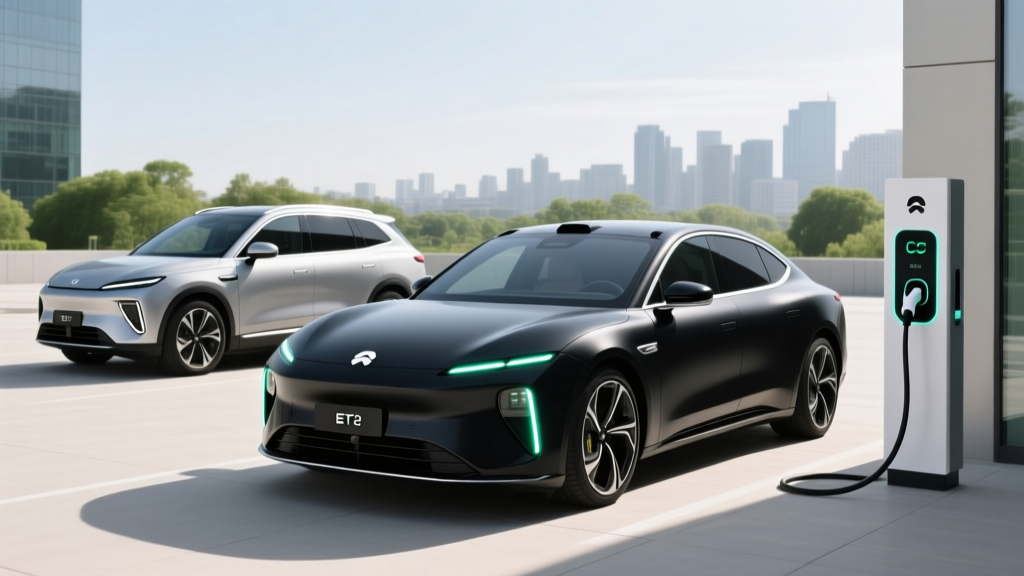
The ET7 is Nio's answer to the Tesla Model S and BMW i5 — a large premium sedan with a focus on range, autonomous-driving hardware, and interior luxury. It launched in China in 2022 and entered European markets shortly after. The 2025/2026 refresh brings updated software and the availability of the 150 kWh semi-solid-state battery.
| Attribute | 75 kWh Pack | 100 kWh Pack | 150 kWh Pack |
|---|---|---|---|
| Battery Chemistry | LFP (CATL) | NMC (CATL) | Semi-solid-state (WeLion) |
| Usable Capacity | ~73 kWh | ~96 kWh | ~145 kWh |
| WLTP Range | ~273 mi (440 km) | ~360 mi (580 km) | ~621 mi (1,000 km) |
| EPA Range (Estimated) | ~230 mi | ~305 mi | ~520 mi |
| Drivetrain | Dual-motor AWD | Dual-motor AWD | Dual-motor AWD |
| Horsepower | 644 hp | 644 hp | 644 hp |
| 0–60 mph | ~3.8 sec | ~3.8 sec | ~3.9 sec |
| Peak DC Charge Rate | ~130 kW | ~180 kW | ~190 kW |
| 10–80% DCFC Time | ~35 min | ~30 min | ~55 min |
| Level 2 Home Charging | 7 kW (single-phase) / 11–22 kW (3-phase) | 7 kW / 11–22 kW | 7 kW / 11–22 kW |
| MPGe (Est.) | ~95 MPGe combined | ~95 MPGe combined | ~90 MPGe combined |
| Length / Wheelbase | 199.4 in / 120.5 in (5,098 mm / 3,060 mm) | ||
| Cargo (Trunk + Frunk) | ~19.4 cu ft trunk; no frunk | ||
| Base Price (China) | ~¥378,000 (~$52,500) | ~¥458,000 (~$63,500) | ~¥598,000 (~$83,000) |
| Battery Subscription (BaaS) | Reduces purchase price ~¥70,000–128,000; monthly lease fee | ||
Nio EL8 (ES8): The Three-Row SUV
The EL8 (sold as the ES8 in China) is Nio's largest SUV, competing with the BMW iX, Mercedes EQS SUV, and Tesla Model X. The second-generation model, introduced in 2023 and refreshed for 2025–2026, rides on Nio's NT2.0 platform with standard air suspension, a 12.8-inch AMOLED center display, and six- or seven-seat configurations.
| Attribute | 75 kWh | 100 kWh | 150 kWh |
|---|---|---|---|
| Battery Chemistry | LFP | NMC | Semi-solid-state |
| WLTP Range | ~255 mi | ~340 mi | ~560 mi |
| EPA Range (Est.) | ~215 mi | ~285 mi | ~470 mi |
| Drivetrain | Dual-motor AWD | ||
| Horsepower | 670 hp | ||
| 0–60 mph | ~4.1 sec | ||
| Peak DC Charge Rate | ~130 kW | ~180 kW | ~190 kW |
| 10–80% DCFC Time | ~35 min | ~30 min | ~55 min |
| Seating | 6 or 7 passengers | ||
| Cargo (Behind 3rd Row) | ~10.6 cu ft; ~44 cu ft (3rd row folded) | ||
| Towing Capacity | ~4,409 lb (2,000 kg, braked, Europe) | ||
| Base Price (China) | From ~¥498,000 (~$69,000) | ||
The EL8's air suspension, standard on all trims, provides up to 3.5 inches of ride-height adjustment — useful for rough roads or towing. The six-seat layout with second-row captain's chairs is the most popular configuration and offers generous legroom (~36 inches in the third row), though the third row is best suited for children on longer trips.
Battery Swap: Nio's Defining Differentiator
No discussion of a Nio EV is complete without addressing the company's battery-swap network. Nio operates over 2,700 Power Swap Stations globally (as of late 2025), primarily in China with a growing footprint in Europe. A swap takes approximately 3–5 minutes — the car drives into an automated bay, the depleted pack is removed, and a fully charged one is installed. No driver action is required beyond positioning the vehicle.
This architecture has several implications:
- Battery-as-a-Service (BaaS): Buyers can purchase a Nio without the battery, reducing the upfront price by roughly $10,000–$18,000 (USD equivalent) and paying a monthly subscription (~$140–$230/month depending on pack size). This separates battery depreciation from vehicle depreciation.
- Upgrade flexibility: A 75 kWh owner can rent a 100 or 150 kWh pack for a road trip, then swap back to the smaller pack for daily commuting.
- Longevity hedge: If a battery degrades beyond acceptable levels, the swap network replaces it at no additional cost to BaaS subscribers.
The catch for US buyers: Nio has zero swap stations in the United States, and the company has not announced any US infrastructure plans. Building a swap network requires significant land, grid connections, and capital — Nio's European rollout has been slow and concentrated in a few countries. Without swap stations, a US-spec Nio would function as a conventional plug-in EV, losing its most distinctive advantage.
Charging Speed: Competitive but Not Class-Leading
| Charging Method | Power (kW) | Miles Added per Hour | Notes |
|---|---|---|---|
| Level 1 (120V household) | ~1.4 kW | ~4–5 mi/hr | Emergency/trickle only |
| Level 2 (240V, single-phase) | 7 kW | ~22–25 mi/hr | Standard home; ~10–12 hrs for 100 kWh pack |
| Level 2 (240V, 3-phase) | 11–22 kW | ~35–70 mi/hr | Requires 3-phase power (common in Europe, rare in US homes) |
| DC Fast Charge (100 kWh pack) | Peak 180 kW | ~500+ mi/hr at peak | 10–80% in ~30 min; tapers significantly above 80% |
| DC Fast Charge (150 kWh pack) | Peak 190 kW | ~500+ mi/hr at peak | 10–80% in ~55 min due to larger pack |
| Battery Swap | N/A | Full pack in 3–5 min | Not available in the US |
Nio's DC fast-charging speeds are competitive with vehicles like the BMW i5 and Mercedes EQE but fall short of the Hyundai Ioniq 5 / Kia EV9 family (which peaks at ~240 kW on 800V architecture) and the Lucid Air (~300+ kW). The ET7 and EL8 use a 400V electrical architecture, which limits peak charge rates compared to 800V competitors. For US buyers accustomed to Tesla Superchargers (250 kW V3) or Electrify America's 350 kW stalls, Nio's charging won't feel slow, but it isn't the fastest in the segment.
One important charging-curve detail: Nio's NMC packs sustain near-peak charge rates up to roughly 50–55% State of Charge, then taper. The 10–80% time is respectable, but the 80–100% top-off can add another 25–35 minutes — typical for NMC chemistry but worth planning for on road trips.
Tech, ADAS, and the NOMI Assistant
Nio equips its NT2.0-platform vehicles with an impressive sensor suite branded as Aquila: 33 sensors total, including a roof-mounted LiDAR unit (Innovusion Falcon), 7 × 8-megapixel cameras, 4 × ring-view cameras, 5 millimeter-wave radars, and 12 ultrasonic sensors. The compute backbone is four Nvidia Drive Orin-X chips delivering a combined 1,016 TOPS (trillions of operations per second).
The NOMI AI assistant — a small robotic sphere on the dashboard with an animated face — is Nio's most distinctive interior feature. It responds to voice commands, turns to face the person speaking, and can control climate, navigation, media, and vehicle settings. It's charming on first encounter, though some owners report it becomes more novelty than utility over time.
The 12.8-inch AMOLED center screen runs Nio's Banyan infotainment system, which supports over-the-air updates, a built-in app store, and wireless Apple CarPlay. A 10.2-inch digital instrument cluster and a 16.6-inch AR-HUD (augmented reality head-up display) round out the driver-facing tech. Audio is a 23-speaker, 2,015-watt Dolby Atmos system — among the most powerful factory audio setups available in any vehicle.
US Availability, Pricing, and Tax Credit Outlook
As of 2026, you cannot buy a Nio EV in the United States. Nio has not announced a US launch date, and the current trade environment — including 100% tariffs on Chinese-manufactured EVs announced in 2024 and maintained into 2026 — makes a near-term entry economically unviable without local manufacturing.
Should Nio eventually enter the US market, here's what pricing and tax credit eligibility might look like, based on current IRS §30D rules:
| Factor | Requirement | Nio Status (Projected) |
|---|---|---|
| Final Assembly | Must be in North America | ❌ Currently assembled in China (Hefei) |
| MSRP Cap (Sedans) | ≤ $55,000 | ❌ ET7 likely $55,000–$75,000 US MSRP |
| MSRP Cap (SUVs/Pickups) | ≤ $80,000 | ⚠️ EL8 borderline; may exceed cap |
| Buyer Income Cap (MFJ) | ≤ $300,000 AGI | Depends on buyer |
| Battery Sourcing (Critical Minerals) | Percentage from US/FTA partners | ❌ CATL battery sourcing unlikely to qualify |
| Battery Component Assembly | Percentage from US/FTA partners | ❌ Unlikely to qualify |
| Estimated Federal Credit | Up to $7,500 | $0 — fails assembly + sourcing requirements |
The bottom line: even if Nio began selling in the US tomorrow, its vehicles would almost certainly not qualify for the §30D federal EV tax credit under current rules. Chinese assembly and CATL battery sourcing fail both the North American final-assembly requirement and the critical-minerals/battery-component sourcing thresholds. This is the same barrier facing BYD, Xpeng, and other Chinese OEMs.
Pros and Cons
Pros
- Class-leading range with 150 kWh semi-solid-state pack (~520 real-world miles)
- Battery swap eliminates long-term degradation risk and enables pack upgrades
- 1,016 TOPS of ADAS compute with LiDAR is among the most capable sensor suites globally
- Premium interior materials and 2,015W Dolby Atmos audio
- BaaS model dramatically lowers upfront cost and decouples battery depreciation
- Air suspension standard on EL8; strong towing capacity (4,409 lb)
Cons
- Not available in the United States — no announced timeline for entry
- DC fast charging (180–190 kW peak) lags behind 800V competitors (240–350 kW)
- No swap stations outside China and select European markets
- Would not qualify for the $7,500 federal EV tax credit under current §30D rules
- European service network still limited; US service infrastructure is nonexistent
- NOMI assistant is novel but may not appeal to all buyers long-term
- Brand recognition in the US is near zero — uncertain resale value
Who Should Watch Nio — and Who Should Buy Now
Nio's technology is genuinely compelling, but US buyers need vehicles they can purchase, charge, and service today. Here's a practical framework:
Choose a current US-market EV now if:
- You need a premium sedan today: the Lucid Air Pure (EPA 419 mi, from ~$69,900) or BMW i5 eDrive40 (EPA 295 mi, from ~$57,000) are available now with established service networks.
- You need a three-row electric SUV: the Kia EV9 (EPA 304 mi, from ~$54,900) or Tesla Model X (EPA 335 mi, from ~$79,990) are proven options.
- Tax credit eligibility matters to your budget — most US-assembled EVs still qualify for up to $7,500 under IRS §30D rules.
Keep Nio on your watchlist if:
- You're 2–4 years out from a purchase and want to see if Nio establishes US manufacturing or partnerships.
- Battery-swap technology interests you as a long-term ownership model.
- You're benchmarking ADAS sensor suites and want to track how Nio's 1,016 TOPS platform evolves.
Warranty and Long-Term Ownership
In European markets, Nio offers a 5-year/100,000 km (~62,000 mi) vehicle warranty and an 8-year/160,000 km (~100,000 mi) battery warranty with a guaranteed minimum 70% State of Health retention. For BaaS subscribers, battery degradation is essentially a non-issue — Nio manages pack health across the swap network and replaces underperforming units proactively.
Without a US presence, there is no US-spec warranty to evaluate. Should Nio enter the market, matching the US industry standard of 8 years/100,000 miles for battery and powertrain (and potentially extending it to compete with Hyundai's 10-year/100,000-mile coverage) would be expected.
Frequently Asked Questions
What is the real-world range of a Nio EV?
For the ET7 with the 100 kWh NMC pack, expect roughly 280–305 miles in mixed real-world driving (EPA-equivalent). The 150 kWh semi-solid-state pack extends this to approximately 480–520 miles — among the longest ranges of any production EV. Highway driving at 75+ mph reduces range by 10–15%, and cold weather (below 32°F) can cut range by 20–30% without preconditioning.
How fast does a Nio EV charge?
The 100 kWh pack charges at up to 180 kW on a DC fast charger, reaching 10–80% in approximately 30 minutes. The 150 kWh pack peaks at ~190 kW but takes roughly 55 minutes for 10–80% due to its larger capacity. Home Level 2 charging at 7 kW adds about 22–25 miles per hour. Battery swaps (where available) deliver a full pack in 3–5 minutes.
Does Nio qualify for the US federal EV tax credit?
No. Even if Nio began US sales, current IRS §30D rules require North American final assembly and battery-component/critical-mineral sourcing from US or free-trade-agreement partners. Nio vehicles are assembled in China with CATL batteries, failing both requirements. The $7,500 credit would not apply.
Is Nio worth waiting for vs. buying a competitor now?
For US buyers, waiting is not practical — Nio has no announced US launch date, and 100% tariffs on Chinese EVs make pricing uncompetitive. The Lucid Air, BMW i5, Kia EV9, and Tesla Model X/Y are all available now with established charging and service networks. If you live in Europe (especially Norway, Germany, or the Netherlands), Nio is a viable purchase today with a growing — though still limited — swap and service network.
What is Nio's battery subscription (BaaS) model?
Battery-as-a-Service lets you buy a Nio vehicle without the battery, reducing the purchase price by roughly $10,000–$18,000. You pay a monthly fee (~$140–$230 depending on pack size) for battery use, swaps, and upgrades. This eliminates battery-degradation risk and lets you swap to a larger pack for road trips. It's an innovative model, but it requires a dense swap-station network to function — something only China currently has.
What is the Nio ET7's safety rating?
The Nio ET7 achieved a 5-star Euro NCAP rating in 2023, with strong scores in adult occupant protection (91%), child occupant protection (87%), and safety assist (82%). Euro NCAP results are publicly available. The vehicle has not been tested by NHTSA or IIHS, as it is not sold in the US.
Sources: Nio official specifications (nio.com), Euro NCAP safety ratings, IRS.gov §30D clean vehicle credit guidance, European WLTP test data. All range, pricing, and availability figures reflect the latest information available as of early 2026 and are subject to change. US pricing and tax credit eligibility are estimates based on current rules and should not be used for purchase or tax decisions. Consult a tax professional for credit eligibility.