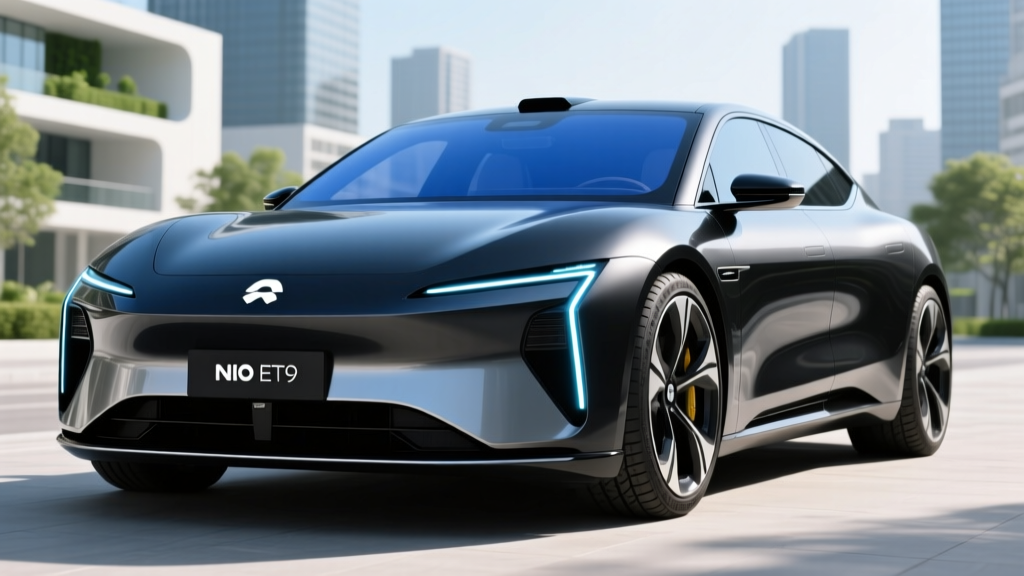
The NIO ET9 electric car is the Chinese automaker's flagship luxury sedan — a technology showcase aimed squarely at the Mercedes-Benz EQS, BMW i7, and Porsche Panamera. Announced in late 2023 and entering Chinese deliveries in 2025, the ET9 represents NIO's most ambitious vehicle to date: a 900-volt architecture, steer-by-wire, active suspension, and a massive 120 kWh battery. But for US-based EV shoppers, the critical question is whether this sedan will ever arrive on American roads — and if it does, whether the specs translate to real-world usability.
This review covers every confirmed specification, real-world range expectations, charging performance, pricing, and tax credit outlook for the NIO ET9 electric car as of the 2026 model year. Where data remains preliminary or market-dependent, we flag it clearly.
NIO ET9 Quick Verdict: Who Should Consider This EV?
The ET9 is a full-size luxury executive sedan designed for buyers who prioritize rear-seat comfort, cutting-edge chassis technology, and ultra-fast charging over sportiness. Think of it as NIO's answer to the Mercedes S-Class — but fully electric and with battery-swap capability unique to the brand.
Choose the NIO ET9 if: You want a tech-forward luxury sedan with class-leading charging speeds, a plush rear cabin, and access to NIO's battery-swap network (currently China-only). You're open to a new luxury brand and value active suspension and steer-by-wire innovation.
Look elsewhere if: You need confirmed US availability, a proven service network outside China, or you prioritize driving engagement over chauffeur-class rear-seat comfort. The BMW i7 or Mercedes EQS remain safer bets for American buyers today.
Range, Battery, and Real-World Efficiency
The NIO ET9 electric car is equipped with a 120 kWh usable battery pack using NMC (nickel-manganese-cobalt) cell chemistry, paired with NIO's proprietary 900V electrical architecture. This high-voltage platform is central to the ET9's charging performance and efficiency claims.
| Specification | Value |
|---|---|
| Battery Capacity (usable) | 120 kWh (NMC) |
| Electrical Architecture | 900V nominal |
| CLTC Range (China cycle) | ~565 miles (910 km) |
| Estimated EPA Range | ~370–390 miles (projected, not EPA-certified) |
| Efficiency (estimated) | ~32–34 kWh/100 mi |
| Heat Pump | Standard |
Real-World Range Reality: NIO quotes 910 km (~565 mi) on China's CLTC cycle, which is notoriously optimistic. For US buyers, the EPA cycle is roughly 25–30% stricter. We estimate the ET9 would achieve approximately 370–390 EPA miles if certified for the US market. In real-world highway driving at 70 mph, expect closer to 310–340 miles. In cold weather (below 32°F), range could drop to 260–290 miles despite the standard heat pump — a large 120 kWh pack helps buffer losses, but a 5,800-lb luxury sedan consumes significant energy heating its cabin and battery.
NIO also offers a 150 kWh semi-solid-state battery option in China, which pushes CLTC range beyond 620 miles. However, this pack is extremely expensive and available primarily through NIO's battery-rental program rather than outright purchase. US availability of this pack is unconfirmed.
Charging Speed: 900V Architecture and DC Fast-Charge Performance
The 900V platform is where the NIO ET9 electric car differentiates itself from nearly every competitor. Higher voltage allows the ET9 to accept dramatically more power at DC fast chargers while keeping current (and therefore heat and cable weight) manageable.
| Charging Method | Power / Rate | Speed / Time |
|---|---|---|
| DC Fast Charge (peak) | 600 kW (at NIO Ultra-Fast stations) | ~255 miles in 5 minutes (claimed) |
| DC Fast Charge 10–80% | Sustained ~350–400 kW avg | ~12–15 minutes (estimated) |
| Level 2 Home (240V, 48A) | 11.5 kW | ~33 mi/hr, full charge in ~10.5 hrs |
| Level 2 Home (240V, 32A) | 7.7 kW | ~22 mi/hr, full charge in ~15.5 hrs |
| Battery Swap | Automated station | ~3 minutes for full pack exchange |
A few critical caveats on charging:
- Peak 600 kW is station-dependent. This speed requires NIO's proprietary ultra-fast chargers, currently deployed only in China. On a third-party 350 kW charger (like Electrify America or Ionity), the ET9 would likely peak around 350–400 kW and charge 10–80% in roughly 15–18 minutes — still exceptional.
- Charge curve taper matters. Like all EVs, the ET9 will not sustain peak kW to 80%. NIO's 900V architecture helps maintain a flatter curve than 400V competitors, but expect power to taper significantly above 80% SoC. Charging from 80–100% could add another 15–20 minutes.
- Battery swap is NIO's ace — in China. NIO operates over 2,700 swap stations in China. A depleted pack is exchanged for a fully charged one in about 3 minutes. This network does not exist in the US or Europe as of 2026, and expansion plans remain unclear.
Performance: 0–60, Horsepower, and Drivetrain
The NIO ET9 is a dual-motor, all-wheel-drive sedan with a combined output that places it firmly in the performance-luxury category.
| Specification | Value |
|---|---|
| Drivetrain | Dual-motor AWD |
| Front Motor | Induction, ~180 kW (241 hp) |
| Rear Motor | Permanent magnet, ~340 kW (456 hp) |
| Combined Output | ~520 kW (697 hp) |
| 0–60 mph | ~3.9 seconds (estimated) |
| Top Speed | Electronically limited, ~155 mph |
| Suspension | Active hydraulic (SkyRide), full-body height adjustment |
| Steering | Steer-by-wire (no mechanical column) |
The SkyRide active suspension is a standout feature: it uses hydraulic actuators at each corner to isolate the cabin from road imperfections, lean into corners like a tilting train, and even perform a "tank shake" to shed snow or debris. Steer-by-wire eliminates the mechanical connection between steering wheel and wheels, enabling a variable ratio and a yoke-style steering option — though some enthusiasts remain skeptical of the lack of physical feedback.
Interior, Cargo, and Technology
The ET9 is configured as a four-seat executive sedan with a strong emphasis on rear-passenger luxury. The cabin features:
- Front: 15.6-inch AMOLED center display, AR heads-up display, digital instrument cluster, NIO's NOMI AI assistant with a robotic avatar on the dashboard
- Rear: Two individual reclining seats with massage, heating, ventilation, fold-out tables, and dual 14.5-inch rear entertainment screens. A center console with refrigerated compartment separates the rear passengers.
- Audio: 23-speaker Dolby Atmos surround system
- ADAS: NIO's Aquila Super Sensing system with 33 sensors including LiDAR (roof-mounted), cameras, and ultrasonic units. Supports NIO's NOP+ (Navigate on Pilot Plus) — a SAE Level 2 driver-assistance system requiring full driver engagement. This is not autonomous driving.
Driver-Assist Limitation: NIO's NOP+ and Aquila system are SAE Level 2 — the driver must remain attentive, keep hands available, and supervise at all times. Despite the LiDAR and 33 sensors, the ET9 cannot drive itself. No consumer vehicle sold in 2026 offers Level 4 autonomy outside geofenced robotaxi services like Waymo.
Cargo space is modest for a sedan of this size, owing to the executive rear-seat configuration and battery placement. Expect approximately 15–17 cu ft of trunk volume, with no traditional frunk (the front motor and 900V power electronics consume the space). Rear seats do not fold flat due to the luxury partition configuration — a notable practicality drawback for a vehicle this large.
Pricing, Trims, and Federal Tax Credit Eligibility
The NIO ET9 launched in China at approximately ¥788,000 (roughly $108,000 USD at 2025 exchange rates) for the standard model, with a limited "First Edition" at ¥818,000 (~$112,000). However, NIO has signaled that if the ET9 reaches international markets, pricing could be restructured — potentially starting lower for a base configuration.
| Item | Estimated Cost |
|---|---|
| Base MSRP (projected US) | ~$95,000–$108,000 |
| First Edition / Loaded | ~$110,000–$115,000 |
| Destination / Delivery | TBD (not US-confirmed) |
| Federal §30D Tax Credit | $0 — exceeds MSRP cap |
| Effective Price After Credit | Same as MSRP (no federal credit) |
Federal tax credit reality: The IRS §30D Clean Vehicle Credit caps eligible sedans at an MSRP of $55,000. At a projected $95,000–$108,000, the NIO ET9 electric car would not qualify for the $7,500 federal tax credit regardless of battery sourcing or buyer income. This is the same limitation facing the Mercedes EQS, BMW i7, and Lucid Air. Buyers in this price bracket should consult a tax professional about potential state-level incentives, which vary by jurisdiction and are not covered here.
Additionally, NIO is a Chinese-headquartered manufacturer. Even if a lower-priced NIO model met the MSRP cap, the §30D credit's foreign entity of concern (FEOC) battery-sourcing rules — which restrict credits for vehicles with battery components or critical minerals from China — would present a significant eligibility hurdle as of 2026 rules. See IRS §30D guidance for current requirements.
Warranty and Ownership Considerations
NIO's standard warranty in China covers:
- Vehicle: 5 years / 120,000 km (~75,000 miles)
- Battery & Powertrain: 10 years / unlimited kilometers (for first owner, with battery-swap program)
- Free battery swap: Included in some purchase packages (typically 4–6 free swaps per month for a set period)
US warranty terms are unconfirmed since NIO has not announced American sales. For comparison, most luxury EV competitors in the US offer 4-year/50,000-mile basic and 8-year/100,000-mile battery warranties. NIO's 10-year battery coverage in China is generous, but US buyers would need written confirmation before purchasing.
Insurance and depreciation are open questions. No US insurance data exists for NIO vehicles, and depreciation for a new Chinese luxury brand entering the US market would likely be steep in the first 3–5 years — a risk factor that established competitors like BMW and Mercedes don't carry.
Pros and Cons: NIO ET9 Electric Car
Pros
- 900V architecture enables class-leading DC charging speeds (600 kW peak, ~12 min 10–80%)
- 120 kWh NMC battery provides an estimated 370–390 EPA miles — among the longest-range luxury sedans
- SkyRide active suspension and steer-by-wire are genuine technological differentiators
- Executive rear cabin rivals or exceeds the Mercedes S-Class for comfort and tech
- Battery swap capability (where available) eliminates charging wait entirely
- Standard LiDAR and 33-sensor ADAS suite
Cons
- Not confirmed for US sale — availability is the single biggest unknown
- Projected $95K–$115K price puts it well above the §30D tax credit MSRP cap
- Battery swap and ultra-fast charger networks are China-only in 2026
- Steer-by-wire lacks physical feedback; not all drivers will adapt
- Modest trunk space (~15–17 cu ft) and no folding rear seats limit practicality
- Unproven brand in Western markets — depreciation and service network are risks
- Chinese battery sourcing likely disqualifies from federal incentives even on cheaper NIO models
NIO ET9 vs. Key Competitors: Is It Worth Buying?
| Spec | NIO ET9 | Mercedes EQS 580 | BMW i7 xDrive60 | Lucid Air Grand Touring |
|---|---|---|---|---|
| Est. EPA Range | ~370–390 mi | ~350 mi | ~318 mi | ~516 mi |
| Battery (kWh) | 120 (NMC) | 108 (NMC) | 101.7 (NMC) | 112 (NMC) |
| Peak DC Charge | 600 kW | 200 kW | 195 kW | 300 kW |
| 10–80% Time | ~12–15 min | ~31 min | ~34 min | ~20 min |
| 0–60 mph | ~3.9 sec | 4.1 sec | 4.5 sec | 3.0 sec |
| Horsepower | 697 hp | 536 hp | 536 hp | 819 hp |
| Base MSRP | ~$95,000–$108,000 | ~$105,000 | ~$120,000 | ~$127,000 |
| Federal Credit | No (MSRP cap) | No (MSRP cap) | No (MSRP cap) | No (MSRP cap) |
The ET9's charging speed is its most defensible advantage — no competitor in this table comes close to 600 kW peak. The Lucid Air Grand Touring offers substantially more EPA range (516 mi vs. ~380 mi) and quicker acceleration, but charges at roughly half the peak rate. The Mercedes EQS and BMW i7 offer established dealer networks, proven US service infrastructure, and comparable luxury — but their 400V-class architectures show their age at the charger.
If NIO can solve the availability, service, and brand-trust challenges in the US, the ET9 would be a compelling alternative. Until then, American buyers are better served by the Lucid Air for range, the EQS for rear-seat luxury, or the i7 for a blend of both with BMW's established infrastructure.
Frequently Asked Questions
What is the real-world range of the NIO ET9 electric car?
NIO claims 565 miles on the CLTC cycle, but the EPA cycle is significantly stricter. We estimate 370–390 EPA miles if certified for the US. Real-world highway driving at 70 mph should yield approximately 310–340 miles, with cold-weather range dropping to 260–290 miles.
How fast does the NIO ET9 charge?
At a NIO ultra-fast station, the ET9 peaks at 600 kW and can add roughly 255 miles in 5 minutes. A 10–80% charge takes an estimated 12–15 minutes. On a standard 350 kW third-party DC charger, expect 15–18 minutes for 10–80%. Home Level 2 charging at 11.5 kW adds about 33 miles per hour, fully charging the 120 kWh pack in roughly 10.5 hours.
Does the NIO ET9 qualify for the federal EV tax credit?
No. The IRS §30D credit caps sedan eligibility at $55,000 MSRP. The ET9's projected $95,000–$108,000 price far exceeds this cap. Additionally, NIO's Chinese battery sourcing would likely trigger FEOC restrictions. Consult a tax professional for state-level incentive details.
Is the NIO ET9 available to buy in the United States?
As of early 2026, NIO has not announced US sales for the ET9 or any other model. NIO operates in China, Norway, Germany, the Netherlands, and a handful of other markets. US entry faces regulatory, tariff, and infrastructure hurdles. Any US availability remains speculative.
Is NIO's steer-by-wire safe?
Steer-by-wire eliminates the mechanical steering column, relying on electronic signals and redundant backup systems. It's approved for use in China and some European markets. NIO includes multiple redundant controllers and a backup power supply. However, some drivers find the lack of physical road feedback disconcerting. A test drive is essential before committing.
How does NIO's battery swap work?
You drive into an automated NIO Power Swap station, and robotic systems unbolt your depleted battery pack and install a fully charged one in approximately 3 minutes. You retain ownership of the vehicle but effectively "rent" the battery in the swap ecosystem. This model keeps the battery off your personal degradation concern but requires proximity to swap stations — currently only available in China.
What is the biggest risk of buying a NIO ET9?
For US buyers, the biggest risk is simply availability — the car isn't sold here. Even in markets where it's available, the risks include an unproven service network, steep depreciation for a new luxury brand, and reliance on proprietary NIO infrastructure (swap stations, ultra-fast chargers) that may not expand quickly.
Sources: NIO official specifications, IRS §30D Clean Vehicle Credit guidance, fueleconomy.gov for EPA testing methodology. All ET9 specs are based on manufacturer-confirmed data as of early 2026; US-market figures are projections based on CLTC-to-EPA conversion factors and are subject to change if NIO announces American availability.