The Nio Swap Promise Meets Reality
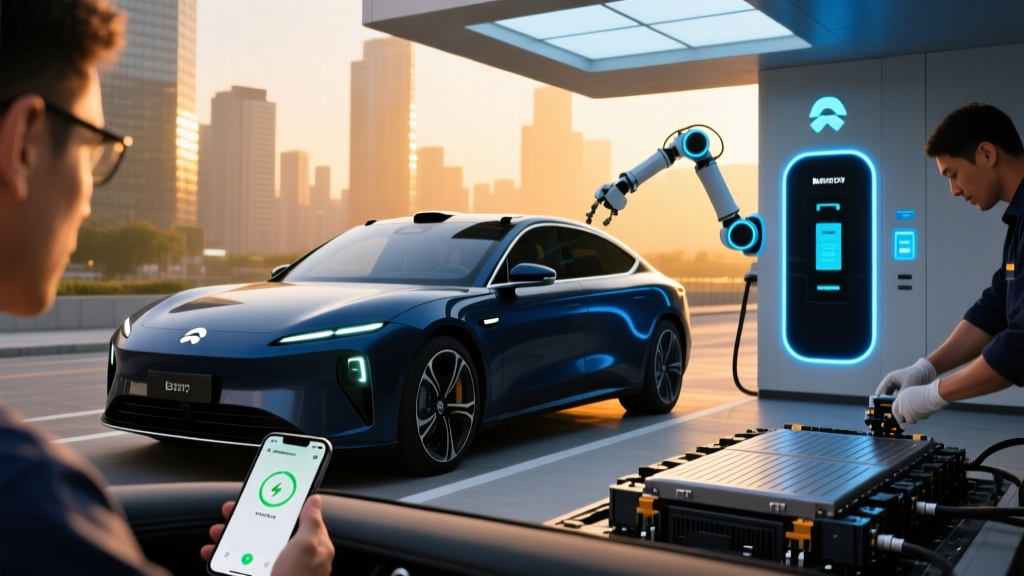
Nio's battery swap stations have generated more curiosity than almost any other EV technology in recent years. The concept is simple: drive into a station, and in under five minutes, a robot unbolts your depleted pack and slides in a fully charged one. No waiting at a charger, no battery degradation concerns (the fleet rotates packs), and the option to upgrade from a 75 kWh to a 100 kWh or even 150 kWh pack for a road trip. But for US-based buyers evaluating Nio swaps as a practical ownership feature, the picture in 2026 requires careful unpacking—particularly because Nio's US market presence remains extremely limited compared to its Chinese and European footprint.
This review examines Nio's battery swap ecosystem through the lens of the 2026 ET7 sedan, Nio's flagship electric executive car. We'll cover the swap hardware, how it compares to DC fast charging, the ET7's actual range and charging specs, and whether the swap model makes financial sense under current US tax rules.
2026 Nio ET7: Core Specifications at a Glance
| Specification | ET7 Standard (75 kWh) | ET7 Long Range (100 kWh) | ET7 Ultra Long Range (150 kWh) |
|---|---|---|---|
| Battery Capacity | 75 kWh usable | 100 kWh usable | 150 kWh usable |
| Battery Chemistry | LFP (CATL) | NMC (CATL) | Semi-solid-state (WeLion) |
| WLTP Range | ~330 mi (530 km) | ~435 mi (700 km) | ~620 mi (1,000 km) |
| EPA-Est. Range (Projected) | ~280 mi | ~370 mi | ~520 mi |
| Drivetrain | Dual-motor AWD | Dual-motor AWD | Dual-motor AWD |
| Horsepower | 644 hp (480 kW) | 644 hp (480 kW) | 644 hp (480 kW) |
| 0–60 mph | 3.7 seconds | 3.7 seconds | 3.8 seconds |
| Max DC Fast Charge | ~130 kW (peak) | ~180 kW (peak) | ~170 kW (peak) |
| 10–80% DC Charge Time | ~34 minutes | ~30 minutes | ~40 minutes |
| Level 2 Home Charge | 11 kW (~30 mi/hr) | 11 kW (~30 mi/hr) | 11 kW (~30 mi/hr) |
| Battery Swap Time | ~3–5 minutes (Gen 4 station) | ||
| Length / Wheelbase | 199.4 in / 118.9 in | ||
| Cargo Volume | ~17.7 cu ft (trunk) | ||
| Rear Legroom | ~37.8 in | ||
| Base MSRP (China, pre-subsidy) | ~¥428,000 (~$59,000) | ~¥486,000 (~$67,000) | ~¥548,000 (~$75,500) |
| Battery-as-a-Service (BaaS) Discount | ~¥70,000–128,000 off purchase price; monthly battery rental ~¥728–1,680/mo | ||
| Warranty (Vehicle) | 6 years / 150,000 km (China) | ||
| Warranty (Battery) | Unlimited years/miles under BaaS; 8 yr / 160,000 km if purchased | ||
Note: Nio does not currently submit vehicles to the US EPA for official testing. The EPA-estimated ranges above are projected based on the typical 12–15% reduction from WLTP figures observed in comparable dual-motor AWD sedans. Actual US EPA numbers would differ if Nio pursued US certification.
Real-World Range: What the Sticker Doesn't Tell You
Projected EPA Equivalent: ~370 miles
Real-World Highway (70 mph, moderate climate): ~310–330 miles
Real-World Cold Weather (32°F, highway): ~250–280 miles
Real-World City / Mixed: ~340–360 miles
The 100 kWh NMC pack delivers the best balance of range and charging speed in the ET7 lineup. In Chinese and European road tests conducted by independent reviewers, the ET7 100 kWh consistently achieves 310–340 miles in mixed driving at moderate speeds. Highway cruising at 70+ mph pushes consumption to roughly 35–38 kWh/100 mi (approximately 85–90 MPGe), cutting into range materially.
The 150 kWh semi-solid-state pack from WeLion is the headline grabber, with Nio claiming over 620 miles WLTP (~520 projected EPA). Real-world Chinese long-distance tests have confirmed 500+ miles in favorable conditions—a genuinely remarkable figure. However, the pack's high cost, limited availability (primarily offered as a short-term rental for road trips), and slower charge rate mean most daily drivers will rely on the 75 kWh or 100 kWh options.
The 75 kWh LFP pack is the value play. LFP chemistry tolerates frequent 100% charges without significant degradation, making it ideal for daily commuting with overnight Level 2 charging. Expect roughly 230–250 real-world highway miles from this pack—adequate for most commutes but tight for road trips without swap access.
Battery Swaps vs. DC Fast Charging: Speed, Cost, and Convenience
The core appeal of Nio swaps is time. A Gen 4 swap station completes a battery exchange in roughly 3–5 minutes, including the automated parking and verification sequence. That compares to 30–40 minutes at a DC fast charger for a 10–80% session. For drivers on long road trips or without reliable home charging, the time savings are substantial.
| Charging Method | Power / Speed | Time (10–80% or Equivalent) | Miles Added per 10 Min |
|---|---|---|---|
| Gen 4 Battery Swap | N/A (full pack exchange) | ~3–5 minutes (full charge) | ~300–370 mi (100 kWh pack) |
| DC Fast Charge (100 kWh) | Peak ~180 kW, avg ~120 kW | ~30 minutes | ~110 mi |
| DC Fast Charge (75 kWh LFP) | Peak ~130 kW, avg ~90 kW | ~34 minutes | ~85 mi |
| Level 2 Home (11 kW / 48A) | 11 kW | ~9–13 hours (full) | ~30 mi |
| Level 1 (120V / 12A) | ~1.4 kW | ~50+ hours (full) | ~4 mi |
Understanding the charge curve: The ET7's DC fast-charge rate peaks at the advertised kW figure only at low state of charge (SoC) and optimal battery temperature. Above ~60% SoC, the charge rate tapers significantly—this is normal for all lithium-ion packs and is managed by the vehicle's thermal system. A "180 kW peak" does not mean you sustain 180 kW for 30 minutes; the average rate over a 10–80% session is closer to 120 kW. Nio's 400V architecture limits peak charge rates compared to 800V competitors like the Hyundai Ioniq 6 or Porsche Taycan, which can sustain higher rates longer.
Swap Station Availability and Cost
As of late 2025, Nio operates over 2,700 battery swap stations in China and roughly 60+ in Europe (primarily Norway, Germany, and the Netherlands). The network is dense in Chinese tier-1 and tier-2 cities, with highway corridor coverage along major routes. In Europe, coverage is still expanding and concentrated in Scandinavia.
Swap costs vary by market and subscription tier. Under Nio's Battery-as-a-Service (BaaS) program, buyers subtract the battery cost from the vehicle purchase price (saving ¥70,000–128,000 upfront, roughly $9,700–$17,700) and pay a monthly rental fee of approximately ¥728 ($100) for the 75 kWh pack or ¥1,680 ($230) for the 100 kWh pack. Swaps themselves are typically included in a free monthly allowance (4–6 swaps depending on the plan), with additional swaps charged at roughly ¥50–80 ($7–11) per swap plus the electricity cost differential.
For non-BaaS owners who purchased their battery outright, swap access is still available on a pay-per-use basis, though the economics shift—you're paying for the convenience rather than amortizing the battery.
Performance and Driving Dynamics
Every ET7 variant uses a dual-motor all-wheel-drive powertrain: a 180 kW permanent magnet motor on the front axle and a 300 kW induction motor on the rear. Combined output is 480 kW (644 hp) and 627 lb-ft of torque. The result is a 3.7-second 0–60 mph time, placing the ET7 firmly in performance-sedan territory alongside the BMW i5 M60 and the Tesla Model S (non-Plaid).
On the road, the ET7 prioritizes composure over sportiness. The standard air suspension with CDC (continuous damping control) delivers a plush ride quality closer to a Mercedes EQE than a Tesla. Steering is light and precise but not communicative—this is a grand tourer, not a track car. Regenerative braking offers adjustable levels but does not achieve true one-pedal driving at its lowest setting, which some EV veterans may find frustrating.
Efficiency sits at approximately 33–36 kWh/100 mi in mixed driving (roughly 93–101 MPGe), competitive for a 5,000+ lb dual-motor sedan. The ET7's 0.208 drag coefficient—one of the lowest of any production sedan—contributes meaningfully to highway efficiency.
Interior, Technology, and Driver Assistance
The ET7's cabin is where Nio makes its strongest statement. Standard features include a 12.8-inch AMOLED center display, a 10.2-inch digital instrument cluster, and a 16-inch heads-up display. The NOMI AI assistant (a small robotic sphere on the dashboard) responds to voice commands and displays expressions—a polarizing feature that some owners love and others disable.
The infotainment system runs on Qualcomm Snapdragon 8155 hardware, supporting wireless Apple CarPlay, Android Auto, and Nio's native app ecosystem. A 23-speaker, 2,230-watt Dolby Atmos sound system is standard. The panoramic glass roof features electrochromic dimming. Rear-seat passengers get heated and ventilated seats with a dedicated 6.6-inch control screen.
Driver Assistance: Nio Aquila and NOP+
The ET7 comes equipped with Nio's Aquila super-sensing system: 33 sensors including a 120-degree LiDAR (mounted above the windshield), 7 x 8MP cameras, 4 x surround cameras, 5 millimeter-wave radars, and 12 ultrasonic sensors. Processing is handled by four Nvidia Orin-X chips providing 1,016 TOPS of compute.
The Navigate on Pilot Plus (NOP+) system offers highway and urban assisted driving, including on-ramp-to-off-ramp lane changes, traffic light recognition, and intersection navigation in mapped areas. This is an SAE Level 2 system—the driver must remain fully engaged, hands on or near the wheel, and eyes on the road at all times. It is not autonomous driving. NOP+ competes with Tesla's FSD (Supervised), GM's Super Cruise, and Ford's BlueCruise in capability, though real-world reviews suggest it performs comparably to these systems in Chinese road conditions but has limited validation outside China and select European markets.
Pricing, Tax Credits, and the BaaS Value Proposition
Because Nio does not officially sell vehicles in the US market as of 2026, the ET7 is not eligible for the IRS §30D federal EV tax credit. The §30D credit requires the vehicle to be purchased new from a manufacturer that has filed required documentation with the IRS, and the vehicle must meet MSRP caps ($55,000 for sedans), buyer income limits ($150,000 single / $300,000 joint AGI), and battery component and critical mineral sourcing requirements. Nio's absence from the US market means none of these conditions can be met.
| Variant | MSRP (China, ¥) | Approx. USD | BaaS Price (Battery Excluded) | Monthly Battery Fee | US §30D Credit |
|---|---|---|---|---|---|
| ET7 75 kWh | ¥428,000 | ~$59,000 | ~¥358,000 (~$49,400) | ¥728/mo (~$100) | Not eligible |
| ET7 100 kWh | ¥486,000 | ~$67,000 | ~¥378,000 (~$52,100) | ¥1,280/mo (~$176) | Not eligible |
| ET7 150 kWh | ¥548,000 | ~$75,500 | ~¥420,000 (~$57,900) | ¥1,680/mo (~$230) | Not eligible |
USD conversions are approximate at ¥7.25 = $1 (early 2026). Chinese-market pricing includes local VAT. European pricing is higher due to import duties, shipping, and VAT. For current §30D rules and eligible vehicle lists, consult the IRS clean vehicle credits page.
Is BaaS Financially Sound?
The BaaS model works like this: you save $9,700–$17,700 upfront by not purchasing the battery, then pay $100–$230/month indefinitely. At the 75 kWh tier ($100/mo), the break-even point versus outright purchase is roughly 8 years. For the 100 kWh pack ($176/mo), break-even is about 7 years. If you plan to own the car for 5 years or less, BaaS saves money. If you plan to keep it for 10+ years, purchasing the battery outright is cheaper long-term.
The hidden value of BaaS is degradation protection. Since you don't own the battery, you don't bear the cost if the pack degrades below acceptable capacity. Nio's swap network rotates packs through health checks, and you'll never be stuck with a $15,000+ battery replacement bill. You also gain the flexibility to upgrade to a larger pack for road trips and downgrade for daily commuting—a unique advantage no conventional EV offers.
Pros and Cons: The Honest Assessment
Pros
- 5-minute battery swap eliminates charging wait on road trips (where stations exist)
- 150 kWh semi-solid-state pack offers 500+ real-world miles—class-leading range
- BaaS model reduces upfront cost by $10K–$18K and eliminates battery degradation risk
- Premium interior with air suspension, 23-speaker audio, and high-quality materials
- Strong performance: 644 hp, 3.7-second 0–60, dual-motor AWD standard
- LFP option (75 kWh) tolerates daily 100% charges for commuters
- Aquila sensor suite with LiDAR is among the most comprehensive in any production sedan
Cons
- Not available in the US—no sales network, no swap stations, no §30D tax credit
- 400V architecture limits DC fast-charge speed vs 800V rivals (peaks at ~180 kW, not 250+ kW)
- Heavy vehicle (~5,100 lbs) impacts efficiency at highway speeds
- NOP+ driver assist is Level 2 only and largely validated for Chinese road conditions
- Swap station density outside China is still sparse (Europe only, limited coverage)
- BaaS monthly fees add up over long ownership periods (7–8 year break-even)
- No EPA testing means US buyers lack standardized range and efficiency data
How the ET7 Compares to Key Rivals
If you're a US buyer drawn to the ET7's combination of range, luxury, and performance, here's how it stacks up against sedans you can actually purchase:
| Vehicle | EPA Range | Battery | Peak DC kW | 0–60 | Base MSRP | §30D Eligible |
|---|---|---|---|---|---|---|
| Nio ET7 100 kWh | ~370 mi (proj.) | 100 kWh NMC | ~180 kW | 3.7s | ~$67,000 (CN) | No |
| Tesla Model S LR | 402 mi | ~100 kWh NMC | ~250 kW | 3.1s | $74,990 | No (over MSRP cap) |
| BMW i5 eDrive40 | 295 mi | 81.2 kWh NMC | ~205 kW | 5.7s | $67,795 | No (over MSRP cap) |
| Mercedes EQE 350+ | 305 mi | 90.6 kWh NMC | ~170 kW | 6.2s | $74,900 | No (over MSRP cap) |
| Hyundai Ioniq 6 LR | 361 mi | 77.4 kWh NMC | ~240 kW | 5.1s | $42,715 | Partial (check sourcing) |
| Lucid Air Pure | 419 mi | 88 kWh NMC | ~200 kW | 5.2s | $69,900 | No (over MSRP cap) |
The ET7's projected 370-mile range and swap capability are compelling, but the Tesla Model S offers more EPA-certified range, faster Supercharger charging, and US availability. The Hyundai Ioniq 6 offers comparable range with 800V fast-charging architecture at a significantly lower price and with potential tax credit eligibility. Luxury sedan buyers may prefer the BMW i5 or Mercedes EQE for dealer support and brand familiarity, even at lower range.
Who Should Consider the Nio ET7 (and Who Shouldn't)
The ET7 with battery swaps is ideal for:
- Buyers in China or Northern Europe with nearby Nio swap stations who take frequent road trips
- Drivers who want to avoid battery degradation risk via the BaaS model
- Range-prioritizing buyers interested in the 150 kWh semi-solid-state pack for 500+ mile journeys
- Tech-forward buyers who value comprehensive sensor suites and premium infotainment
Look elsewhere if:
- You're a US-based buyer (no sales, no swaps, no tax credit)
- You need the fastest possible DC charging (800V rivals charge 20–30% faster)
- You prefer established dealer networks and domestic service infrastructure
- You want a sporty, driver-focused chassis (the ET7 is a comfort cruiser)
Frequently Asked Questions
What is the real-world range of the Nio ET7?
The 100 kWh ET7 achieves approximately 310–340 miles in real-world mixed driving, with highway-only range closer to 310 miles at 70 mph. Cold weather (below freezing) can reduce range by 25–30%, yielding 250–280 miles. The 150 kWh semi-solid-state pack extends this to 500+ real-world miles in favorable conditions—the longest range of any production EV sedan as of 2026.
How fast does the ET7 charge at home and on DC fast chargers?
At home on a Level 2 charger (11 kW / 48A), the 100 kWh pack charges from 10–100% in roughly 9 hours, adding about 30 miles of range per hour. On DC fast chargers, the 100 kWh pack peaks at approximately 180 kW and completes a 10–80% session in about 30 minutes. A battery swap at a Gen 4 station takes 3–5 minutes for a full charge.
Does the Nio ET7 qualify for the US federal EV tax credit?
No. Nio does not sell vehicles in the US market, so the ET7 is not eligible for the IRS §30D clean vehicle credit. Even if it were available, the 100 kWh and 150 kWh variants exceed the $55,000 MSRP cap for sedans. The §30D credit also requires battery component and critical mineral sourcing compliance, buyer income limits ($150K single / $300K joint), and manufacturer documentation with the IRS. Always check the IRS website for current eligible vehicle lists.
How much does a Nio battery swap cost?
Under the BaaS subscription, owners receive 4–6 free swaps per month (depending on plan), with additional swaps costing roughly $7–11 each plus the electricity cost difference. Non-BaaS owners pay per-swap fees that vary by station and market. In China, a typical paid swap costs approximately ¥50–80 ($7–11) for the service fee.
Is battery swapping better than DC fast charging?
For time savings, yes—a 3–5 minute swap beats a 30-minute fast-charge session. For battery health, swapping can also be advantageous since the fleet operator manages charge rates and pack rotation, avoiding the degradation impact of frequent DC fast charging. However, swap stations are geographically limited (primarily China and parts of Europe), while DC fast-charging networks (Electrify America, Tesla Supercharger, Ionity) are far more widespread globally. The 400V architecture in the ET7 also means slower DC charging than 800V competitors.
How long does a Nio battery last before replacement?
Under the BaaS model, battery longevity is Nio's responsibility—packs are rotated, health-checked, and replaced as needed within the swap network. For purchased batteries, Nio warrants the pack for 8 years / 160,000 km (approximately 100,000 miles) with a capacity retention threshold of 70–80% (varies by market). NMC packs typically retain 85–90% capacity after 100,000 miles in moderate climates; LFP packs often retain 90%+ due to their superior cycle life. The 150 kWh semi-solid-state pack's long-term degradation data is still limited given its 2024 market introduction.
Can I upgrade my Nio battery later?
Yes—this is one of the swap system's strongest advantages. A 75 kWh owner can rent a 100 kWh or 150 kWh pack for a road trip (daily or monthly rental fees apply) and swap back to their standard pack afterward. No other EV manufacturer offers this kind of modular battery flexibility in production vehicles.
Sources: Nio official specifications (nio.com), Chinese MIIT vehicle registration data, European WLTP certification filings, IRS §30D clean vehicle credit guidelines, independent road tests by CarNewsChina and InsideEVs.