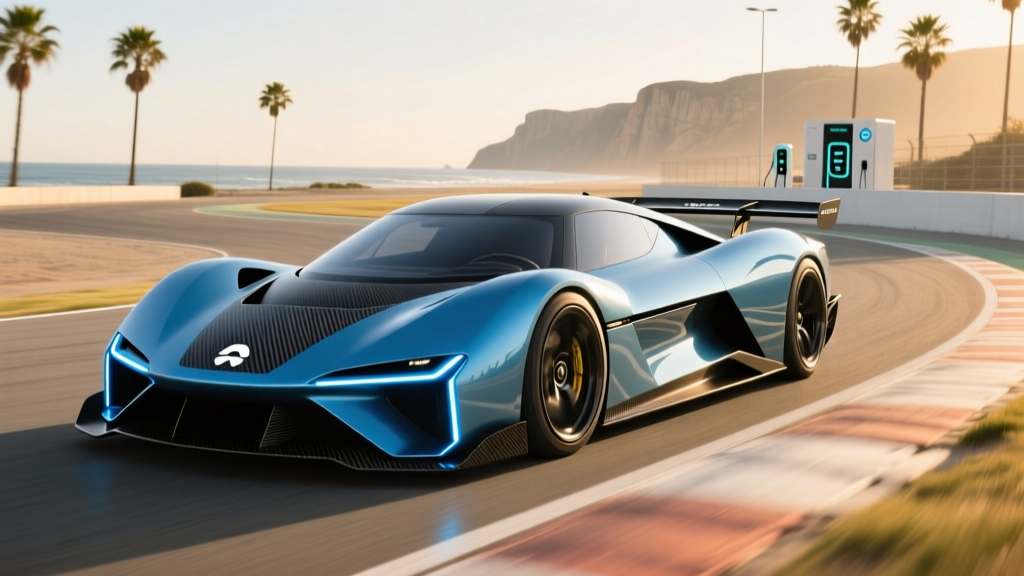
Quick Verdict: The NIO EP9 Is a Halo Car, Not a Hypercar You Can Buy
If you've searched for "NIO EP9 for sale" and hit a wall, you're not alone. The NIO EP9 remains one of the most talked-about electric vehicles ever built — and one of the least accessible. Limited to just 16 units (all allocated to NIO investors), the EP9 was never homologated for US road use, never offered for public sale, and never received EPA certification. It is, in every practical sense, a track-only technology demonstrator that proved Chinese EV engineering could compete at the highest levels of motorsport.
As of 2026, the EP9 exists as a collector-grade artifact and a brand-building exercise that paved the way for NIO's consumer vehicles like the ET7 sedan and EL8 SUV. This review breaks down the EP9's verified specifications, explains why it can't be driven on public roads, and examines what it means for buyers considering NIO's actual US-bound lineup.
NIO EP9 Specification Sheet: The Numbers Behind the Hype
| Specification | NIO EP9 Detail |
|---|---|
| Powertrain | Quad-motor AWD (one motor per wheel) |
| Horsepower | 1,341 hp (1,000 kW) combined |
| Torque | ~6,334 Nm (4,676 lb-ft) combined |
| 0-60 mph | 2.7 seconds |
| 0-124 mph (0-200 km/h) | 7.1 seconds |
| Top Speed | 194 mph (313 km/h) |
| Battery Capacity | 54 kWh (swappable pack) |
| Battery Chemistry | NMC (Nickel Manganese Cobalt) |
| Claimed Range (NEDC) | 265 miles (427 km) |
| Estimated EPA Range | No EPA rating — not road-legal in US |
| Real-World Track Range | ~20-30 minutes of hard driving per charge |
| Max DC Charge Rate | Not publicly disclosed (track-side custom charger) |
| Battery Swap Time | ~8 minutes (full pack exchange) |
| Home Level 2 Charging | Not applicable (track-only vehicle) |
| Weight | 3,825 lbs (1,735 kg) |
| Chassis | Carbon fiber monocoque, FIA E-GT race spec |
| Production Run | 16 units (2016-2017) |
| Original Price | ~$1.2 million USD per unit (investors only) |
| US Road Legality | Not street-legal; no DOT/EPA homologation |
| Federal EV Tax Credit (§30D) | Not eligible — not a production consumer vehicle |
Range and Efficiency: Track Metrics, Not Commuter Numbers
NEDC Claim: 265 miles (427 km) under the older, generous NEDC cycle.
Real-World Expectation: The 54 kWh battery pack was optimized for power delivery, not endurance. On the Nürburgring Nordschleife, the EP9 can complete roughly one hot lap (12.9 miles) before requiring a battery swap or charge. Under steady highway-speed driving (if it were legal), expect roughly 120-150 miles based on the pack size and hypercar drag coefficient — well below the NEDC claim.
The EP9's battery was designed around a fundamentally different use case than any consumer EV. The 54 kWh NMC pack prioritizes extreme discharge rates — pushing 1,000 kW to four individual motors — over energy density or longevity. For context, a 2026 Tesla Model S Plaid carries a ~100 kWh pack for 396 EPA miles. The EP9 has roughly half that capacity in a vehicle with dramatically higher power draw and aerodynamic drag.
NIO's solution to range limitations was its signature battery-swap system. Rather than waiting for a charge, the EP9's entire pack can be exchanged in approximately 8 minutes using a purpose-built track-side swap station. This technology later evolved into NIO's consumer Power Swap stations, which by 2026 number over 2,500 across China and are beginning pilot programs in Europe.
Charging: A Custom Track-Side Ecosystem
The NIO EP9 does not use standard CCS, NACS, or CHAdeMO connectors. Charging was handled via a proprietary track-side system designed specifically for the vehicle's extreme discharge and recharge requirements. NIO never published a peak DC fast-charge kW figure for the EP9, and no 10-80% charge time has been officially verified.
| Charging Method | Power / Details | Time |
|---|---|---|
| Track-Side Battery Swap | Full 54 kWh pack exchange | ~8 minutes |
| Proprietary DC Charger | Undisclosed kW (custom connector) | ~45 minutes (estimated 0-100%) |
| Level 2 (240V) | Not equipped for consumer Level 2 | N/A |
| Level 1 (120V) | Not equipped | N/A |
For NIO's actual consumer vehicles — like the ET7 and EL6 — the company supports standard CCS2 in Europe and GB/T in China, with DC fast-charge capability up to 180 kW on newer platforms and battery-swap compatibility across NIO's Power Swap network. If you're researching the EP9 to evaluate NIO as a brand, these consumer charging specs are far more relevant to a potential purchase.
Performance: 1,341 Horsepower and a Nürburgring Record
The EP9's performance figures remain staggering even by 2026 hypercar standards. Four individual motors — one at each wheel — produce a combined 1,341 horsepower (1,000 kW) and enable torque vectoring with millisecond precision. The result is a 0-60 mph time of 2.7 seconds and a 0-124 mph sprint in just 7.1 seconds.
But the EP9's defining performance achievement was its lap record. In October 2017, the EP9 lapped the Nürburgring Nordschleife in 6 minutes 45.90 seconds, making it (at the time) the fastest electric vehicle ever to circle the German circuit. That record has since been eclipsed by the Volkswagen ID.R (6:05.336, a purpose-built race car) and the Porsche Taycan Turbo GT (7:07.55, a production sedan), but the EP9's run proved that electric powertrains could compete with internal-combustion hypercars on the world's most demanding track.
The car generates up to 24,000 Newtons of downforce at 150 mph — roughly equivalent to its own weight — thanks to an active rear wing, full flat floor, and aggressive front splitter. This aerodynamic grip is what separates the EP9 from straight-line EV dragsters; it was engineered to corner, not just accelerate.
Why You Can't Buy a NIO EP9 (and What to Buy Instead)
What the EP9 Delivered
- 1,341 hp quad-motor AWD — among the most powerful EVs ever built
- Nürburgring EV lap record holder (2017)
- Carbon fiber monocoque, FIA-compliant race chassis
- Pioneered NIO's battery-swap technology
- Active aero generating 24,000 N of downforce
- Autonomous driving mode (track-only, Level 4 demonstration)
Why It's Not a Real Purchase Option
- Only 16 units built — all allocated to NIO investors
- Not street-legal in the US, EU, or China
- No EPA range rating, no DOT crash certification
- No standard charging connector (CCS, NACS, or CHAdeMO)
- ~$1.2M price was never offered to the public
- No warranty, no service network, no parts availability for consumers
- Battery swap requires proprietary track-side infrastructure
If the EP9 sparked your interest in NIO, the brand's actual consumer lineup is worth exploring — though US availability remains limited as of 2026. NIO has focused its international expansion on Europe (Norway, Germany, Netherlands, Sweden) with models like the ET7 sedan and EL6 SUV. A US market entry has been discussed but not confirmed with specific timing or models.
NIO Consumer Alternatives (Available in Select Markets, 2026)
| Model | Body Style | Battery | WLTP Range | Price (Europe) |
|---|---|---|---|---|
| NIO ET7 | Sedan | 75 kWh / 100 kWh NMC | 310-440 mi | €69,900+ |
| NIO EL6 | SUV | 75 kWh / 100 kWh NMC | 295-415 mi | €54,900+ |
| NIO ET5 | Compact Sedan | 75 kWh NMC | 280 mi | €47,900+ |
| NIO EC7 | Coupe SUV | 100 kWh NMC | 400 mi | €72,900+ |
Note: WLTP range figures are typically 10-15% higher than EPA estimates. US-spec models (if launched) would likely carry lower EPA-rated range. All NIO consumer models support battery swap on NIO's Power Swap network where available.
Federal Tax Credit and US Pricing Reality
NIO EP9 Pricing and Tax Credit Status
| Item | Detail |
|---|---|
| Original Unit Price | ~$1,200,000 (investor allocation only) |
| Current Availability | Not for sale; all 16 units privately held |
| Federal EV Tax Credit (§30D) | Not eligible |
| Reason for Ineligibility | Not a production consumer vehicle; no US homologation; exceeds $55,000 sedan / $80,000 SUV MSRP cap; no battery-sourcing documentation |
| Point-of-Sale Transfer | Not applicable |
The IRS §30D clean vehicle credit has strict requirements that the EP9 fails on every front: the vehicle must be purchased new from a licensed dealer, have an MSRP below $55,000 (sedans) or $80,000 (SUVs/trucks/vans), meet buyer income caps ($150K single / $300K joint), and satisfy critical-mineral and battery-component sourcing requirements. The EP9 was never sold through dealers, cost over $1 million, and was built before current battery-sourcing rules existed.
For NIO's future US models (if they arrive), tax credit eligibility would depend on where batteries and minerals are sourced. NIO's supply chain is heavily China-based, which currently triggers foreign entity of concern (FEOC) exclusions under §30D — likely disqualifying most NIO vehicles from the full $7,500 credit even if they were sold stateside.
The EP9's Real Legacy: What It Means for NIO Buyers Today
The NIO EP9 was never meant to be a product. It was a proof of concept — a rolling billboard that demonstrated NIO's engineering ambition to investors, media, and the motorsport world. In that role, it succeeded spectacularly. The EP9's Nürburgring record generated global headlines, and the battery-swap technology it debuted became a core differentiator for NIO's consumer vehicles.
For US-based EV shoppers drawn to the EP9's performance ethos, the practical alternatives are clear:
- Tesla Model S Plaid — 1,020 hp, 396 EPA miles, 0-60 in 1.99s, ~$89,990 MSRP. The closest US-market EV to the EP9's performance envelope.
- Lucid Air Sapphire — 1,234 hp, 427 EPA miles, 0-60 in 1.89s, ~$249,000 MSRP. American-built, EPA-certified, and genuinely faster than the EP9 to 60 mph.
- Porsche Taycan Turbo GT — 1,092 hp (Launch Control), 269 EPA miles, 0-60 in 2.1s, ~$230,000 MSRP. Track-focused with Nürburgring credentials of its own.
- Rimac Nevera — 1,914 hp, 0-60 in 1.74s, ~$2.2M. The closest spiritual successor to the EP9, limited to 150 units, but fully road-legal.
Frequently Asked Questions
Is the NIO EP9 street-legal in the United States?
No. The NIO EP9 was built as a track-only vehicle to FIA E-GT specifications. It has no DOT crash-test certification, no EPA emissions compliance (even as a zero-emission vehicle, it lacks the required certification paperwork), and no US-spec lighting or safety equipment. It cannot be registered for road use in any US state.
How many NIO EP9s were built, and who owns them?
NIO produced 16 EP9 units between 2016 and 2017. All were allocated to NIO investors and board members, including founder William Li and early backers like Tencent and Sequoia Capital. None were offered for public sale, and NIO has not announced any plans for additional production runs.
What is the real-world range of the NIO EP9?
The EP9 has no EPA range rating. Under NEDC testing (an older, generous European standard), NIO claimed 265 miles (427 km) from the 54 kWh pack. In real-world track use, the battery lasts approximately 20-30 minutes of aggressive driving — roughly one full Nürburgring lap. At steady highway speeds (if road-legal), the realistic range would likely fall between 120-150 miles based on the small pack size and high-drag aero profile.
Does the NIO EP9 qualify for the federal EV tax credit?
No. The IRS §30D clean vehicle credit requires a vehicle to be purchased new from a licensed dealer, fall under MSRP caps ($55,000 for sedans), meet buyer income limits, and satisfy battery-sourcing requirements. The EP9 was never sold through dealers, cost approximately $1.2 million, and predates current sourcing rules by several years.
How fast does the NIO EP9 charge?
NIO never published an official DC fast-charge kW rate for the EP9. The vehicle was designed primarily around its battery-swap system, which exchanges the entire 54 kWh pack in approximately 8 minutes. When plugged into its proprietary track-side charger, a full charge is estimated to take roughly 45 minutes. The EP9 does not support CCS, NACS, CHAdeMO, or any consumer charging standard.
Is NIO planning to sell cars in the United States?
As of early 2026, NIO has not confirmed a US market entry date or specific models. The company's international expansion has focused on Europe, with operations in Norway, Germany, the Netherlands, Sweden, and Austria. NIO's sub-brand Firefly, launched for international markets, could serve as an entry point for price-sensitive markets, but US homologation, dealer network establishment, and tariff considerations remain significant barriers.
What makes the NIO EP9 different from other electric hypercars?
The EP9's defining feature was its battery-swap architecture — no other hypercar, electric or otherwise, was designed around interchangeable battery packs. Combined with its active aerodynamics (24,000 N of downforce), autonomous driving demonstration mode, and Nürburgring record, the EP9 occupied a unique space between race car and technology showcase. The Rimac Nevera (1,914 hp, road-legal) and Lotus Evija (1,972 hp, road-legal) are its closest peers in the electric hypercar segment, but neither offers battery swapping.