NIO's September 2025 Delivery Numbers: A Signal Worth Watching
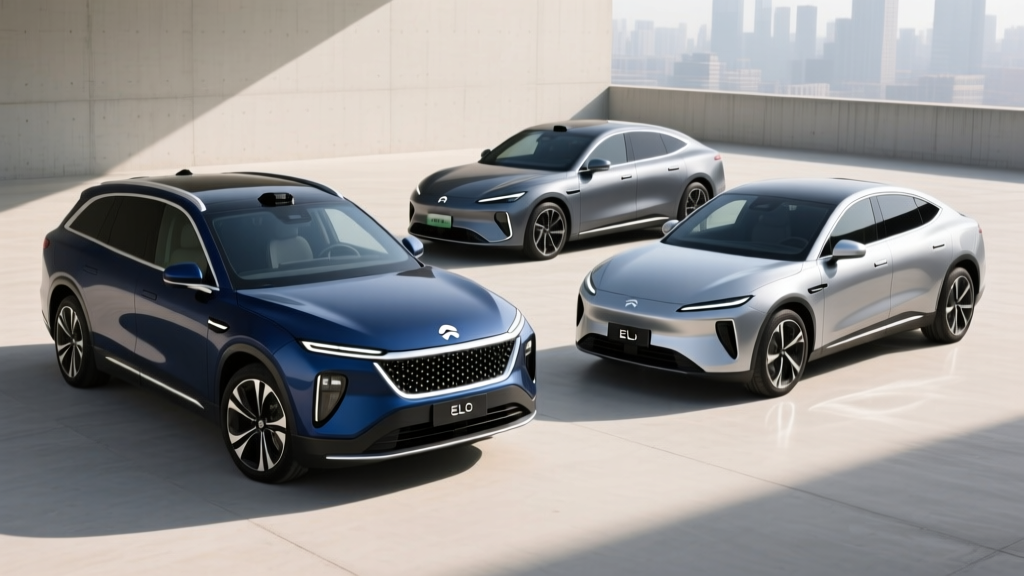
NIO reported 21,352 vehicle deliveries in September 2025, marking its strongest month of the year and a roughly 30% year-over-year increase. The Chinese automaker's lineup — anchored by the redesigned EL8 SUV, the ET7 sedan, and the EL6 mid-size crossover — is finding traction in China and expanding across Europe. But for US-based EV shoppers tracking the global market, the question isn't just whether NIO is selling well abroad. It's whether these vehicles are viable options stateside, and what their specs actually look like when measured against American benchmarks.
This review profiles the three core models driving NIO's September 2025 delivery surge, translating WLTP figures to EPA estimates, mapping charging compatibility to US networks, and evaluating federal tax credit eligibility under current IRS §30D rules. If you're considering importing a NIO or simply benchmarking it against domestic alternatives, here's the data you need.
Spec Snapshot: NIO EL8, ET7, and EL6 at a Glance
| Spec | NIO EL8 (2025) | NIO ET7 (2025) | NIO EL6 (2025) |
|---|---|---|---|
| Body Style | 3-row SUV | Sedan | 2-row crossover |
| Drivetrain | Dual-motor AWD | Dual-motor AWD | Dual-motor AWD |
| Battery (usable) | 100 kWh (NMC) | 100 kWh (NMC) | 75 kWh (LFP) / 100 kWh (NMC) |
| EPA Est. Range | ~260 mi (est.) | ~310 mi (est.) | ~225 mi (75 kWh) / ~290 mi (100 kWh) (est.) |
| Peak DC Charge | ~185 kW | ~185 kW | ~170 kW |
| 10–80% DC Time | ~34 min | ~34 min | ~30 min (75 kWh) |
| Level 2 Rate | 11 kW (~33 mi/hr) | 11 kW (~37 mi/hr) | 11 kW (~27 mi/hr) |
| 0–60 mph | ~4.1 sec | ~3.8 sec | ~4.5 sec |
| Horsepower | 644 hp | 644 hp | 483 hp |
| Base MSRP (China) | ¥498,000 (~$68,500) | ¥428,000 (~$59,000) | ¥338,000 (~$46,500) |
| Battery Warranty | 8 yr / 100,000 mi (est.) | 8 yr / 100,000 mi (est.) | 8 yr / 100,000 mi (est.) |
Note: NIO does not currently sell vehicles through US dealerships. MSRP figures reflect China-market pricing converted at approximate exchange rates. EPA range figures are estimates derived from WLTP data with a standard ~15% reduction factor. Actual US-spec figures would differ if NIO enters the market.
Real-World Range: What the EPA Estimates Actually Mean
The ET7's estimated 310-mile EPA range drops to roughly 250–270 miles at sustained highway speeds (75+ mph) and can fall to 220–240 miles in sub-freezing temperatures without preconditioning. The EL8, with its heavier curb weight (~5,400 lbs) and boxier aero profile, sees steeper highway losses — expect 210–230 miles on a road trip from its estimated 260-mile sticker. The EL6 with the 75 kWh LFP pack is best treated as a 180–200 mile real-world highway vehicle despite its 225-mile estimate.
NIO's WLTP range claims — 580 km for the ET7, 510 km for the EL8, and 490 km for the EL6 (100 kWh) — are characteristically optimistic compared to EPA methodology. WLTP cycles include more low-speed city driving and gentler acceleration profiles. Applying a ~15% WLTP-to-EPA conversion, plus accounting for real-world highway and cold-weather losses, gives a more honest picture of what you'd actually drive.
The 100 kWh NMC packs in the ET7 and EL8 use Samsung SDI cells with a nickel-manganese-cobalt chemistry optimized for energy density. The EL6's optional 75 kWh pack uses lithium iron phosphate (LFP) — heavier and less energy-dense, but more durable over thousands of charge cycles and less prone to thermal runaway. LFP packs also tolerate regular 100% charging without the degradation concerns that NMC packs carry above 80–90% state of charge.
Charging Speed and Network Compatibility
NIO's charging architecture is built around China's GB/T connector standard and Europe's CCS2. For US use, you'd need a CCS1 adapter (or wait for NACS adoption, which NIO has not announced for its current platform). Here's how the numbers break down:
| Charging Level | Power / Rate | EL8 | ET7 | EL6 |
|---|---|---|---|---|
| Level 1 (120V) | ~1.4 kW | ~4 mi/hr | ~4 mi/hr | ~4 mi/hr |
| Level 2 (240V) | 11 kW | ~33 mi/hr | ~37 mi/hr | ~27 mi/hr |
| DC Fast Charge | Peak ~185 kW | 10–80% in ~34 min | 10–80% in ~34 min | 10–80% in ~30 min |
NIO's peak DC charge rate of ~185 kW is respectable but not class-leading. Competitors like the Hyundai Ioniq 5 (peak 240 kW, 10–80% in ~18 minutes) and the Tesla Model Y (peak 250 kW on V3 Superchargers) significantly outpace it. The NIO charge curve also tapers noticeably above 70% state of charge, meaning the final 10–20% adds substantially to your stop time if you charge past 80%.
Battery swapping remains NIO's differentiator. In China, NIO operates over 2,500 Power Swap stations that exchange a depleted pack for a fully charged one in roughly 3 minutes. However, this infrastructure does not exist in the US, and NIO has not announced plans to build swap stations in North America. Without swap capability, US buyers would rely entirely on plug-in charging.
Performance, Interior, and Technology
All three models use NIO's dual-motor all-wheel-drive powertrain. The ET7 sedan leads with a 3.8-second 0–60 mph time and 644 hp, competitive with the Tesla Model S and BMW i5. The EL8 hits 60 mph in roughly 4.1 seconds despite its 5,400-pound mass — impressive for a three-row SUV. The EL6, with 483 hp, clocks in at ~4.5 seconds, which is adequate for merging and passing but trails sportier rivals like the Porsche Macan EV.
Interior space is where NIO models make a strong case:
- EL8: Three rows with ~15 cu ft cargo behind the third row, expanding to ~45 cu ft with the third row folded. Second-row legroom is a generous ~37 inches.
- ET7: ~18 cu ft trunk (no frunk). Rear legroom is ~38 inches, aided by the flat floor and long wheelbase (120.5 in).
- EL6: ~22 cu ft cargo behind the second row, ~52 cu ft with seats folded. Rear legroom ~36 inches.
Technology highlights include NIO's NOMI AI companion (an animated dashboard robot that responds to voice commands), a 12.8-inch AMOLED center display, a 10.2-inch digital instrument cluster, and a 7.1.4 Dolby Atmos surround sound system with 23 speakers. The ET7 and EL8 also offer a 150 kWh solid-state battery option in China (pushing WLTP range past 1,000 km), though this pack is not available outside China and costs roughly $30,000 additional.
On the driver-assist front, NIO's NAD (NIO Autonomous Driving) system uses 33 sensors including a roof-mounted LiDAR unit, 11 cameras, and 5 millimeter-wave radars. It supports highway and urban assisted driving, but it is a SAE Level 2 system — the driver must remain engaged and hands on or near the wheel at all times. It is not self-driving.
Pricing, Tax Credits, and the Import Question
Here's where the NIO proposition gets complicated for US buyers. NIO does not sell vehicles in the United States. There are no NIO dealerships, no US-homologated models, and no NHTSA crash-test ratings for current NIO vehicles. Importing one privately is theoretically possible but involves significant regulatory hurdles (EPA emissions compliance, DOT safety standards, bumper regulations) and would almost certainly void any manufacturer warranty.
If NIO were to enter the US market, federal tax credit eligibility under IRS §30D would depend on several factors:
- MSRP cap: SUVs (EL8, EL6) must be under $80,000; sedans (ET7) under $55,000. China-market pricing puts the ET7 dangerously close to the sedan cap.
- Buyer income cap: AGI must not exceed $300,000 (joint), $225,000 (head of household), or $150,000 (individual).
- Battery sourcing: Critical minerals and battery components must meet escalating domestic-content and free-trade-agreement thresholds. NIO's supply chain is heavily China-based, which would likely disqualify its vehicles from the full $7,500 credit under current rules — and potentially trigger the foreign entity of concern (FEOC) exclusion entirely, reducing the credit to $0.
In short: even if you could buy a NIO in the US, it would almost certainly not qualify for the $7,500 federal EV tax credit due to battery-sourcing rules. Check the latest eligibility details at fueleconomy.gov.
How NIO Compares to US-Market Alternatives
Pros
- Battery swap capability (in markets with infrastructure)
- Premium interior materials and spacious cabins
- Strong standard AWD performance across lineup
- LFP battery option on EL6 for longevity-focused buyers
- LiDAR-equipped ADAS hardware as standard
Cons
- Not sold or supported in the United States
- DC fast-charge speed (185 kW peak) lags Hyundai, Tesla, and Porsche
- No NHTSA or IIHS safety ratings
- Likely ineligible for §30D tax credit due to China-sourced battery
- Real-world range 15–20% below WLTP claims
- Resale value and parts availability unknown in US
If you're drawn to what the ET7 offers — a premium electric sedan with ~310 miles of estimated range and strong performance — the closest US-available alternatives are:
- Tesla Model S: EPA 402 mi, 250 kW peak charging, extensive Supercharger network, from ~$79,990.
- BMW i5 eDrive40: EPA 295 mi, 205 kW peak charging, strong build quality, from ~$66,800.
- Lucid Air Pure: EPA 419 mi, 200+ kW charging, from ~$69,900.
For the EL8's three-row SUV role, the Kia EV9 (EPA 304 mi, 236 kW peak, from ~$54,900) and Tesla Model X (EPA 335 mi, from ~$79,990) are the benchmarks. For the EL6, the Tesla Model Y, Hyundai Ioniq 5, and Ford Mustang Mach-E all offer comparable or superior charging speeds with full US support and tax credit eligibility.
Who Should Consider a NIO — and Who Shouldn't
NIO's September 2025 delivery milestone reflects genuine product strength in China and growing European presence. The vehicles are well-built, tech-forward, and competitively priced in their home market. But for US-based buyers, the practical barriers are substantial:
Consider NIO if: You're based in Europe or China where these vehicles are sold and supported, you value battery-swap flexibility, and you want a premium EV with distinctive tech (NOMI, LiDAR-standard ADAS).
Look elsewhere if: You're a US buyer. Without dealership support, US safety certification, NACS/CCS1 charging compatibility, or tax credit eligibility, importing a NIO is a high-risk proposition with no warranty safety net. The US-market alternatives listed above match or exceed NIO's specs in the areas that matter most: charging speed, range, and ownership infrastructure.
Frequently Asked Questions
What is the real-world range of the NIO ET7?
The ET7's estimated EPA range is ~310 miles on the 100 kWh NMC pack. Expect 250–270 miles at highway speeds and 220–240 miles in cold weather without preconditioning.
How fast does a NIO charge on DC fast charging?
NIO's current platform peaks at ~185 kW on DC fast charging, delivering a 10–80% charge in roughly 30–34 minutes depending on the model and pack size. This is slower than the Hyundai Ioniq 5 (~18 min) and Tesla Model Y (~15–20 min on V3 Superchargers).
Does NIO qualify for the US federal EV tax credit?
Even if NIO sold vehicles in the US, its China-sourced battery supply chain would likely disqualify it under the §30D battery-sourcing and FEOC rules. Always verify current eligibility at irs.gov.
Is NIO coming to the United States?
NIO has not announced a US launch timeline. The company is currently focused on China, Europe (Norway, Germany, Netherlands, Sweden, Denmark), and potential expansion into Southeast Asia. A US entry would require significant homologation work and charging infrastructure partnerships.
What is NIO's battery warranty?
NIO offers an estimated 8-year / 100,000-mile battery warranty in its current markets, consistent with industry norms. Specific terms vary by region and are not applicable in the US where NIO does not operate.
Is NIO's NOMI AI or NAD system self-driving?
No. NIO's NAD driver-assist system is an SAE Level 2 feature, meaning the driver must remain fully engaged and responsible for vehicle control at all times. It assists with steering, acceleration, and braking on compatible roads but does not replace the driver.