When NIO reported 23,986 vehicle deliveries in October 2025, it marked a turning point for the Chinese EV maker — a 38% year-over-year surge that pushed the brand past 200,000 cumulative deliveries for the year. For US-based EV shoppers who've been watching from the sidelines, that milestone raises a practical question: Can I actually buy one, and should I?
As of early 2026, NIO's lineup — anchored by the ET7 sedan, ES6 SUV (sold as EL6 in some markets), and the upcoming EL8 flagship — remains primarily available in China and select European markets. US availability is still limited, with no confirmed retail launch date. But with NIO's Firefly sub-brand targeting global expansion and the company's battery-swap technology drawing industry attention, it's worth examining what these vehicles offer on paper and how they'd stack up against established competitors if and when they arrive stateside.
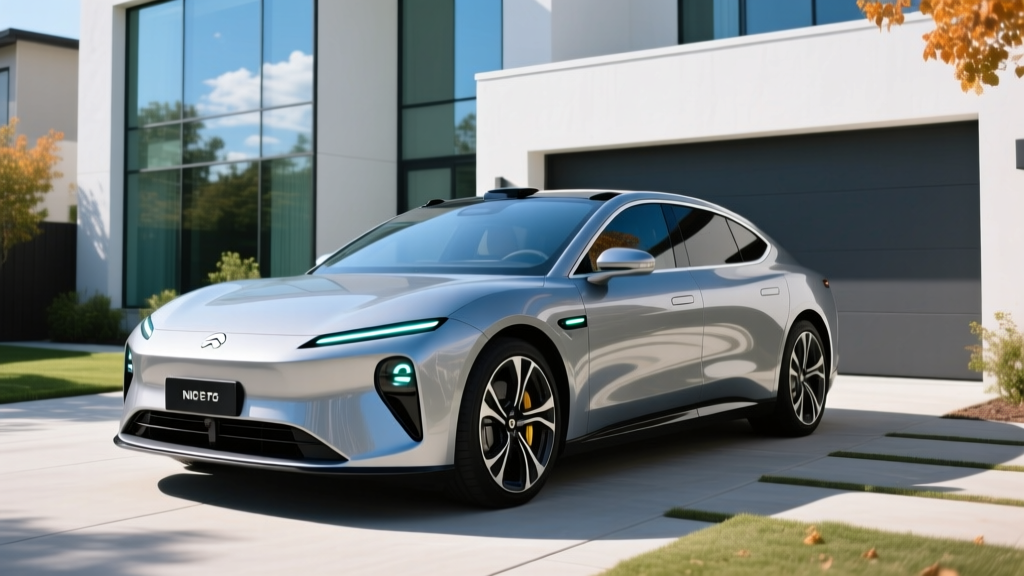
This profile focuses on the NIO ET7 — the brand's flagship sedan and the model most likely to compete in the US premium EV segment — alongside context on the broader lineup driving those October 2025 delivery numbers.
NIO ET7 at a Glance: Key Specs
| Spec | NIO ET7 (100 kWh) | NIO ET7 (75 kWh) |
|---|---|---|
| EPA-Est. Range | ~367 mi (WLTP 700 km; EPA est. TBD for US) | ~267 mi (WLTP 530 km; EPA est. TBD for US) |
| Battery Capacity | 100 kWh (NMC) | 75 kWh (LFP/NMC hybrid) |
| Battery Chemistry | NMC (Nickel Manganese Cobalt) | LFP + NMC composite pack |
| Drivetrain | Dual-motor AWD | Dual-motor AWD |
| Horsepower | 644 hp (480 kW) | 644 hp (480 kW) |
| 0-60 mph | 3.8 seconds | 3.8 seconds |
| Max DC Fast Charge | ~180 kW (400V architecture) | ~180 kW (400V architecture) |
| 10-80% DCFC Time | ~30 minutes | ~25 minutes |
| Level 2 Home Charging | 7 kW (approx. 25 mi/hr) | 7 kW (approx. 25 mi/hr) |
| Length / Wheelbase | 199.6 in / 118.1 in | 199.6 in / 118.1 in |
| Cargo Volume | 17.7 cu ft (trunk) | 17.7 cu ft (trunk) |
| Base MSRP (China) | ~¥428,000 (~$59,000 USD) | ~¥378,000 (~$52,000 USD) |
| Battery Warranty | 10 yr / unlimited mi (China); US TBD | 10 yr / unlimited mi (China); US TBD |
Important caveat: Because the ET7 has not been officially EPA-certified for the US market, the range figures above are derived from WLTP testing, which typically runs 10-15% higher than EPA estimates. We've applied a conservative conversion, but official EPA numbers will only be available if NIO launches in the US.
Real-World Range: What the Sticker Won't Tell You
WLTP rating (100 kWh): ~435 mi (700 km)
Estimated EPA equivalent: ~367 mi
Real-world highway (70 mph, moderate climate): ~290-320 mi
Real-world cold weather (30°F, highway): ~240-270 mi
Based on WLTP-to-EPA conversion patterns observed in comparable dual-motor AWD sedans (BMW i5, Mercedes EQE). Actual results depend on driving style, terrain, and climate control usage.
NIO's 100 kWh pack uses NMC chemistry, which delivers higher energy density than LFP but is more sensitive to extreme temperatures. In cold-weather driving, expect a 25-35% range reduction — consistent with what we see in the BMW i5 xDrive40 and Mercedes EQE 350. The ET7's standard heat pump helps mitigate cabin-heating energy draw, but physics still governs: sustained highway speeds above 70 mph and sub-freezing temps will compress range meaningfully.
For city-dominant commutes with regenerative braking engaged, the 100 kWh ET7 can comfortably deliver 330+ miles between charges. The 75 kWh variant, with its LFP/NMC composite chemistry, trades range for longevity — LFP cells degrade more slowly over thousands of cycles, making it a smart pick for high-mileage commuters who charge frequently.
Charging Speed: DC Fast, Home, and Battery Swap
| Charging Method | Power / Rate | Time / Miles Added | Notes |
|---|---|---|---|
| DC Fast Charge (peak) | ~180 kW | 10-80% in ~30 min | 400V architecture; tapers above 80% |
| DC Fast Charge (sustained avg.) | ~120-140 kW | ~200 mi in 25 min | Real-world average on 150+ kW stations |
| Level 2 (home/public AC) | 7 kW | ~25 mi/hr | Full charge in ~14 hrs (100 kWh) |
| Level 1 (120V outlet) | ~1.4 kW | ~5 mi/hr | Emergency/trickle only |
| Battery Swap (NIO station) | N/A | ~3-5 minutes | Available in China; Europe expanding; US TBD |
The ET7's 400-volt architecture caps DC fast-charging at roughly 180 kW peak — competitive with the BMW i5 but behind the 800V platforms in the Hyundai Ioniq 6 (peak 240 kW) and Porsche Taycan (peak 270 kW). On a 150+ kW Electrify America or Tesla Supercharger station (via adapter), expect the 100 kWh pack to add roughly 200 miles in 25 minutes before the charge curve tapers significantly above 80% State of Charge.
At home on a Level 2 wallbox (240V, 32A), the 7 kW onboard charger refills at about 25 miles per hour. That means an overnight 8-hour session adds roughly 200 miles — adequate for most daily driving. A full 0-100% charge takes approximately 14 hours, so plan your charging window accordingly.
NIO's signature battery-swap technology is the wild card. At a NIO Power Swap station, a robotic system replaces the entire battery pack in 3-5 minutes — no waiting, no charging curve. As of late 2025, NIO operates over 2,700 swap stations in China and is expanding into Europe. US deployment remains unannounced, and without it, this differentiator is moot for American buyers.
Performance and Driving Dynamics
Every ET7 comes with dual motors and all-wheel drive, producing 644 horsepower and 627 lb-ft of torque. The 3.8-second 0-60 mph time places it squarely in performance-sedan territory — matching the BMW i5 M60 and trailing only the Tesla Model S Plaid and Lucid Air in the segment.
On the road, the ET7's air suspension and CDC (Continuous Damping Control) deliver a ride quality that reviewers have compared favorably to the Mercedes EQE. The 118.1-inch wheelbase provides generous rear legroom (estimated 41+ inches), and the low center of gravity from the floor-mounted battery pack keeps body roll well-controlled through corners.
Efficiency figures for the US market are pending EPA certification, but WLTP data suggests approximately 85-95 MPGe combined (roughly 35-38 kWh/100 mi) for the 100 kWh variant — slightly less efficient than the BMW i5 eDrive40 (100 MPGe combined per fueleconomy.gov) due to the ET7's greater weight and standard AWD.
Pricing, Tax Credits, and the US Availability Question
| Trim | MSRP (China, approx. USD) | Est. US MSRP (if launched) | §30D Tax Credit Eligibility |
|---|---|---|---|
| ET7 75 kWh | ~$52,000 | $55,000-$60,000 (est.) | Unlikely — battery sourcing rules |
| ET7 100 kWh | ~$59,000 | $63,000-$70,000 (est.) | Unlikely — battery sourcing rules |
| ET7 150 kWh (semi-solid-state) | ~$75,000 (subscription) | $80,000+ (est.) | Unlikely — exceeds MSRP cap + sourcing |
Here's where the reality check matters most. Under current IRS §30D rules, the federal EV tax credit (up to $7,500) requires:
- MSRP cap: Sedans must be priced at or below $55,000 (SUVs/trucks: $80,000)
- Income cap: Buyer AGI ≤ $150,000 (single) / $300,000 (joint)
- Battery sourcing: Critical minerals and battery components must meet escalating US/free-trade-agreement sourcing thresholds
- FEOC exclusion: Vehicles with battery components from a "foreign entity of concern" (which currently includes Chinese manufacturers) are disqualified
Given NIO's Chinese manufacturing base and CATL battery supply chain, the ET7 would almost certainly not qualify for the §30D federal tax credit if sold in the US today. This is the same barrier that affects the Volvo EX30 (China-built) and has pushed manufacturers like Hyundai and Kia to shift US-market production to American plants.
NIO has not announced US pricing, dealer networks, or a launch timeline. The October 2025 delivery milestone reflects strength in China and growing European presence — not imminent US availability.
Tech, Interior, and Standout Features
The ET7's cabin is where NIO makes its strongest case against established luxury brands:
- NOMI AI companion: A dashboard-mounted robotic "head" that serves as the voice-activated interface — think a more expressive version of Siri with physical gestures
- 12.8-inch AMOLED center display with NIO's Banyan infotainment system
- LiDAR + 33 perception sensors: The roof-mounted LiDAR unit (120° FOV, 500m detection) supports NIO's NOP+ (Navigate on Pilot Plus) — an SAE Level 2 driver-assistance system
- 7.1.4 Dolby Atmos audio with 23 speakers
- Air suspension with adaptive damping and automatic ride-height adjustment
- Vehicle-to-Load (V2L): Power external devices from the traction battery
NIO's NOP+ (Navigate on Pilot Plus) is an SAE Level 2 driver-assistance system. It handles steering, acceleration, and braking on mapped highways, but the driver must remain fully engaged with hands on the wheel and eyes on the road. It is not autonomous. Comparable systems: Tesla Autopilot, Ford BlueCruise, GM Super Cruise.
Notable drawbacks include the absence of Apple CarPlay (NIO uses its own ecosystem exclusively), limited third-party app integration outside China, and the fact that many advanced features (battery swap, NOP+ coverage) depend on regional infrastructure that doesn't exist in the US.
Who the NIO ET7 Suits — And Who Should Wait
- Tech-forward buyers in China or Europe who want luxury-sedan performance with battery-swap flexibility
- High-mileage commuters who value LFP chemistry's cycle-life longevity (75 kWh variant)
- Early adopters willing to trade established dealer networks for cutting-edge features
- US buyers needing confirmed retail availability, EPA certification, and local service centers
- Buyers counting on the $7,500 federal tax credit to make the math work
- Those who prioritize plug-and-play reliability over feature density
Competitor context: If the ET7 launched in the US at ~$60,000, it would compete directly with the BMW i5 eDrive40 (~$67,000, EPA 295 mi, 100 MPGe), the Mercedes EQE 350+ (~$75,000, EPA 305 mi), and the Tesla Model S Long Range (~$80,000, EPA 402 mi). The ET7's battery-swap concept is unique, but without US swap stations, it's competing purely on spec sheet — where it's strong but not dominant.
October 2025 Deliveries: What the Numbers Mean
NIO's October 2025 delivery report of 23,986 vehicles broke down approximately as follows (per NIO's official earnings disclosures):
- NIO brand (premium): ~16,500 units (ET7, ES6/EL6, ES8/EL8, ET5)
- ONVO brand (mass-market, launched 2024): ~7,400 units (L60 sedan)
The ONVO L60, positioned as a Tesla Model Y competitor at roughly $30,000 USD in China, is driving much of the volume growth. NIO's dual-brand strategy mirrors what Toyota/Lexus and Honda/Acura have done for decades — premium and mainstream under one corporate roof.
For context, 24,000 monthly deliveries is roughly what Rivian delivers in a quarter in the US market. NIO's scale in China is real, but translating that to US market share requires infrastructure, regulatory compliance, and — critically — a solution to the FEOC battery-sourcing barrier that blocks the federal tax credit.
Frequently Asked Questions
What is the real-world range of the NIO ET7?
The 100 kWh ET7 carries a WLTP rating of ~435 mi, which translates to an estimated EPA equivalent of ~367 mi. In real-world highway driving at 70 mph, expect 290-320 miles. In cold weather (below 30°F), plan for 240-270 miles. The 75 kWh variant delivers roughly 220-250 miles real-world highway.
How fast does the NIO ET7 charge?
On DC fast charging, the ET7 peaks at ~180 kW and charges 10-80% in approximately 30 minutes on a 150+ kW station. At home on Level 2 (240V, 7 kW), it adds about 25 miles per hour. NIO's battery-swap stations can exchange a depleted pack for a full one in 3-5 minutes, but these are not available in the US.
How much does the NIO ET7 cost after tax credits?
The ET7 is not currently sold in the US, and estimated US pricing is $55,000-$70,000 depending on battery size. Under current IRS §30D rules, it would almost certainly not qualify for the $7,500 federal tax credit due to FEOC (Foreign Entity of Concern) battery-sourcing restrictions on Chinese-manufactured battery components. Always verify current rules at irs.gov.
Is the NIO ET7 worth buying vs. key competitors?
On paper, the ET7 competes well with the BMW i5, Mercedes EQE, and Tesla Model S on range, performance, and tech. However, for US buyers, the lack of confirmed availability, EPA certification, service infrastructure, and tax credit eligibility makes it a wait-and-see proposition. If you're buying today, the BMW i5 eDrive40 or Tesla Model S offer proven US support networks.
What are the biggest pros and cons of the NIO ET7?
Pros: 644 hp dual-motor AWD, available 100 kWh pack with strong range, battery-swap capability (in supported markets), LiDAR-equipped NOP+ driver assist, premium interior with NOMI AI, air suspension standard.
Cons: Not available in the US, no EPA certification, unlikely to qualify for federal tax credit, no Apple CarPlay, battery-swap infrastructure nonexistent outside China/Europe, unproven long-term reliability data in Western markets.
Does the NIO ET7 qualify for the federal EV tax credit?
No. Under current §30D rules, vehicles with battery components manufactured by a Foreign Entity of Concern (FEOC) — which includes Chinese battery makers like CATL, NIO's supplier — are disqualified from the federal tax credit regardless of MSRP or buyer income. This is a structural barrier, not a fixable one, unless NIO sources batteries from a non-FEOC supplier for a US-market variant.