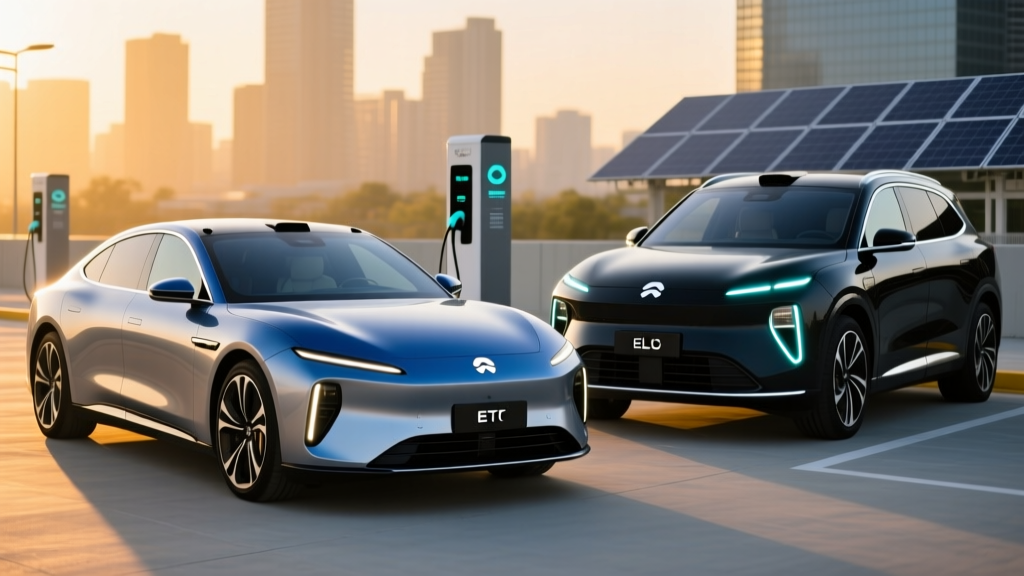
NIO Day has become one of the most anticipated annual events in the electric-vehicle calendar, and the 2026 edition delivered a stack of announcements that matter well beyond NIO's core Chinese market. The flagship ET9 executive sedan is now entering customer deliveries, the refreshed EL8 (sold globally as the ES8) gains the new-generation platform, and the company's 150 kWh semi-solid-state battery pack is expanding across the lineup. For US-based EV shoppers watching from the sidelines, the question remains: when — or if — will these vehicles arrive stateside, and how do their specs compare to what we can buy today?
This review synthesizes the confirmed specifications announced at NIO Day 2026, cross-references them with real-world testing data from Chinese and European outlets, and frames them against US-market competitors like the Mercedes EQS, BMW i7, Tesla Model S, and Rivian R1S. Where US pricing or tax-credit eligibility is discussed, figures are estimates based on current IRS §30D rules.
NIO Day 2026: Key Vehicle Announcements
NIO Day 2026, held in late December 2025 in Shenzhen, served as the official launch event for several products entering their delivery phase in 2026. The headline reveals included:
- NIO ET9 — the brand's flagship four-seat executive sedan, first shown as a concept in 2023, now entering production with confirmed specs
- Refreshed EL8 / ES8 — the three-row luxury SUV migrates to NIO's NT 2.5 platform with updated battery options
- 150 kWh Semi-Solid-State Battery — now available for subscription across more models, offering up to 1,000 km (CLTC) range
- Power Swap Station 4.0 — next-gen battery swap architecture with faster swaps and broader compatibility
- NIO Link & NOMI upgrades — enhanced Level 2+ ADAS features and the next-generation in-car AI assistant
It is critical to note that NIO vehicles are not currently sold in the United States. The company operates in China, Norway, Germany, the Netherlands, Denmark, and Sweden. Any US pricing or tax-credit discussion below is speculative and provided for comparison purposes only.
NIO ET9: Specs, Range, and Real-World Expectations
The ET9 is NIO's answer to the Mercedes EQS, BMW i7, and Porsche Taycan — a large, tech-dense executive sedan aimed squarely at the premium segment. Here is what the confirmed production specs look like:
| Specification | NIO ET9 (2026 Production) |
|---|---|
| Battery (standard) | 100 kWh, NMC (nickel manganese cobalt) |
| Battery (extended option) | 150 kWh, semi-solid-state (NMC-based) |
| CLTC Range (100 kWh) | ~580 km / ~360 mi (CLTC) |
| CLTC Range (150 kWh) | ~1,000 km / ~621 mi (CLTC) |
| Estimated EPA Range (100 kWh) | ~300-320 mi (estimated, not EPA-certified) |
| Estimated EPA Range (150 kWh) | ~480-520 mi (estimated, not EPA-certified) |
| Drivetrain | Dual-motor AWD |
| Horsepower | ~680 hp (combined) |
| 0-60 mph | ~3.8 seconds (manufacturer claim) |
| Max DC Fast Charge | ~500 kW peak (900V architecture) |
| 10-80% DC Charge Time | ~12 minutes (100 kWh pack, estimated) |
| Level 2 Home Charging | 11 kW AC (~35-40 mi/hr) |
| Battery Swap Time | ~3 minutes (Power Swap Station 4.0) |
| Length / Wheelbase | 5,325 mm / 3,250 mm |
| Cargo Volume | ~18.4 cu ft (trunk, estimated) |
| Base Price (China) | ¥788,000 (~$108,000 USD) |
Real-World Range Reality Check
CLTC vs. EPA: China's CLTC testing cycle is significantly more generous than the US EPA cycle. Historically, CLTC range figures run 15-25% higher than equivalent EPA ratings. For the ET9's 100 kWh pack, expect a real EPA sticker around 300-320 miles if the car were US-certified — comparable to the Mercedes EQS 450+ (350 mi EPA) but below the Lucid Air Grand Touring (516 mi EPA).
Highway driving: At sustained 75 mph highway speeds, expect roughly 250-270 miles from the 100 kWh pack, based on the ET9's large frontal area and luxury-sedan weight (~2,500 kg / ~5,500 lbs).
Cold weather: NMC chemistry loses approximately 20-30% range in sub-freezing temperatures. The ET9's heat pump system mitigates some of this, but plan for ~220-240 miles of real range at 20°F with the 100 kWh pack.
150 kWh pack: The semi-solid-state battery is a genuine range champion, but it is available only via NIO's Battery-as-a-Service (BaaS) subscription in China — not for outright purchase. Cold-weather and highway losses still apply proportionally.
Charging and Battery Swap: NIO's Dual Approach
NIO's defining differentiator has always been battery swapping, and the ET9 supports both ultra-fast DC charging and the swap ecosystem. Understanding how these interact is key to evaluating the car's practicality.
| Charging Method | Power / Rate | Estimated Miles Added |
|---|---|---|
| Battery Swap (Station 4.0) | Full pack in ~3 min | ~300-520 mi (depending on pack) |
| DC Fast Charge (peak) | 500 kW (900V architecture) | ~180 mi in 10 min (peak conditions) |
| DC Fast Charge (sustained 10-80%) | Avg ~280 kW | ~12 min for 10-80% (100 kWh) |
| Level 2 Home (11 kW AC) | 11 kW | ~35-40 mi/hr |
| Level 1 (120V, 1.4 kW) | 1.4 kW | ~4-5 mi/hr |
The 900V electrical architecture is the enabler of the 500 kW peak charge rate. In practice, as with all EVs, the charge curve tapers significantly above 80% state of charge. The 10-80% time of roughly 12 minutes is impressive — faster than the Porsche Taycan's ~22 minutes on its 800V system — but this assumes optimal battery preconditioning and a compatible ultra-high-power charger. NIO's own Power Swap Stations are the fastest "refueling" option, but they are available only in China and select European markets.
For US readers, the battery swap infrastructure does not exist, and NIO has not announced plans to build swap stations in North America. Any US-market ET9 would rely entirely on conventional DC fast charging and home Level 2 charging.
Refreshed EL8 / ES8: The Family SUV Gets NT 2.5
The three-row EL8 (badged ES8 outside China) received a platform migration to NT 2.5, bringing it in line with the ET7, ET5, and EL7 in terms of electrical architecture, driver-assistance hardware, and battery compatibility. Key specs for the 2026 model year:
- Battery options: 75 kWh (LFP), 100 kWh (NMC), or 150 kWh (semi-solid-state, BaaS only)
- CLTC range: Up to ~620 km / ~385 mi (100 kWh), ~900 km / ~560 mi (150 kWh)
- Estimated EPA range: ~310-330 mi (100 kWh), ~440-470 mi (150 kWh) — not EPA-certified
- Drivetrain: Dual-motor AWD, ~644 hp combined
- 0-60 mph: ~4.1 seconds
- Seating: 6 or 7 passengers; second-row captain's chairs available
- Cargo: ~15.5 cu ft (behind third row), ~42 cu ft (behind second row, estimated)
- China MSRP: Starting at ¥528,000 (~$72,500 USD)
The EL8 competes most directly with the BMW iX, Mercedes EQE SUV, and Rivian R1S in global markets. Its key advantage is battery flexibility: owners can subscribe to a smaller pack for daily commuting and swap to the 150 kWh pack for road trips — a concept with no equivalent in the US market.
Technology, ADAS, and the NOMI Assistant
NIO vehicles ship with an extensive sensor suite branded as the Aquila Super Sensing System, which includes:
- 1 ultra-long-range LiDAR (Innovusion, 1,550 nm wavelength, ~500 m detection range)
- 7 x 8-megapixel cameras
- 4 x surround-view cameras
- 5 millimeter-wave radars
- 12 ultrasonic sensors
This hardware supports NIO's NOP+ (Navigate on Pilot Plus), a Level 2 driver-assistance system that handles highway lane-keeping, automatic lane changes, on-ramp-to-off-ramp navigation, and limited urban driving in mapped areas.
SAE Automation Level: Level 2 (Driver Supervision Required)
NOP+ is a Level 2 system under the SAE J3016 framework. This means the driver must remain fully engaged, keep hands on or near the steering wheel, and monitor the road at all times. It is not autonomous driving. NIO has not announced a Level 4 robotaxi service, though the company has invested in autonomous-driving R&D through its subsidiary.
The NOMI in-car AI assistant, represented by a small animatronic sphere on the dashboard, received a major software update for 2026 with expanded voice-command capabilities, contextual awareness, and integration with the vehicle's navigation and climate systems. It remains one of the more distinctive UX features in any EV, though its practical value over conventional voice assistants is debatable.
The ET9 also debuts NIO's SkyRide chassis system, which uses a fully active suspension with individual wheel control — similar in concept to the Porsche Active Ride system in the new Panamera. This allows the car to lean into corners, isolate bumps proactively, and even perform a "tank turn" in tight spaces (limited to low speeds).
Pricing, Tax Credits, and US Market Prospects
NIO's pricing in China is structured around two models: outright purchase (battery included) and Battery-as-a-Service (BaaS), where the battery is leased monthly, reducing the vehicle's upfront cost significantly.
| Model | China MSRP (Battery Included) | BaaS Starting Price | Estimated US Price (if launched) | Federal Tax Credit (§30D) |
|---|---|---|---|---|
| NIO ET9 | ¥788,000 (~$108,000) | ¥708,000 + ~¥12,800/mo battery lease | $95,000 - $115,000 (est.) | Not eligible (not sold in US) |
| NIO EL8 / ES8 | ¥528,000 (~$72,500) | ¥428,000 + ~¥12,800/mo battery lease | $68,000 - $85,000 (est.) | Not eligible (not sold in US) |
| NIO ET7 (existing) | ¥428,000 (~$58,800) | ¥328,000 + ~¥12,800/mo | $55,000 - $70,000 (est.) | Not eligible (not sold in US) |
Federal tax credit reality: Even if NIO began selling in the US, the §30D credit (up to $7,500) requires the vehicle to undergo final assembly in North America, meet critical-mineral and battery-component sourcing thresholds, and fall under MSRP caps ($55,000 for sedans, $80,000 for SUVs/trucks). The ET9 would exceed the sedan MSRP cap. The EL8, if classified as an SUV, could theoretically qualify on price — but only if NIO established North American assembly, which the company has not announced. Buyer income caps ($150,000 single / $300,000 joint MAGI) also apply. Always verify current rules at IRS.gov.
How NIO Day Reveals Compare to US-Market Competitors
For readers cross-shopping from the US, here is how the ET9's confirmed specs stack up against vehicles you can actually buy today:
| Spec | NIO ET9 (100 kWh) | Mercedes EQS 450+ | BMW i7 xDrive60 | Tesla Model S Plaid | Lucid Air Grand Touring |
|---|---|---|---|---|---|
| EPA / Est. Range | ~310 mi (est.) | 350 mi (EPA) | 318 mi (EPA) | 396 mi (EPA) | 516 mi (EPA) |
| Battery | 100 kWh NMC | 107.8 kWh NMC | 101.7 kWh NMC | 100 kWh (est.) | 112 kWh NMC |
| 0-60 mph | 3.8s | 5.9s | 4.5s | 1.99s | 3.0s |
| HP | ~680 | 355 | 536 | 1,020 | 819 |
| Max DC Charge | ~500 kW | 200 kW | 195 kW | 250 kW | 300 kW |
| Starting Price | ~$108,000 (China) | $105,550 | $120,295 | $89,990 | $125,600 |
The ET9's standout advantage is its 500 kW charging capability and battery-swap compatibility — neither of which matters for US buyers without infrastructure. In pure spec-sheet terms, the Lucid Air Grand Touring dominates on range, the Tesla Model S Plaid dominates on performance, and the Mercedes EQS offers a more mature luxury-ownership experience in North America. The ET9 occupies a niche that would appeal to buyers who value tech density and battery flexibility over proven dealer networks.
Who Should Pay Attention to NIO Day Reveals?
These announcements matter if:
- You live in China or Northern Europe and are shopping for a premium EV — the ET9 and refreshed EL8 are genuine contenders against established German luxury brands.
- You're tracking battery technology — the 150 kWh semi-solid-state pack represents one of the first production-scale deployments of solid-state-adjacent chemistry in a passenger vehicle.
- You're evaluating battery-swap models — NIO's Power Swap Station 4.0 reduces swap time and expands compatibility, making the BaaS model more practical for fleet and high-mileage drivers.
Look elsewhere if:
- You're a US-based buyer ready to purchase now — NIO has no confirmed US launch timeline, and importing a vehicle independently is not practical due to homologation, parts, and service constraints.
- You need a proven service network — NIO's NIO Houses and mobile service vans work well in China and Norway but are untested at North American scale.
- Tax-credit eligibility is a deciding factor — no NIO vehicle currently qualifies for §30D, and that won't change without North American assembly.
Pros and Cons: NIO Day 2026 Lineup
Pros
- 900V architecture enables class-leading 500 kW peak DC charging
- Battery swap ecosystem eliminates long-term degradation anxiety
- 150 kWh semi-solid-state pack offers 500+ mile range potential
- Comprehensive LiDAR + camera sensor suite standard
- SkyRide active suspension on ET9 is genuinely innovative
- BaaS model lowers upfront purchase cost significantly
- Premium interior materials and build quality rival German competitors
Cons
- Not available in the United States; no confirmed US launch date
- CLTC range figures are inflated vs. EPA — real-world expectations need adjustment
- No federal tax credit eligibility for US buyers
- Battery swap infrastructure doesn't exist outside China and select European markets
- NOMI assistant and infotainment software are China-optimized (limited English, local services)
- Long-term reliability and resale value are unproven outside China
- ET9 pricing exceeds the §30D sedan MSRP cap even if it were eligible
Frequently Asked Questions
What is the real-world range of the NIO ET9?
The ET9 with the 100 kWh NMC pack is rated at approximately 580 km (360 mi) on the generous CLTC cycle. In real-world mixed driving, expect roughly 300-320 EPA-equivalent miles. Highway-only driving at 75 mph drops this to about 250-270 miles. In freezing weather, plan for 220-240 miles. The 150 kWh semi-solid-state pack extends these figures proportionally but is available only through NIO's BaaS subscription in China.
How fast does the NIO ET9 charge?
The ET9's 900V architecture supports up to 500 kW peak DC fast charging, with a 10-80% time of approximately 12 minutes on the 100 kWh pack under optimal conditions (preconditioned battery, compatible charger). Home Level 2 charging at 11 kW adds roughly 35-40 miles per hour, meaning a full overnight charge from 20% to 100% takes about 8-9 hours. Battery swap at a Power Swap Station 4.0 delivers a full pack in approximately 3 minutes — but this infrastructure is China- and Europe-only.
Does any NIO vehicle qualify for the US federal EV tax credit?
No. NIO does not currently sell vehicles in the United States, and no NIO model undergoes final assembly in North America — a core requirement of the IRS §30D credit. Even if NIO launched in the US, the ET9 (estimated ~$108,000) would exceed the $55,000 sedan MSRP cap. The EL8, classified as an SUV under the $80,000 cap, could theoretically qualify on price, but only with North American assembly and compliant battery sourcing. Verify current rules at IRS.gov.
Is the NIO ET9 worth buying vs. the Mercedes EQS or BMW i7?
If you're in China or a supported European market, the ET9 offers competitive specs — faster charging, more horsepower, and battery-swap flexibility — at a lower price point than the EQS or i7. However, the German sedans have established dealer networks, EPA-certified range figures, stronger resale value histories, and more mature infotainment ecosystems for Western buyers. In the US, neither the ET9 nor any NIO is purchasable, so the EQS, i7, Lucid Air, and Tesla Model S remain the practical choices.
What is NIO's battery swap technology, and how does it work?
NIO's Power Swap Stations are automated facilities where a robot removes the vehicle's depleted battery pack and installs a fully charged one in approximately 3 minutes. The driver stays in the car. Owners can subscribe to Battery-as-a-Service (BaaS), paying a monthly fee (~¥12,800 / ~$1,760 in China) instead of purchasing the battery outright, which lowers the vehicle's upfront cost and eliminates long-term battery degradation risk — you always swap into a maintained, healthy pack. Over 2,700 swap stations operate in China, with a growing network in Norway, Germany, and the Netherlands.
When will NIO launch in the United States?
NIO has not announced a US launch date. The company has previously indicated interest in entering the US market but has prioritized European expansion and deepening its China presence. Geopolitical factors, tariff structures, and the need for North American assembly (for tax-credit eligibility) make a near-term US launch unlikely before 2028 at the earliest. This is speculative — NIO has not confirmed any timeline.
What battery chemistry does NIO use?
NIO offers three battery options across its lineup: 75 kWh LFP (lithium iron phosphate — lower energy density but longer cycle life, better thermal stability, and can be charged to 100% daily without degradation concerns), 100 kWh NMC (nickel manganese cobalt — higher energy density, better for long-range driving but benefits from staying between 20-80% for daily use), and 150 kWh semi-solid-state (NMC-based with a solid electrolyte, offering the highest energy density but available only via BaaS subscription). The ET9 ships with the 100 kWh NMC as standard, with the 150 kWh available through swap.
Sources: NIO official specifications via nio.com/et9; US federal EV tax credit rules at IRS.gov; EPA range and efficiency data at fueleconomy.gov for US-market comparison vehicles.