The Bottom Line: Nio's US Status in 2026
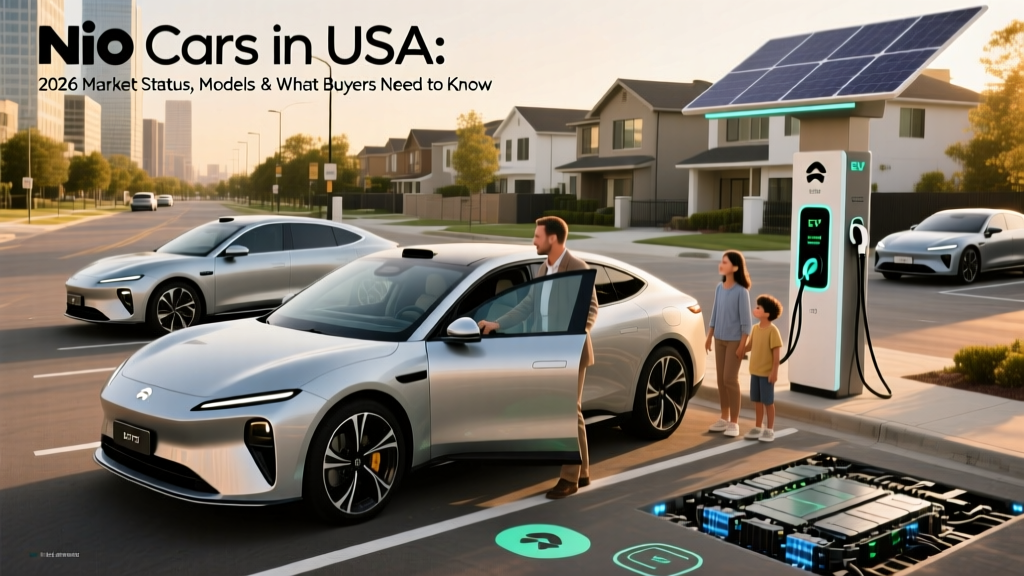
If you've been searching for Nio cars in USA showrooms, here's the honest answer as of early 2026: Nio has not yet launched retail vehicle sales in the United States. The Chinese premium EV maker — known for its battery-swap stations, NOMI AI assistant, and competitive pricing against Tesla and BMW — continues to focus its international expansion on Europe, the Middle East, and Southeast Asia.
That said, Nio remains one of the most closely watched EV brands by American enthusiasts, and the company has not ruled out a US entry. Below, we break down exactly where Nio stands, what models a US launch would likely include, the real-world specs you'd be getting, and which available alternatives make sense right now if you want a similar experience.
Why Nio Hasn't Entered the US Market (Yet)
Several intersecting factors explain Nio's US absence:
- Trade tariffs: The US imposed 100% tariffs on Chinese-made electric vehicles effective in 2024, making direct imports from Nio's Hefei manufacturing base economically unviable at current price points.
- Geopolitical friction: Ongoing US-China trade tensions, data-security scrutiny of connected vehicles, and national-security reviews create regulatory uncertainty for Chinese automakers.
- Infrastructure requirements: Nio's signature battery-swap model requires dedicated swap stations — a heavy infrastructure investment that's harder to justify without regulatory clarity.
- Strategic prioritization: Nio has chosen to build brand presence in Europe (Norway, Germany, Netherlands, Denmark, Sweden) and expand into markets like the UAE and Singapore before tackling the complex US landscape.
Nio CEO William Li has stated publicly that the US market remains on the company's long-term roadmap, but no concrete timeline or localized production plan has been announced as of 2026.
Nio's Current Global Lineup: Specs That Would Come to America
Based on Nio's current international portfolio, here are the models most likely to be candidates for a US launch, along with their verified specifications from Nio's European market offerings.
| Spec | Nio ET7 (Sedan) | Nio EL7 / ES7 (SUV) | Nio ET5 (Compact Sedan) | Nio EL8 / ES8 (Large SUV) |
|---|---|---|---|---|
| EPA-Est. Range | ~310 mi (est.)* | ~280 mi (est.)* | ~265 mi (est.)* | ~270 mi (est.)* |
| Battery (Standard) | 75 kWh (LFP/NMC hybrid) | 75 kWh (LFP/NMC hybrid) | 75 kWh (LFP/NMC hybrid) | 75 kWh (LFP/NMC hybrid) |
| Battery (Long Range) | 100 kWh (NMC) | 100 kWh (NMC) | 100 kWh (NMC) | 100 kWh (NMC) |
| Battery (Ultra Long) | 150 kWh (semi-solid-state) | 150 kWh (semi-solid-state) | N/A | 150 kWh (semi-solid-state) |
| Drivetrain | Dual-motor AWD | Dual-motor AWD | Dual-motor AWD | Dual-motor AWD |
| Horsepower | 644 hp | 644 hp | 483 hp | 670 hp |
| 0–60 mph | 3.8 sec | 3.9 sec | 4.3 sec | 4.1 sec |
| Max DC Charge | ~140 kW (75 kWh) / ~180 kW (100 kWh) | ~140 kW / ~180 kW | ~140 kW / ~180 kW | ~140 kW / ~180 kW |
| 10–80% DC Time | ~30 min (75 kWh) / ~34 min (100 kWh) | ~30–34 min | ~30–34 min | ~30–34 min |
| Level 2 Home | 7–11 kW (~25–37 mi/hr) | 7–11 kW | 7–11 kW | 7–11 kW |
| Cargo Volume | 17.7 cu ft (trunk) | 22.5 cu ft (rear seats up) | 14.8 cu ft (trunk) | 25.6 cu ft (rear seats up) |
| Length | 199.4 in | 193.5 in | 187.8 in | 200.1 in |
*Range figures are WLTP-based estimates converted to approximate EPA equivalents. Nio vehicles have not received official EPA certification. Real-world EPA numbers would likely be 10–15% lower than WLTP.
Nio's Battery-Swap System: A Unique Selling Point
Nio's most distinctive technology is its Battery as a Service (BaaS) model and Power Swap station network. Rather than waiting 30 minutes at a DC fast charger, Nio owners can drive into an automated swap station and receive a fully charged battery in approximately 3–5 minutes.
Key details about the swap ecosystem:
- Swap time: ~3–5 minutes (fully automated, driver stays in vehicle)
- Station count: Over 2,800 swap stations globally (primarily China, with ~50 in Europe as of 2026)
- BaaS pricing: In Europe, buyers can purchase the car without the battery (reducing upfront cost by €10,000–€21,000) and subscribe to a battery for approximately €99–€289/month depending on pack size
- Battery flexibility: Swap between 75 kWh, 100 kWh, and 150 kWh packs as needed — use the smaller pack for daily commuting and upgrade to the 150 kWh pack for road trips
For a US launch, Nio would need to build swap stations along major corridors — a capital-intensive process. However, this model could address two major American EV pain points simultaneously: charging time and battery-degradation anxiety, since you never own a degrading battery.
Charging Specs: How Nio Compares on Standard Plug-In
Even without swap stations, Nio vehicles support conventional plug-in charging. Here's how the charging speeds break down:
| Charging Level | 75 kWh Pack | 100 kWh Pack | Miles Added per Hour |
|---|---|---|---|
| Level 1 (120V, 12A) | ~1.4 kW | ~1.4 kW | ~4–5 mi/hr |
| Level 2 (240V, 32A) | 7.7 kW | 7.7 kW | ~25–28 mi/hr |
| Level 2 (240V, 48A) | 11 kW | 11 kW | ~35–38 mi/hr |
| DC Fast (Peak) | ~140 kW | ~180 kW | N/A |
| DC 10–80% | ~30 min | ~34 min | N/A |
Charging-curve reality check: Nio's peak DC rate is not sustained across the entire session. Expect peak rates between 10–50% State of Charge, with significant tapering above 70%. A 10–80% session on a 180 kW-capable charger will average around 100–120 kW sustained, which is competitive but not class-leading compared to Hyundai/Kia's E-GMP platform (which peaks at 240+ kW on 800V architecture) or the Lucid Air's ~300 kW capability.
Nio vehicles sold in Europe use the CCS2 connector. A US-market version would need either CCS1 or, increasingly likely given industry trends, the NACS (Tesla) connector, which has been adopted by Ford, GM, Rivian, Volvo, and others for the North American market.
Tech, Interior, and Driver Assistance
Nio positions itself as a premium tech-forward brand, and the cabin experience reflects that:
Infotainment & Connectivity
- Center display: 12.8-inch AMOLED (ET7/EL7) or 15.6-inch AMOLED (EL8)
- Instrument cluster: 10.2-inch digital display
- NOMI AI: A dashboard-mounted robotic companion with facial recognition, voice control, and contextual awareness — think a more interactive version of Siri/Alexa built into the car
- Audio: 23-speaker Dolby Atmos 7.1.4 system (ET7/EL8)
- PanoCinema: AR/VR glasses integration for passenger entertainment while parked
ADAS — Nio Aquila Super Sensing + Adam Super Computing
- 33 sensors including LiDAR (roof-mounted, 120° FOV, 500m detection range)
- 4x NVIDIA Orin X chips providing 1,016 TOPS of compute
- Nio Pilot / NOP+ (Navigate on Pilot Plus): highway lane changes, on/off-ramp navigation, adaptive cruise
Interior Space Highlights
- ET7 rear legroom: ~37.4 inches — competitive with the BMW 5 Series and Mercedes E-Class
- EL7 rear legroom: ~38.2 inches — generous for a midsize SUV
- Materials: Nappa leather, open-pore wood, recycled microfiber — premium execution on par with European rivals
- Frunk: Minimal or no front trunk on most models due to the front-mounted AC motor and HVAC components
Pricing, Tax Credits, and What a US Launch Would Cost
Because Nio is not sold in the US, there are no official MSRPs or IRS §30D tax credit eligibility determinations. However, we can project based on European pricing:
| Model | Europe Price (€) | Estimated US MSRP | §30D Credit Eligibility |
|---|---|---|---|
| Nio ET5 (75 kWh) | €47,500 | ~$48,000–$52,000 | Unknown — likely ineligible initially due to China battery sourcing |
| Nio ET7 (100 kWh) | €69,500 | ~$68,000–$75,000 | Sedan MSRP cap is $55,000 — likely ineligible |
| Nio EL7 (100 kWh) | €65,500 | ~$64,000–$70,000 | SUV MSRP cap is $80,000 — price may qualify; sourcing is the barrier |
| Nio EL8 (100 kWh) | €79,500 | ~$78,000–$85,000 | May exceed $80,000 SUV cap at higher trims |
The §30D tax credit reality: Even if Nio entered the US market, qualifying for the up-to-$7,500 federal EV tax credit would be an uphill battle. The IRS §30D rules require:
- Battery component sourcing: A percentage of battery components must be manufactured or assembled in North America (thresholds increase annually through 2029)
- Critical minerals: A percentage of critical minerals must be sourced from the US or free-trade-agreement partners
- Foreign Entity of Concern (FEOC) exclusion: Vehicles with battery components from a FEOC (which includes many Chinese suppliers) are disqualified entirely starting 2024 for components and 2025 for critical minerals
- MSRP caps: $55,000 for sedans; $80,000 for SUVs/pickups
- Buyer income caps: $150,000 single / $300,000 joint AGI
Given that Nio manufactures in China and sources batteries primarily from CATL (a Chinese company), federal tax credit eligibility would be extremely unlikely without significant supply-chain restructuring or a North American production facility.
Best Available Alternatives to Nio in the US
If Nio's blend of premium design, strong range, fast charging, and tech-forward cabin appeals to you, these currently available US-market EVs deliver a similar experience:
✅ Choose a Tesla Model S if:
You want a premium electric sedan with 405 miles of EPA range, Supercharger network access, and 0–60 in 3.1 seconds. Starting at ~$74,990. The closest analog to the Nio ET7 in the US market.
✅ Choose a BMW iX if:
You want a luxury midsize electric SUV with 307–324 EPA miles, premium materials, and ~200 kW DC fast-charging. Starting at ~$87,250. Comparable to the Nio EL8 in size and positioning.
✅ Choose a Genesis GV60 if:
You want a tech-forward compact luxury SUV with an 800V architecture, 248–294 EPA miles, and ~240 kW peak DC charging. Starting at ~$53,350. Similar premium-tech philosophy to Nio.
✅ Choose a Lucid Air if:
Range is your top priority. The Lucid Air Pure delivers 419 EPA miles and ~300 kW DC fast charging. Starting at ~$69,900. Outperforms the ET7 on efficiency metrics.
Frequently Asked Questions
Can I buy a Nio car in the United States in 2026?
No. Nio does not currently sell vehicles in the US, and no official launch date has been announced. The company's current international focus is on European and Middle Eastern markets.
Will Nio ever come to America?
Nio's CEO has indicated the US is on the long-term roadmap, but 100% tariffs on Chinese-made EVs and battery-sourcing requirements for tax credits present significant barriers. A US entry would likely require localized manufacturing or a partnership — neither of which has been announced.
How does Nio's battery swap compare to DC fast charging?
A battery swap takes 3–5 minutes versus 25–35 minutes for a 10–80% DC fast-charge session. The swap model also eliminates battery-degradation concerns since you don't own the battery. However, swap stations require dedicated infrastructure that doesn't exist in the US, while DC fast chargers are widely available.
What connector would Nio use in the US?
Nio currently uses CCS2 in Europe. For a US launch, the most likely scenario in 2026 would be adoption of the NACS (Tesla) connector, given that Ford, GM, Rivian, Volvo, Polestar, Mercedes, and others have committed to NACS for North America. CCS1 remains possible but increasingly unlikely for a new market entrant.
Would Nio vehicles qualify for the $7,500 federal EV tax credit?
Almost certainly not under current rules. The IRS §30D credit requires battery components and critical minerals to be sourced outside of Foreign Entities of Concern (FEOC), which includes most Chinese battery suppliers like CATL. Without a North American supply chain, Nio vehicles would be disqualified regardless of MSRP or buyer income.
What is Nio's battery warranty in markets where it's sold?
In Europe, Nio offers a 6-year/93,000-mile (150,000 km) vehicle warranty and an 8-year/100,000-mile (160,000 km) battery warranty with a minimum 70% capacity retention guarantee. BaaS subscribers have additional protection since the battery is leased, not owned.
Is Nio's NOMI AI assistant similar to Tesla's voice commands?
NOMI goes further than typical voice assistants. It's a physical, animated robot sphere on the dashboard that tracks who's speaking via facial recognition, displays expressions, and can control nearly every vehicle function via natural-language voice commands. It's closer to a personalized concierge than a simple voice interface, though its practical utility varies by user preference.