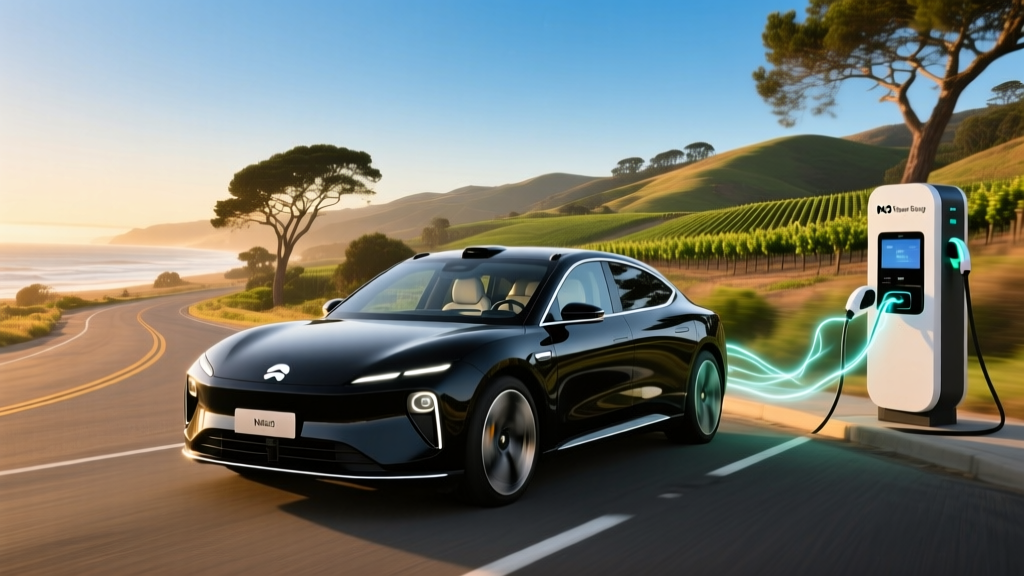
If you have been following the Chinese EV market, you already know Nio is one of its most ambitious players. The Shanghai-based automaker has built a reputation on battery-swap technology, premium interiors, and a growing lineup of sedans and SUVs that rival Tesla, BMW, and Mercedes-Benz on paper. But for US-based shoppers — especially those in the largest EV market in the country — the persistent question remains: Can you actually buy a Nio in California?
As of early 2026, the short answer is no. Nio has not launched retail sales in the United States, and no Nio vehicle is currently available for purchase or order from a California dealership or direct-to-consumer channel. However, the company has made incremental moves toward a global expansion that could eventually include North America, and its current vehicle lineup tells an important story about what American buyers might get — and what they would be giving up.
This guide breaks down Nio's current status in the US market, profiles the models most likely to arrive first, and provides the hard specs, charging data, and ownership economics you need to evaluate whether waiting for Nio makes sense versus buying an EV that is already on sale in California today.
Nio's US Launch Status: Where Things Stand in 2026
Nio has been publicly discussing a US market entry since at least 2021, when CEO William Li confirmed the company was studying the American market. As of 2026, Nio's international footprint includes China, Norway, Germany, the Netherlands, Denmark, Sweden, and Austria — but the United States remains conspicuously absent.
Several factors explain the delay:
- Geopolitical tariff risk: US tariffs on Chinese-manufactured vehicles reached 100% in 2024 under Section 301 actions, effectively doubling the landed cost of any Chinese-built EV sold in America. This tariff structure has not been reversed as of 2026.
- Battery-swap infrastructure: Nio's signature differentiator — swapping a depleted battery for a fully charged one in under five minutes — requires a proprietary network of swap stations. Building this network in California alone would demand hundreds of millions in investment before a single car is sold.
- Federal tax credit ineligibility: Under current IRS §30D rules, a vehicle assembled in China with a battery containing Chinese-sourced critical minerals cannot qualify for the $7,500 federal EV tax credit. This puts Nio at a significant pricing disadvantage versus domestically assembled competitors.
- Regulatory homologation: US-market vehicles must meet Federal Motor Vehicle Safety Standards (FMVSS), which differ from the UNECE standards used in Europe and China. Adapting Nio's platform for FMVSS compliance requires engineering changes that add cost and time.
Nio has not announced a firm US launch date. Industry analysts have projected a possible entry in 2027 or 2028, potentially through a localized assembly partnership or a sub-brand (Nio's more affordable "Firefly" and "Onvo" brands have been positioned for global markets). Until then, California shoppers cannot purchase, lease, or test-drive any Nio model.
Models Most Likely to Reach California: ET7 Sedan and EL7 SUV
Based on Nio's European rollout strategy and public statements, two models are the strongest candidates for a US debut: the ET7 executive sedan and the EL7 (known as the ES7 in China) midsize SUV. Here is what their current specifications look like based on the latest European and Chinese market data.
| Specification | Nio ET7 (Long Range) | Nio EL7 (Long Range) |
|---|---|---|
| Battery Capacity | 100 kWh usable (NMC) | 100 kWh usable (NMC) |
| WLTP Range | ~367 miles (590 km) | ~311 miles (500 km) |
| Estimated EPA Range* | ~300–320 miles | ~260–280 miles |
| Drivetrain | Dual-motor AWD | Dual-motor AWD |
| Horsepower | 644 hp | 644 hp |
| 0–60 mph | 3.8 seconds | 3.9 seconds |
| Max DC Fast Charge | ~130 kW (100 kWh pack) | ~130 kW (100 kWh pack) |
| 10–80% DC Charge Time | ~35 minutes | ~35 minutes |
| Level 2 Home Charging | Up to 7 kW (AC) | Up to 7 kW (AC) |
| Battery Swap | Yes (Nio Power Swap) | Yes (Nio Power Swap) |
| Cargo Volume | ~17.7 cu ft (trunk) | ~21.5 cu ft (rear seats up) |
| Starting Price (Europe, est.) | ~€81,900 (~$89,000) | ~€74,900 (~$81,500) |
*EPA range estimates are projected based on typical WLTP-to-EPA conversion ratios (EPA is generally 15–20% lower than WLTP). Final EPA figures would be published only after US homologation.
Battery-Swap Technology: Nio's Biggest Differentiator
Nio's Power Swap system is the single feature that most distinguishes it from every other EV brand. Instead of plugging in and waiting 20–40 minutes at a DC fast charger, a Nio owner can drive into an automated swap station and have their depleted battery replaced with a fully charged one in approximately 3–5 minutes.
The advantages are significant:
- Speed: A swap is faster than even a 350 kW DC fast-charge session for most EVs.
- Battery longevity: Nio manages the battery fleet centrally, retiring degraded packs and ensuring owners always receive a healthy unit. This eliminates individual battery-degradation anxiety.
- Upgradeability: Nio owners can subscribe to larger battery packs for road trips (e.g., swapping a 75 kWh pack for a 100 kWh pack temporarily) and return to a smaller pack for daily commuting.
- BaaS pricing model: In some markets, Nio sells vehicles without the battery (Battery as a Service), reducing the purchase price by approximately $14,000–$18,000 and replacing it with a monthly subscription fee of ~$140–$170.
The challenge for California is infrastructure. Nio operates over 2,700 swap stations globally, almost entirely in China, with a small number in Europe. California would need a meaningful network — likely 50+ stations in major metro areas and along freeway corridors — before battery swap becomes a practical advantage. Building that network without an installed vehicle base is a classic chicken-and-egg problem.
If Nio launches in the US, it would almost certainly debut in California first, given the state's EV adoption rate, charging infrastructure density, and regulatory alignment. But swap stations would likely follow the vehicle launch, not precede it — meaning early US adopters would rely on conventional plug-in charging.
Charging Specs: What California Buyers Should Expect
Without battery swap, Nio's plug-in charging performance becomes the primary concern. Here is how the ET7 and EL7 compare to established competitors on conventional charging:
| Vehicle | Battery (kWh) | Peak DC kW | 10–80% Time | Connector |
|---|---|---|---|---|
| Nio ET7 (100 kWh) | 100 | ~130 kW | ~35 min | CCS2 (EU) / GB/T (CN) |
| Tesla Model S (2026) | 100 | 250 kW | ~20 min | NACS |
| BMW i5 eDrive40 | 84.3 | 205 kW | ~22 min | CCS1 / NACS |
| Lucid Air Pure | 88 | 200+ kW | ~20 min | CCS1 / NACS |
| Mercedes EQE 350+ | 90.6 | 170 kW | ~32 min | CCS1 / NACS |
Nio's peak charge rate of approximately 130 kW on the 100 kWh pack is modest by 2026 standards. The Hyundai Ioniq 6, for comparison, peaks at 240 kW on its 77.4 kWh pack and reaches 10–80% in about 18 minutes. Nio's charging architecture uses a 400V system, while competitors like the Porsche Taycan, Hyundai/Kia E-GMP vehicles, and the Lucid Air use 800V architectures that enable faster sustained charging.
For California home charging, Nio's 7 kW AC onboard charger would add roughly 25–30 miles of range per hour on a Level 2 home charger (240V, 32A). This is adequate for overnight replenishment but slower than competitors offering 11 kW or 19.2 kW onboard chargers.
Pricing, Tax Credits, and the California Cost Reality
Because Nio is not currently sold in the US, there is no official MSRP. Based on European pricing and adding typical US import costs, here is a projected price range:
| Model | Estimated US MSRP | Federal Tax Credit (§30D) | Effective Price |
|---|---|---|---|
| Nio ET7 (100 kWh) | $85,000–$95,000 | $0 (not eligible) | $85,000–$95,000 |
| Nio EL7 (100 kWh) | $78,000–$88,000 | $0 (not eligible) | $78,000–$88,000 |
| Nio ET7 (75 kWh, base) | $68,000–$75,000 | $0 (not eligible) | $68,000–$75,000 |
California does offer its own Clean Vehicle Rebate Project (CVRP) and various utility incentives, but these programs have their own eligibility requirements and funding limitations. California's CVRP, for instance, has historically required vehicles to be on an approved list and has faced funding pauses. A Chinese-assembled Nio would need to navigate these state-level requirements independently.
Standout Technology and Notable Drawbacks
Nio vehicles are loaded with technology that would be competitive in the California luxury EV market — if they were available:
What Stands Out
- NOMI AI assistant: A dashboard-mounted robotic "companion" with facial recognition, voice control, and contextual responses — more personality-driven than Siri or Google Assistant integrations.
- 150 kWh semi-solid-state battery option (China only): Nio is one of the first automakers to offer a semi-solid-state battery pack, providing over 620 miles of WLTP range. This technology could eventually reach export markets.
- 7.1.4 Dolby Atmos sound system: 23 speakers with immersive spatial audio, competitive with the best systems from Burmester (Mercedes) and Bowers & Wilkins (BMW).
- Aquila super-sensing system: 33 sensors including a 120-line lidar, 11 cameras, 5 millimeter-wave radars, and 12 ultrasonic sensors — supporting Nio's NOP+ (Navigate on Pilot Plus) driver-assist system.
- Battery-as-a-Service (BaaS): The option to buy the car without the battery and subscribe monthly could lower the upfront purchase price significantly, if offered in the US.
Notable Drawbacks
- Slow DC charging for the segment: 130 kW peak on a 100 kWh pack means longer road-trip stops than a Tesla Model S, Lucid Air, or Hyundai Ioniq 6.
- No NACS connector: Nio currently uses CCS2 in Europe and GB/T in China. A US model would need either CCS1 or NACS. With the industry rapidly adopting NACS (Tesla's standard), Nio would need to commit to a connector strategy for the US market.
- Driver assist is SAE Level 2: Nio's NOP+ is a supervised driver-assist system — not autonomous driving. The driver must remain engaged, hands on or near the wheel, at all times.
- Unproven US service network: Luxury EV buyers expect accessible service centers. Nio would need to build a US service and parts infrastructure from scratch.
- Resale value uncertainty: Without US sales history, projected depreciation is unknown — a significant risk for buyers planning to sell or trade within 3–5 years.
Pros
- Battery swap eliminates charging wait (if stations exist)
- Strong dual-motor AWD performance (644 hp, sub-4-sec 0–60)
- Premium interior with NOMI AI and Dolby Atmos audio
- Available semi-solid-state battery (future-proof potential)
- BaaS model could reduce upfront cost by $14K–$18K
- Comprehensive sensor suite with lidar standard
Cons
- Not available in the US — cannot purchase in 2026
- Peak DC charge rate of ~130 kW is slow for the price point
- Would not qualify for $7,500 federal tax credit
- No US service network or parts supply chain
- Resale value completely unproven
- Battery swap infrastructure would take years to build in California
- 100% tariff on Chinese-built vehicles inflates pricing
Should You Wait for Nio or Buy a Competitor Now?
For California EV shoppers considering Nio, the practical decision is whether the brand's technology and design justify waiting for an uncertain US launch — or whether a currently available competitor better serves your needs today.
Decision Framework
Buy a Tesla Model S or Lucid Air now if: You want a premium electric sedan with proven California charging infrastructure, NACS access, strong DC fast-charging speeds (200–250 kW), and a service network you can rely on. Both vehicles are available today, qualify for varying incentives depending on trim and sourcing, and have established resale value data.
Buy a BMW i5 or Mercedes EQE now if: You prefer traditional luxury-brand build quality, dealer service relationships, and a European driving feel. Both offer competitive range (250–300 miles EPA), faster DC charging than Nio's current architecture, and are available with NACS adapters or native NACS ports in 2026.
Wait for Nio if: You are specifically interested in battery-swap technology as a long-term ownership strategy, you are willing to be an early adopter with an unproven US brand, and you have reliable home charging to compensate for the initially sparse swap-station network. Be prepared to pay a premium without federal tax credit support and to accept higher depreciation risk.
Warranty and Long-Term Ownership Outlook
Nio's European warranty structure provides a useful reference for what US buyers might expect:
- Vehicle limited warranty: 6 years / 93,000 miles (150,000 km) in Europe
- Battery warranty: 8 years / 100,000 miles (160,000 km) with a minimum 70% state-of-health retention threshold — competitive with the industry standard of 8 years/100,000 miles at 70% capacity
- BaaS subscribers: Battery health is Nio's responsibility; degraded packs are rotated out of the swap fleet, so subscribers always receive a functional unit
The BaaS model has an interesting implication for battery longevity: because Nio centrally manages thousands of batteries through its swap stations, the company can monitor cell health at scale, balance charging to minimize degradation, and retire packs before they fall below acceptable thresholds. This is a structural advantage over ownership models where a single battery bears all of one driver's charging habits.
However, US warranty terms would need to be finalized before launch, and California's consumer protection laws (including the California Air Resources Board emissions warranty requirements) could mandate additional coverage.
Frequently Asked Questions
Can I buy a Nio in California right now?
No. As of 2026, Nio does not sell vehicles in the United States. There are no Nio dealerships, direct-sales showrooms, or online ordering channels available to California residents. The company's current markets are limited to China and select European countries.
When will Nio launch in the US?
Nio has not announced a specific US launch date. CEO William Li has acknowledged the US market is under study, but the combination of 100% tariffs on Chinese vehicles, battery-sourcing tax credit restrictions, and the cost of building a swap-station and service network have delayed entry. Industry estimates suggest 2027–2028 at the earliest, with no official confirmation.
Would a Nio qualify for the $7,500 federal EV tax credit?
Almost certainly not under current rules. The IRS §30D credit requires North American final assembly, battery critical-mineral sourcing from approved trade partners, and MSRP caps ($55,000 for sedans, $80,000 for SUVs). Nio vehicles are assembled in China, use CATL batteries with Chinese-sourced minerals, and several trims exceed MSRP thresholds. Even a future US-assembled Nio would face the battery-sourcing hurdle.
How does Nio's battery swap compare to DC fast charging?
A Nio battery swap takes approximately 3–5 minutes, which is faster than any DC fast-charge session currently available. However, swap requires proprietary infrastructure that does not exist in the US. On a conventional plug, Nio's ~130 kW peak charge rate is slower than competitors — a Tesla Model S at a V3 Supercharger (250 kW) or a Hyundai Ioniq 6 at a 350 kW Electrify America station will charge significantly faster.
What is the real-world range of the Nio ET7?
The ET7's WLTP rating is 367 miles on the 100 kWh pack. The EPA equivalent would likely be approximately 300–320 miles. In real-world highway driving at 70+ mph, expect 260–280 miles. In cold weather (below 40°F), that figure drops to approximately 210–240 miles. These are projections based on WLTP-to-EPA conversion patterns; official EPA numbers would only be available after US homologation.
Is Nio's NOP+ driver assist self-driving?
No. Nio's NOP+ (Navigate on Pilot Plus) is an SAE Level 2 driver-assist system. It can manage steering, acceleration, and braking on highways under certain conditions, but the driver must remain fully engaged and prepared to take over at any time. It is not autonomous driving. Only Level 4 services like Waymo's robotaxi operate without a human driver in defined geographic zones.
What connector would Nio use in the US?
Nio has not confirmed a US connector strategy. In Europe, Nio uses CCS2. In China, it uses GB/T. For the US market, the choice would be between CCS1 and NACS (the Tesla-originated standard now adopted by Ford, GM, Rivian, Hyundai, and others). Given the industry's rapid shift to NACS and Tesla Supercharger network access, NACS would be the strategically sound choice — but no commitment has been made.