Nikola Tre BEV Drive Modes: What Eco and Sport Actually Change
The Nikola Tre BEV is a Class 8 battery-electric semi-truck built for regional drayage and short-haul freight — not a consumer pickup or commuter car. When fleet operators and commercial drivers search for "Nikola Tre BEV drive modes Eco Sport," they're looking for practical answers: how much range does Eco mode recover, does Sport mode cost efficiency, and which setting makes sense for a loaded 80,000-lb GCW run? This review breaks down the Tre BEV's powertrain calibration, real-world energy consumption across drive modes, charging behavior, and total cost of ownership for the 2025–2026 model years.
Unlike passenger EVs where Eco/Sport toggles adjust throttle mapping and steering weight, the Tre BEV's drive modes primarily recalibrate regenerative braking intensity, torque delivery curves, and thermal management thresholds. In a Class 8 application, these differences compound over hundreds of stop-start drayage cycles or sustained highway pulls — directly affecting kWh/mile consumption and depot charging schedules.
Spec Table: Nikola Tre BEV at a Glance
| Specification | Value |
|---|---|
| Battery Capacity | ~169 kWh usable (NMC lithium-ion) |
| EPA Estimated Range | Up to 330 miles (unladen, optimal conditions) |
| Real-World Range (loaded, highway) | ~150–200 miles at 80,000 lb GCW |
| Motor Output | 485 hp (362 kW) continuous / ~645 hp peak |
| Torque | ~1,400 lb-ft at wheels (via 2-speed transmission) |
| Drivetrain | 4x2 (single rear axle, RWD) |
| 0-60 mph (unladen) | ~12 seconds (governed to ~65 mph) |
| Max DC Fast Charge Rate | ~175 kW peak (CCS1) |
| 10–80% DC Charge Time | ~90–120 minutes |
| Level 2 / Depot AC Charge | ~19.2 kW (adds ~30–40 miles/hr) |
| Efficiency (Eco mode, mixed) | ~2.0–2.2 kWh/mile |
| Efficiency (Sport mode, loaded) | ~2.6–3.0 kWh/mile |
| GVWR | ~22,000 lb (tractor) / 82,000 lb GCW max |
| Wheelbase Options | 158", 174", 192" |
| Battery Warranty | 8 years / 500,000 miles (70% capacity retention) |
| Base MSRP (estimated) | ~$280,000–$320,000 (pre-incentives) |
Real-World Range: EPA Sticker vs. Loaded Highway Reality
The 169 kWh NMC battery pack sits between the frame rails, providing a low center of gravity. NMC chemistry was chosen for its higher energy density compared to LFP — critical in a weight-sensitive Class 8 application where every pound of battery reduces available payload. However, NMC cells require more aggressive thermal management than LFP, which is why the Tre BEV's liquid cooling system draws measurable parasitic load during extreme-temperature operations.
Drive mode impact on range is significant in this platform. In Eco mode, the regenerative braking system is calibrated to capture maximum kinetic energy during deceleration — particularly valuable in port drayage where trucks cycle between 0–35 mph dozens of times per shift. Fleet testing has shown Eco mode can recover 18–25% more energy than Sport mode in stop-and-go operations, translating to roughly 20–40 additional miles of range over a full shift.
Eco vs. Sport: How Each Drive Mode Changes the Truck
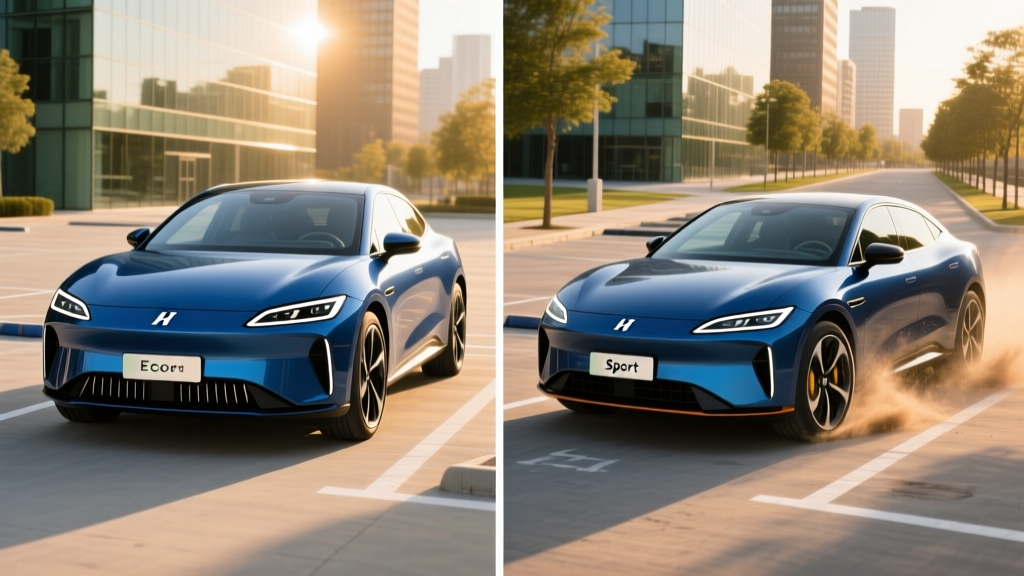
Eco Mode: Efficiency-First Calibration
Eco mode on the Tre BEV prioritizes energy conservation through several coordinated systems:
- Aggressive regenerative braking: Near one-pedal driving behavior at low speeds; lifting off the accelerator provides strong deceleration that feeds energy back into the 169 kWh pack.
- Smoothed torque delivery: Peak torque is ramped in progressively rather than delivered instantaneously, reducing tire slip and energy waste during heavy-load launches.
- Thermal management optimization: Cabin HVAC and battery cooling operate on conservative schedules, reducing parasitic draw from the traction battery.
- Speed governor adjustment: Top speed may be limited to ~60 mph in some fleet configurations, reducing aerodynamic drag (which increases with the square of velocity).
Sport Mode: Performance-Priority Calibration
Sport mode — sometimes labeled "Power" in Nikola's fleet configuration menus — is designed for situations demanding maximum responsiveness:
- Reduced regen intensity: Allows freer coasting and more natural deceleration feel, preferred by drivers transitioning from diesel trucks who find aggressive regen disorienting.
- Immediate torque availability: Full motor torque is accessible with minimal pedal travel, useful for merging onto highways with heavy loads or climbing grades.
- Active thermal management: Battery and motor cooling run at higher capacity to sustain peak power output during sustained high-load operation.
- Higher speed ceiling: Governed speed raised to ~65–68 mph where permitted.
Which mode should fleet operators default to? For typical port drayage and urban delivery routes with average speeds under 40 mph, Eco mode delivers measurably lower kWh/mile consumption. For highway-heavy regional routes with sustained 60+ mph cruising and fewer regen opportunities, the efficiency gap narrows — and Sport mode's improved drivability may reduce driver fatigue without dramatically increasing energy consumption.
Charging Speed: Depot and DC Fast-Charging Breakdown
| Charging Method | Power (kW) | Miles Added/Hour | 10–80% Time |
|---|---|---|---|
| Level 1 (120V, emergency) | ~1.4 kW | ~2–3 mi/hr | Not practical |
| Depot AC (Level 2, 19.2 kW) | 19.2 kW | ~30–40 mi/hr | ~6–8 hours |
| DC Fast Charge (CCS1, peak) | ~175 kW | ~180–220 mi/hr (initial) | ~90–120 min |
| DC Fast Charge (sustained avg) | ~110–130 kW | ~120–150 mi/hr | — |
The Tre BEV's charging profile reflects the realities of large-format NMC battery packs. While the peak DC fast-charge rate of ~175 kW is competitive for Class 8, the sustained rate matters more. Like all lithium-ion packs, the Tre BEV's charge curve tapers significantly above 80% State of Charge (SoC) to protect cell longevity. Fleet operators planning mid-shift top-ups should budget for 90–120 minutes at a CCS1-equipped truck charging station to go from 10% to 80%.
Depot charging is where most Tre BEV operations live. A 19.2 kW AC connection — standard for commercial depot installations — fully replenishes the 169 kWh pack overnight in roughly 8–10 hours. For high-utilization fleets running two shifts, installing multiple 19.2 kW chargers with smart load management software is typically more cost-effective than relying on public DC fast-charging infrastructure, which remains sparse for Class 8 vehicles outside major freight corridors.
The Nikola Tre BEV product page details connector placement on the driver's side, with CCS1 as the standard connector for the North American market. Nikola has indicated future NACS compatibility planning, but as of the 2025–2026 model year, CCS1 remains the primary interface.
Pricing, Tax Credits, and Total Cost of Ownership
The Nikola Tre BEV carries a base price estimated between $280,000 and $320,000 depending on wheelbase, battery configuration, and fleet options — a significant premium over a comparable Class 8 diesel tractor ($140,000–$180,000). However, the commercial EV incentive landscape substantially alters the math.
5-Year Operating Cost Comparison (Estimated)
| Cost Category | Diesel Tractor | Nikola Tre BEV |
|---|---|---|
| Fuel/Energy (60,000 mi/yr) | ~$54,000 | ~$18,000 (at $0.15/kWh depot) |
| Maintenance | ~$12,000 | ~$4,000 |
| DEF / Fluids | ~$2,500 | $0 |
| Annual Total | ~$68,500 | ~$22,000 |
| 5-Year Operating Savings | — | ~$232,500 |
At typical depot electricity rates of $0.12–$0.18/kWh, the Tre BEV's energy cost per mile drops to roughly $0.30–$0.45, compared to $0.80–$1.10/mile for diesel at current fuel prices. Over a 5-year, 300,000-mile lifecycle, energy and maintenance savings can offset $200,000+ of the purchase premium — before incentives.
Who the Nikola Tre BEV Suits Best
This is not a long-haul truck. The Tre BEV is purpose-built for specific duty cycles:
- Port drayage operators: Short, repetitive routes with frequent stops where regenerative braking maximizes energy recovery and the 150–200 mile real-world range comfortably covers a full shift.
- Regional distribution fleets: Hub-and-spoke routes under 150 miles with overnight depot charging — especially in states with ZEV mandates (California, New York, New Jersey) where zero-emission truck compliance is accelerating.
- Urban delivery and refuse-adjacent operations: Where noise restrictions, idling emissions rules, and municipal clean-air zones favor electric drivetrains.
Fleets operating long-haul routes exceeding 250 miles between charging opportunities should evaluate hydrogen fuel-cell alternatives (including Nikola's own Tre FCEV) or wait for next-generation battery packs with higher energy density.
Pros and Cons: Honest Assessment
- Zero tailpipe emissions — critical for port and urban compliance
- Strong regen recovery in Eco mode adds real range in drayage
- Dramatically lower fuel and maintenance costs vs. diesel
- Up to $40,000 federal §45W credit + substantial state incentives
- Quiet operation reduces driver fatigue and meets noise ordinances
- 8-year/500,000-mile battery warranty provides fleet confidence
- 150–200 mile real-world loaded range limits route flexibility
- 90–120 minute DC fast-charge time requires schedule planning
- ~$280K–$320K base price is roughly 2x a diesel equivalent
- Public CCS1 truck charging infrastructure remains very limited
- Cold-weather range loss of 15–25% impacts northern-climate fleets
- Nikola's financial stability has been a concern — monitor closely
- NMC battery requires active thermal management (parasitic draw)
Technology, Cab Features, and Driver-Assist Systems
The Tre BEV's cab is derived from the Iveco S-Way platform (a Nikola partnership legacy), offering a modern, car-like interior unusual in Class 8:
- 15-inch touchscreen infotainment with navigation, route planning, and real-time energy consumption display.
- Digital instrument cluster showing SoC, kWh/mile, regen contribution, and drive-mode status.
- ADAS suite: Forward collision warning, automatic emergency braking, lane departure warning, and adaptive cruise control. These are SAE Level 1–2 driver-assist features — the driver must remain fully engaged at all times.
- Over-the-air (OTA) updates: Nikola deploys firmware updates that can adjust drive-mode calibrations, thermal management strategies, and battery management parameters remotely.
- Fleet telematics integration: Real-time vehicle data accessible through Nikola's fleet management portal, enabling dispatchers to monitor SoC, route efficiency, and drive-mode usage across their fleet.
Notable drawback: the driver's seat and suspension have drawn mixed reviews from operators accustomed to premium Freightliner or Volvo cabs. For 10-hour shifts, seat comfort matters — and some fleets report upgrading aftermarket.
Frequently Asked Questions
What is the real-world range of the Nikola Tre BEV?
While Nikola and EPA testing suggest up to 330 miles under ideal drayage conditions, real-world operations at 80,000 lb GCW on highway routes yield 150–200 miles. Eco mode in stop-and-go port operations pushes toward the upper end; Sport mode on hilly highway routes with a full load pulls toward the lower end. Cold weather below freezing reduces range by an additional 15–25%.
How fast does the Tre BEV charge?
At a DC fast charger, the Tre BEV peaks at approximately 175 kW via CCS1, achieving a 10–80% charge in roughly 90–120 minutes. Depot AC charging at 19.2 kW fully replenishes the pack in 8–10 hours — the standard overnight strategy for most fleet operators.
Does the Nikola Tre BEV qualify for federal EV tax credits?
Yes, but under IRC §45W (Commercial Clean Vehicle Credit), not the consumer §30D credit. Eligible commercial purchasers can claim up to $40,000 per vehicle. There is no MSRP cap or buyer income cap, but the vehicle must be used for business purposes and meet battery component sourcing requirements. Always verify current-year rules at IRS.gov and consult a tax professional.
Is Eco mode always better for fleet efficiency?
For drayage and urban routes, yes — Eco mode's aggressive regen recovers significantly more energy in stop-and-go conditions. For highway-dominant routes with fewer deceleration events, the efficiency gap narrows, and some drivers prefer Sport mode's more natural coasting behavior and responsive torque delivery for merging and grade climbing.
How does the Tre BEV compare to diesel competitors?
Against Class 8 diesels from Freightliner, Volvo, and Peterbilt, the Tre BEV offers dramatically lower per-mile operating costs and zero tailpipe emissions but trades off range, refueling speed, and upfront price. The breakeven point for most fleets falls between years 3–5 of operation, depending on mileage, electricity costs, and incentive stacking.
What about the Nikola Tre FCEV (hydrogen) alternative?
For routes exceeding 300 miles or operations where downtime for charging is unacceptable, Nikola's Tre FCEV hydrogen fuel-cell variant offers 500+ mile range and ~20-minute refueling. However, hydrogen fueling infrastructure is far more limited than electric charging, and fuel costs per mile are typically higher than depot electricity.