If you've typed "Nikola Tesla signature" into a search bar hoping to find a special-edition electric vehicle, you aren't alone. The phrase pulls in curious shoppers every month, blending the name of the AC-inventing pioneer with the brand that dominates today's EV market. But here's the data-driven reality: there is no "Nikola Tesla Signature Edition" vehicle — not from Tesla, Inc., not from Nikola Corporation, and not from any other automaker as of the 2026 model year.
What exists is a fascinating collision of two companies, one legendary surname, and a lot of internet confusion. Below, we untangle the myth, explain what each company actually sells in 2026, and redirect you to the real EVs that best honor Nikola Tesla's engineering legacy — complete with the EPA range, kWh, charge rates, and pricing you need to make a purchase decision.
The "Nikola Tesla Signature" Confusion Explained
Two publicly traded companies carry pieces of the Nikola Tesla name, and their overlap fuels the search:
- Tesla, Inc. — the Elon Musk-led automaker producing the Model 3, Model Y, Model S, Model X, and Cybertruck. The company is named after Nikola Tesla, specifically referencing his AC induction motor patents.
- Nikola Corporation — the Phoenix-based startup founded in 2015, named for Nikola Tesla, which focused on hydrogen fuel-cell and battery-electric Class 8 semi trucks (the Nikola Tre and Nikola Two). Nikola filed for Chapter 11 bankruptcy in early 2025 and ceased vehicle production.
Neither company has ever released a "Signature" trim or special edition bearing Nikola Tesla's actual signature. The keyword likely stems from a mix of AI-generated concept renders, speculative forum posts, and simple name conflation. As of 2026, no production vehicle carries this badge, and Tesla's official model lineup lists no such variant.
What Tesla Actually Sells in 2026: The Real Lineup
If you're chasing a premium Tesla that feels "signature-worthy" — something that captures the spirit of the inventor — here's where the 2026 lineup stands, with exact specs:
| Model | EPA Range | Battery (kWh / Chemistry) | 0-60 mph | HP | Base MSRP |
|---|---|---|---|---|---|
| Model 3 Long Range AWD | 341 mi | 79 kWh / NMC | 4.2 sec | 346 | $47,740 |
| Model 3 Performance | 315 mi | 79 kWh / NMC | 2.9 sec | 510 | $54,990 |
| Model Y Long Range AWD | 320 mi | 78 kWh / NMC | 4.8 sec | 384 | $48,990 |
| Model S Long Range | 402 mi | 100 kWh / NMC | 3.1 sec | 670 | $79,990 |
| Model S Plaid | 359 mi | 100 kWh / NMC | 1.99 sec | 1,020 | $89,990 |
Sources: fueleconomy.gov, Tesla.com. MSRP excludes destination fee and any applicable incentives.
Charging Speed: What the Numbers Actually Mean
A common mistake in EV shopping is looking only at peak kW without understanding the charge curve. Tesla's V4 Superchargers can deliver up to 350 kW, but no current Tesla vehicle sustains that rate for a full session. Here's what you'll see in practice:
| Charging Level | Power (kW) | Speed (miles of range added) | Notes |
|---|---|---|---|
| Level 1 (120V household) | ~1.4 kW | ~3-5 mi/hr | Emergency/top-up only |
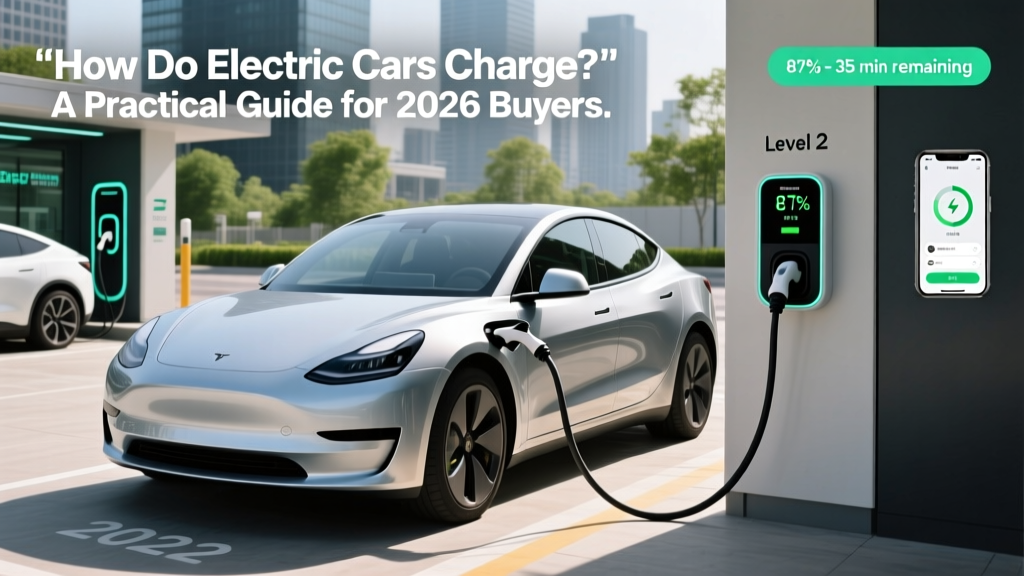
| Level 2 (240V home Wall Connector) | 11.5 kW | ~44 mi/hr | Full charge overnight (~8 hrs) |
| DC Fast Charge (V3 Supercharger) | Peak 250 kW | 10-80% in ~25 min | Sustains ~150 kW avg through 60% |
| DC Fast Charge (V4 Supercharger) | Peak 250+ kW | 10-80% in ~22 min | Model 3 architecture caps below 350 kW |
The critical insight: kW is power (how fast energy flows), and kWh is energy (the battery's total capacity). A 250 kW charger doesn't deliver 250 kW the entire session — the rate tapers as the battery approaches full to protect cell health. Expect an average of 130-150 kW across a 10-80% session on a V3 Supercharger.
Federal Tax Credit Eligibility (§30D Rules for 2026)
Not every Tesla qualifies for the full $7,500 federal tax credit under IRS §30D. Eligibility depends on three intersecting requirements:
- MSRP cap: Sedans (Model 3, Model S) must have an MSRP at or below $55,000. SUVs/trucks (Model Y, Model X, Cybertruck) cap at $80,000.
- Buyer income cap: Modified AGI must not exceed $150,000 (single), $225,000 (head of household), or $300,000 (married filing jointly).
- Battery sourcing: A percentage of critical minerals and battery components must be sourced from the U.S. or free-trade-agreement countries. These thresholds tighten annually.
As of early 2026, the Model 3 Long Range ($47,740 MSRP) and Model Y Long Range ($48,990 MSRP) have generally qualified for the full $7,500 credit when purchased by income-eligible buyers — and the credit can be transferred at the point of sale to reduce the purchase price directly. The Model S exceeds the $55,000 sedan cap and does not qualify. Always verify current eligibility on fueleconomy.gov before purchasing, as sourcing compliance can shift with supply-chain changes.
The Nikola Corporation Story: What Happened
For readers who landed on this search thinking of Nikola Corporation — the hydrogen and battery truck maker — here's the sobering update. After a high-profile SPAC merger in 2020, a fraud conviction of founder Trevor Milton, and years of production delays, Nikola Corporation filed for Chapter 11 bankruptcy protection in early 2025. The company produced fewer than 500 trucks total across its Tre BEV and hydrogen fuel-cell variants.
Nikola's Class 8 trucks were never consumer vehicles. The Tre BEV offered a ~330-mile range with a 753 kWh battery pack — designed for regional drayage, not personal transportation. There was no "Signature" edition in the Nikola lineup either. The company's assets have been undergoing liquidation proceedings through 2025-2026.
Which Real EV Best Honors Nikola Tesla's Legacy?
If you want the vehicle that most embodies Nikola Tesla's vision of efficient, accessible alternating-current propulsion, the data points to the 2026 Tesla Model 3 Long Range AWD. Here's why, by the numbers:
| Specification | Value |
|---|---|
| EPA Range | 341 miles |
| Battery Capacity | 79 kWh (NMC chemistry) |
| Efficiency | 132 MPGe combined / 25 kWh/100 mi |
| Motor / Drivetrain | Dual-motor AWD |
| Horsepower | 346 hp |
| 0-60 mph | 4.2 seconds |
| Max DC Fast Charge | 250 kW (peak) |
| 10-80% DC Charge Time | ~25 minutes |
| Level 2 Home Charge Rate | 11.5 kW (~44 mi/hr) |
| Cargo Volume | 23 cu ft (rear trunk + frunk) |
| Rear Legroom | 35.3 inches |
| Driver Assist | Autopilot (SAE Level 2); FSD Supervised optional |
| Battery Warranty | 8 years / 120,000 miles (70% capacity retention) |
| Base MSRP | $47,740 |
| Est. Price After §30D Credit | ~$40,240 |
Pros and Cons: Model 3 Long Range at a Glance
- 341-mile EPA range — among the highest in its class
- Access to the Tesla Supercharger network (17,000+ stalls in North America)
- Over-the-air updates continuously add features
- Strong resale value relative to EV segment average
- Qualifies for $7,500 §30D credit (income/source permitting)
- No physical instrument cluster — all info on central screen
- Rear visibility compromised by sloping roofline
- FSD Supervised adds $8,000 with limited real-world capability
- Insurance premiums run 15-25% above segment average
- Build quality inconsistencies still reported by some owners
Competitor Check: Model 3 vs. the Field
If you're cross-shopping, here's how the Model 3 Long Range stacks up against key rivals in 2026:
| Spec | Tesla Model 3 LR | Hyundai Ioniq 6 SEL | BMW i4 eDrive40 |
|---|---|---|---|
| EPA Range | 341 mi | 361 mi | 307 mi |
| Battery | 79 kWh NMC | 77.4 kWh NMC | 81.5 kWh NMC |
| Peak DC Charge | 250 kW | 235 kW | 205 kW |
| 0-60 mph | 4.2 sec | 5.1 sec | 5.5 sec |
| Base MSRP | $47,740 | $42,750 | $57,900 |
| §30D Credit | $7,500 | $7,500 | Not eligible (MSRP/manufacturing) |
The Ioniq 6 edges out the Model 3 on EPA range and price, but Tesla's Supercharger network remains a decisive advantage for road-trip-heavy buyers. The BMW i4 offers superior interior materials but loses the federal credit and costs significantly more.
Frequently Asked Questions
Is there a Nikola Tesla Signature Edition vehicle?
No. Neither Tesla, Inc. nor the now-bankrupt Nikola Corporation has ever produced a vehicle with this name. The search term appears to stem from internet confusion between the two companies that share Nikola Tesla's name.
Can I buy a Nikola truck in 2026?
No. Nikola Corporation filed for Chapter 11 bankruptcy in early 2025 and ceased truck production. Its assets are in liquidation proceedings. Even when in production, Nikola trucks were Class 8 commercial vehicles, not consumer automobiles.
Which Tesla model is closest to a "signature" premium experience?
The Model S Plaid ($89,990) offers Tesla's most premium experience — 1,020 hp, 1.99-second 0-60, and a 402-mile EPA range in Long Range trim. However, the Model S exceeds the $55,000 sedan MSRP cap for the federal tax credit. For a credit-eligible option, the Model 3 Performance ($54,990) delivers 510 hp and a 2.9-second 0-60.
Does the Tesla Model 3 qualify for the $7,500 federal tax credit?
The Model 3 Long Range ($47,740) has qualified for the full $7,500 credit under IRS §30D for income-eligible buyers. Requirements include buyer AGI below $150,000 (single) / $300,000 (married filing jointly), and compliance with battery critical-mineral and component sourcing rules. The credit can be transferred at point of sale. Always verify current status at irs.gov.
What's the real-world range of a Tesla Model 3 Long Range?
The EPA rates it at 341 miles. In real-world highway driving at 75 mph, expect approximately 290-305 miles. In cold weather (below freezing), range drops to roughly 240-270 miles. Preconditioning the battery while plugged in helps recover some of that loss.
Is Tesla's Autopilot self-driving?
No. Autopilot and FSD (Supervised) are SAE Level 2 driver-assistance systems. They can manage steering, acceleration, and braking on highways under specific conditions, but the driver must remain fully attentive and ready to take over at any moment. They are not autonomous systems.
This article was written from a 2026 perspective. Tax credit rules, pricing, and model availability are subject to change. Always confirm current details with the manufacturer and IRS before purchasing.