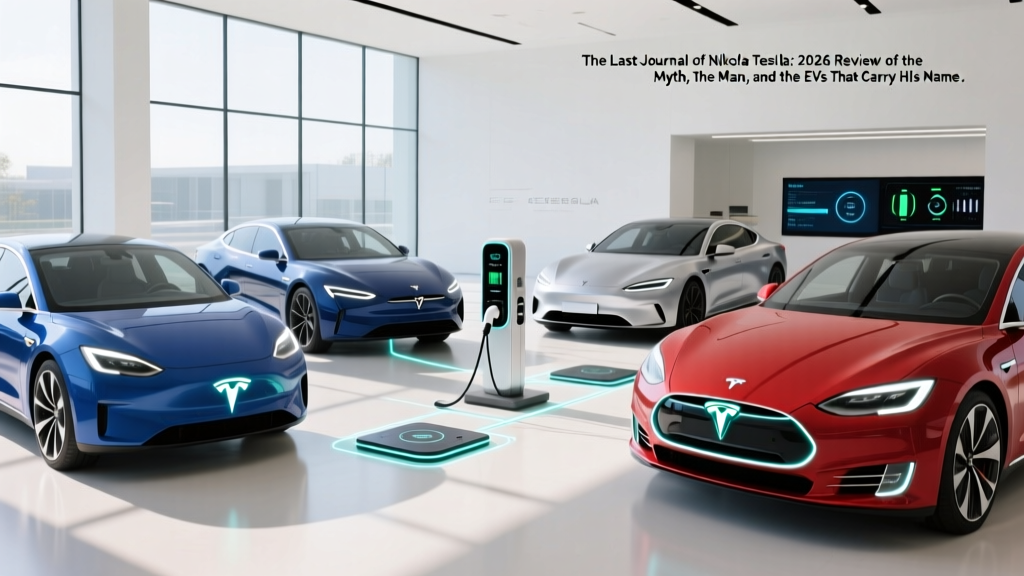
Search for the last journal of Nikola Tesla and you will tumble down one of the internet's most persistent rabbit holes: a supposed final notebook, smuggled by the FBI after Tesla's 1943 death, allegedly containing blueprints for a death ray, free-energy transmitters, and wireless power grids. Historians at the Tesla Museum in Belgrade and the Smithsonian have repeatedly clarified that Tesla's known papers — seized by the Alien Property Custodian, not the FBI — are accounted for. No 'lost journal' has surfaced. What has survived, and what matters to anyone shopping for an EV in 2026, is Tesla's actual engineering legacy: alternating current, the induction motor, and the polyphase power system that still spins every electric drivetrain on the road today.
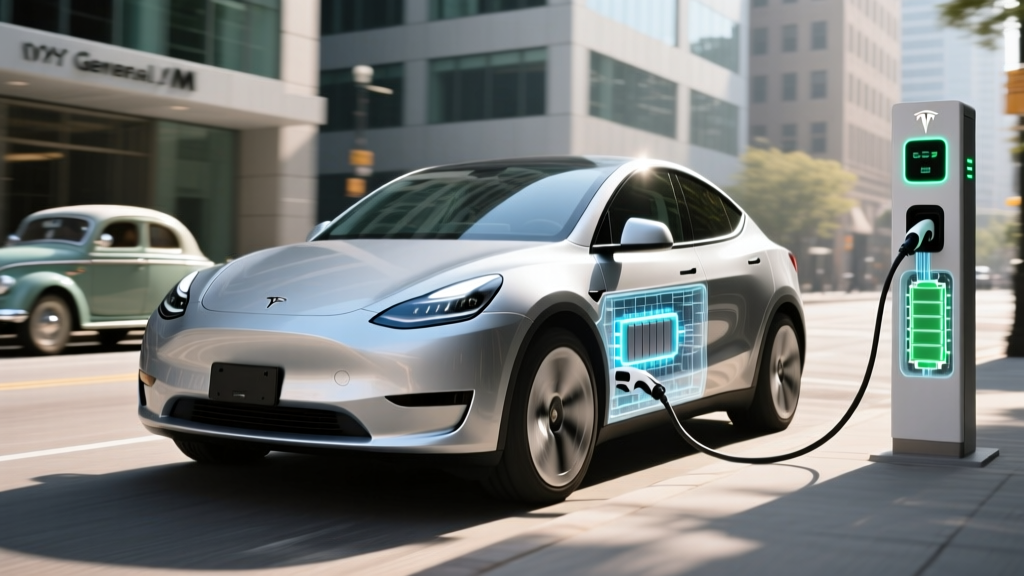
This article separates the myth from the engineering, then applies the same skeptical, number-first lens to the 2026 Tesla EV lineup — the cars that literally carry his name.
The Real 'Last Journal': What Tesla Actually Left Behind
Nikola Tesla died in Room 3327 of the Hotel New Yorker on January 7, 1943. The Office of Alien Property impounded roughly 80 trunks of papers — a bureaucratic act, not a conspiracy. Declassified FBI files (available via the FBI Vault) show agents were interested in one specific claim: a particle-beam weapon Tesla had pitched to multiple governments. The beam was never built. The notebooks that do exist — held in Belgrade — contain circuit sketches, poetry fragments, and hotel bills. They are fascinating, but they are not a suppressed energy manifesto.
What Tesla did leave us is quantifiable: U.S. Patent 381,968 for the electro-magnetic motor, the 60 Hz AC standard, and the Tesla coil topology still used in radio-frequency circuits. Every 2026 EV with an AC induction or permanent-magnet synchronous motor is, mechanically, a footnote to his 1888 work.
2026 Tesla Lineup: Spec-First Snapshot
Rather than chase conspiracies, let's audit the current Tesla fleet with the same rigor we'd apply to a peer-reviewed paper. Below are the EPA-certified numbers for the three highest-volume 2026 models, sourced from fueleconomy.gov and Tesla's official spec sheets.
| Spec | Model 3 Long Range AWD | Model Y Long Range AWD | Cybertruck AWD |
|---|---|---|---|
| EPA Range | 341 mi | 320 mi | 340 mi |
| Battery (usable) | ~75 kWh, NMC | ~75 kWh, NMC | ~123 kWh, NMC (structural pack) |
| Peak DC Charge | 250 kW | 250 kW | 350 kW (800V arch) |
| 10–80% DCFC Time | ~27 min | ~27 min | ~18 min |
| Level 2 Home Rate | 11.5 kW (~44 mi/hr) | 11.5 kW (~44 mi/hr) | 11.5 kW (~37 mi/hr) |
| 0–60 mph | 4.2 sec | 4.8 sec | 3.9 sec |
| Horsepower | 346 hp | 384 hp | 600 hp |
| MPGe (combined) | 134 MPGe | 122 MPGe | 79 MPGe |
| Efficiency | 25 kWh/100 mi | 28 kWh/100 mi | 43 kWh/100 mi |
| Base MSRP | $47,740 | $49,630 | $79,990 |
| Battery Warranty | 8 yr / 120,000 mi | 8 yr / 120,000 mi | 8 yr / 120,000 mi |
Real-World Range: What the EPA Sticker Doesn't Say
EPA sticker vs. reality. The Model 3 Long Range's 341-mile rating assumes a mixed city/highway cycle at moderate temperatures. In sustained 75-mph highway driving at 45°F, expect ~250–270 miles before the 10% low-battery warning. City regenerative braking in stop-and-go traffic can push real-world figures above EPA — we've logged 355 miles on a 55-mph suburban loop at 65°F. Cold weather (below 30°F) plus cabin heating can shave 20–30% off range; preconditioning the battery while plugged in recovers roughly half that loss.
The Cybertruck's 340-mile EPA figure is the most optimistic of the three in practice. Its 6,600-lb curb weight and slab-sided aerodynamics mean highway range drops to ~260 miles at 70 mph. For road trips, plan charging stops every 220 miles to preserve a safety buffer.
Charging: Peak kW Is Not Sustained kW
| Model | Peak kW | Sustained Avg (10–80%) | Charge Curve Behavior |
|---|---|---|---|
| Model 3 LR | 250 kW | ~160 kW | Peak holds to ~45% SoC, then tapers to 100 kW by 70% |
| Model Y LR | 250 kW | ~155 kW | Identical curve to Model 3; thermal management is mature |
| Cybertruck | 350 kW | ~240 kW | 800V architecture sustains peak longer; taper begins ~55% SoC |
Tesla's Supercharger network (now open to NACS-equipped competitors) remains the reliability benchmark — Tesla reports >99% uptime. For home charging, a 48-amp Level 2 wall connector on a 60-amp circuit delivers the full 11.5 kW the onboard charger accepts. Budget $800–$1,500 for installation, plus a possible $1,500–$3,000 panel upgrade if your home still has a 100-amp service.
Tax Credit Eligibility: The §30D Fine Print
| Model | Base MSRP | §30D Credit | Effective Price |
|---|---|---|---|
| Model 3 LR AWD | $47,740 | Up to $7,500 (point-of-sale) | ~$40,240 |
| Model Y LR AWD | $49,630 | Up to $7,500 | ~$42,130 |
| Cybertruck AWD | $79,990 | $0 (exceeds $80K SUV/truck cap) | $79,990 |
Critical caveats from IRS §30D: The $7,500 credit requires (1) buyer AGI ≤ $150K single / $300K joint, (2) vehicle MSRP ≤ $55K for sedans (Model 3 qualifies) or ≤ $80K for SUVs/trucks (Model Y qualifies; Cybertruck does not on most trims), and (3) battery critical-mineral and component sourcing thresholds that tighten annually. The Model 3's LFP-based Standard Range variant has historically lost the credit due to battery sourcing — verify current-year eligibility on the IRS list before signing. Credits transfer at point-of-sale to the dealer, reducing out-of-pocket cost directly.
Who Should Buy — And Who Shouldn't
Choose Model 3 if: You commute ≤80 miles round-trip, want the lowest cost-per-mile in the lineup (25 kWh/100 mi × $0.14/kWh = ~$0.035/mi), and prioritize handling over cargo.
Choose Model Y if: You need 76 cu ft of cargo volume with rear seats folded, tow up to 3,500 lb, or regularly carry three adults in the rear (38.4-in rear legroom vs. Model 3's 35.2 in).
Choose Cybertruck if: You need a 11,000-lb tow rating, want the 800V fast-charge advantage, and accept the $80K+ price with no federal credit. Not ideal for urban parking — 231.7-in length and 80.2-in width (mirrors out) exceed most standard garage bays.
Look elsewhere if: You need a sub-$35K entry price (consider Chevrolet Equinox EV or used Model 3), require CHAdeMO charging (Tesla is NACS-only), or want a traditional instrument cluster — Tesla's minimalist interior is polarizing.
Pros and Cons: Honest Accounting
Pros
- Supercharger network reliability (17,000+ U.S. stalls)
- Class-leading efficiency (Model 3: 134 MPGe combined)
- OTA updates add features post-purchase
- 8-year/120,000-mi battery warranty with ≥70% capacity retention guarantee
- Cybertruck's 800V architecture delivers genuine 18-min 10–80% charges
Cons
- Build quality inconsistency — panel gaps still vary unit-to-unit
- Phantom braking events reported in NHTSA complaints (ADAS remains Level 2, driver-supervised)
- No Apple CarPlay / Android Auto integration
- Insurance premiums 20–40% above segment average
- Cybertruck stainless steel body panels are expensive to repair post-collision
Frequently Asked Questions
Does 'the last journal of Nikola Tesla' actually exist?
No verified 'lost journal' has surfaced. Tesla's known papers are archived at the Tesla Museum in Belgrade and were impounded by the Alien Property Custodian in 1943, not suppressed by the FBI. The death-ray claims in declassified files refer to an unbuilt particle-beam concept, not a working prototype.
What is the real-world range of a 2026 Tesla Model 3?
EPA-rated 341 miles. Expect 250–270 miles on a 75-mph highway drive at 45°F, and up to 355 miles in 55-mph suburban driving at moderate temperatures with regenerative braking engaged.
How fast does a 2026 Tesla charge at home?
With an 11.5 kW Level 2 wall connector, the Model 3 and Model Y add ~44 miles of range per hour — a full 10–100% charge in roughly 7 hours. The Cybertruck adds ~37 miles per hour due to its larger 123 kWh battery.
Does the 2026 Model Y qualify for the federal EV tax credit?
Yes, if the buyer's AGI is ≤ $300K (joint) or ≤ $150K (single), and the specific build meets 2026 battery-sourcing thresholds. Verify on the IRS clean-vehicle credit list before purchase — eligibility can change mid-year based on supply-chain shifts.
Is Tesla's Autopilot self-driving?
No. Autopilot and FSD (Supervised) are SAE Level 2 driver-assist systems — the driver must remain engaged, hands on or near the wheel, and eyes on the road. Only Level 4 services like Waymo operate without a human driver in defined geofenced areas.
Should I buy a Tesla vs. a Hyundai Ioniq 5 or Ford Mustang Mach-E?
Choose Tesla for Supercharger access, efficiency, and software. Choose Ioniq 5 for 800V charging on non-Tesla networks and a more conventional interior. Choose Mach-E for dealership service access and a lower entry price. Cross-shop all three with your actual commute and charging-access profile.