The Short Answer
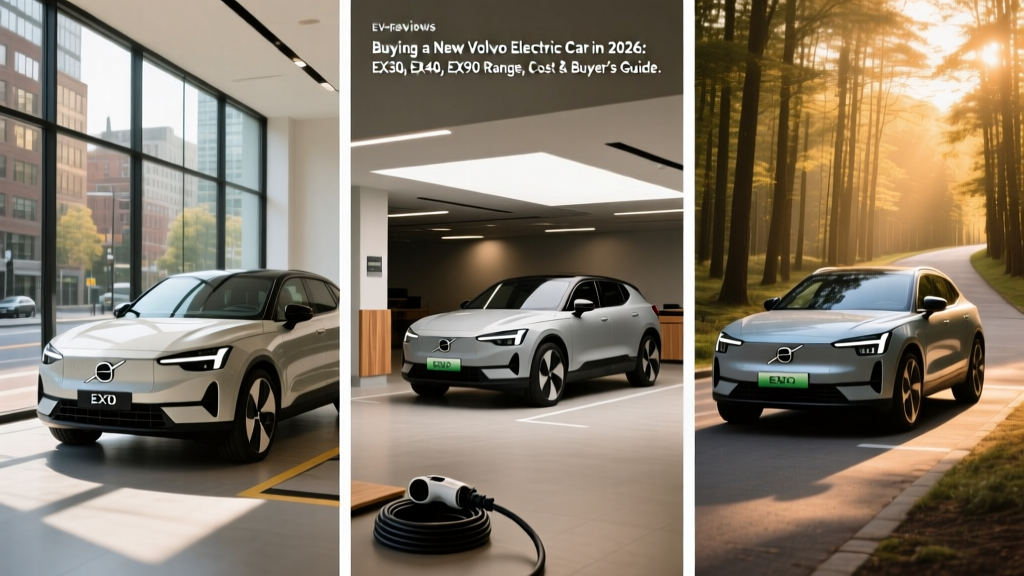
Volvo's 2026 EV lineup spans three models: the compact EX30 (EPA est. 265 mi, starting ~$36,350), the midsize EX40 (EPA est. 296 mi, starting ~$54,850), and the flagship three-row EX90 (EPA est. 300–310 mi, starting ~$76,695). The EX30 is the entry point for urban buyers with home charging; the EX40 suits commuters who want proven hardware and faster DC charging; the EX90 targets families needing three rows and advanced sensor suites. All three qualify for varying degrees of federal or state incentive eligibility depending on battery sourcing, buyer income, and MSRP caps under IRS §30D rules — but none should be assumed to receive the full $7,500 credit without verifying current-year sourcing requirements at IRS.gov.
Volvo's 2026 Electric Lineup at a Glance
Volvo committed to full electrification earlier than most legacy automakers, and by 2026 the Swedish brand fields a three-model EV portfolio built on the Ge集团's SEA and SPA2 platforms. Each model targets a distinct buyer profile, and the specs diverge meaningfully in battery chemistry, charging architecture, and real-world efficiency.
| Spec | 2026 EX30 (Extended Range) | 2026 EX40 (Single Motor) | 2026 EX90 (Twin Motor) |
|---|---|---|---|
| EPA Range (est.) | 265 mi | 296 mi | 300–310 mi |
| Battery (usable) | 69 kWh (NMC) | 78 kWh (NMC) | 111 kWh (NMC) |
| Peak DC Charge Rate | 153 kW | 200 kW | 250 kW |
| 10–80% DCFC Time | ~26 min | ~28 min | ~30 min |
| Level 2 (240V) Rate | 11 kW | 11 kW | 11 kW |
| Horsepower | 272 hp | 292 hp | 408–517 hp |
| 0–60 mph | 6.1 sec | 6.2 sec | 4.7–5.7 sec |
| MPGe (combined, est.) | 104 MPGe | 98 MPGe | 82–88 MPGe |
| Base MSRP | $36,350 | $54,850 | $76,695 |
| Battery/Powertrain Warranty | 8 yr / 100,000 mi | 8 yr / 100,000 mi | 8 yr / 100,000 mi |
Real-World Range Reality Check
EPA stickers are best-case composites. On the EX40, expect roughly 250–265 miles on sustained highway driving at 70+ mph. In cold weather (below 32°F), NMC batteries lose 20–30% of range depending on cabin heating demand — the EX30 could drop to ~190–210 miles in a Midwest winter. The EX90's massive 111 kWh pack provides a buffer, but its heavy curb weight (~6,100 lbs) and boxy aerodynamics compress highway efficiency. Always precondition the battery before DC fast charging to avoid slow charge curves below optimal temperature.
Purchase Price, Tax Credits, and What You'll Actually Pay
The sticker price tells only part of the story. Federal tax credit eligibility under IRS §30D depends on three moving targets: buyer income caps (AGI ≤ $150,000 single / $300,000 joint), MSRP caps ($55,000 for sedans/compact SUVs, $80,000 for SUVs/trucks), and critical mineral and battery-component sourcing thresholds that tighten each year through 2029.
§30D Federal Tax Credit Checklist (2026 Rules)
- EX30: MSRP under $55K cap ✓ — but battery cell sourcing (CATL-supplied LFP variants in some markets) may disqualify certain trims. Verify current critical-mineral and component compliance at IRS.gov.
- EX40: MSRP exceeds $55K sedan/hatch cap — likely ineligible for the new-vehicle §30D credit unless reclassified as an SUV. Confirm classification with your dealer and tax professional.
- EX90: MSRP near $80K SUV cap — eligibility depends on exact trim MSRP and whether the vehicle's battery sourcing meets 2026 thresholds. Top trims may exceed the cap.
- Point-of-sale transfer: If eligible, you can apply the credit as an immediate rebate at the dealership rather than waiting for tax filing.
- State incentives: Vary widely — check your state's energy office or fueleconomy.gov for local programs.
Volvo EV vs. Gas and Hybrid: The 5-Year Cost Breakdown
How does a new Volvo electric car compare to its gas-burning Volvo siblings or a plug-in hybrid alternative? We modeled a 5-year, 75,000-mile ownership cycle using national average electricity ($0.17/kWh) and gasoline ($3.40/gallon) prices.
| Cost Category | EX40 (EV) | XC40 Mild Hybrid (Gas) | XC60 PHEV |
|---|---|---|---|
| Purchase Price (base MSRP) | $54,850 | $40,150 | $57,400 |
| Est. Federal/State Incentives | $0–$7,500* | $0 | $0–$7,500* |
| Fuel/Energy (75K mi) | $2,550 | $7,650 | $4,200 |
| Maintenance (5 yr) | $1,800 | $4,500 | $4,100 |
| Insurance (5 yr avg.) | $9,200 | $7,100 | $8,400 |
| Est. Depreciation (5 yr) | $22,000 | $17,500 | $23,000 |
| 5-Year Total (approx.) | $83,400–$90,900 | $69,750 | $89,600–$97,100 |
*Incentive eligibility varies. Consult IRS.gov and a tax professional.
Key takeaway: The EX40's energy and maintenance savings (~$7,800 over 5 years vs. the gas XC40) are significant, but higher insurance premiums (EVs average 15–25% more to insure) and steeper depreciation narrow the gap. The break-even point against the gas XC40 arrives around year 6–7 if the §30D credit applies. Against the PHEV XC60, the EX40 wins on running costs but loses on purchase price.
Charging at Home and on the Road: What to Expect
Volvo equips all 2026 EVs with an 11 kW onboard charger for Level 2 (240V) charging. That translates to roughly 30–38 miles of range added per hour of charging — enough to fully replenish any model overnight on a home Level 2 unit.
| Charging Level | Power | Miles Added/Hour (EX40) | Typical Use Case |
|---|---|---|---|
| Level 1 (120V) | 1.4 kW | ~4 mi/hr | Emergency / trickle top-up |
| Level 2 (240V, home) | 11 kW | ~35 mi/hr | Daily overnight charging |
| DC Fast (EX40 peak) | 200 kW | ~180 mi in 30 min | Road trips, highway corridors |
| DC Fast (EX90 peak) | 250 kW | ~210 mi in 30 min | Road trips, highway corridors |
Home charging installation cost: A dedicated 240V/48A circuit with a hardwired Level 2 charger (like the ChargePoint Home Flex or Wallbox Pulsar Max) typically costs $800–$2,200 installed, depending on panel proximity. Homes with older 100A electrical panels may need a $1,500–$3,000 panel upgrade — factor this in before purchase. Always hire a licensed electrician and pull a permit.
Public charging reality: Volvo has partnered with Starbucks and Electrify America for destination charging, but day-to-day DC fast charging relies on the broader CCS/NACS network. As of 2026, Volvo models in North America use the CCS1 connector, though Volvo has announced a transition to NACS for future model years. Check Volvo's official site for the latest connector details on your specific model year.
Common Misconceptions About Volvo EVs — Fact vs. Fiction
| Myth | Fact |
|---|---|
| "Volvo EVs qualify for the full $7,500 federal tax credit." | Eligibility depends on MSRP caps, buyer AGI, and battery-sourcing rules that change annually. The EX40 may exceed the $55K cap. Always verify at IRS.gov. |
| "The EX90's lidar makes it self-driving." | The EX90's lidar + camera suite supports a Level 2 driver-assist system. Per SAE definitions, the driver must remain fully engaged. It is not Level 4 autonomy like Waymo. |
| "I'll get 300+ miles no matter how I drive." | EPA estimates combine city and highway cycles. Sustained 75+ mph highway driving, cold weather, and roof cargo boxes can reduce range by 20–35%. |
| "EV batteries need replacing every 5 years." | NMC batteries in Volvos are warranted for 8 years/100,000 miles at 70%+ capacity retention. Industry data shows most EV batteries retain 85–92% capacity at 100K miles with normal use. |
| "Public charging is unreliable everywhere." | Network reliability varies. Electrify America and Tesla Superchargers (via adapter for CCS vehicles) average 90%+ uptime. Plan routes using PlugShare or A Better Routeplanner. |
Ownership Realities: Climate, Driving Patterns, and Charging Access
A Volvo EV is an excellent fit if your situation matches these criteria — and a poor one if it doesn't:
Is a New Volvo Electric Car Right for You?
Choose the EX30 if: You live in a mild climate, commute under 50 miles/day, have home Level 2 charging access, and want the lowest entry price into the Volvo EV lineup. It's ideal as a second car or urban daily driver.
Choose the EX40 if: You need 280+ miles of real-world range, take road trips 4–6 times per year, and value proven SPA2 platform reliability. It's the best all-rounder in Volvo's EV lineup for most buyers.
Choose the EX90 if: You need three rows, tow occasionally (up to 5,000 lbs), and want Volvo's most advanced ADAS suite with lidar. Budget for higher insurance and potential MSRP-cap issues with the §30D credit.
Consider a Volvo PHEV instead if: You lack home charging, frequently drive 400+ miles in rural areas with sparse DC fast charging, or live in extreme cold (below 0°F regularly) where range loss compounds.
What First-Time Volvo EV Buyers Should Know
1. Order and wait times vary. The EX30 and EX90 have seen strong demand. Confirm delivery timelines with your local dealer — some trims may have 2–4 month wait lists.
2. Volvo's software-defined approach means OTA updates. Features, range optimizations, and ADAS improvements can arrive over-the-air, but software bugs in early model-year vehicles are not uncommon. Check owner forums for known issues.
3. Insurance quotes before you buy. EV insurance premiums are higher due to battery replacement costs and specialized repair networks. Get quotes from GEICO, Progressive, and State Farm for the exact VIN before signing.
4. Understand the charge curve. Peak DC fast-charge rates (153–250 kW) apply only between roughly 10–40% state of charge. Above 80%, charging slows dramatically to protect battery health — plan to unplug at 80% on road trips for the best time efficiency.
5. Schedule a test charge. Ask the dealer to walk you through the Volvo Cars app, Plug&Charge functionality, and preconditioning settings before delivery. Knowing how to precondition for fast charging can shave 10+ minutes off your DCFC stops.
Frequently Asked Questions
Does Volvo make a fully electric SUV?
Yes. The 2026 lineup includes the compact EX30, the midsize EX40 (formerly XC40 Recharge), and the full-size three-row EX90. All are battery-electric vehicles with no gas engine.
What is the cheapest new Volvo electric car?
The 2026 Volvo EX30 starts at approximately $36,350 MSRP for the Single Motor Extended Range trim, making it Volvo's most affordable EV and one of the least expensive luxury-brand EVs on the market.
How long does it take to charge a Volvo EV at home?
On a Level 2 (240V, 11 kW) home charger, the EX40 charges from empty to full in roughly 7–8 hours. The EX90's larger 111 kWh battery takes about 10–11 hours. Most owners charge overnight and wake up to a full battery daily.
Is the Volvo EX90 self-driving?
No. The EX90 features lidar, cameras, and radar supporting a Level 2 driver-assist system per SAE definitions. The driver must remain attentive and in control at all times. It is not an autonomous vehicle.
Will Volvo EVs work with Tesla Superchargers?
Volvo has announced plans to adopt the NACS connector for future models and provide CCS-to-NACS adapters for existing vehicles. As of early 2026, check with Volvo for the latest adapter availability and Supercharger network compatibility for your specific model.
What's the battery replacement cost for a Volvo EV?
Out-of-warranty NMC battery replacement for the EX40 or EX90 is estimated at $15,000–$25,000 depending on the pack size. However, Volvo's 8-year/100,000-mile battery warranty covers defects and capacity loss below 70%, and real-world degradation data suggests most packs outlast the warranty period with 85%+ capacity remaining.