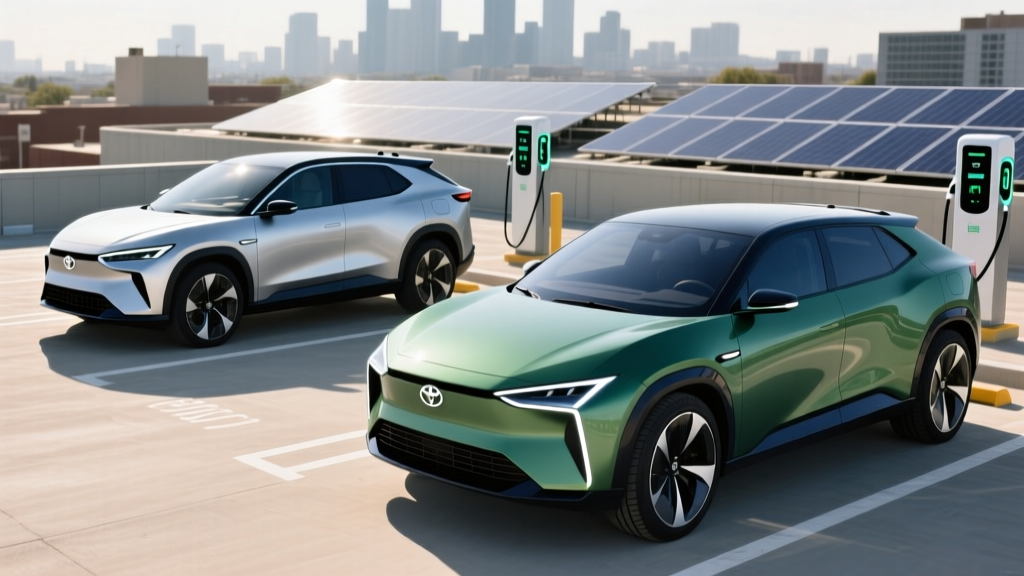
Looking for a new Toyota electric car? As of early 2026, Toyota offers two fully electric models in the U.S.: the bZ4X crossover SUV (EPA range up to 252 miles, starting around $38,465) and the newly arriving bZ Woodland SUV (EPA range up to 283 miles, starting around $45,000). Both use a 71.4 kWh usable lithium-ion battery, support up to 150 kW DC fast charging (10–80% in ~30 minutes), and qualify for varying levels of the federal §30D tax credit depending on your income, the vehicle's MSRP, and battery-sourcing requirements. If you can charge at home and drive under 200 miles daily, either model covers most needs. If you frequently drive 300+ miles in cold weather or lack home charging access, a Toyota hybrid like the RAV4 Hybrid (39 MPG combined) may be a more practical bridge.
The 2026 Toyota EV Lineup at a Glance
Toyota has been cautious with full battery-electric vehicles compared to competitors like Hyundai, Tesla, and Ford. That changes meaningfully in 2026. The bZ4X, launched for the 2023 model year, receives incremental range and charging software updates. The bZ Woodland, announced in late 2024 and arriving at dealers through early-to-mid 2026, slots above the bZ4X as a slightly larger, more rugged dual-motor AWD SUV with improved range.
Here's how the two stack up on paper and in practice:
| Spec | 2026 Toyota bZ4X (FWD) | 2026 Toyota bZ4X (AWD) | 2026 Toyota bZ Woodland (AWD) |
|---|---|---|---|
| EPA Range | 252 mi | 228 mi | 283 mi |
| Battery (usable) | 71.4 kWh | 71.4 kWh | 74.7 kWh |
| Chemistry | NMC lithium-ion | NMC lithium-ion | NMC lithium-ion |
| Horsepower | 201 hp | 215 hp | 338 hp |
| 0–60 mph | 7.1 sec | 6.5 sec | ~4.4 sec (est.) |
| Peak DC Fast Charge | 150 kW | 150 kW | 150 kW |
| 10–80% DC Charge | ~30 min | ~30 min | ~30 min |
| Level 2 Charge Rate | 6.6 kW (onboard) | 6.6 kW (onboard) | 11 kW (onboard) |
| MPGe (combined) | 131 MPGe | 114 MPGe | ~117 MPGe (est.) |
| Starting MSRP | $38,465 | $42,565 | $45,000 (est.) |
| Battery Warranty | 8 yr / 100,000 mi | 8 yr / 100,000 mi | 8 yr / 100,000 mi |
Sources: fueleconomy.gov — Toyota bZ4X, Toyota bZ4X official page, manufacturer preliminary estimates for bZ Woodland.
Real-World Range: What the EPA Sticker Doesn't Tell You
EPA vs. Reality: The bZ4X FWD's 252-mile EPA rating is achievable in mild weather with mixed city/highway driving. Expect 220–235 miles on a sustained 70-mph highway trip in 65°F conditions. In freezing temperatures (below 32°F), range drops to roughly 180–200 miles due to battery chemistry limitations and cabin heating demands. The bZ4X AWD sacrifices about 24 EPA miles due to the second motor's drag and added weight.
The bZ Woodland's 283-mile EPA figure benefits from a slightly larger battery pack and improved aerodynamics, but its taller, boxier shape means highway efficiency still lags behind sleeker crossovers like the Hyundai Ioniq 5 (EPA 303 mi). Real-world highway range for the Woodland: expect 245–260 miles in fair weather, 200–220 miles in deep cold.
Toyota does not currently offer a heat pump as standard on all bZ4X trims (it's included on the AWD and higher trims). This matters significantly: EVs without heat pumps rely on resistive cabin heating, which can draw 3–5 kW in cold weather, directly cutting into range. If you live in the northern U.S. or mountain states, confirm heat pump inclusion on your specific trim before purchasing.
Charging Speed and Infrastructure: Toyota's Honest Limitation
Charging is where Toyota's EVs face the most scrutiny compared to segment leaders. The bZ4X peaks at 150 kW on a DC fast charger — respectable, but behind the Hyundai Ioniq 5 (240 kW peak), Kia EV6 (240 kW), and Tesla Model Y (250 kW on V3 Superchargers). The 10–80% charge time of roughly 30 minutes means longer road-trip stops than competitors that hit 10–80% in 18–20 minutes.
| Charging Level | Power | bZ4X Miles Added per Hour | bZ Woodland Miles Added per Hour | Notes |
|---|---|---|---|---|
| Level 1 (120V household) | ~1.2 kW | ~4 mi/hr | ~4 mi/hr | Emergency/trickle only |
| Level 2 (240V home) | 6.6 kW (bZ4X) / 11 kW (Woodland) | ~22 mi/hr | ~37 mi/hr | Overnight full charge |
| DC Fast Charge | Up to 150 kW peak | ~190 mi in 30 min | ~210 mi in 30 min | Tapers significantly above 80% |
Charge curve reality: The 150 kW peak only sustains roughly between 10–55% state of charge. Above 60%, the rate drops to ~80 kW; above 80%, it falls to ~30 kW. This is typical for NMC batteries at this capacity, but it means the last 20% can add 15–20 minutes to your stop. Plan road trips around 10–80% charges and skip topping off unless necessary.
The bZ4X uses the J1772 connector for AC charging and CCS1 for DC fast charging. Toyota has committed to adopting the Tesla NACS port on future models, and adapters are becoming available for access to the Tesla Supercharger network (over 20,000 stalls in the U.S.). Confirm adapter availability for your specific model year at purchase.
New Toyota Electric Car vs. Toyota Hybrid: The Cost and Practicality Breakdown
Toyota built its reputation on hybrids — the RAV4 Hybrid, Camry Hybrid, and Prius are benchmarks. So the most common question from Toyota shoppers is: should I go full EV or stick with hybrid?
| Factor | 2026 bZ4X FWD (EV) | 2026 RAV4 Hybrid AWD | 2026 RAV4 Prime PHEV |
|---|---|---|---|
| Starting MSRP | $38,465 | $34,465 | $44,565 |
| Fed. Tax Credit (§30D) | Up to $7,500* | None | Up to $7,500* |
| Effective Price (with max credit) | ~$30,965 | $34,465 | ~$37,065 |
| Fuel/Energy Cost per Mile | ~$0.045 (home charging)** | ~$0.10 (gas, 39 MPG) | ~$0.05 (electric) / ~$0.10 (gas) |
| Annual Fuel/Energy (12,000 mi) | ~$540 | ~$1,200 | ~$600–$900 |
| 5-Year Fuel/Energy Total | ~$2,700 | ~$6,000 | ~$3,500 |
| Maintenance (5-year est.) | ~$1,200 | ~$2,800 | ~$2,000 |
| Electric-Only Range | 252 mi | 0 mi | 42 mi |
| Total Range (full tank/charge) | 252 mi | 580 mi | 600+ mi |
*§30D credit eligibility depends on buyer income caps ($150K single / $300K joint), MSRP caps ($55K for SUVs), and battery critical-mineral sourcing rules. Verify at IRS.gov. **Based on U.S. average residential electricity rate of ~$0.17/kWh.
5-Year Total Cost of Ownership (estimates, 60,000 miles):
| Category | bZ4X FWD (EV) | RAV4 Hybrid AWD |
|---|---|---|
| Net Purchase (after credit) | ~$30,965 | $34,465 |
| Energy/Fuel | $2,700 | $6,000 |
| Maintenance | $1,200 | $2,800 |
| Insurance (avg) | $7,500 | $6,000 |
| Depreciation (est. 5-yr) | ~$14,000 | ~$11,000 |
| Total 5-Year TCO | ~$56,365 | ~$60,265 |
The bZ4X can break even or save modestly over 5 years when the full $7,500 credit applies. Without the credit, the RAV4 Hybrid is the cheaper path.
Federal Tax Credit: What Actually Applies to Toyota EVs in 2026
The §30D Clean Vehicle Credit can reduce your federal tax liability by up to $7,500 for a qualifying new EV — and as of 2024, it can be transferred to the dealer at point of sale, functioning as an immediate price reduction rather than a tax-year refund. However, eligibility is not automatic.
§30D Requirements for the Toyota bZ4X / bZ Woodland (2026):
- MSRP Cap: Vehicle MSRP must not exceed $80,000 for SUVs / $55,000 for sedans. Both bZ models clear this.
- Buyer Income Cap: Modified AGI ≤ $150,000 (single) or ≤ $300,000 (married filing jointly).
- Battery Sourcing: The $7,500 credit splits into two halves — $3,750 for critical-mineral sourcing and $3,750 for battery-component manufacturing. Toyota's supply chain compliance varies by model year. Check the latest DOE/Fueleconomy.gov qualifying vehicle list for the exact credit amount.
- Point-of-Sale Transfer: You can assign the credit to the dealer for an immediate price reduction at purchase, or claim it on your tax return (Form 8936).
- VIN Verification: The dealer must report the VIN to the IRS at time of sale. Confirm this before leaving the lot.
Key caveat: Battery-sourcing rules tighten annually. A Toyota EV that qualified for the full $7,500 in 2024 may qualify for only $3,750 or $0 in 2026 depending on where the battery minerals and components were sourced. Always verify the current status on fueleconomy.gov before committing to a purchase.
First-Time EV Buyer: What Toyota Owners Need to Know
If you're transitioning from a Camry or RAV4 to your first EV, the driving experience is familiar, but ownership logistics require preparation.
Home Charging Is the Foundation
Over 80% of EV charging happens at home. A Level 2 (240V) home charger is practically essential. For the bZ4X with a 6.6 kW onboard charger, a standard 32-amp Level 2 unit adds roughly 22 miles per hour of charging — enough to fully replenish the 71.4 kWh battery overnight (about 10–11 hours from empty). The bZ Woodland's 11 kW onboard charger pairs better with a 48-amp unit, cutting that to ~7 hours.
Home installation cost breakdown:
| Item | Typical Cost Range |
|---|---|
| Level 2 charger (hardware) | $350–$700 |
| Electrician labor (240V/50A circuit) | $500–$2,000 |
| Permit & inspection | $50–$300 |
| Electrical panel upgrade (if needed, 200A) | $1,500–$4,000 |
| Total (no panel upgrade) | $900–$3,000 |
| Total (with panel upgrade) | $2,400–$7,000 |
Have a licensed electrician evaluate your panel before purchasing. Many homes built after 2000 with 200A service can accommodate a Level 2 charger without an upgrade. Older homes with 100A panels often need one.
Public Charging: Plan Ahead
Toyota's CCS1-equipped EVs access Electrify America, EVgo, ChargePoint, and other major networks. Reliability on non-Tesla networks remains inconsistent — plan for 10–15% of public chargers being out of service at any time. Apps like PlugShare and A Better Routeplanner are essential for road-trip planning. With a NACS adapter, bZ4X and bZ Woodland owners can access Tesla Superchargers, dramatically expanding fast-charging coverage on highways.
Cold Weather Preparation
If you live where temperatures regularly drop below freezing, budget for 20–30% range loss in winter. Preconditioning the battery while plugged in (using the Toyota app to warm the cabin and battery before departure) recovers some of that range and improves charging speed. This is where a heat pump matters — confirm your trim includes one.
Common Misconceptions About Toyota EVs
| Myth | Fact |
|---|---|
| "Toyota doesn't make real EVs." | The bZ4X has been on sale since 2023, and the bZ Woodland expands the lineup in 2026. They're competitive mid-range options, not segment leaders in charging speed but solid in build quality and reliability. |
| "The battery will need replacing in 5 years." | Toyota warranties the battery for 8 years/100,000 miles against capacity loss below 70%. Real-world data from early bZ4X owners shows ~5–8% degradation after 50,000 miles — well within warranty thresholds. NMC batteries typically retain 85–90% capacity at 100,000 miles. |
| "EVs cost more to insure." | Sometimes true. EV insurance premiums average 15–25% higher than comparable gas vehicles due to higher repair costs. Shop quotes from multiple carriers — some now offer EV-specific discounts. |
| "I can't take road trips." | With 228–283 miles of range and 150 kW DC fast charging, road trips require a 30-minute stop every ~2.5 hours. That's more frequent than a gas car but aligns with natural rest/meal breaks. The NACS adapter unlocking Tesla Superchargers makes this significantly easier in 2026. |
| "Toyota's EVs are just as efficient as their hybrids." | Not directly comparable. The bZ4X achieves 131 MPGe combined, which translates to roughly $0.045/mile on home electricity. The RAV4 Hybrid at 39 MPG costs roughly $0.10/mile on gas. The EV is cheaper per mile, but the hybrid has far greater total range and zero charging dependency. |
Decision Framework: Which Toyota Electrified Vehicle Is Right for You?
Choose the Toyota bZ4X (EV) if:
- You have reliable Level 2 home charging access (garage or driveway with 240V outlet).
- Your daily driving is under 150 miles round-trip.
- You qualify for the §30D tax credit (income and sourcing requirements met).
- You want the lowest per-mile energy cost and minimal maintenance.
- You're comfortable planning road-trip charging stops.
Choose the Toyota bZ Woodland (EV) if:
- You want more range (283 mi EPA), more power (338 hp), and AWD standard.
- You need the faster 11 kW onboard Level 2 charging rate.
- You're willing to pay a ~$6,500 premium over the bZ4X FWD for those upgrades.
Choose the RAV4 Hybrid if:
- You lack home charging access or live in an apartment without EV infrastructure.
- You regularly drive 300+ miles in a single trip and don't want to plan charging stops.
- You live in a region with extreme cold where EV range loss is punishing.
- Your budget is tighter and you don't qualify for the EV tax credit.
Choose the RAV4 Prime (PHEV) if:
- You want 42 miles of electric-only commuting AND a gas engine for long trips.
- You can charge at home but want zero range anxiety.
- You qualify for the §30D credit (the Prime may qualify — verify sourcing rules).
Frequently Asked Questions
Is the Toyota bZ4X a good EV for a first-time buyer?
Yes, with caveats. It's a competent, well-built crossover with adequate range (252 mi EPA), competitive pricing after the tax credit, and Toyota's reliability reputation. Its main weakness is DC fast-charging speed (150 kW peak, ~30 min 10–80%) compared to rivals like the Ioniq 5 or Model Y. If charging speed on road trips is a top priority, test-drive competitors as well.
What is the real-world range of the Toyota bZ4X?
In mild weather with mixed driving, expect 220–240 miles from a full charge. Sustained 75-mph highway driving drops this to ~210–225 miles. In freezing temperatures, plan for 180–200 miles. The AWD model loses roughly 10–15% range across all conditions due to the second motor.
Does the Toyota bZ4X qualify for the $7,500 federal tax credit?
It may qualify for the full $7,500, a partial $3,750, or nothing, depending on the current battery-sourcing compliance. This changes as Toyota adjusts its supply chain. Always verify the exact credit amount on fueleconomy.gov before purchasing. You must also meet income caps ($150K single / $300K joint).
Can I charge a Toyota EV at a Tesla Supercharger?
Starting in 2025–2026, Toyota EVs with CCS1 ports can use a NACS adapter to access Tesla Superchargers. Check with your dealer for adapter availability and compatibility with your specific model year. Future Toyota EV models will ship with the native NACS port.
How long will the Toyota bZ4X battery last?
Toyota warranties the traction battery for 8 years or 100,000 miles, guaranteeing it retains at least 70% of original capacity. Industry data on similar NMC packs suggests 85–92% retention at 100,000 miles under normal use. Battery replacement, if ever needed outside warranty, currently costs $12,000–$18,000 — but most EV batteries outlast the vehicle's economic life.
How does the bZ4X compare to the Hyundai Ioniq 5?
The Ioniq 5 offers more EPA range (up to 303 mi), significantly faster DC charging (240 kW peak, 10–80% in ~18 min), and a similar starting price. The bZ4X counters with Toyota's dealership network, brand loyalty, and a slightly lower effective price when the full tax credit applies. If charging speed and range are your top priorities, the Ioniq 5 leads. If brand trust and dealer proximity matter more, the bZ4X is a reasonable choice.