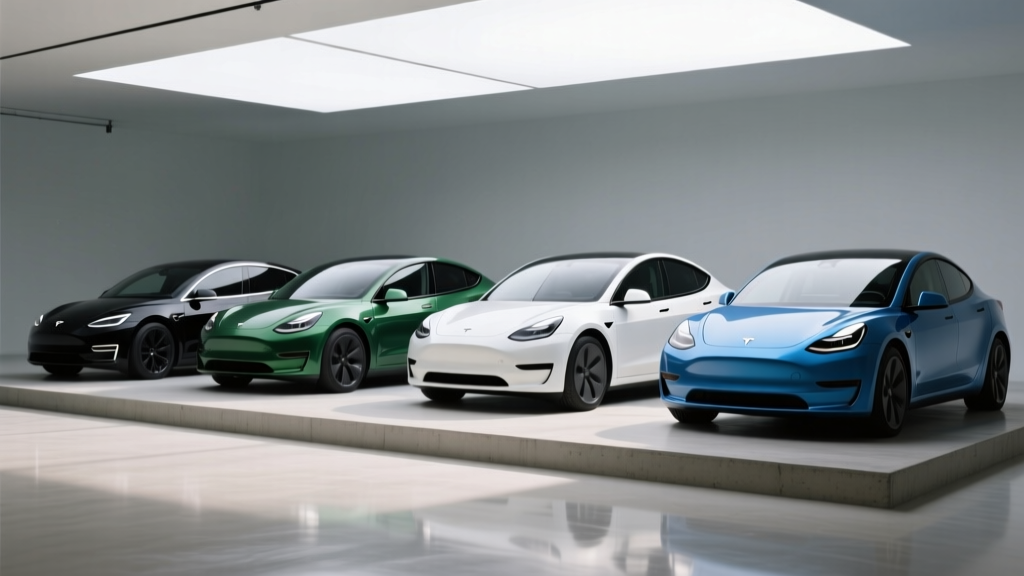
If you've browsed Tesla's configurator lately, you've probably noticed the palette has shifted dramatically from the muted grays and whites of a few years ago. The new Tesla colors rolling out across the 2026 lineup range from deep chromatic flairs to matte-inspired finishes, and they're not just cosmetic — several of these paints affect pricing, delivery timelines, and even resale value. This guide breaks down every current Tesla color option by model, what each costs, and pairs that with the hard EV data you need: EPA range, charging speeds, battery chemistry, and federal tax credit eligibility.
The Complete 2026 Tesla Color Lineup by Model
Tesla's paint strategy has evolved considerably. Where the company once offered five standard colors, the 2026 lineup includes region-exclusive shades, premium multi-coat options, and Cybertruck's unique stainless-steel finish that bypasses paint entirely. Here's the current breakdown:
| Color | Model 3 | Model Y | Model S | Model X | Cybertruck | Price Add-On |
|---|---|---|---|---|---|---|
| Pearl White Multi-Coat | ✓ | ✓ | ✓ | ✓ | — | Free (standard) |
| Solid Black | ✓ | ✓ | ✓ | ✓ | — | $1,500 |
| Deep Blue Metallic | ✓ | ✓ | ✓ | ✓ | — | $1,500 |
| Ultra Red | ✓ | ✓ | ✓ | ✓ | — | $2,500 |
| Quicksilver | ✓ | ✓ | ✓ | ✓ | — | $2,500 |
| Stealth Grey | ✓ | ✓ | ✓ | ✓ | — | $1,500 |
| Midnight Cherry Red | ✓ | ✓ | — | — | — | $2,500 |
| Aurora Green Metallic | — | ✓ | — | — | — | $2,500 |
| Raw Stainless Steel | — | — | — | — | ✓ | Free (only option) |
What changed for 2026: Tesla retired Midnight Silver Metallic from the Model 3/Y lineup and replaced it with Stealth Grey, which carries a slightly warmer undertone. Aurora Green Metallic remains a Model Y exclusive introduced in mid-2025 for the refreshed Juniper body. Ultra Red and Quicksilver, originally Model S/X exclusives, have cascaded down to Model 3 and Model Y — a move Tesla made to unify its premium paint offerings across the portfolio.
Paint Quality, Durability, and Real-Owner Notes
Tesla's paint quality has been a perennial discussion point. The Fremont-built cars historically drew more complaints than Shanghai-built Model 3/Y units, but the 2026 production run benefits from Tesla's upgraded paint shop investments at both facilities. Ultra Red and Quicksilver are multi-coat processes (typically 5-7 layers including primer, base, and clear), which deliver depth and chip resistance but add cost.
From an ownership perspective, darker colors like Solid Black and Stealth Grey show swirl marks and dust more readily — a practical consideration if you're washing weekly or live in a dusty climate. Pearl White remains the most forgiving color for hiding minor imperfections and is the default for a reason. For Cybertruck, the bare stainless-steel exoskeleton eliminates paint entirely, though owners report that fingerprints, water spots, and fine scratches require specific stainless-steel cleaning products to maintain the satin finish.
Model 3 (2026): Range, Charging, and Performance Specs
The refreshed Model 3 Highland continues into 2026 with minimal powertrain changes but a more refined interior. Here's what the numbers look like across the current trim lineup:
| Spec | Model 3 RWD | Model 3 Long Range AWD | Model 3 Performance |
|---|---|---|---|
| EPA Range | 272 mi | 341 mi | 315 mi |
| Battery (usable) | ~57.5 kWh (LFP) | ~75 kWh (NMC) | ~75 kWh (NMC) |
| Drivetrain | RWD | Dual-Motor AWD | Dual-Motor AWD |
| Horsepower | 271 hp | 346 hp | 510 hp |
| 0–60 mph | 5.8 sec | 4.2 sec | 2.9 sec |
| Max DC Fast Charge | 170 kW | 250 kW | 250 kW |
| 10–80% DC Time | ~28 min | ~25 min | ~25 min |
| Level 2 Home Rate | 11.5 kW (~44 mi/hr) | 11.5 kW (~44 mi/hr) | 11.5 kW (~44 mi/hr) |
| Efficiency | 132 MPGe / 25 kWh/100mi | 132 MPGe / 25 kWh/100mi | 119 MPGe / 28 kWh/100mi |
| Base MSRP | $38,990 | $45,990 | $53,990 |
Model Y (2026 Juniper): What Changed and What It Costs
The Juniper-refreshed Model Y entered production in 2025 and carries into 2026 with the Aurora Green Metallic color exclusive and a redesigned interior featuring ambient lighting, ventilated front seats, and a rear touchscreen. The powertrain received efficiency improvements that bumped range across the board.
| Spec | Model Y Long Range AWD | Model Y Performance |
|---|---|---|
| EPA Range | 320 mi | 298 mi |
| Battery (usable) | ~75 kWh (NMC) | ~75 kWh (NMC) |
| Drivetrain | Dual-Motor AWD | Dual-Motor AWD |
| Horsepower | 384 hp | 510 hp |
| 0–60 mph | 4.8 sec | 3.5 sec |
| Max DC Fast Charge | 250 kW | 250 kW |
| 10–80% DC Time | ~25 min | ~25 min |
| Level 2 Home Rate | 11.5 kW (~44 mi/hr) | 11.5 kW (~44 mi/hr) |
| Efficiency | 122 MPGe / 28 kWh/100mi | 115 MPGe / 30 kWh/100mi |
| Cargo (rear seats up) | 30.2 cu ft | 30.2 cu ft |
| Cargo (rear seats folded) | 72.1 cu ft | 72.1 cu ft |
| Base MSRP | $46,990 | $52,990 |
The Model Y's 72.1 cu ft cargo volume with seats folded remains class-leading among electric crossovers and is a key reason this model continues to dominate the family-EV segment. Rear legroom measures 41.6 inches — enough for adult passengers on long trips.
Model S and Model X (2026): Premium Colors and Flagship Specs
Tesla's flagship sedan and SUV continue with the Plaid powertrain option and access to Ultra Red and Quicksilver — the two most expensive and visually striking colors in the lineup. These multi-coat paints were originally developed for the S/X platform and use higher pigment density than the standard options.
| Spec | Model S Long Range | Model S Plaid | Model X Long Range | Model X Plaid |
|---|---|---|---|---|
| EPA Range | 402 mi | 359 mi | 335 mi | 311 mi |
| Battery (usable) | ~95 kWh (NMC) | ~95 kWh (NMC) | ~95 kWh (NMC) | ~95 kWh (NMC) |
| 0–60 mph | 3.1 sec | 1.99 sec | 3.8 sec | 2.5 sec |
| Horsepower | 670 hp | 1,020 hp | 670 hp | 1,020 hp |
| Max DC Fast Charge | 250 kW | 250 kW | 250 kW | 250 kW |
| 10–80% DC Time | ~30 min | ~30 min | ~32 min | ~32 min |
| Base MSRP | $74,990 | $89,990 | $79,990 | $94,990 |
Cybertruck (2026): One Finish, Zero Paint
The Cybertruck's cold-rolled stainless-steel exoskeleton is unpainted by design. Tesla offers no color options — the raw brushed-metal finish is the only exterior treatment available. Some owners have applied vinyl wraps (typically $3,000–$5,000 installed) to achieve color, but this is an aftermarket modification.
| Spec | Cybertruck AWD | Cybertruck Cyberbeast |
|---|---|---|
| EPA Range | 318 mi (est.) | 301 mi (est.) |
| Battery (usable) | ~123 kWh (NMC) | ~123 kWh (NMC) |
| 0–60 mph | 3.9 sec | 2.6 sec |
| Horsepower | 600 hp | 845 hp |
| Towing Capacity | 11,000 lbs | 11,000 lbs |
| Max DC Fast Charge | 250 kW | 250 kW |
| Base MSRP | $79,990 | $99,990 |
The Cybertruck does not qualify for the federal EV tax credit due to its MSRP exceeding the §30D light-truck cap of $80,000 for the AWD trim and the Cyberbeast's classification and pricing placing it firmly outside eligibility. The stainless-steel body, while distinctive, requires specific care — Tesla recommends using their branded stainless-steel cleaning kit to remove water spots and maintain the uniform grain pattern.
Federal Tax Credit Eligibility (§30D) Across the 2026 Tesla Lineup
Tax credit eligibility is where paint choices meet financial reality. The IRS §30D clean vehicle credit provides up to $7,500 for qualifying new EVs, but several rules apply:
- MSRP Caps: Sedans (Model 3, Model S) must be priced at or below $55,000. SUVs, vans, and pickups (Model Y, Model X, Cybertruck) must be at or below $80,000.
- Buyer Income Limits: Modified AGI must not exceed $300,000 (married filing jointly), $225,000 (head of household), or $150,000 (single).
- Battery Sourcing: The $7,500 credit splits into two halves — $3,750 for critical-mineral sourcing and $3,750 for battery-component manufacturing. As of 2026, Tesla's US-built vehicles with North American-sourced LFP and NMC cells qualify for the full $7,500 on eligible trims.
- Point-of-Sale Transfer: Buyers can transfer the credit to the dealer at purchase, reducing the upfront cost immediately rather than waiting to claim it on a tax return.
| Model / Trim | Base MSRP | With Ultra Red (+$2,500) | MSRP Cap | Max Credit | Effective Price After Credit |
|---|---|---|---|---|---|
| Model 3 RWD | $38,990 | $41,490 | $55,000 (sedan) | $7,500 | $33,990 |
| Model 3 Long Range | $45,990 | $48,490 | $55,000 (sedan) | $7,500 | $40,990 |
| Model 3 Performance | $53,990 | $56,490 | $55,000 (sedan) | $0 (over cap) | $56,490 |
| Model Y Long Range | $46,990 | $49,490 | $80,000 (SUV) | $7,500 | $41,990 |
| Model Y Performance | $52,990 | $55,490 | $80,000 (SUV) | $7,500 | $47,990 |
| Model S Long Range | $74,990 | $77,490 | $55,000 (sedan) | $0 (over cap) | $77,490 |
| Model X Long Range | $79,990 | $82,490 | $80,000 (SUV) | $0 (over cap) | $82,490 |
Key insight: Choosing Ultra Red or Quicksilver on a Model 3 Performance pushes the MSRP to $56,490 — over the $55,000 sedan cap — eliminating the $7,500 credit entirely. On Model Y trims, even with the $2,500 premium paint, the MSRP stays well under the $80,000 SUV cap, so you keep the full credit. This makes premium colors effectively $2,500 on Model Y but potentially $10,000 on a Model 3 Performance when you factor in the lost credit. Always check the configurator total against current IRS guidelines before ordering.
Warranty, Driver Assists, and Standout Tech
All 2026 Teslas include Tesla's standard warranty package:
- Basic Vehicle: 4 years / 50,000 miles
- Battery & Drive Unit: 8 years / 100,000 miles (Model 3 RWD) or 8 years / 120,000 miles (Long Range, Performance, Model S/X)
- Battery Capacity Retention: Tesla warrants a minimum of 70% capacity retention over the warranty period
Every Tesla ships with Basic Autopilot (lane-centering and adaptive cruise control). Full Self-Driving (Supervised) remains an $8,000 add-on or $99/month subscription. This is an SAE Level 2 driver-assistance system — the driver must remain attentive with hands on the wheel at all times. It is not autonomous driving.
Standout tech across the 2026 lineup includes Tesla Vision (camera-only perception, no radar or ultrasonic sensors), over-the-air software updates that regularly add features, the Tesla Supercharger network (now open to NACS-equipped competitors but still the most reliable DC fast-charging network in the US), and for Model Y Juniper, the rear-seat entertainment touchscreen and power-folding second row.
Pros, Cons, and Verdict
Pros
- Class-leading Supercharger network access with reliable 250 kW charging
- Model 3 RWD's LFP battery allows daily 100% charging without degradation worry
- Model Y cargo space (72.1 cu ft) beats every electric crossover competitor
- OTA updates continuously improve functionality post-purchase
- Premium colors (Ultra Red, Quicksilver) are genuinely multi-coat, high-quality finishes
- Strong efficiency (25–30 kWh/100mi) translates to low per-mile charging cost
Cons
- Model 3 Performance with premium paint exceeds $55K sedan MSRP cap — loses $7,500 credit
- No ultrasonic sensors — vision-only parking can feel imprecise
- FSD (Supervised) is Level 2, not self-driving — requires constant driver attention
- Insurance premiums 15–30% higher than comparable gas sedans in many states
- Cybertruck offers no color options and no tax credit eligibility
- Service center wait times remain long in many metro areas
Who Should Buy Which Tesla in 2026?
Choose Model 3 RWD if: You want the lowest entry price ($31,490 after credit), commute under 50 miles daily, and can charge at home. The LFP battery is ideal for drivers who prefer charging to 100% daily.
Choose Model 3 Long Range if: You take regular road trips, need AWD for snow, and want 341 miles of EPA range. Premium colors like Ultra Red look excellent on this trim and stay under the credit cap.
Choose Model Y Long Range if: You need family SUV space, want the new Aurora Green Metallic color, and value 72.1 cu ft of cargo room. The best all-around Tesla for most buyers.
Choose Model S/X if: Budget is secondary, you want 402-mile range (Model S), and premium features like the yoke steering option and rear-seat entertainment. Tax credits won't apply at this price point.
Choose Cybertruck if: You need 11,000-lb towing, want a stainless-steel truck that stands apart from every other vehicle on the road, and don't need paint options or federal credits.
Frequently Asked Questions
What is the real-world range of a Tesla in 2026?
Real-world range depends on the model, driving conditions, and temperature. The Model 3 Long Range delivers roughly 290–310 highway miles in summer and 230–250 in winter. The Model S Long Range achieves 340–365 highway miles in mild weather. City driving with regenerative braking often matches or exceeds EPA estimates. Always budget for 20–30% range reduction in sub-freezing temperatures.
How fast do 2026 Teslas charge at home and on the road?
At home on a Level 2 charger (11.5 kW / 48-amp circuit), all Tesla models add approximately 44 miles of range per hour — a full overnight charge from 20% to 80% takes about 6–8 hours depending on battery size. On DC fast chargers, Model 3 Long Range and Performance peak at 250 kW, achieving 10–80% in roughly 25 minutes. The RWD model peaks at 170 kW, taking about 28 minutes. All models taper charge speed significantly above 80% to protect the battery.
Does the 2026 Tesla lineup qualify for the federal EV tax credit?
Model 3 RWD and Long Range, and Model Y Long Range and Performance all qualify for the full $7,500 credit, provided the buyer meets income limits ($150K single / $300K joint) and the vehicle MSRP stays under the cap ($55K sedan / $80K SUV). Model 3 Performance with premium paint exceeds the sedan cap. Model S, Model X, and Cybertruck are priced above their respective caps and do not qualify. Always verify current rules at irs.gov before purchasing.
Is Tesla still worth buying vs. competitors like Hyundai Ioniq 5 or Ford Mustang Mach-E?
Tesla's advantages remain the Supercharger network, software ecosystem, and efficiency. The Ioniq 5 offers faster 800V charging (~18 minutes 10–80%) and a more conventional interior with physical controls. The Mach-E provides a more traditional dealership service experience. If reliable DC fast-charging infrastructure and OTA updates matter most, Tesla still leads. If you prefer physical buttons, 800V architecture, or dealer-based service, competitors are strong alternatives.
Which new Tesla color holds resale value best?
Pearl White and Deep Blue Metallic historically perform best at resale because they appeal to the widest buyer pool and don't show wear as readily. Ultra Red and Quicksilver command attention but may narrow the resale audience. For Cybertruck, the raw stainless steel is the only option, and condition of the finish (scratch-free, well-maintained grain) is what matters at trade-in time.