The Short Answer: What Subaru EVs Can You Buy Right Now?
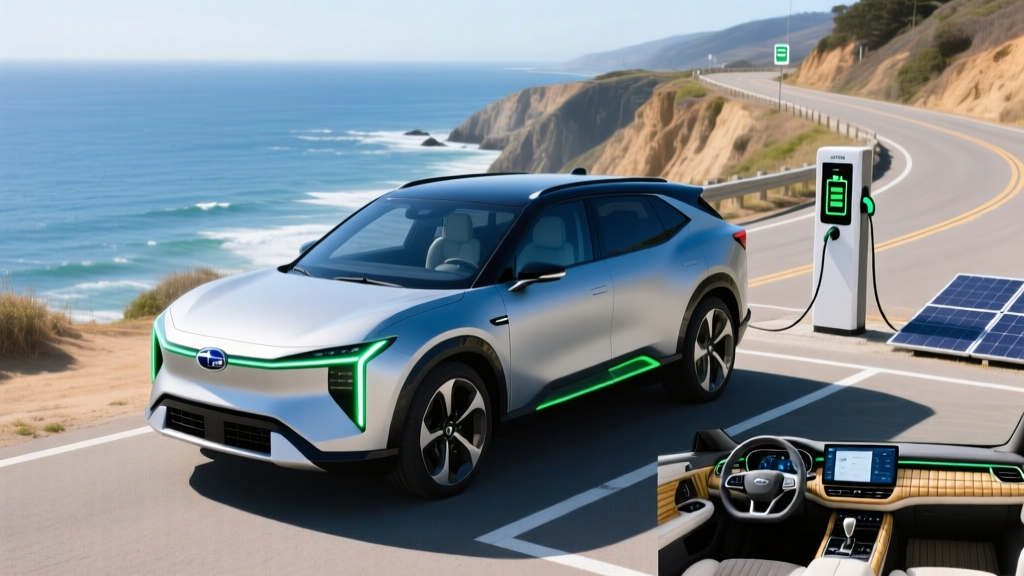
As of the 2026 model year, Subaru sells one fully electric vehicle: the Solterra, a compact electric SUV developed jointly with Toyota (which sells it as the bZ4X). The 2026 Solterra starts at $39,995 (Premium trim) and offers up to 227 miles of EPA-estimated range. A second Subaru EV — a larger, three-row SUV built on a new dedicated EV platform — has been announced for the 2027 model year but is not yet available for purchase. If you're browsing listings for new Subaru EVs for sale today, the Solterra is your only option, and whether it's the right choice depends heavily on your charging access, climate, and daily driving needs.
2026 Subaru Solterra: Range, Battery, and Efficiency
The 2026 Subaru Solterra carries over the upgraded battery pack introduced for 2025: a 72.8 kWh usable lithium-ion NMC battery shared with the Toyota bZ4X. Subaru offers two range ratings depending on trim and wheel size:
- Premium (18-inch wheels): 227 miles EPA
- Limited and Touring (20-inch wheels): 222 miles EPA
Efficiency lands at approximately 104 MPGe combined (roughly 30 kWh/100 miles) according to fueleconomy.gov. That's mid-pack for the compact EV SUV segment — the Hyundai Ioniq 5 achieves 114 MPGe combined, and the Ford Mustang Mach-E (standard range) sits at 101 MPGe.
Real-World Range Expectations
EPA sticker: 227 miles (Premium) / 222 miles (Limited/Touring)
Expect in practice: ~190–210 miles on mixed highway driving at 70 mph; approximately 160–180 miles in sustained cold weather (below 30°F) without preconditioning. The Solterra's heat pump helps, but NMC chemistry loses 15–25% range in deep cold. If your daily commute is under 80 miles round-trip with home charging, the real-world range is perfectly adequate. For frequent 200+ mile highway trips, you'll want to plan DC fast-charging stops.
Charging Speeds: Home and DC Fast Charging
Charging capability is where prospective Solterra buyers need to pay close attention. The Solterra supports both Level 2 AC charging and DC fast charging, but the speeds matter for daily usability.
| Charging Level | Power (kW) | Connector | Speed / Time |
|---|---|---|---|
| Level 1 (120V outlet) | ~1.4 kW | J1772 (NACS adapter available) | ~4 miles/hour; full charge in ~50+ hours |
| Level 2 (240V home/public) | Up to 7.2 kW (peak ~9.6 kW on compatible chargers) | J1772 / NACS (with adapter) | ~25–33 miles/hour; 0–100% in ~9–11 hours |
| DC Fast Charging | Peak ~100 kW | CCS1 (NACS adapter for Tesla Superchargers) | 10–80% in ~35 minutes; tapers significantly above 80% |
The Solterra's DC fast-charging peak of roughly 100 kW is below class leaders. The Hyundai Ioniq 5 peaks at 240 kW (10–80% in ~18 minutes), and the Kia EV6 hits 239 kW. This matters on road trips: you'll spend roughly twice as long at a DC fast charger compared to an 800V-architecture competitor. For owners who charge at home overnight and rarely road-trip, this is a minor concern. For frequent long-distance drivers, it's a legitimate drawback.
Key distinction: kW (kilowatts) measures charging power — the rate at which energy flows into the battery. kWh (kilowatt-hours) measures total energy capacity — the size of the "tank." The Solterra's 72.8 kWh battery is the tank; 100 kW is how fast you can fill it at peak.
Pricing, Trims, and Federal Tax Credit Eligibility
The 2026 Subaru Solterra is available in three trims:
| Trim | MSRP | EPA Range | Drivetrain | Key Features |
|---|---|---|---|---|
| Premium | $39,995 | 227 mi | AWD (dual motor, 215 hp) | 18" wheels, heated seats, EyeSight, 12.3" touchscreen |
| Limited | $43,995 | 222 mi | AWD (dual motor, 215 hp) | 20" wheels, SofTex seats, power liftgate, 360° camera |
| Touring | $47,495 | 222 mi | AWD (dual motor, 215 hp) | Panoramic roof, ventilated seats, Harman Kardon audio, digital rearview mirror |
All trims include Subaru's Symmetrical All-Wheel Drive as standard — dual electric motors producing a combined 215 horsepower and 248 lb-ft of torque. The 0–60 mph time is approximately 6.5 seconds.
Federal Tax Credit (§30D) — What You Need to Know
The Solterra's eligibility for the up-to-$7,500 federal EV tax credit under IRS §30D depends on several factors that change frequently:
- MSRP cap: The Solterra (classified as an SUV) must stay under the $80,000 MSRP cap — all trims qualify.
- Buyer income cap: Modified adjusted gross income must not exceed $150,000 (single), $225,000 (head of household), or $300,000 (joint).
- Battery sourcing requirements: Critical minerals and battery component sourcing thresholds tighten each year. As of 2026, vehicles must meet escalating domestic-content and free-trade-agreement sourcing rules. The Solterra is assembled at Toyota's Motomachi plant in Japan, which affects component sourcing compliance.
- Point-of-sale transfer: Eligible buyers can transfer the credit to the dealer at purchase, reducing the purchase price directly rather than waiting for a tax refund.
Important: Battery sourcing requirements have disqualified several previously eligible models in recent years. Always verify current eligibility on IRS.gov's qualified vehicle list before signing paperwork. Consult a tax professional for your specific situation.
Solterra vs. Gas Subaru: Cost of Ownership Breakdown
Many Solterra shoppers are cross-shopping against the Subaru Outback or Forester. Here's how a 5-year ownership comparison looks between the Solterra Premium and a comparably priced Outback Premium (MSRP ~$34,000), assuming 12,000 miles/year, home Level 2 charging, and national-average electricity and fuel prices.
| Cost Category (5 Years) | 2026 Solterra Premium | 2026 Outback Premium (Gas) |
|---|---|---|
| Purchase Price (MSRP) | $39,995 | $34,000 |
| Estimated Tax Credit | –$0 to –$7,500 (verify eligibility) | $0 |
| Fuel / Electricity (60,000 mi) | ~$3,600 (at $0.16/kWh) | ~$7,200 (at $3.40/gal, 28 MPG avg) |
| Maintenance | ~$1,200 (no oil changes, fewer brake replacements due to regen) | ~$3,500 (oil, filters, brakes, fluids) |
| Insurance (estimated avg) | ~$9,500 (EV premiums run 10–20% higher) | ~$7,800 |
| Estimated 5-Year Total | ~$46,795 – $54,295 | ~$52,500 |
The Solterra can break even or save money over five years if you qualify for the full tax credit and charge primarily at home. Without the credit, or if you rely on public DC fast charging (which costs $0.35–$0.50/kWh in most markets), the gas Outback is cheaper to own. Your break-even point depends entirely on charging access and credit eligibility.
Who Should Buy the Solterra — and Who Shouldn't
Decision Framework: Is the Solterra Right for You?
Choose the Solterra if:
- You have Level 2 home charging (or can install it) and drive under 150 miles daily.
- You want Subaru's standard AWD for snow and rain without paying for a separate AWD package.
- You value Subaru's EyeSight safety suite and the brand's reputation for long-term reliability.
- Your typical trips are under 200 miles, or you don't mind a ~35-minute DC fast-charge stop on longer drives.
- You qualify for the federal tax credit or your state offers additional EV incentives.
Look elsewhere if:
- You frequently drive 300+ miles between charging opportunities and need the fastest possible DC charging (consider the Ioniq 5 or EV6).
- You need three rows of seating — the Solterra seats five; Subaru's upcoming three-row EV isn't available until 2027.
- You lack any access to home or workplace charging and your area has sparse public charging infrastructure.
- You need more than 227 miles of range for your daily routine without charging (consider the Tesla Model Y at 320+ miles or the Chevrolet Equinox EV at 315 miles).
Home Charging Setup: What Solterra Buyers Need
The single most important ownership factor for any EV is home charging access. Here's what Solterra buyers should budget for:
| Item | Estimated Cost |
|---|---|
| Level 2 charger (240V, 32–48A hardwired unit) | $400–$700 |
| Electrician labor (run 240V circuit, 50A breaker) | $800–$2,500 |
| Permit and inspection | $100–$400 |
| Electrical panel upgrade (if needed — 200A service) | $1,500–$4,000 |
| Total typical install | $1,300–$3,600 (no panel upgrade) / $2,800–$7,600 (with panel upgrade) |
Most Solterra owners charging at home on Level 2 will wake up to a full battery every morning — the 72.8 kWh battery charges from empty to full in roughly 9–11 hours at 7.2 kW. Have a licensed electrician evaluate your panel capacity before purchasing equipment; a 200-amp panel with spare breaker slots is ideal.
Common Misconceptions About the Solterra
| Myth | Fact |
|---|---|
| "The Solterra is just a rebadged Toyota bZ4X." | While they share the e-TNGA platform and battery, the Solterra has distinct suspension tuning, standard X-MODE AWD software, different exterior styling, and Subaru's EyeSight safety system. They are siblings, not clones. |
| "227 miles of range isn't enough for anyone." | The average American drives ~37 miles per day (FHWA data). For 85%+ of drivers with home charging, 227 miles is more than sufficient for daily use. Range only becomes limiting on infrequent long trips. |
| "EV batteries need replacing every few years." | Subaru covers the Solterra's battery with an 8-year/100,000-mile warranty guaranteeing at least 70% capacity retention. Real-world NMC degradation data shows most packs retain 85–90% capacity after 100,000 miles. Replacement is rare and covered if it falls below the threshold. |
| "Charging an EV is more expensive than gas." | At the U.S. average residential rate of ~$0.16/kWh, the Solterra costs roughly $0.06 per mile to fuel. A 28 MPG gas SUV at $3.40/gallon costs ~$0.12 per mile. Home charging is nearly half the per-mile cost. Public DC fast charging narrows the gap. |
| "The Solterra can't handle winter." | Standard dual-motor AWD, 8.3 inches of ground clearance, and X-MODE traction software make it one of the more capable EVs in snow. Range drops 15–25% in deep cold — a physics reality for all EVs — but the vehicle itself is built for it. |
Battery Longevity and Warranty
Subaru provides the following coverage for the 2026 Solterra:
- Battery warranty: 8 years / 100,000 miles (whichever comes first), guaranteeing ≥70% state of health (SoH).
- EV component warranty: 5 years / 60,000 miles for powertrain components including motors and inverters.
- Basic vehicle warranty: 3 years / 36,000 miles bumper-to-bumper.
- Roadside assistance: 3 years / 36,000 miles.
If the battery does need replacement out of warranty, industry estimates for a ~73 kWh NMC pack currently run $12,000–$18,000 including labor, though prices continue to decline as battery costs fall. In practice, very few EV batteries require full replacement within the first decade of ownership.
Safety and Driver Assistance
The 2026 Solterra comes standard with Subaru's EyeSight Driver Assist Technology, which includes adaptive cruise control, lane-centering assist, pre-collision braking, and lane-departure warning. This is a SAE Level 2 driver-assistance system — it does not drive the car autonomously. You must keep your hands on the wheel and eyes on the road at all times.
The Solterra earned a Top Safety Pick+ rating from IIHS (iihs.org), with top marks in crashworthiness. NHTSA has not yet published a full rating for the 2026 model year as of this writing.
Frequently Asked Questions
Is Subaru making any other EVs besides the Solterra?
Subaru has announced a next-generation three-row electric SUV expected for the 2027 model year, built on a new dedicated EV architecture. The company has also referenced additional EV models through 2028. However, as of the 2026 model year, the Solterra is the only Subaru EV available for purchase. Any other "Subaru EV" you see in search results is either the Solterra or an unreleased concept.
Can the Solterra use Tesla Superchargers?
Yes, but with a caveat. The Solterra uses the CCS1 connector natively. Subaru offers a NACS (North American Charging Standard) adapter that enables access to Tesla's Supercharger network, which is the largest and most reliable DC fast-charging network in the U.S. The adapter typically costs around $200–$250. Confirm adapter availability and compatibility with your dealer before purchase.
How does the Solterra compare to the Toyota bZ4X?
Both share the e-TNGA platform, 72.8 kWh battery, and similar range ratings (the bZ4X is rated at 236–252 miles EPA depending on trim). Key differences: the Solterra has standard AWD across all trims (the bZ4X offers FWD on lower trims), Subaru's X-MODE off-road traction system, different suspension tuning, and distinct interior/exterior design. The bZ4X starts slightly lower (~$37,000). If AWD and snow performance are priorities, the Solterra edges ahead. If you want FWD efficiency and a lower entry price, the bZ4X is worth considering.
What's the real-world cost to charge the Solterra at home?
At the U.S. average residential electricity rate of ~$0.16/kWh, a full charge of the 72.8 kWh battery costs approximately $11.65. That delivers ~227 EPA miles, or roughly $0.051 per mile. Compare that to a 28 MPG gas SUV at $3.40/gallon: ~$0.121 per mile. Over 12,000 annual miles, home-charging the Solterra saves approximately $840/year in fuel costs.
Should I wait for Subaru's next EV or buy the Solterra now?
If you need a compact EV SUV with AWD now and your daily driving fits within 200 miles, the Solterra is a solid, safe choice backed by Subaru's warranty and safety record. If you need three rows, 300+ miles of range, or faster DC charging, waiting for the 2027 three-row SUV (or cross-shopping competitors like the Kia EV9) makes sense. Just know that new-model launches often come with first-year production delays and early-build quality unknowns.