The Bottom Line on the New Honda EV Options
If you are shopping for a new Honda EV in 2026, your primary available option is the Honda Prologue, a midsize electric SUV with an EPA-estimated range of up to 296 miles, a starting MSRP around $47,400, and DC fast charging that peaks near 150 kW. Honda's next-generation "0 Series" EVs (announced for late 2026/2027) promise a dedicated EV platform with thinner batteries and improved aerodynamics, but are not yet available for purchase. For buyers needing a vehicle today, the Prologue offers competitive space and comfort, though its charging speed and efficiency lag behind segment leaders like the Hyundai Ioniq 5 or Tesla Model Y.
Honda Prologue: Specs, Range, and Real-World Performance
The Honda Prologue is built on General Motors' Ultium platform (the same architecture underpinning the Chevrolet Blazer EV and Cadillac Lyriq). This partnership gave Honda a fast track to market, but it also means the Prologue inherits GM's charging architecture and battery chemistry rather than Honda's own engineering.
| Specification | Prologue EX (FWD) | Prologue Touring/Elite (AWD) |
|---|---|---|
| EPA Range | 296 miles | 273–281 miles |
| Battery (usable) | 85 kWh (NMC) | 85 kWh (NMC) |
| Horsepower | 212 hp | 288 hp |
| 0–60 mph | ~7.2 sec | ~5.8 sec |
| Peak DC Fast Charge | ~150 kW | ~150 kW |
| 10–80% DC Charge Time | ~35 min | ~35 min |
| Level 2 (240V) Charge Rate | ~11.5 kW | ~11.5 kW |
| MPGe (combined) | 99 MPGe | 92–95 MPGe |
| Base MSRP (2025/2026) | ~$47,400 | ~$52,900–$57,900 |
| Battery/Powertrain Warranty | 8 years / 100,000 miles | |
Charging at a public DC fast charger, the Prologue peaks around 150 kW but does not sustain that rate for long. The charge curve tapers noticeably above 50% state of charge (SoC). On a 300-mile road trip, plan for 30–40 minute charging stops rather than the sub-20-minute stops that vehicles like the Ioniq 5 (which peaks at 240 kW on 800V architecture) can achieve. For daily driving with home Level 2 charging, this is less of a concern—the 11.5 kW onboard charger replenishes the battery from empty to full in roughly 7.5 hours overnight.
Honda 0 Series: What's Coming Next
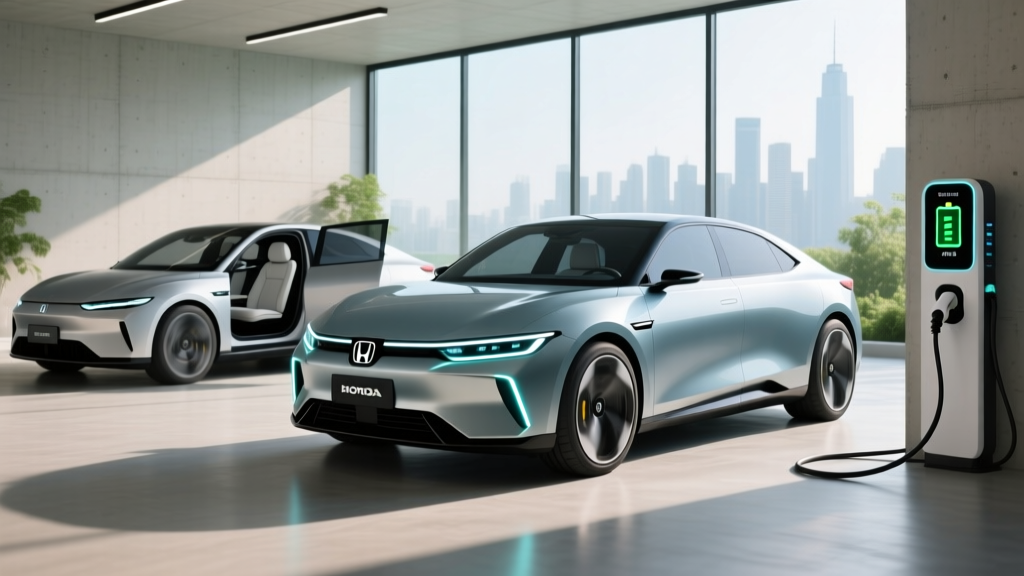
Honda has announced its 0 Series EV lineup, a family of vehicles built on a new dedicated EV platform developed in-house. The first models—a sedan and an SUV—are expected to arrive in the U.S. for the 2027 model year (likely late 2026 availability). Honda has previewed several key goals for the 0 Series:
- Thinner, lighter battery packs using improved NMC chemistry
- Improved aerodynamics targeting class-leading efficiency
- Faster charging capability (specific kW figures not yet confirmed)
- Level 3 autonomous capability in limited conditions (SAE Level 3 means the driver can fully disengage in specific, geofenced scenarios—unlike today's Level 2 systems)
- Starting MSRP targeting the $40,000–$50,000 range
These are announced/preliminary specifications. Honda has not released final EPA range, battery capacity, or charging speed figures. Buyers who need an EV now should evaluate the Prologue on its current merits rather than wait for the 0 Series, which remains over a year from widespread dealer availability.
Cost Breakdown: Honda Prologue vs. Gas Alternative
To understand whether the Prologue makes financial sense, let's compare it against a comparably equipped gas SUV—the Honda Passport, which starts around $42,000 and gets approximately 21 MPG combined.
| Cost Factor | Honda Prologue (EX FWD) | Honda Passport (AWD, gas) |
|---|---|---|
| Base MSRP | $47,400 | $42,000 |
| Federal Tax Credit (§30D) | Up to $7,500 (see eligibility below) | $0 |
| Effective Purchase Price | ~$39,900 | $42,000 |
| Fuel/Energy Cost (15,000 mi/yr) | ~$550–$750/yr (home charging at $0.14/kWh) | ~$2,500/yr (gas at $3.50/gal, 21 MPG) |
| Annual Maintenance | ~$300–$400 | ~$800–$1,100 |
| Insurance (annual avg) | ~$1,800–$2,200 | ~$1,400–$1,700 |
| 5-Year Total Operating Cost | ~$14,000–$17,000 | ~$24,000–$28,000 |
Key takeaway: The Prologue's higher MSRP is substantially offset by the federal tax credit and dramatically lower fuel and maintenance costs. Over five years, the Prologue can save $8,000–$12,000 in operating costs compared to a gas equivalent. However, EV insurance premiums are typically 15–30% higher, and depreciation remains uncertain for the Prologue specifically.
- Vehicle MSRP must not exceed $80,000 for SUVs (Prologue qualifies)
- Buyer AGI must not exceed $150,000 (single) / $300,000 (joint)
- Battery must meet critical mineral and component sourcing requirements (verify current-year compliance on IRS.gov)
- Credit can now be transferred to the dealer at point of sale as an immediate discount
- The Prologue is assembled in North America (Mexico), which satisfies the assembly requirement
Eligibility varies by buyer and can change with updated sourcing rules. Consult a tax professional and verify on IRS.gov before purchasing.
EV vs. Hybrid: Is the Prologue Right for Your Driving Pattern?
Honda also sells excellent hybrids—the CR-V Hybrid achieves 40 MPG combined and starts around $34,000. For many buyers, a hybrid may be the more practical choice. Here's a decision framework:
Choose the Honda Prologue (EV) if:
- You have reliable home Level 2 charging (240V, 30–50 amp circuit)
- Your daily driving is under 150 miles round-trip
- You live in a mild climate or have garage parking (cold weather hits the Prologue hard without a heat pump)
- You qualify for the full $7,500 federal tax credit and/or state incentives
- You want to minimize maintenance and fuel costs long-term
Choose the Honda CR-V Hybrid if:
- You lack home charging access and rely on street or apartment parking
- You regularly drive 300+ miles in a single trip through areas with sparse charging infrastructure
- You live in an extremely cold climate where EV range loss is a daily concern
- Your budget is under $35,000 and you don't want to stretch for the EV price premium
- You want the flexibility of gas station refueling on demand
| Metric | Honda Prologue (EV) | Honda CR-V Hybrid |
|---|---|---|
| Starting MSRP | $47,400 | $34,000 |
| EPA Efficiency | 99 MPGe / 3.0 kWh/mi | 40 MPG combined |
| Annual Fuel Cost (15k mi) | $550–$750 | $1,310 |
| Range / Tank | 296 mi (EPA) | ~430 mi |
| "Refuel" Time | 35 min (10–80% DC) / 7.5 hr (L2 home) | 5 min (gas station) |
| Tax Credit Eligible | Potentially up to $7,500 | No (not a PHEV) |
Charging at Home: What First-Time Honda EV Buyers Need
Home charging is the foundation of convenient EV ownership. Over 80% of EV charging happens at home, and the Prologue's 11.5 kW onboard charger is well-suited to overnight replenishment. Here's what installation involves:
| Item | Estimated Cost |
|---|---|
| Level 2 EVSE (charger unit, 32–48 amp) | $400–$700 |
| Electrician labor (240V circuit install) | $600–$2,000 |
| Electrical permit | $50–$200 |
| Panel upgrade (if needed, 100A→200A) | $1,500–$3,500 |
| Total (typical, no panel upgrade) | $1,050–$2,900 |
The Prologue uses the standard J1772 connector for Level 2 charging and CCS1 for DC fast charging. Honda has not announced a transition to the NACS (Tesla) connector for the Prologue, though future 0 Series models may adopt it. If you plan to use Tesla Superchargers, you'll need to verify adapter compatibility—Honda has not officially endorsed a third-party NACS adapter for the Prologue.
Important: Have a licensed electrician assess your panel capacity before purchasing a charger. A 48-amp Level 2 charger requires a 60-amp dedicated circuit. Older homes with 100-amp service may need a panel upgrade, which adds significant cost and lead time.
Common Misconceptions About the Honda Prologue
| Myth | Fact |
|---|---|
| "The Prologue is fully Honda-engineered" | It uses GM's Ultium platform, battery, and powertrain. Honda designed the exterior, interior, and tuning. |
| "296 miles of range means I can drive 296 miles" | EPA range is a lab estimate. Real-world highway and cold-weather range is 20–35% lower. Plan for 220–250 miles in practice. |
| "Everyone gets the $7,500 tax credit" | Eligibility depends on buyer income, vehicle MSRP, battery sourcing, and assembly location. Always verify on IRS.gov. |
| "I can charge at any Tesla Supercharger" | The Prologue uses CCS1. Tesla Supercharger access requires an approved adapter, and Honda has not confirmed compatibility for the Prologue. |
| "EV batteries need replacing every few years" | The Prologue's battery is warranted for 8 years/100,000 miles. GM's Ultium batteries show less than 10% degradation over 100,000 miles in fleet data. |
Ownership Considerations: Climate, Driving, and Infrastructure
Before committing to the Prologue, honestly assess these factors:
- Home charging access: If you can install a Level 2 charger at home, daily ownership is effortless. If you rely solely on public charging, the Prologue's 150 kW peak rate means longer stops than competitors—factor in 35+ minutes per session.
- Climate: The Prologue's lack of a heat pump is a real disadvantage in sub-40°F weather. Resistive heating draws significant battery power, cutting range by 20–35%. If you live in the northern U.S., budget for more frequent winter charging.
- Road trips: For annual road trips over 300 miles, the Prologue works but requires planning. CCS1 charging infrastructure via Electrify America and EVgo is widespread along major corridors, but rural routes may have gaps. Use apps like PlugShare to map charging before trips.
- Cargo and towing: The Prologue offers 25.2 cu ft of cargo space behind the rear seats (57.7 cu ft with seats folded). It does not offer a frunk. Towing capacity is limited to 1,500 lbs—adequate for a small trailer but not a boat or camper.
Frequently Asked Questions
Is the Honda Prologue eligible for the $7,500 federal tax credit in 2026?
The Prologue has qualified for the §30D credit in prior years due to its North American assembly and GM battery sourcing. However, critical mineral and component sourcing rules tighten annually. Always check the latest eligibility list on IRS.gov before purchasing. The credit can be applied as a point-of-sale discount at the dealer.
How does the Prologue compare to the Tesla Model Y?
The Model Y offers longer range (up to 330 miles EPA), faster DC charging (up to 250 kW, 10–80% in ~20 minutes), access to the Supercharger network, and a lower starting price (~$44,990). The Prologue counters with a more traditional SUV interior layout, physical buttons alongside its touchscreen, and a quieter ride quality that some testers prefer. If charging speed and network access are top priorities, the Model Y leads. If you prefer Honda's build quality and dealer experience, the Prologue is competitive.
Should I wait for Honda's 0 Series EVs?
The 0 Series is Honda's in-house EV platform, expected in the U.S. for the 2027 model year. It promises better efficiency, potentially faster charging, and Honda's own engineering. If your current vehicle is functional and you're not in a rush, waiting could yield a more compelling product. If you need an EV now—perhaps to capture expiring incentives or replace a failing vehicle—the Prologue is a capable, if not class-leading, choice today.
Does the Prologue support one-pedal driving?
Yes. The Prologue offers adjustable regenerative braking, including a strong enough regen setting for near one-pedal driving in city traffic. However, it does not come to a complete hold without applying the brake pedal—unlike some competitors that offer full stop-and-hold regen.
What is the Prologue's safety rating?
The Prologue earned strong marks from NHTSA and was tested by IIHS. It includes Honda Sensing as standard—adaptive cruise control, lane-keeping assist, automatic emergency braking, and blind-spot monitoring. This is an SAE Level 2 driver-assistance system, meaning the driver must remain fully attentive at all times.