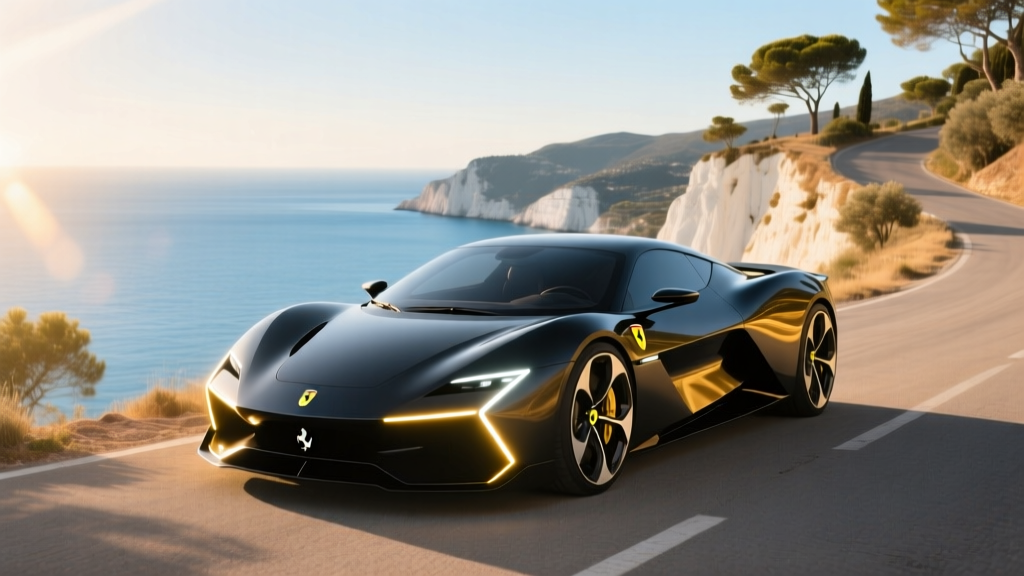
Ferrari's first fully electric production car is no longer a rumor — it's a confirmed, upcoming model expected to debut in late 2025 with customer deliveries beginning in 2026. If you're researching the new Ferrari EV, here's the direct answer: Ferrari has confirmed a four-door, four-seat grand tourer (internally code-named F167) built on a dedicated EV platform, with a targeted price above $500,000 and performance figures that aim to exceed the SF90 Stradale's 986 horsepower. Full EPA range, battery capacity, and charging specifications remain preliminary until the official reveal, but industry estimates and Ferrari's own engineering disclosures point to a 120+ kWh battery pack, 270–310 miles of EPA-estimated range, and DC fast-charging capability above 350 kW.
Quick Answer: The New Ferrari EV at a Glance
Status: Confirmed by Ferrari; full specs expected at official unveiling in 2025, deliveries in 2026.
Body style: Four-door, four-seat grand tourer (Ferrari's first 4-door production car).
Estimated price: $500,000–$600,000+ (pre-options).
Estimated range: 270–310 miles EPA (preliminary).
Estimated battery: ~120–130 kWh usable capacity.
Estimated power: 1,000+ hp (quad-motor or tri-motor AWD).
Federal EV tax credit: Not eligible — exceeds the $55,000 MSRP sedan cap under IRS §30D rules.
What Ferrari Has Confirmed About Its First EV
Ferrari CEO Benedetto Vigna has stated publicly that the company's first battery-electric vehicle will be "unmistakably a Ferrari" — prioritizing driving dynamics, sound character, and emotional engagement over pure efficiency metrics. The vehicle is being developed at Ferrari's new e-building in Maranello, a dedicated EV assembly facility that began construction in 2022.
What we know with reasonable confidence based on Ferrari's disclosures and supply-chain reporting:
- Platform: A bespoke EV architecture, not a rebadged Stellantis or shared platform. Ferrari has invested heavily in proprietary battery module design and power electronics.
- Battery chemistry: Likely high-nickel NMC (nickel manganese cobalt) or NCA cells optimized for power density and discharge rate, given Ferrari's performance mandate. LFP chemistry is improbable at this tier — energy density and weight are the primary constraints.
- Thermal management: An advanced liquid-cooling system designed to sustain repeated high-speed runs without significant power derating — critical for track-capable EVs where sustained 200+ mph demand rapidly heats battery packs.
- Sound design: Ferrari has filed multiple patents related to synthetic and augmented exhaust sound for EVs, suggesting an active audio system that generates a signature Ferrari acoustic profile rather than silence.
Estimated Specifications: Range, Battery, and Charging
Until Ferrari publishes official figures, the following estimates are based on the vehicle's expected weight class (~5,000–5,500 lbs), performance targets, and comparable high-performance EV platforms currently on the market. All figures are preliminary and subject to change at the official reveal.
| Spec | Ferrari EV (Est.) | Lotus Eletre R | Porsche Taycan Turbo GT | Tesla Model S Plaid |
|---|---|---|---|---|
| Battery (usable) | ~120–130 kWh (NMC est.) | 109 kWh (NMC) | 97 kWh (NMC) | 95 kWh (NMC) |
| EPA Range | 270–310 mi (est.) | 304 mi | 276 mi | 396 mi |
| Peak DC Charge Rate | 350+ kW (est.) | 350 kW | 320 kW | 250 kW |
| 10–80% DC Fast Charge | ~18–22 min (est.) | ~20 min | ~18 min | ~25 min |
| Power | 1,000+ hp (est.) | 905 hp | 1,019 hp | 1,020 hp |
| 0–60 mph | ~2.3 sec (est.) | 2.95 sec | 2.1 sec | 1.99 sec |
| Base MSRP | $500,000+ (est.) | $120,000 | $230,000 | $89,990 |
Real-World Range Caveat: Even if the Ferrari EV achieves a 310-mile EPA estimate, expect real-world highway range of roughly 240–270 miles at sustained 75–80 mph speeds. In cold weather (below 32°F), plan for a 20–30% reduction, bringing usable range down to approximately 190–230 miles. High-performance EVs with aggressive tire compounds and heavy curb weights tend to consume more energy at speed than their EPA tests suggest. This is physics, not a Ferrari-specific shortcoming.
Ferrari EV vs. Gas Ferrari: Cost of Ownership Comparison
The most practical comparison for a prospective Ferrari EV buyer isn't against a Tesla — it's against the gas-powered Ferraris in the same stable. Let's model a five-year ownership scenario comparing the estimated Ferrari EV against a Ferrari Roma (a V8 grand tourer in a similar spirit, MSRP ~$270,000).
| Cost Category | Ferrari EV (Est.) | Ferrari Roma (V8) |
|---|---|---|
| Purchase Price | $550,000 | $280,000 |
| Fuel/Energy (7,500 mi/yr) | $4,500 ($0.18/kWh avg, 3 mi/kWh) | $18,750 (14 mpg, $4.50/gal premium) |
| Maintenance (5 yr) | $8,000–$12,000 (tires, cabin filter, fluid top-offs) | $15,000–$25,000 (oil, brakes, belts, service intervals) |
| Insurance (5 yr est.) | $45,000–$60,000 | $30,000–$45,000 |
| Federal EV Tax Credit | $0 (exceeds §30D MSRP cap) | N/A |
| Depreciation (5 yr est.) | $200,000–$275,000 (high uncertainty for first EV) | $100,000–$140,000 |
| Est. 5-Year Total | $807,500–$901,500 | $443,750–$508,750 |
Energy and maintenance savings for the EV are meaningful — roughly $14,000–$21,000 over five years — but they're a rounding error against a $270,000 price gap and significantly higher projected depreciation. Nobody buys a Ferrari for total-cost-of-ownership optimization. The EV will be purchased for performance novelty, instant torque delivery, and the statement of owning Ferrari's first electric car.
Charging the Ferrari EV at Home and on the Road
At this price point, every owner will have access to dedicated home charging. The practical question is whether your electrical panel can support the optimal Level 2 setup.
Home Level 2 Charging (Recommended Setup):
- Circuit: 60-amp dedicated circuit with a 48-amp (11.5 kW) Level 2 charger.
- Charge time (0–100%): Approximately 11–13 hours for a ~125 kWh battery — overnight is sufficient.
- Installation cost: $1,500–$4,000 depending on panel capacity, conduit run length, and local permitting. If your home has a 200-amp main panel already near capacity, a panel upgrade to 400 amps could add $3,000–$5,000+.
- Electrician: Always use a licensed electrician. Ferrari is likely to recommend or require certified installers to maintain warranty coverage on the charging system.
Public DC Fast Charging:
With an estimated 350+ kW peak charge rate, the Ferrari EV should be compatible with the fastest public chargers available — including Electrify America's 350 kW stations and Tesla Supercharger V4 stalls (assuming Ferrari adopts the NACS connector, which is increasingly the industry standard as of 2025–2026). At peak rate, a 10–80% session would take roughly 18–22 minutes. However, expect the charge curve to taper significantly above 80% State of Charge (SoC) to protect battery longevity — the final 20% could add another 20–30 minutes.
Ferrari is also expected to offer access to premium charging networks, potentially including dedicated high-power chargers at Ferrari dealer locations or partner facilities — similar to how Porsche has installed 800V Turbo chargers at its dealerships for Taycan owners.
Who Should (and Shouldn't) Consider the New Ferrari EV
Decision Framework
Consider the Ferrari EV if:
- You already own multiple Ferraris and want the brand's first EV as a collector milestone.
- You have secure, climate-controlled garage space with a dedicated 60-amp circuit for overnight Level 2 charging.
- Your typical drives are under 200 miles round-trip, with occasional longer trips where DC fast charging is available.
- You value instant torque and silent high-speed cruising as a different experience from your V8/V12 Ferraris.
- Budget flexibility allows for $500,000+ acquisition and uncertain early-adopter depreciation.
Wait or look elsewhere if:
- This would be your only Ferrari and you want proven reliability data and established resale values.
- You regularly drive in regions with sparse DC fast-charging infrastructure (rural West, mountain corridors).
- You need confirmed specs, warranty terms, and independent reviews before committing — wait 12–18 months after launch.
- You prioritize range efficiency over performance — the Tesla Model S Plaid offers similar acceleration at 1/6th the price with superior range.
Common Misconceptions About the Ferrari EV
| Misconception | Reality |
|---|---|
| "It will qualify for the $7,500 federal EV tax credit." | No. Under IRS §30D rules, sedans and similar vehicles must have an MSRP at or below $55,000 to qualify. The Ferrari EV will be priced above $500,000. |
| "An electric Ferrari won't feel like a real Ferrari." | Ferrari's engineering team is targeting sub-2.3-second 0–60 mph times and has invested heavily in torque vectoring, active aero, and sound design. The driving experience will be different — not necessarily lesser. EVs deliver peak torque at 0 rpm, which changes the character but not the intensity. |
| "The battery will degrade quickly and cost $80,000 to replace." | Modern NMC batteries with active thermal management typically retain 85–90% capacity after 100,000 miles. Ferrari is expected to offer an 8-year/100,000-mile battery warranty (industry standard for luxury EVs). Replacement cost for a ~125 kWh pack is currently estimated at $35,000–$55,000 but will likely decline by the time replacement is needed. |
| "I can just walk in and buy one at MSRP." | Ferrari allocates new models to existing clients first, typically those with prior Ferrari purchase history. Expect a waitlist measured in years, with initial allocations going to top-tier collectors. Secondary market markups in the first 12–24 months are likely. |
| "It's basically a rebadged Maserati or Alfa Romeo EV." | Ferrari operates independently from Stellantis and has developed a proprietary EV platform. While some component suppliers may overlap, the powertrain, battery architecture, chassis, and software are Ferrari-designed. |
Battery Longevity, Warranty, and What First-Time Ferrari EV Buyers Should Know
Ferrari's existing warranty for hybrid models (SF90, 296 GTB) includes 7 years of maintenance coverage, setting a high bar for the EV. Industry expectations for the Ferrari EV's warranty package:
- Battery warranty: 8 years / 100,000 miles, with a capacity retention threshold of 70% (consistent with Porsche, Mercedes, and BMW luxury EV warranties).
- Vehicle warranty: 3 years / unlimited miles bumper-to-bumper, plus 7 years of scheduled maintenance included.
- Battery chemistry: Almost certainly NMC or NCA — chosen for energy density and power delivery. LFP (lithium iron phosphate) offers superior cycle life and lower cost but is heavier and less energy-dense, making it unsuitable for a performance-first application at this weight target.
For first-time EV buyers entering at this tier, three ownership realities deserve emphasis:
- Preconditioning matters. The Ferrari EV will almost certainly include battery preconditioning — a feature that warms the battery pack before DC fast charging to maximize charge speed. If you navigate to a fast charger using the car's built-in navigation, preconditioning activates automatically. Arriving at a charger with a cold battery can reduce peak charge rates by 30–50%.
- The 80% charging rule. DC fast charging slows dramatically above 80% SoC to protect battery health. Plan road trips around 10–80% charge sessions rather than waiting for a full charge. The last 20% can take as long as the first 70%.
- Tire costs are significant. High-performance EVs are heavy (5,000+ lbs) and deliver instant torque, which accelerates tire wear. Expect to replace tires every 10,000–15,000 miles at $400–$700 per corner for OEM-spec performance rubber.
Ferrari EV Frequently Asked Questions
When will the new Ferrari EV be available to buy?
Ferrari has confirmed an official reveal in 2025, with first customer deliveries expected in 2026. Exact timing depends on allocation priority — existing Ferrari collectors and VIP clients will receive first access. Walk-in availability at MSRP is unlikely in the first 1–2 years of production.
Will the Ferrari EV use NACS or CCS for charging?
As of early 2025, Ferrari has not officially confirmed the charging connector. However, with nearly every major automaker (Ford, GM, Rivian, Volvo, BMW, Mercedes, Hyundai) adopting Tesla's NACS (North American Charging Standard) for 2025–2026 models, it would be surprising if Ferrari did not follow suit for the North American market. European models will use CCS2, as is standard there.
How does the Ferrari EV compare to the Lamborghini Lanzador?
Lamborghini's first EV, the Lanzador, is a 2+2 grand tourer expected around 2028–2029 — significantly later than Ferrari's offering. The Ferrari EV will have a 2–3 year head start as the first ultra-luxury Italian EV. Direct comparison will depend on Lanzador's eventual specs, but Ferrari's earlier entry gives it a first-mover advantage in this niche.
Can I charge a Ferrari EV on a standard 120V outlet?
Technically yes (Level 1 charging at ~1.4 kW), but it would add only about 3–4 miles of range per hour — meaning a full charge from empty would take roughly 30–40 hours. This is impractical for daily use. A dedicated 240V Level 2 home charger is effectively mandatory.
What will insurance cost for the Ferrari EV?
Expect annual premiums of $9,000–$12,000+ depending on your driving record, location, and coverage levels. High-value EVs carry elevated insurance costs due to expensive battery replacement, specialized repair requirements, and high performance. Insurers like Hagerty, Chubb, and AIG typically underwrite vehicles in this range. Get quotes before committing to a purchase.
Is the Ferrari EV eligible for any state or local EV incentives?
Most state EV incentives have price caps similar to the federal program (often $60,000–$80,000 MSRP maximum), making the Ferrari EV ineligible for the vast majority of rebates. Check your state's specific program rules via your state energy office or DMV, but plan your budget assuming no incentives apply.