The New Electric Volkswagen Bus at a Glance
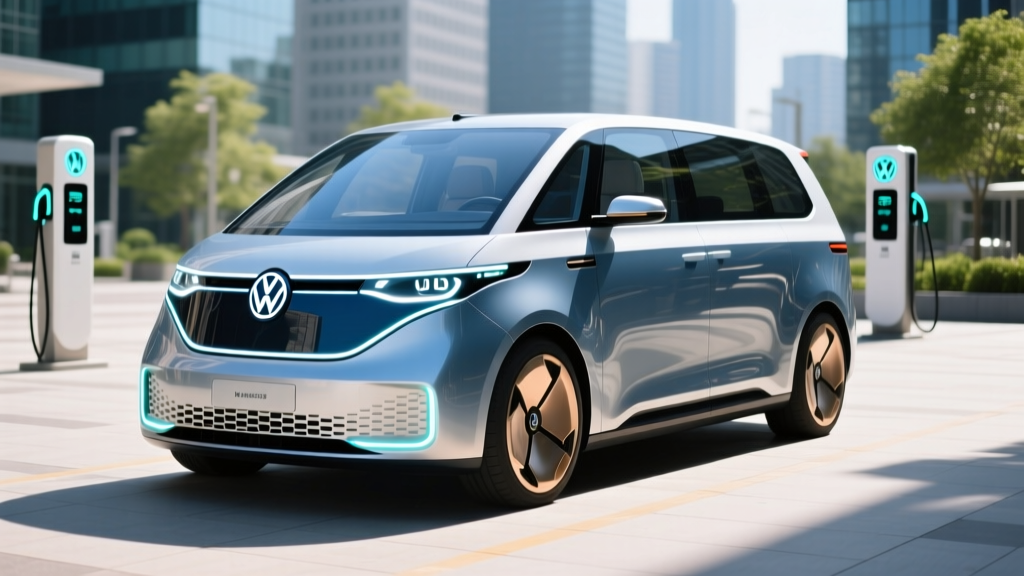
The new electric Volkswagen bus is the Volkswagen ID. Buzz, a retro-styled, three-row electric minivan based on VW's MEB platform. For the 2025–2026 model year, the long-wheelbase ID. Buzz delivers an EPA-estimated 234 miles of range (RWD) or 231 miles (AWD 4Motion), powered by a 91 kWh usable NMC lithium-ion battery. Pricing starts at $59,995 before destination for the Pro S trim. DC fast charging peaks at 175 kW, reaching 10–80% in approximately 26 minutes. The ID. Buzz qualifies for up to $7,500 in federal tax credits under IRS §30D, subject to income, MSRP, and battery-sourcing requirements. It competes against the Chrysler Pacifica Hybrid, Toyota Sienna Hybrid, and electric minivans like the Kia Carnival (ICE) — offering a fully electric alternative with zero tailpipe emissions but at a premium starting price.
Range, Battery & Real-World Efficiency
The ID. Buzz uses a floor-mounted 91 kWh (usable) NMC battery pack — one of the largest in its class. Volkswagen pairs it with a rear-mounted APP550 electric motor producing 282 horsepower and 406 lb-ft of torque in RWD form. The available 4Motion AWD adds a front motor for a combined 335 hp.
| Spec | ID. Buzz Pro S (RWD) | ID. Buzz 4Motion (AWD) |
|---|---|---|
| EPA Range | 234 miles | 231 miles |
| Battery (usable) | 91 kWh NMC | 91 kWh NMC |
| Motor Output | 282 hp / 406 lb-ft | 335 hp (combined) |
| 0–60 mph | ~7.9 sec (est.) | ~6.5 sec (est.) |
| Efficiency (MPGe) | ~87 MPGe combined | ~84 MPGe combined |
| EPA kWh/100mi | ~39 kWh/100mi | ~40 kWh/100mi |
Real-World Range Reality Check
The 234-mile EPA figure assumes mixed driving at moderate temperatures. In our experience with MEB-platform vehicles (ID.4, ID.7), expect:
- Highway cruising (75 mph): ~190–210 miles before needing a charge
- Cold weather (below 32°F): ~165–185 miles — the ID. Buzz's large frontal area and tall profile amplify aerodynamic drag and cold-weather battery inefficiency
- City / suburban driving: ~240+ miles — regenerative braking recovers energy effectively in stop-and-go traffic
For a family hauler primarily used for school runs, groceries, and weekend trips within a 100-mile radius, the range is adequate. Road trips require planning around DC fast chargers every ~180 miles to maintain a comfort buffer.
Charging Speeds: Home & Public
The ID. Buzz supports Level 2 AC charging at up to 11 kW (via its onboard charger) and DC fast charging at up to 175 kW peak via its CCS1 connector. VW has confirmed future NACS adapter compatibility, but as of the 2025–2026 model year, the native port is CCS1.
| Charging Level | Power | Miles Added per Hour | Time (10–80%) | Best For |
|---|---|---|---|---|
| Level 1 (120V household) | ~1.4 kW | ~4 mi/hr | ~55+ hours | Emergency / trickle |
| Level 2 (240V home) | 11 kW (max) | ~30 mi/hr | ~7.5 hours | Overnight home charging |
| DC Fast Charge | 175 kW (peak) | ~180 mi/30 min | ~26 minutes | Road trips |
Charging curve reality: The 175 kW peak is not sustained across the full session. Like most MEB vehicles, the ID. Buzz charges aggressively between 10–50% SoC, then tapers progressively. Expect an average rate closer to 110–120 kW over a full 10–80% session. That 26-minute figure is achievable at a functioning 350 kW Electrify America or compatible station — but real-world sessions at older 150 kW chargers will take closer to 35–40 minutes.
Home charging note: To get the full 11 kW Level 2 rate, you'll need a 48-amp hardwired charger on a 60-amp dedicated circuit. Most homes with a 200-amp electrical panel can accommodate this, but older homes with 100-amp panels may require a panel upgrade ($1,500–$3,000) before installation. Budget $500–$1,200 for a quality Level 2 charger (e.g., ChargePoint Home Flex, Emporia V2, Wallbox Pulsar Plus) and $500–$2,000 for electrician labor, depending on run length from panel to garage.
How the ID. Buzz Compares: EV vs. Hybrid vs. Gas Minivans
The ID. Buzz enters a minivan segment dominated by hybrids and conventional ICE models. Here's how it stacks up against the most relevant alternatives for a family buyer cross-shopping the new electric Volkswagen bus:
| Spec | VW ID. Buzz (RWD) | Toyota Sienna Hybrid (AWD) | Chrysler Pacifica PHEV |
|---|---|---|---|
| Powertrain | BEV (all-electric) | HEV (hybrid) | PHEV (plug-in hybrid) |
| EPA Range / Fuel | 234 mi (electric) | 36 MPG combined | 32 mi electric + 30 MPG gas |
| Starting MSRP | $59,995 | ~$39,500 | ~$51,000 |
| Fed. Tax Credit | Up to $7,500 (§30D) | None (HEV) | Up to $7,500 (§30D) |
| Est. Cost per Mile (fuel) | ~$0.045 (home L2) | ~$0.095 (gas) | ~$0.06 (blended) |
| Annual Fuel/Energy Cost* | ~$540 | ~$1,425 | ~$900 (blended) |
| Seats | 7 | 7–8 | 7 |
| Cargo (behind 3rd row) | ~18 cu ft | ~33 cu ft | ~32 cu ft |
*Based on 12,000 miles/year. Electricity at $0.15/kWh; gas at $3.50/gallon. Source: fueleconomy.gov estimates.
The trade-offs are clear: The ID. Buzz costs significantly more upfront (~$20,000 more than a Sienna) but delivers dramatically lower per-mile energy costs. Over 5 years and 60,000 miles, the fuel savings alone approach $4,500–$5,500 compared to a gas minivan. Factor in the $7,500 federal credit (if eligible), and the effective price gap narrows to roughly $10,000. However, the Sienna and Pacifica offer substantially more cargo space behind the third row — a practical dealbreaker for families who regularly haul bulky gear.
Total Ownership Cost Breakdown (5 Years / 60,000 Miles)
| Cost Category | VW ID. Buzz (RWD) | Toyota Sienna Hybrid |
|---|---|---|
| Purchase Price (base MSRP) | $59,995 | $39,500 |
| Federal Tax Credit (§30D) | −$7,500 (if eligible) | $0 |
| Effective Purchase Price | $52,495 | $39,500 |
| Home Charger Install (one-time) | $1,500 | $0 |
| Energy/Fuel (5 years) | $2,700 | $7,125 |
| Maintenance (5 years) | ~$1,200 | ~$2,800 |
| Insurance (est. 5 years) | ~$11,500 | ~$8,500 |
| Estimated Depreciation | ~$22,000 | ~$15,000 |
| 5-Year Total Cost | ~$91,395 | ~$72,925 |
| Cost per Mile | ~$1.52 | ~$1.22 |
Key takeaways from the numbers:
- The ID. Buzz saves roughly $4,425 in energy costs and $1,600 in maintenance (no oil changes, fewer brake replacements due to regen) over 5 years.
- Insurance premiums run 15–35% higher for EVs — the ID. Buzz's premium starting price and repair-cost profile push estimates to $2,200–$2,400/year depending on your state and driving record.
- Depreciation remains the wildcard. VW's MEB vehicles have seen steeper-than-average depreciation; the ID. Buzz's niche appeal could help or hurt resale depending on market demand at trade-in time.
- Even with the tax credit, the 5-year total cost of ownership is roughly $18,500 higher than the Sienna Hybrid. You're paying a premium for the EV experience, zero tailpipe emissions, and the ID. Buzz's unique design.
Federal Tax Credit & Incentives: What You Actually Qualify For
The ID. Buzz may qualify for the full $7,500 federal EV tax credit under IRS §30D, but eligibility depends on several factors that change annually. As of the 2025–2026 tax year:
- MSRP cap: Vans classified as SUVs/trucks have an $80,000 MSRP cap. The ID. Buzz qualifies at its ~$60K–$66K pricing.
- Buyer income cap: Modified AGI must not exceed $300,000 (joint), $225,000 (head of household), or $150,000 (single).
- Battery sourcing: The critical-minerals and battery-component requirements phase in annually. VW has worked to localize supply chains, but verify current-year compliance on the IRS qualified vehicles list.
- Point-of-sale transfer: Since 2024, you can transfer the credit to the dealer at purchase, reducing your out-of-pocket cost immediately rather than waiting for a tax refund.
Always confirm eligibility on IRS.gov before signing a purchase agreement, as sourcing requirements tighten each year. Some states (California, Colorado, Massachusetts, and others) stack additional rebates of $1,000–$5,000 on top — check your state energy office for current programs.
Real-World Ownership: What First-Time EV Buyers Must Know
Common ID. Buzz Misconceptions vs. Reality
| Myth | Fact |
|---|---|
| "234 miles is enough for any road trip" | At highway speeds in cold weather, usable range drops to ~170 miles. Plan stops at DC chargers every 150–170 miles for a comfort buffer. |
| "It charges as fast as a Tesla" | The ID. Buzz peaks at 175 kW vs. Tesla Model X at 250 kW. Expect 10–80% in ~26 min vs. ~15–18 min for the fastest Tesla Supercharger sessions. |
| "I don't need a home charger" | Public DC charging costs $0.30–$0.50/kWh vs. ~$0.15/kWh at home. Without home Level 2 charging, your per-mile cost doubles and convenience drops significantly. |
| "The battery will need replacing soon" | VW warranties the battery for 8 years / 100,000 miles against degradation below 70% capacity. NMC batteries in MEB vehicles have shown <10% degradation at 60,000 miles in fleet data. |
| "It has the cargo space of a regular minivan" | Behind the third row, the ID. Buzz offers only ~18 cu ft — far less than the Sienna (~33 cu ft) or Pacifica (~32 cu ft). Fold the third row for ~75 cu ft. |
Home Charging Access Is Non-Negotiable
If you cannot install a Level 2 charger at home (apartment living, no garage, HOA restrictions), the ID. Buzz becomes significantly less practical. Level 1 charging (standard 120V outlet) adds only ~4 miles of range per hour — meaning a full recharge from 10% takes over 55 hours. For daily driving of 30–40 miles, Level 1 can barely keep up overnight, but any day with extra driving leaves you stranded or dependent on public chargers. Confirm your home's electrical capacity before committing to the purchase.
Climate Considerations
The ID. Buzz includes a heat pump for cabin heating, which reduces the range penalty of cold weather compared to resistive heaters — but the tall, boxy shape (high drag coefficient) compounds cold-weather range loss at highway speeds. Buyers in northern climates (Minnesota, New England, Mountain West) should budget for 25–30% range loss in winter and plan accordingly.
Decision Framework: Should You Buy the New Electric Volkswagen Bus?
Choose the ID. Buzz If:
- You have reliable home Level 2 charging access (garage or driveway with 240V circuit)
- Your daily driving is under 80 miles round-trip, with occasional 150–200 mile weekend trips
- You value zero tailpipe emissions and lower per-mile energy costs
- You want a distinctive, retro-styled family vehicle that stands out from the minivan crowd
- You qualify for the $7,500 federal credit and potentially state incentives
- You prioritize driving refinement (quiet, smooth, instant torque) over maximum cargo volume
Choose a Hybrid Minivan (Sienna / Pacifica) Instead If:
- You cannot install a Level 2 home charger
- You regularly drive more than 250 miles between stops or tow heavy loads
- You need maximum cargo space behind the third row for sports gear, strollers, or luggage
- Your budget tops out around $40,000–$50,000
- You live in a region with sparse DC fast-charging infrastructure (rural Great Plains, remote mountain areas)
- You plan to keep the vehicle 10+ years and want to avoid battery replacement risk entirely
Trims, Pricing & What's Included
For the 2025–2026 model year, the ID. Buzz is offered in three trims, all with the 91 kWh battery:
| Trim | Drivetrain | MSRP (before dest.) | Key Features |
|---|---|---|---|
| Pro S | RWD | $59,995 | Heated front seats, 12.9" infotainment, IQ.DRIVE ADAS, power sliding doors |
| Pro S Plus | RWD or AWD | ~$63,495 | Harman Kardon audio, panoramic roof, ventilated front seats, 360° camera |
| 1st Edition | AWD | ~$65,495 | Two-tone heritage paint, exclusive interior trim, all Pro S Plus features |
All trims include VW's IQ.DRIVE suite (SAE Level 2 driver assistance): adaptive cruise control, lane centering, automatic emergency braking, and blind-spot monitoring. This is a hands-on-wheel system — not self-driving — and requires continuous driver attention, consistent with all consumer Level 2 ADAS systems.
Frequently Asked Questions
Is the VW ID. Buzz eligible for the $7,500 federal EV tax credit?
It can be, depending on current-year battery-sourcing compliance, your income level, and the vehicle's MSRP classification. The ID. Buzz falls under the $80,000 MSRP cap for vans/SUVs. Verify eligibility on the IRS qualified vehicles list before purchase, as requirements tighten annually.
How long does it take to charge the ID. Buzz at home?
On a 48-amp Level 2 home charger (11 kW), a full charge from 10% to 100% takes approximately 8–9 hours. Most owners plug in overnight and wake to a full battery every morning — the practical advantage of home charging.
Can the ID. Buzz tow?
The ID. Buzz has a maximum towing capacity of approximately 2,500 pounds (braked trailer, RWD). This is adequate for a small utility trailer or a pair of jet skis but not suitable for a travel trailer or boat. The Toyota Sienna Hybrid offers a similar 3,500-lb rating when properly equipped.
What is the battery warranty?
Volkswagen covers the ID. Buzz high-voltage battery for 8 years or 100,000 miles (whichever comes first) against degradation below 70% of original capacity. The basic vehicle warranty is 4 years / 50,000 miles.
Will the ID. Buzz work with Tesla Superchargers?
Not natively. The ID. Buzz uses a CCS1 connector. Volkswagen has indicated NACS adapter support, which would grant access to Tesla's Supercharger network, but confirm adapter availability and compatibility at the time of purchase. Electrify America, EVgo, and ChargePoint networks work natively via CCS1.
How does the ID. Buzz handle in snow and ice?
The AWD 4Motion variant provides dual-motor traction that performs well in light-to-moderate snow. The low center of gravity (battery under the floor) aids stability. However, fit dedicated winter tires for serious snow-belt driving — the stock all-season tires prioritize efficiency and comfort over winter grip.
Is the ID. Buzz bigger than a regular minivan?
Externally, the long-wheelbase ID. Buzz is roughly 192 inches long — about 20 inches shorter than a Chrysler Pacifica or Toyota Sienna. It's easier to park but sacrifices interior cargo volume as a result. Think of it as closer to a compact minivan in footprint with a midsize minivan's passenger space.