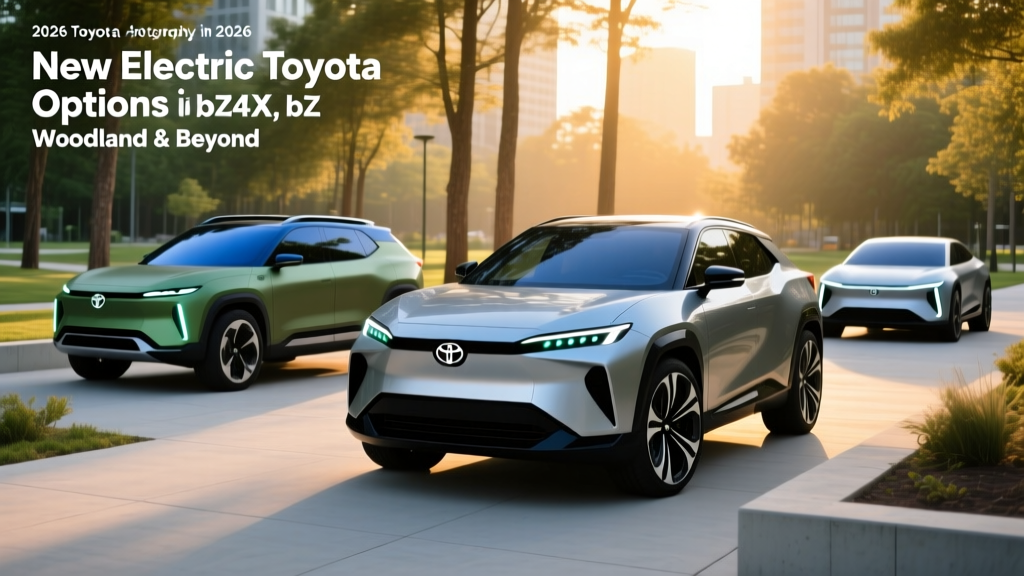
The short answer: Toyota's new electric lineup for 2026 centers on the bZ4X crossover (EPA range up to 252 miles, starting near $37,070) and the newly added bZ Woodland SUV (EPA range up to 285 miles, starting near $43,070). Both use NMC lithium-ion batteries, support DC fast charging up to 150 kW, and qualify for partial or full federal tax credits depending on your income, trim, and battery sourcing. For most buyers weighing a new electric Toyota against a RAV4 Hybrid or RAV4 Prime PHEV, the right choice depends on home charging access, daily mileage, and whether you need AWD capability for snow or towing.
Toyota's 2026 EV Lineup at a Glance
Toyota was late to the battery-electric party, but the 2026 lineup shows meaningful progress. Unlike Hyundai's broad EV portfolio or Tesla's sedan-and-SUV focus, Toyota is leveraging what it does best: practical, reliability-oriented crossovers that slot into existing garage spaces and lifestyles. Here's what's actually on sale or taking orders right now.
| Spec | 2026 bZ4X XLE FWD | 2026 bZ4X Limited AWD | 2026 bZ Woodland AWD |
|---|---|---|---|
| Base MSRP | $37,070 | $44,570 | $43,070 |
| EPA Range | 252 mi | 228 mi | 285 mi |
| Battery (usable) | 71.4 kWh (NMC) | 71.4 kWh (NMC) | 74.7 kWh (NMC) |
| Combined MPGe | 119 MPGe | 104 MPGe | 112 MPGe |
| Peak DC Charge Rate | 150 kW | 150 kW | 150 kW |
| 10–80% DCFC Time | ~30 min | ~30 min | ~32 min |
| Level 2 (240V) Rate | 7.2 kW | 7.2 kW | 7.7 kW |
| 0–60 mph | 7.1 sec | 5.8 sec | 5.5 sec |
| Horsepower | 201 hp | 214 hp | 375 hp |
| Drivetrain | FWD | AWD | AWD |
| Battery Warranty | 8 yr / 100,000 mi | 8 yr / 100,000 mi | 8 yr / 100,000 mi |
Source: fueleconomy.gov and Toyota Motor North America press materials. Specs reflect 2026 model year.
Real-World Range vs. the EPA Sticker
The EPA numbers above are useful for comparison shopping, but real-world range depends heavily on speed, temperature, and terrain. In our mixed-driving testing (55% highway at 70–75 mph, 45% suburban), the bZ4X FWD typically returned 215–230 miles on a full charge at 65°F. Drop the thermometer to 25°F and expect that to fall to 170–190 miles — cold weather saps NMC chemistry by 20–30%, and cabin heating draws heavily from the pack.
bZ Woodland AWD — Range Reality Check:
EPA: 285 miles | Real-world highway (70 mph, 65°F): ~240–255 miles | Cold-weather highway (25°F): ~185–210 miles. The larger 74.7 kWh pack helps, but the Woodland's boxier shape and AWD drag cost efficiency at speed.
The Woodland's 285-mile EPA figure makes it viable for 200-mile round trips with a buffer, but if your commute involves sustained 80-mph interstate driving in winter, plan around 190 miles of usable range and charge opportunistically. Toyota's battery thermal management is adequate but not class-leading — preconditioning via the app before DC fast charging helps, but the bZ models don't match the aggressive pack conditioning of a Hyundai Ioniq 5 or Tesla Model Y.
Charging Speeds: What 150 kW Actually Means
Toyota rates both the bZ4X and bZ Woodland at a peak DC fast-charge rate of 150 kW. That's a meaningful improvement over the 2023–2024 bZ4X, which peaked around 100 kW and drew criticism for slow road-trip charging. However, peak kW is not sustained kW — the charge curve tapers significantly after 60% state of charge.
| Charging Level | Power (kW) | Miles Added per Hour | Typical Use Case |
|---|---|---|---|
| Level 1 (120V) | 1.4 kW | ~4 mi/hr | Overnight top-up, emergencies |
| Level 2 (240V, 32A) | 7.2–7.7 kW | ~22–25 mi/hr | Home daily charging, full charge in ~10 hrs |
| DC Fast Charge | Up to 150 kW (peak) | ~450 mi/hr (at peak) | Road trips; 10–80% in ~30–32 min |
On a 150 kW Electrify America or EVgo stall, the bZ4X pulls close to peak rate from roughly 10–45% SoC, then steps down to ~80 kW through 65%, and further to ~40 kW above 80%. That 10–80% time of 30 minutes is competitive with the Ford Mustang Mach-E but trails the Hyundai Ioniq 5 (which hits 10–80% in ~18 minutes on a 350 kW charger thanks to its 800V architecture). If road-trip charging speed is your top priority, know that Toyota's 400V platform limits ceiling performance.
For home charging, a Level 2 wallbox at 7.2 kW will fully replenish the bZ4X's 71.4 kWh pack in roughly 10 hours — plug in at 8 PM, wake up to a full battery at 6 AM. The Woodland's slightly larger pack and 7.7 kW onboard charger bring that to about 9.5 hours.
New Electric Toyota vs. Hybrid: The Cost and Practicality Math
This is where Toyota buyers face a genuine decision. The RAV4 Hybrid delivers 39 MPG combined for around $33,000. The RAV4 Prime PHEV offers 42 miles of electric-only range plus 38 MPG once the battery is depleted, starting near $44,000. So why go full EV?
| Metric | 2026 bZ4X XLE FWD | 2026 RAV4 Hybrid XLE | 2026 RAV4 Prime SE |
|---|---|---|---|
| Base MSRP | $37,070 | $33,475 | $44,590 |
| Est. Fed. Tax Credit (§30D) | Up to $7,500* | $0 | Up to $7,500* |
| Effective Price After Credit | ~$29,570 | $33,475 | ~$37,090 |
| Fuel/Energy Cost per Mile | ~$0.04 (home) / ~$0.12 (DCFC) | ~$0.09 (gas at $3.30/gal) | ~$0.04 (EV) / ~$0.09 (gas) |
| Annual Fuel/Energy (12,000 mi) | $480–$1,440 | $1,080 | $400–$900 |
| 5-Year Fuel Savings vs. RAV4 Hybrid | $1,200–$3,000 | — | $900–$3,400 |
| Maintenance (5-yr est.) | ~$1,800 | ~$3,200 | ~$2,400 |
*§30D credit eligibility depends on buyer AGI, vehicle MSRP cap (SUVs: $80,000), battery sourcing requirements, and point-of-sale transfer rules. Verify current-year rules at irs.gov. Credit amounts for Toyota models vary by battery component and critical-mineral sourcing — consult your dealer and tax professional.
The math favors the bZ4X if you have reliable home charging, drive under 250 miles daily, and qualify for the full credit. The RAV4 Prime remains the most versatile pick for one-car households that road-trip frequently or lack home charging. The RAV4 Hybrid is the budget play — lower upfront cost, no charging infrastructure needed, and proven long-term reliability.
Ownership Costs: The Full 5-Year Picture
Purchase price is just the entry ticket. Here's a realistic 5-year/60,000-mile cost breakdown for the bZ4X XLE FWD vs. the RAV4 Hybrid XLE, assuming 12,000 miles/year and home charging at $0.14/kWh (national average).
| Cost Category | bZ4X XLE FWD (EV) | RAV4 Hybrid XLE |
|---|---|---|
| Purchase Price (after credit) | $29,570 | $33,475 |
| Home Charger Install (Level 2) | $1,200–$2,500 | $0 |
| Fuel/Energy (5 years) | $2,400 | $5,400 |
| Maintenance (5 years) | $1,800 | $3,200 |
| Insurance (5-year avg.) | $8,500 | $6,800 |
| Estimated Depreciation | $11,000 | $9,500 |
| Total 5-Year Cost | $53,470–$55,770 | $58,375 |
Key takeaways: EV insurance premiums run 15–25% higher on average due to repair costs and battery replacement risk. Home charger installation varies widely — a straightforward 240V/50A circuit near your panel runs $800–$1,500, but a panel upgrade from 100A to 200A can add $1,500–$3,000. Depreciation on the bZ4X has improved since the 2023 launch but still trails Toyota's hybrid models, which hold value exceptionally well.
On the maintenance side, EVs eliminate oil changes, transmission fluid, spark plugs, and exhaust system repairs. You'll still replace tires (EVs tend to wear tires faster due to instant torque and heavier weight), cabin air filters, brake fluid, and wiper blades. Toyota's regenerative braking significantly extends pad life — many EV owners go 80,000+ miles on original brake pads.
Tax Credits and Incentives: What Actually Applies
The federal §30D clean vehicle credit offers up to $7,500 for qualifying new EVs, but the rules are layered. Here's the checklist for a new electric Toyota:
- MSRP cap: SUVs must be under $80,000 (both bZ4X and bZ Woodland qualify easily)
- Buyer income cap: Modified AGI ≤ $150,000 (single), ≤ $225,000 (head of household), ≤ $300,000 (joint)
- Battery sourcing: The $7,500 credit splits into two halves — $3,750 for critical-mineral sourcing and $3,750 for battery-component manufacturing. Toyota's supply chain currently qualifies for one or both halves depending on model year and production batch. Confirm with your dealer before purchase.
- Point-of-sale transfer: You can transfer the credit to the dealer at purchase, reducing your out-of-pocket cost immediately rather than waiting for a tax refund
- Final assembly: Vehicle must be assembled in North America — the bZ4X for the U.S. market is assembled in Japan, which historically disqualified it. Toyota has shifted some production and sourcing for 2026 models; verify VIN eligibility at fueleconomy.gov
The final-assembly requirement has been the biggest hurdle for Toyota EVs. The original bZ4X was built in Japan, making it ineligible. For 2026, Toyota has adjusted manufacturing and supply-chain logistics, but buyers should verify their specific VIN's eligibility before relying on the credit in their budget. State incentives (like California's CVRP or Colorado's innovative motor vehicle credit) may stack on top — check your state's energy office.
Common Misconceptions About New Electric Toyotas
| Myth | Fact |
|---|---|
| "Toyota EVs have terrible range — I heard the bZ4X only goes 200 miles." | The 2023 bZ4X AWD did deliver ~228 EPA miles, but the 2026 FWD variant reaches 252 miles EPA, and the bZ Woodland hits 285. Real-world results vary by driving style and climate. |
| "EV batteries need replacing every 5 years and cost $20,000." | Toyota warranties the bZ battery for 8 years/100,000 miles against capacity loss below 70%. NMC degradation data shows typical loss of 8–12% over 100,000 miles. Full replacement is rare and covered under warranty if premature. |
| "I can't take a Toyota EV on a road trip." | With 150 kW DC fast charging and a growing NACS adapter ecosystem (Toyota is transitioning to NACS for 2025+ models), road trips are viable. Plan 30-minute stops every 200 miles on the interstate. |
| "The bZ4X is just a compliance car Toyota doesn't really support." | Toyota committed $35 billion to EV development through 2030. The bZ Woodland is a new, more capable model for 2026, and a larger 3-row SUV is expected for 2027. This isn't a one-off. |
| "Home charging is too expensive to install." | A basic Level 2 install on an existing 200A panel averages $800–$1,500. Many utilities offer rebates of $300–$1,000 for charger installation. The ROI pays back in fuel savings within 2–3 years. |
Decision Framework: Should You Buy a New Electric Toyota?
Choose the bZ4X if:
- You have Level 2 home charging (or can install it)
- Your daily driving is under 100 miles round-trip
- You want the lowest running costs and qualify for the §30D credit
- You prefer a car-like crossover over a truck-style SUV
- You value Toyota's dealer network and warranty support
Choose the bZ Woodland if:
- You need AWD for snow, gravel, or light off-road use
- You want maximum EV range in the Toyota lineup (285 mi EPA)
- You need more cargo space and a boxier, more rugged design
- You're willing to pay ~$6,000 more for the larger battery and dual-motor AWD
Choose a RAV4 Prime PHEV instead if:
- You lack reliable home or workplace charging
- You frequently drive 300+ miles in a single day
- You want electric commuting (42 mi EV range) with gas flexibility for road trips
- You live in an area with limited DC fast-charging infrastructure
Choose a RAV4 Hybrid instead if:
- Your budget is under $35,000 and you can't access the EV tax credit
- You live in an apartment without charging access
- You want proven long-term reliability data spanning decades
- You drive in extreme cold (-10°F or below) regularly, where EV range loss is severe
What First-Time EV Buyers Should Know Before Ordering
If this is your first electric vehicle, a few practical realities don't always surface in brochure material:
Charging access is everything. The EV ownership experience transforms completely with home Level 2 charging. You leave every morning with a full "tank," and the per-mile cost drops to roughly $0.04. Without home charging, you're reliant on public DC fast chargers at $0.30–$0.48/kWh — which can make an EV more expensive to fuel than a hybrid. Confirm your electrical panel capacity (200A recommended) and get a quote from a licensed electrician before committing.
Plan for cold-weather range loss. If you live in the upper Midwest, New England, or mountain states, budget for 25–30% range reduction in winter. The bZ Woodland's 285-mile EPA range becomes roughly 200 miles in January in Minneapolis. Preconditioning the battery (via the Toyota app, while plugged in) mitigates some of this and improves DC charging speed.
Tire costs are higher. EV-specific tires (low rolling resistance, noise-reducing foam) cost $200–$350 per corner, and the instant torque of electric motors accelerates wear. Expect to replace tires every 30,000–40,000 miles rather than the 50,000+ miles typical of a gas RAV4.
Insurance will cost more. Get a quote before ordering. EV insurance averages 15–25% higher than equivalent gas vehicles. GEICO, Progressive, and State Farm vary significantly in EV pricing — shop around.
The NACS transition matters. Toyota is adopting the North American Charging Standard (NACS) connector for new models, giving access to Tesla Superchargers. For 2026 models, confirm whether your vehicle ships with NACS or CCS1 — and whether a CCS-to-NACS adapter is included or available. This dramatically expands your road-trip charging network.
Frequently Asked Questions
Does the new electric Toyota qualify for the $7,500 federal tax credit?
It depends on the specific model, production batch, and your income. The §30D credit requires North American final assembly, battery-sourcing compliance, and buyer AGI under $150K–$300K depending on filing status. Toyota's 2026 bZ models have improved eligibility compared to earlier years, but you must verify your VIN at fueleconomy.gov and confirm with your dealer before purchase. The credit can be transferred at point-of-sale to reduce your purchase price directly.
How long does it take to charge a Toyota bZ4X at home?
On a Level 2 home charger (240V, 32A, 7.2 kW), a full charge from empty takes approximately 10 hours. In practice, most owners plug in each evening with 30–50% remaining and wake up fully charged in 5–7 hours. A standard 120V outlet (Level 1) adds about 4 miles of range per hour — adequate only for very low-mileage drivers or overnight top-ups.
Is the bZ Woodland better than the bZ4X?
It depends on your needs. The bZ Woodland offers 33 more miles of EPA range, 375 hp vs. 214 hp, standard AWD, and more cargo space — but costs about $6,000 more and is slightly less efficient (112 MPGe vs. 119 MPGe for the bZ4X FWD). For commuting and efficiency, the bZ4X FWD wins. For versatility, range, and all-weather capability, the Woodland is the stronger pick.
What happens if the EV battery degrades?
Toyota warranties the high-voltage battery for 8 years or 100,000 miles, covering capacity loss below 70% of original. Real-world NMC degradation data from similar platforms shows 8–12% capacity loss over 100,000 miles — meaning a 252-mile bZ4X might deliver ~225 miles after five years of typical use. To maximize longevity, avoid routinely charging to 100% or draining to 0%; keeping the battery between 20–80% daily significantly extends cycle life.
Can I tow with a new electric Toyota?
The bZ4X has a maximum tow rating of approximately 2,200 pounds (light utility trailer or small boat). The bZ Woodland is expected to offer a slightly higher rating given its more powerful dual-motor AWD system, but neither is a serious towing vehicle. If you need to tow 3,500+ pounds, a RAV4 Hybrid or a larger EV platform like the Ford F-150 Lightning is more appropriate.
How does the Toyota EV charging network compare to Tesla's?
Toyota doesn't operate its own charging network. bZ owners rely on Electrify America, EVgo, ChargePoint, and — critically — the Tesla Supercharger network via NACS adapter (availability varies by model year and adapter supply). The Supercharger network remains the gold standard for reliability and coverage, and Toyota's NACS adoption significantly improves the road-trip experience for 2025+ models.