The Short Answer for Fleet Buyers
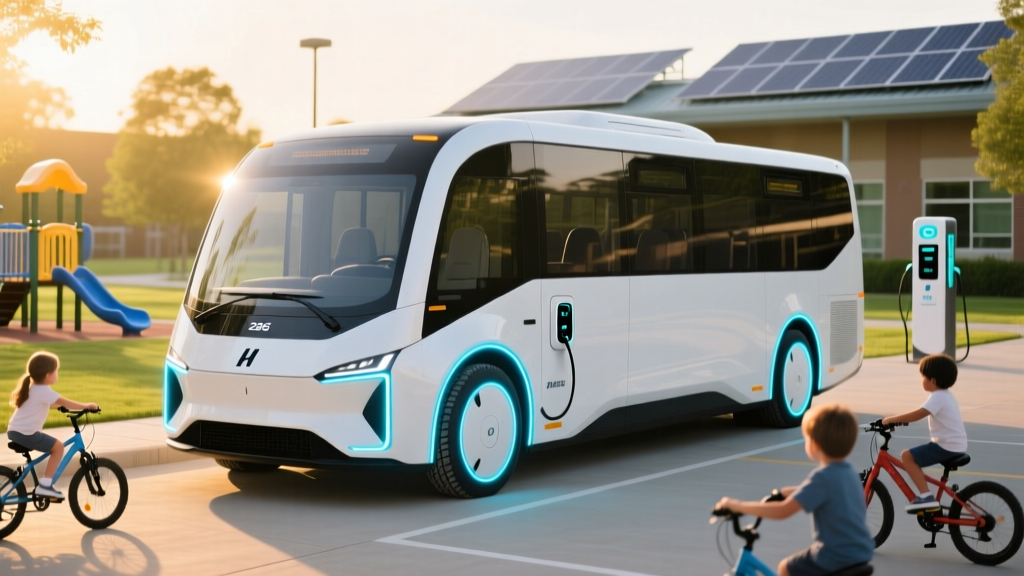
A new electric school bus in 2026 carries a base purchase price between $230,000 and $410,000 depending on size (Type A–D), compared to $90,000–$130,000 for a comparable diesel bus. However, after the EPA Clean School Bus Program rebates (up to $375,000 for qualifying districts) and the IRS §45W Commercial Clean Vehicle Credit (up to $40,000), the net acquisition cost can approach or undercut diesel. Operating savings are the real story: electricity costs average $0.14–$0.22 per mile versus $0.55–$0.85 per mile for diesel, and maintenance drops by an estimated 40–60% due to the elimination of oil changes, DPF filters, exhaust aftertreatment, and transmission servicing. Real-world range sits between 100 and 175 miles on a single charge depending on battery size, climate, and route topography — sufficient for roughly 85–90% of U.S. school bus routes, which average under 80 miles round-trip per day.
2026 Electric School Bus Market: What's Available Now
The electric school bus segment has consolidated around a handful of production-ready manufacturers after the departure of Lion Electric from the U.S. market in late 2025. The dominant players for the 2026 model year are:
- Blue Bird Vision Electric (Type C) — The highest-volume electric school bus in North America, built on the familiar Vision chassis with a Cummins-supplied electric powertrain and an LFP battery pack.
- Thomas Built Saf-T-Liner eC2 (Type C) — Daimler Truck's electric school bus offering, using the Detroit ePowertrain and available with NMC or LFP chemistry depending on spec.
- IC Bus RE-Series Electric (Type D) — Navistar/Traton's rear-engine electric platform targeting large-capacity routes with a larger battery option.
- GreenPower BEAST Type D — A purpose-built electric platform from GreenPower Motor Company, available in 35- and 40-foot configurations.
- Collins NexBus Electric (Type A) — A smaller, cutaway-based electric bus for special education and activity routes, typically seating 14–24 passengers.
All current-production models use liquid-cooled battery packs with active thermal management, CCS1 DC fast charging ports (with NACS adapters available for some), and Level 2 AC charging capability via J1772 or CCS Combo connectors.
Spec Comparison: Electric vs. Diesel School Bus
| Specification | Blue Bird Vision Electric (2026) | Blue Bird Vision Diesel (2026) |
|---|---|---|
| Base MSRP | $265,000–$310,000 | $105,000–$125,000 |
| Battery Capacity | 155 kWh usable (LFP) | N/A — 60-gal diesel tank |
| EPA Range | ~140 miles (loaded) | ~500+ miles |
| Real-World Range (cold) | ~95–110 miles at 20°F | ~420 miles (minor cold loss) |
| Peak DC Fast Charge | 60 kW (CCS1) | N/A |
| Charge Time 10–80% (DC) | ~75 minutes | Refuel: ~10 minutes |
| Level 2 Charge Rate | 19.2 kW (AC) | N/A |
| Level 2 Charge Time (Full) | ~8 hours (overnight) | N/A |
| Motor Output | 200 kW (268 hp) / 1,770 lb-ft | 260 hp / 660 lb-ft |
| Fuel/Energy Cost per Mile | $0.14–$0.22 | $0.55–$0.85 |
| Estimated Annual Maintenance | $3,500–$5,000 | $8,000–$12,000 |
| Battery/Powertrain Warranty | 8 years / 150,000 miles | 5 years / 100,000 miles (engine) |
| Passenger Capacity | 72–78 (depending on config) | 72–78 |
| GVWR | 33,000 lbs | 33,000 lbs |
Sources: Blue Bird Corporation, U.S. DOE Alternative Fuels Data Center. Real-world range estimates based on fleet operator data and third-party testing; cold-weather figures assume 20°F ambient with cabin heating active.
Total Cost of Ownership: Where Electric Wins (and Where It Doesn't)
The purchase price of a new electric school bus is roughly 2.0–2.8× higher than a diesel equivalent before incentives. This is the single biggest barrier for school districts operating on tight capital budgets. The economics only work when you factor in three elements: incentives, operating savings, and time horizon.
5-Year Cost Breakdown (Single Bus, 12,000 Miles/Year)
| Cost Category | Electric Bus | Diesel Bus |
|---|---|---|
| Purchase Price (base) | $285,000 | $115,000 |
| EPA Clean School Bus Rebate | −$285,000 (Priority districts) | $0 |
| IRS §45W Commercial Credit | −$40,000 | $0 |
| Net Acquisition Cost | $0–$40,000* | $115,000 |
| Charging Infrastructure (allocated per bus) | $25,000–$50,000 | $0 |
| Fuel/Energy (5 years) | $10,500–$13,200 | $33,000–$51,000 |
| Maintenance (5 years) | $17,500–$25,000 | $40,000–$60,000 |
| Estimated 5-Year Total Cost | $53,000–$128,200 | $188,000–$226,000 |
*Net acquisition cost can reach $0 for EPA-designated priority districts (low-income, rural, or Tribal) receiving maximum rebate. Districts not qualifying for priority status may receive $15,000–$40,000 in rebates, raising net cost accordingly. Federal incentive rules are subject to annual appropriations and rulemaking — verify current availability at epa.gov/cleanschoolbus and irs.gov.
The critical variable is charging infrastructure cost. Installing depot-level Level 2 chargers (19.2 kW per stall) typically costs $15,000–$30,000 per stall including the EVSE hardware, electrical conduit, trenching, and switchgear. If your depot requires a utility service upgrade — common when electrifying more than 5–10 buses — add $50,000–$200,000+ for transformer upgrades, new panels, and utility demand charges. DC fast chargers (60 kW) add $40,000–$80,000 per unit installed and are generally unnecessary for overnight-depot operations but valuable for mid-day opportunity charging on split-shift routes.
Charging Realities: What Districts Must Plan For
Unlike a consumer EV plugged into a home garage, school bus charging is a depot-scale electrical project. Here's what fleet operators need to know:
- Overnight Level 2 is the baseline. A 19.2 kW Level 2 charger delivers roughly 2.5 kWh per mile of range per hour of charging. To fully replenish a 155 kWh pack from 10–100% takes approximately 8 hours — perfectly aligned with overnight depot parking.
- kW vs. kWh matters here. The bus battery stores 155 kWh of energy. The charger delivers power at 19.2 kW. Dividing capacity by power gives charge time: 155 ÷ 19.2 ≈ 8 hours. Fleet managers must size their electrical service based on the simultaneous kW draw of all chargers running at once — a 20-bus depot at 19.2 kW each requires 384 kW of continuous capacity, plus a 20–25% overhead margin.
- Utility demand charges can erode savings. Many commercial electricity tariffs include demand charges of $10–$25 per kW of peak demand. A 384 kW peak could add $3,800–$9,600 per month in demand charges alone. Smart charging software that staggers bus charging schedules (e.g., charging 5 buses at a time in rotation) can cut peak demand by 60–75%.
- Cold-weather preconditioning is essential. In northern climates, battery packs must be preconditioned (warmed) before charging to avoid lithium plating and slow charge acceptance. Most 2026 electric school buses include onboard thermal management, but preconditioning draws 5–15 kW and adds 30–90 minutes to a cold-soak charge cycle. Budget for this in scheduling.
Range in Practice: Cold Weather, Hills, and Air Conditioning
EPA Sticker: ~140 miles (Blue Bird Vision Electric, 155 kWh LFP pack)
Real-World Expectations:
- Mild weather (50–80°F), flat terrain, moderate stops: 125–140 miles
- Hot weather (90°F+), A/C running, suburban route: 110–130 miles
- Cold weather (20°F), cabin heating, urban stop-and-go: 95–110 miles
- Cold weather + hilly terrain + highway segments: 80–95 miles
LFP (lithium iron phosphate) battery chemistry, used by Blue Bird and increasingly by other OEMs, offers a key trade-off: lower energy density than NMC (nickel manganese cobalt), meaning a heavier and physically larger pack for the same kWh, but significantly better cycle life (3,000–5,000 full cycles vs. 1,500–2,500 for NMC) and superior thermal stability. For a school bus that charges nightly and operates a fixed route, the longevity advantage of LFP outweighs the weight penalty — the pack should outlast the bus's typical 12–15 year service life.
Regenerative braking recovers meaningful energy on stop-and-go routes. Districts with hilly terrain can see a 10–15% efficiency improvement from regen on the return leg of a route. Conversely, sustained highway-speed segments (55+ mph) are the least efficient operating mode for an electric school bus due to aerodynamic drag on a large, boxy vehicle.
Common Misconceptions About Electric School Buses
| Myth | Fact |
|---|---|
| "Electric buses can't handle cold climates." | LFP packs with active thermal management operate in sub-zero conditions. Range drops 20–35% at 20°F, but most routes still complete within the reduced envelope. Districts in Minnesota, New York, and Vermont operate electric buses year-round. |
| "The battery will need replacing in 5 years." | LFP packs are warrantied for 8 years/150,000 miles at 70%+ capacity retention. Real degradation data from early-adopter fleets shows 8–12% capacity loss after 5 years of daily cycling — well within warranty thresholds. |
| "Electric buses are slower and can't merge safely." | Electric motors deliver peak torque from 0 RPM. The Blue Bird Vision Electric produces 1,770 lb-ft of torque, enabling 0–30 mph acceleration in under 6 seconds — faster than any diesel school bus in the same weight class. |
| "There's no funding available." | The EPA Clean School Bus Program allocated $5 billion through 2026 under the Bipartisan Infrastructure Law. As of early 2026, rebate rounds remain open with priority given to high-need districts. Additionally, many state programs (California's HVIP, New York's Truck Voucher Incentive, Colorado's ALT Fuels Colorado) stack on top of federal incentives. |
| "Diesel is cheaper when you count everything." | On a total-cost-of-ownership basis over a 12-year bus lifecycle, electric is lower-cost for most districts after incentives — primarily due to fuel and maintenance savings of $4,000–$8,000 per bus per year. |
Who Should Buy Electric — and Who Should Wait
Buy electric now if:
- Your routes average under 100 miles round-trip per day (covers ~85–90% of U.S. school bus routes per DOE AFDC data).
- You have depot parking with access to utility electrical infrastructure (or your utility offers make-ready programs).
- You qualify for EPA priority-district rebates (low-income, rural, or Tribal designation) — this can bring net acquisition cost near zero.
- You operate in a state with additional stacking incentives (CA, NY, CO, MA, WA, OR).
- Your fleet runs predictable, fixed routes with overnight downtime for Level 2 charging.
Wait or consider diesel/CNG if:
- Your routes regularly exceed 150 miles per day without mid-day charging opportunity (long rural routes, activity/field trip buses).
- Your depot is leased short-term or lacks three-phase electrical service and a utility upgrade is cost-prohibitive.
- You operate in an extreme cold climate (consistent sub-0°F) with routes near the range limit — the 35% cold-weather range loss may leave insufficient margin.
- Your district does not qualify for priority rebates and cannot absorb the $150,000–$200,000 upfront price gap without state/local grant stacking.
- You need a bus within 3–6 months — production lead times for electric school buses remain 9–14 months for most OEMs as of early 2026.
First-Time Electric Bus Buyer: 6 Things to Know Before You Spec
- Audit your routes before ordering. Pull GPS or telematics data for every route. You need daily mileage, elevation profile, ambient temperature range, and number of stops. This determines whether a 155 kWh pack is sufficient or if you need to spec a larger battery (available on some Type D models at 195–220 kWh for a $30,000–$50,000 premium).
- Engage your utility on Day 1. Electrical infrastructure upgrades can take 12–18 months if a new transformer or feeder line is needed. Start the conversation before you submit your bus order.
- Budget for smart charging software. Platforms like Amply (now BP Pulse), Electric Era, or ChargePoint Fleet manage staggered charging, demand-response, and energy cost optimization. Budget $500–$1,500 per bus per year for software licensing.
- Plan for technician training. Your diesel mechanics will need high-voltage safety certification and OEM-specific training on electric drivetrains. Blue Bird and Thomas Built offer 40-hour certification courses. Budget $3,000–$5,000 per technician plus ongoing tooling for insulated hand tools and HV PPE.
- Understand the warranty structure. The battery warranty covers capacity retention (typically 70% of original capacity at 8 years/150,000 miles). It does not cover physical damage from road debris, flooding, or improper charging practices. Clarify with your OEM what voids coverage.
- Factor in resale value uncertainty. The used electric school bus market is immature. Unlike diesel buses that hold predictable residual values at 12–15 years, electric bus resale prices are still being established. Early data suggests battery state-of-health (SoH) will be the primary determinant of residual value — treat your battery well.
Frequently Asked Questions
How long does it take to charge an electric school bus?
On a 19.2 kW Level 2 depot charger, a full charge from 10–100% takes approximately 8 hours — designed for overnight charging. On a 60 kW DC fast charger, a 10–80% charge takes roughly 75 minutes. The charge curve tapers significantly above 80% SoC to protect the battery, so the final 20% can take as long as the first 80%. Most fleet operators set an 80% daily charge limit and charge to 100% only when extra range is needed.
What happens if the battery degrades over time?
LFP battery packs degrade gradually, losing approximately 1.5–2.5% capacity per year under normal daily cycling. After 8 years, expect 85–90% of original capacity retained — well above the 70% warranty threshold. If a pack does fall below warranty threshold, the OEM replaces or refurbishes it at no cost. Out-of-warranty battery replacement for a 155 kWh pack runs $60,000–$90,000 as of 2026, though prices are declining.
Can electric school buses handle hilly or mountainous routes?
Yes, with caveats. Climbing grades consumes significantly more energy — a sustained 5% grade can increase consumption by 40–60%. However, regenerative braking on the descent recovers much of that energy. Districts with mountainous routes should spec the larger battery option (195–220 kWh) and run a detailed energy simulation with the OEM before ordering.
Do electric school buses qualify for the $7,500 consumer tax credit?
No. The §30D consumer tax credit applies to light-duty personal vehicles under 14,000 lbs GVWR. School buses qualify instead for the §45W Commercial Clean Vehicle Credit (up to $40,000 for vehicles over 14,000 lbs) and the EPA Clean School Bus Program rebates. Both have specific eligibility requirements — consult your district's tax advisor and the IRS §45W guidance for current rules.
What's the difference between kW and kWh, and why does it matter for my bus?
kW (kilowatts) measures power — the rate at which energy flows. kWh (kilowatt-hours) measures energy — the total amount stored or consumed. Your bus battery stores 155 kWh of energy. Your charger delivers power at 19.2 kW. Think of kWh as the size of the fuel tank and kW as the diameter of the fuel hose. Confusing them is the most common mistake in fleet electrification planning — a "60 kW charger" does not add 60 kWh of range per hour; it delivers energy at 60 kW, meaning a 155 kWh battery would take about 2.5 hours at that rate (155 ÷ 60 ≈ 2.6 hours, minus taper losses).
How does extreme cold affect an electric school bus in daily operation?
At 20°F, expect 20–35% range reduction due to cabin heating load and reduced battery efficiency. At 0°F, the reduction can reach 35–45%. Battery preconditioning (warming the pack before charging) is critical in cold weather and adds 30–90 minutes to your charge cycle if the bus has been cold-soaked. Districts in severe cold climates should spec auxiliary diesel or propane cabin heaters (available from Blue Bird and Thomas Built) to preserve battery energy for propulsion rather than heating. This is a pragmatic trade-off that extends practical winter range by 15–25 miles.