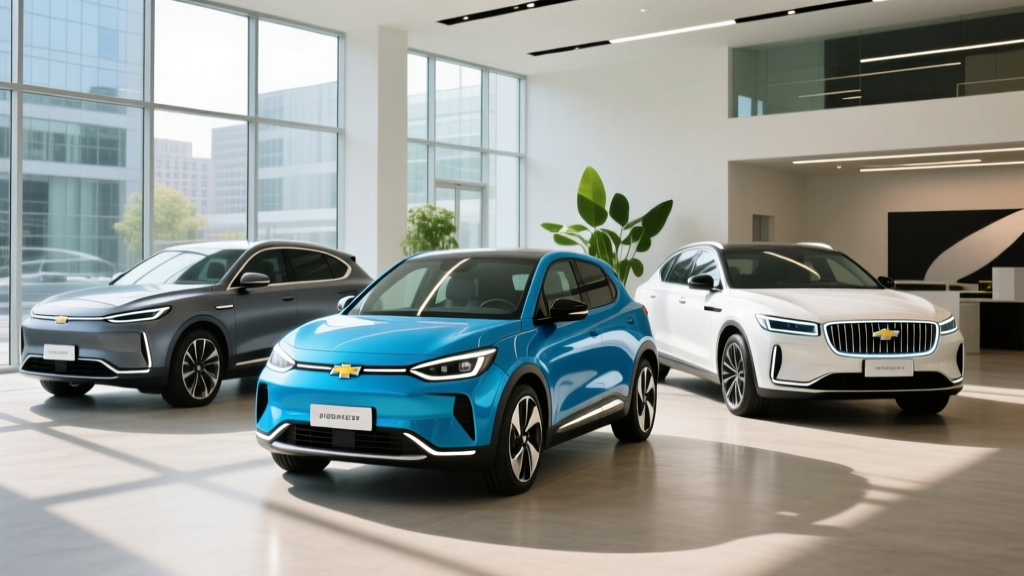
Quick Answer: If you're shopping for a new electric Chevy in 2026, you have three main options: the Equinox EV (compact crossover, ~319 mi EPA range, starting ~$33,600), the Blazer EV (midsize crossover, ~324 mi EPA range, starting ~$44,600), and the Silverado EV (full-size pickup, ~440 mi EPA range, starting ~$39,900 for Work Truck). The Equinox EV is the volume play — affordable, efficient, and eligible for the full $7,500 federal tax credit under current §30D rules for qualified buyers. The Blazer EV offers more space and power, while the Silverado EV targets truck buyers who need towing and payload. All three ride on GM's Ultium platform with NMC battery chemistry and support DC fast charging up to 190–350 kW depending on the model.
Why Chevy's EV Lineup Matters Right Now
Chevrolet has aggressively repositioned itself as an EV value leader after the Bolt EV/EUV was discontinued following the 2023 model year. The current Ultium-based lineup — Equinox EV, Blazer EV, and Silverado EV — covers the three highest-volume segments in the US market: compact crossovers, midsize crossovers, and full-size pickups. Unlike some legacy automakers still relying on compliance-car conversions, these are purpose-built electric vehicles on a dedicated platform with competitive range, modern electrical architecture, and DC fast-charging capability that actually rivals Tesla and Hyundai's best.
For buyers cross-shopping a new electric Chevy against a gas equivalent, the math has shifted meaningfully. The Equinox EV's starting price undercuts many well-equipped gas compact SUVs once you factor in the federal tax credit, and fuel savings can exceed $1,200 annually depending on your local electricity rates and driving volume. But the decision isn't purely financial — charging access, climate, and driving patterns all shape which model (or whether an EV at all) makes sense for you.
2026 Chevy EV Models: Spec-by-Spec Breakdown
Here's how the three current Chevy EVs stack up on the numbers that matter most for purchase decisions. All figures reflect 2025–2026 model-year data from fueleconomy.gov and Chevrolet's official specifications.
| Specification | Equinox EV | Blazer EV | Silverado EV |
|---|---|---|---|
| Segment | Compact Crossover | Midsize Crossover | Full-Size Pickup |
| EPA Range (max config) | 319 mi | 324 mi | 440 mi (Max Range) |
| Battery (usable, kWh) | ~85 kWh | ~102 kWh | ~200 kWh (Max Range) |
| Battery Chemistry | NMC (Ultium) | NMC (Ultium) | NMC (Ultium) |
| Peak DC Fast Charge | 150 kW | 190 kW | 350 kW |
| 10–80% DC Charge Time | ~32 min | ~28 min | ~20 min (Max Range) |
| Level 2 Charge Rate | 11.5 kW | 11.5 kW | 19.2 kW (available) |
| Horsepower (top AWD) | 288 hp | 557 hp (SS) | 754 hp (4WT) |
| 0–60 mph (quickest) | ~6.3 sec | ~3.4 sec (SS) | ~4.5 sec (4WT) |
| Starting MSRP | ~$33,600 | ~$44,600 | ~$39,900 (WT) |
| Federal §30D Credit Eligible | Yes (up to $7,500) | Yes (up to $7,500) | Yes (up to $7,500) |
| Battery/Powertrain Warranty | 8 yr / 100,000 mi | 8 yr / 100,000 mi | 8 yr / 100,000 mi |
| MPGe (combined, est.) | ~109 MPGe | ~96 MPGe | ~72 MPGe (WT) |
Real-World Range Reality: EPA estimates assume a mix of city and highway driving at moderate temperatures. On the highway at 70+ mph, expect to lose roughly 10–15% from the EPA sticker. In freezing conditions (below 32°F), range can drop 20–30% without preconditioning. For the Equinox EV with its 319-mile EPA rating, plan for roughly 255–280 miles on a road trip in fair weather and as low as 220–240 miles in deep cold. The Silverado EV's massive battery gives it a bigger buffer, but its aerodynamic profile and weight hit efficiency hard at highway speeds.
EV vs. Gas vs. Hybrid: Cost and Capability Compared
The most common question from Chevy shoppers is whether the electric version actually saves money compared to a gas Equinox, Blazer, or Silverado — or whether a hybrid splits the difference. Let's run the numbers.
| Metric | Equinox EV (LT2) | Equinox Gas (1.5T AWD) | CR-V Hybrid (AWD) |
|---|---|---|---|
| MSRP (base) | ~$35,900 | ~$31,000 | ~$36,000 |
| After $7,500 §30D Credit | ~$28,400 | $31,000 | $36,000 |
| Fuel/Energy Cost (15,000 mi/yr) | ~$550 (home charging) | ~$1,800 (gas @ $3.30/gal) | ~$1,100 (gas) |
| Annual Maintenance | ~$200 | ~$600 | ~$500 |
| 5-Year Fuel + Maintenance | ~$3,750 | ~$12,000 | ~$8,000 |
| EPA Range / MPG | 319 mi / 109 MPGe | 28 MPG combined | 40 MPG combined |
The Equinox EV, after the federal credit, can be the cheapest option at purchase and the cheapest to operate — but only if you qualify for the full credit and can charge at home. If you can't install a Level 2 charger and rely entirely on public DC fast charging at $0.35–$0.50/kWh, your annual fuel cost rises to roughly $1,400–$1,800, erasing much of the savings advantage. This is why home charging access is the single biggest variable in the EV ownership equation.
A hybrid like the CR-V or Toyota RAV4 Hybrid makes sense for buyers who drive long rural routes, lack home charging, or live in extreme cold climates where EV range loss is most punishing. You still save on fuel versus a gas-only vehicle, but without the upfront price advantage or the zero-tailpipe-emission benefit.
Total Cost of Ownership: 5-Year Breakdown
Purchase price is just the entry fee. Here's a realistic 5-year/75,000-mile ownership estimate for the Equinox EV versus its gas counterpart, assuming 15,000 miles driven annually, home charging at $0.14/kWh (national average), and gas at $3.30/gallon.
| Cost Category | Equinox EV | Equinox Gas |
|---|---|---|
| Purchase Price (after credit) | $28,400 | $31,000 |
| Home Charger Install (Level 2) | $1,200 | $0 |
| Fuel/Energy (5 years) | $2,750 | $9,000 |
| Maintenance (5 years) | $1,000 | $3,000 |
| Insurance (5 years, avg.) | $7,500 | $6,000 |
| Estimated Depreciation | $10,000 | $11,500 |
| 5-Year Total | $50,850 | $60,500 |
The EV wins by nearly $10,000 over five years in this scenario, driven primarily by the tax credit, lower fuel costs, and reduced maintenance (no oil changes, fewer brake replacements thanks to regenerative braking, no transmission fluid). However, insurance premiums for EVs tend to run 15–25% higher than comparable gas vehicles — a factor many buyers overlook. Get quotes before you buy.
Also note: EV depreciation has been volatile. Early adopters of some models saw steeper-than-expected value drops as newer, cheaper EVs hit the market. The Equinox EV's aggressive pricing should provide some floor, but resale values for EVs remain less predictable than for established gas models. Check Kelley Blue Book projections for the latest.
Federal Tax Credit: What You Actually Qualify For
The §30D federal EV tax credit can knock up to $7,500 off your purchase, but eligibility depends on several factors that change periodically. As of current IRS rules, here's what applies:
- Buyer Income Caps: Modified AGI must not exceed $300,000 (joint), $225,000 (head of household), or $150,000 (single).
- MSRP Caps: Vans, SUVs, and pickups must have an MSRP at or below $80,000; sedans at or below $55,000. All current Chevy EVs qualify.
- Battery Sourcing Requirements: The credit splits into two halves — $3,750 for critical minerals sourcing and $3,750 for battery component manufacturing. Meeting both halves requires compliant supply chains. Chevy's Ultium batteries, manufactured in US joint-venture plants, have generally qualified for the full $7,500, but verify the specific model year and build date.
- Point-of-Sale Transfer: You can transfer the credit to the dealer at purchase, reducing your out-of-pocket cost immediately rather than waiting to claim it on your tax return.
- Foreign Entity of Concern (FEOC) Restrictions: Vehicles with battery components or critical minerals from certain restricted foreign entities may lose partial or full credit eligibility. This rule has tightened progressively since 2024.
Always confirm eligibility with your dealer and a tax professional before finalizing a purchase. Credit rules are subject to legislative changes, and your personal tax situation determines whether you can actually use a non-refundable credit (you need sufficient tax liability to absorb it, unless you use the point-of-sale transfer).
Real-World Ownership: What First-Time EV Buyers Must Know
If this is your first EV purchase, the driving experience is genuinely superior in many ways — instant torque, quiet operation, one-pedal driving with regenerative braking, and a low center of gravity. But the ownership logistics differ from gas cars in ways that catch new buyers off guard.
Home Charging Is Non-Negotiable for Most Buyers
Over 80% of EV charging happens at home. A Level 2 home charger (240V, 32–48 amps) adds roughly 25–35 miles of range per hour of charging for the Equinox EV, easily replenishing a day's driving overnight. Installation typically costs $800–$2,000 if your electrical panel has capacity, or $2,500–$5,000+ if you need a panel upgrade from 100A to 200A service. Get an electrician's assessment before buying the car.
If you live in an apartment, condo, or street-parking situation without charging access, a PHEV (plug-in hybrid) or conventional hybrid may be a more practical choice. Public DC fast charging works for occasional road trips but is too expensive and time-consuming as a daily fueling strategy.
Cold Climate Range Loss Is Real
Lithium-ion batteries lose efficiency in cold weather, and cabin heating draws significant energy. In sustained sub-freezing temperatures, expect 20–30% range reduction. The Equinox EV's heat pump (standard on most trims) mitigates this somewhat compared to resistance heating, but you'll still see meaningful drops. If you live in Minnesota or Maine and regularly drive 200+ miles in winter, plan your routes around charging availability or consider the Silverado EV's larger battery buffer.
Charging Speed Isn't Constant
When Chevy says the Blazer EV charges at up to 190 kW, that's the peak rate — typically sustained only between roughly 10–40% State of Charge (SoC). Above 60%, the charge curve tapers significantly to protect battery health. A 10–80% session at a sufficiently powerful DC fast charger takes about 28 minutes for the Blazer EV, but the last 20% (80–100%) can take nearly as long as the first 70%. For road trips, the optimal strategy is to charge from 10–80% and drive on, rather than waiting for a full charge.
| Common Misconception | Reality (with Data) |
|---|---|
| "EV batteries need replacing every few years" | GM warranties Ultium batteries for 8 years/100,000 miles with a capacity retention threshold of ~70%. Real-world data from high-mileage EVs shows typical degradation of 10–15% over 100,000 miles. |
| "Charging takes too long" | Home Level 2 charging is overnight (8–10 hours for a full charge). DC fast charging adds 150–200 miles in 20–30 minutes on road trips — comparable to a meal stop. |
| "EVs are worse for the environment" | Manufacturing an EV creates more upfront emissions, but lifetime emissions are significantly lower even on coal-heavy grids. On the US average grid, an EV breaks even within 1–2 years of driving (EPA analysis). |
| "The tax credit is $7,500 for everyone" | Income caps, MSRP caps, battery sourcing rules, and tax liability all affect eligibility. Not every buyer qualifies for the full amount. |
Decision Framework: Which New Electric Chevy Is Right for You?
Choose the Equinox EV if:
- You want the most affordable entry point into a new electric Chevy (under $30K after credit)
- Your daily commute is under 100 miles round-trip
- You can install a Level 2 charger at home
- You prioritize efficiency (109 MPGe) over performance
- You don't need towing capability
Choose the Blazer EV if:
- You need more rear-seat room and cargo space than the Equinox offers
- You want available performance (557 hp SS model) or a more premium interior
- You'll take longer road trips and value the slightly faster 190 kW DC charging
- Your budget extends to $44,000–$55,000 before incentives
Choose the Silverado EV if:
- You need a truck bed, towing (up to 10,000 lbs on certain configs), or payload capacity
- You want maximum range (440 mi on Max Range trim) for long rural routes
- You need the 350 kW DC fast-charging capability for minimal road-trip downtime
- You're replacing a gas Silverado and want to eliminate $3,000+/year in fuel costs
Choose a hybrid instead if:
- You can't install a home charger
- You regularly drive 300+ miles in areas with sparse charging infrastructure
- You live in an extreme cold climate and can't tolerate range uncertainty
- Your budget doesn't accommodate the higher upfront cost even after incentives
Frequently Asked Questions
Is the Chevy Bolt still available in 2026?
No. The Bolt EV and Bolt EUV were discontinued after the 2023 model year. GM has indicated a next-generation Bolt on the Ultium platform may return, but as of the 2026 model year, it has not entered production. The Equinox EV effectively replaces it as Chevy's most affordable electric vehicle.
Can I use Tesla Superchargers with a Chevy EV?
Yes. GM transitioned to the NACS (North American Charging Standard) connector for its EVs. Newer 2025–2026 model-year Chevy EVs come with the NACS port natively, granting access to Tesla's Supercharger network — the largest and most reliable DC fast-charging network in the US. Older Ultium vehicles with CCS ports can use a GM-approved NACS adapter.
What does it cost to charge a Chevy Equinox EV at home?
The Equinox EV's ~85 kWh battery, charged from 10% to 90% (~68 kWh) at the US average residential rate of $0.14/kWh, costs roughly $9.50 per session. If you drive 40 miles daily and charge every other day, your monthly electricity cost for driving is approximately $45–$55 — compared to $130–$150 in gasoline for an equivalent gas SUV.
How long will the Ultium battery last?
GM warranties the Ultium battery pack for 8 years or 100,000 miles (whichever comes first), covering defects and excessive capacity loss (typically below 60–70% of original capacity). NMC chemistry, which Ultium uses, typically degrades 1–2% per year under normal use. Real-world data from early Ultium vehicles is still limited, but comparable NMC packs from other manufacturers show 85–90% capacity retention at 100,000 miles. Full battery replacement, if ever needed out of warranty, currently costs $10,000–$18,000 depending on the pack size, though prices continue to decline.
Does the Equinox EV qualify for state incentives too?
Many states offer additional EV rebates or tax credits on top of the federal §30D credit — for example, Colorado offers up to $5,000, California's CVRP provides up to $7,000 for income-qualified buyers, and several utilities offer $500–$1,500 rebates for home charger installation. These vary widely by state and utility district. Check your state energy office and local utility for current programs, as amounts and eligibility change frequently.
What's the difference between kW and kWh?
This is the most common EV confusion. kWh (kilowatt-hours) measures energy capacity — think of it as the size of your "fuel tank." The Equinox EV has an ~85 kWh battery. kW (kilowatts) measures power — the rate at which energy flows. A 150 kW DC fast charger delivers energy at that rate (when conditions allow). A simple analogy: kWh is how many gallons your tank holds; kW is how fast the pump fills it.