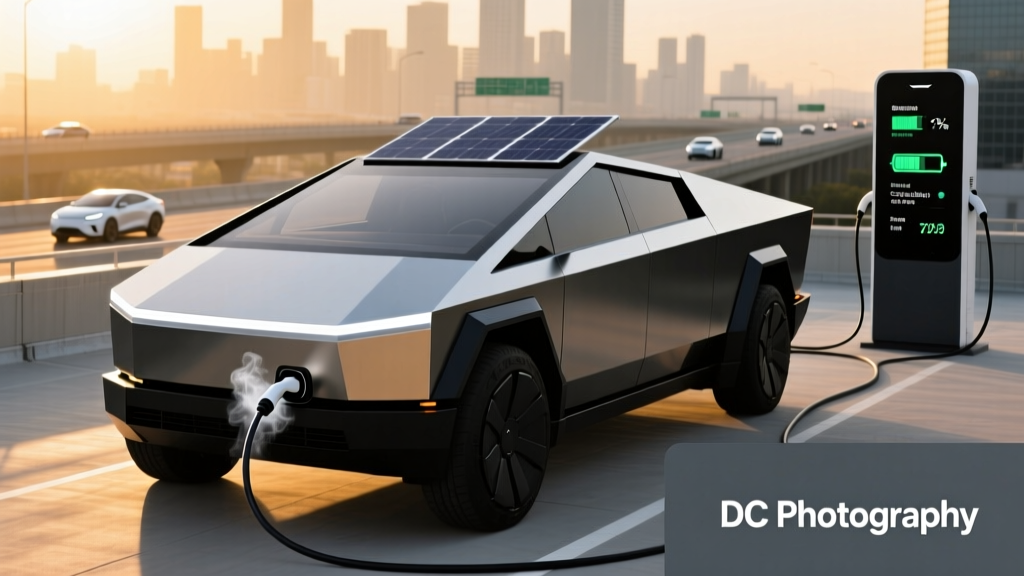
The Tesla Cybertruck entered production in late 2023 and has since settled into a more predictable lineup for the 2025 model year. Stripped of early "Foundation Series" markups, the new Cybertruck 2025 is now offered in three trims — Long Range AWD, All-Wheel Drive (Dual Motor), and the high-performance Cyberbeast. With its stainless-steel exoskeleton, 48-volt electrical architecture, and steer-by-wire system, it remains one of the most unconventional electric pickups on the market. But does the spec sheet hold up against real-world driving, charging, and ownership costs? We break down every number that matters.
2025 Cybertruck Specs at a Glance
| Spec | Long Range AWD | AWD (Dual Motor) | Cyberbeast |
|---|---|---|---|
| EPA Range | 350+ mi (est.) | 340 mi | 320 mi |
| Battery (usable) | ~123 kWh (NMC) | ~123 kWh (NMC) | ~123 kWh (NMC) |
| Drivetrain | Dual Motor AWD | Dual Motor AWD | Tri-Motor AWD |
| Horsepower | ~600 hp | 600 hp | 845 hp |
| 0–60 mph | ~4.1 sec | 4.1 sec | 2.6 sec |
| Max DC Fast Charge | 250 kW | 250 kW | 250 kW |
| 10–80% DCFC Time | ~30 min | ~30 min | ~30 min |
| Level 2 Charge Rate | 11.5 kW (~37 mi/hr) | 11.5 kW (~37 mi/hr) | 11.5 kW (~37 mi/hr) |
| MPGe (combined) | TBD (est. ~70) | ~68 MPGe | ~65 MPGe |
| Efficiency (kWh/100 mi) | ~48 | ~50 | ~52 |
| Towing Capacity | 11,000 lbs | 11,000 lbs | 11,000 lbs |
| Base MSRP | ~$79,990 | $79,990 | $99,990 |
Note: The Long Range AWD was announced for late 2025 availability. Specs marked with "est." are Tesla's preliminary targets. The AWD and Cyberbeast trims are currently in production. Always verify final specs at Tesla's configurator.
EPA Range vs. Real-World Expectations
Real-World Highway (70 mph, 75°F): ~270–295 miles (AWD)
Real-World Cold Weather (30°F, mixed): ~230–260 miles
Towing (5,000-lb trailer): ~150–180 miles
The Cybertruck's angular stainless-steel body creates substantial aerodynamic drag — its frontal area and boxy profile work against highway efficiency. In independent testing, the Dual Motor AWD achieves roughly 2.0–2.2 kWh per mile at 70 mph, which translates to 270–295 real-world highway miles on the ~123 kWh usable battery. That's a 13–20% reduction from the EPA sticker, which is typical for large, heavy electric pickups like the Ford F-150 Lightning and Rivian R1T.
Cold weather compounds the loss. Without preconditioning, expect 25–35% range reduction in sub-freezing temperatures. The Cybertruck's heat pump helps mitigate cabin energy draw, but battery chemistry (NMC) still loses efficiency in the cold. If your commute is mostly city driving with regenerative braking opportunities, you'll see figures closer to the EPA number — often 310–330 miles in mild conditions at lower speeds.
Towing is where the Cybertruck's range collapses most dramatically. Pulling a 5,000-pound trailer at highway speeds, efficiency drops to roughly 3.5–4.0 kWh per mile, cutting range to 150–180 miles. This is consistent with all electric pickups and means long-distance towing requires careful route planning around DC fast chargers.
Charging Speed: DC Fast, Level 2, and the Charge Curve
| Charging Level | Power / Rate | Miles Added per Hour | Notes |
|---|---|---|---|
| Level 1 (120V) | ~1.4 kW | ~4–5 mi/hr | Emergency/trickle only |
| Level 2 (240V, 48A) | 11.5 kW | ~37 mi/hr | Full charge in ~11 hours |
| DC Fast (Tesla Supercharger V3/V4) | Peak 250 kW | ~185 mi in 15 min | 10–80% in ~30 min |
| DC Fast (CCS adapter, non-Tesla) | Peak ~150–250 kW | Varies by station | Requires Tesla CCS adapter (included) |
The Cybertruck charges at a peak rate of 250 kW on Tesla's V3 and V4 Superchargers. However, as with all EVs, peak kW is not sustained kW. The charge curve tapers significantly above 50% state of charge (SoC). In practice, the truck pulls close to 250 kW only between roughly 10–30% SoC, then steps down through the curve. A 10–80% session takes approximately 30 minutes — competitive but not class-leading. The Hyundai Ioniq 5, for comparison, hits 10–80% in about 18 minutes thanks to its 800V architecture.
At home on a Level 2 wall connector (48 amps, 240V), the onboard charger accepts up to 11.5 kW, adding about 37 miles of range per hour. A full 0–100% charge takes roughly 11 hours, which is fine for overnight replenishment. If your electrical panel supports a 60-amp circuit (required for 48A continuous draw), installation typically runs $800–$2,000 depending on run length and permit requirements.
The Cybertruck uses Tesla's native NACS connector, giving it full access to the Supercharger network — currently the most reliable DC fast-charging infrastructure in the U.S. A CCS adapter is included for use with Electrify America, EVgo, and other non-Tesla networks, though charge speeds on those stations may vary.
Performance and Drivetrain
The Dual Motor AWD pairs two permanent-magnet motors producing a combined 600 horsepower. The 0–60 mph sprint takes 4.1 seconds — remarkably quick for a 6,800-pound stainless-steel truck. The Cyberbeast adds a third motor on the rear axle for 845 horsepower and a 2.6-second 0–60 time, placing it in supercar territory despite its mass.
The steer-by-wire system (Tesla calls it "steer-by-wire with variable ratio") eliminates the mechanical connection between the steering wheel and the wheels. At low speeds, the yoke requires less than a full turn lock-to-lock, which is convenient for parking. At highway speeds, the ratio firms up for stability. Most drivers adapt within a few days, though it remains a polarizing feature.
The 48-volt electrical architecture — a first for a production vehicle — reduces wiring harness weight and enables higher-power accessories. It also powers the ethernet-based vehicle bus, replacing traditional CAN bus communication. From a driver's perspective, this translates to faster infotainment response and tighter integration of vehicle systems.
Pricing, Trims, and Federal Tax Credit Eligibility
| Trim | Base MSRP | §30D Tax Credit | Effective Price |
|---|---|---|---|
| Long Range AWD | ~$79,990 | $0 (MSRP cap exceeded) | ~$79,990 |
| AWD (Dual Motor) | $79,990 | $0 (MSRP cap exceeded) | $79,990 |
| Cyberbeast | $99,990 | $0 (MSRP cap exceeded) | $99,990 |
Under current IRS §30D rules, the federal EV tax credit is capped at $80,000 MSRP for trucks, SUVs, and vans. The Cybertruck AWD at $79,990 sits right at the threshold — however, adding any paid options, destination fees, or configuration upgrades that push the total MSRP above $80,000 eliminates eligibility. The Cyberbeast at $99,990 is well above the cap and does not qualify.
Even if the base AWD MSRP stays at or below $80,000, eligibility depends on additional §30D requirements:
- Buyer income caps: Modified AGI ≤ $150,000 (single), $225,000 (head of household), $300,000 (joint)
- Battery sourcing: Critical minerals and battery components must meet phased-in percentages from U.S. or FTA-partner countries (requirements increase annually through 2029)
- Point-of-sale transfer: The credit can be applied at purchase as a price reduction if the dealer is registered with the IRS
- Final assembly: Must occur in North America (Cybertruck is assembled in Austin, TX — qualifies)
Given Tesla's battery supply chain and the annual tightening of critical-mineral sourcing rules, the AWD trim's credit eligibility is uncertain and may change mid-year. Always verify current eligibility on the IRS clean vehicle credits page and confirm with your tax professional before relying on the $7,500 credit in your purchase budget.
Cargo, Passenger Space, and Utility
The Cybertruck's 6-foot bed (Tesla calls it the "vault") offers approximately 74 cubic feet of lockable storage with the tonneau cover closed. The bed width between the wheel wells is roughly 47 inches — enough for standard 4×8 sheets of plywood if angled. A powered frunk (front trunk) adds about 7 cubic feet of secure storage.
Interior passenger space is adequate but not generous for the vehicle's exterior footprint. Rear-seat legroom measures approximately 38 inches, which trails the Ford F-150 Lightning's 43 inches. The rear bench fits three adults, though the center position is compromised by a raised floor section. Headroom is ample thanks to the flat roofline.
The Cybertruck's 11,000-pound towing capacity matches the upper range of electric pickups, though real-world towing range (as noted above) is the limiting factor, not the mechanical capability. The truck also offers bidirectional charging: a 240V outlet in the bed (up to 9.6 kW) powers tools, appliances, or can back-feed a home during outages via Tesla's Powershare system.
Tech, Driver Assistance, and Warranty
The Cybertruck runs Tesla's latest infotainment stack on an 18.5-inch center touchscreen with a secondary 9.4-inch rear display. Wireless Apple CarPlay and Android Auto are not supported — Tesla uses its own interface exclusively. The 15-speaker audio system includes active noise cancellation.
Driver assistance comes via Tesla Autopilot (standard) with adaptive cruise control, lane centering, and automatic emergency braking. Full Self-Driving (Supervised) is a $8,000 option or $99/month subscription that adds automated lane changes, navigation-based on/off-ramp handling, and city-street autosteer. Important: FSD is an SAE Level 2 system. The driver must remain fully engaged, hands on the yoke, eyes on the road at all times. It is not autonomous driving.
Tesla Autopilot and FSD (Supervised) require continuous driver supervision. The vehicle does not drive itself. You are responsible for all driving decisions and must be prepared to take over instantly.
Tesla's warranty covers the Cybertruck with a 4-year/50,000-mile basic limited warranty and an 8-year/120,000-mile battery and drive unit warranty. Tesla guarantees the battery will retain at least 70% of its original capacity during the warranty period. This is competitive with the Rivian R1T (8-year/120,000-mile battery) and slightly better than the Ford F-150 Lightning (8-year/100,000-mile battery).
Pros, Cons, and Who Should Buy
Pros
- Supercharger network access (NACS native) — best DC charging reliability in the U.S.
- Stainless-steel exoskeleton is dent- and corrosion-resistant
- 11,000-lb towing and 9.6 kW Powershare bidirectional outlet
- Cyberbeast's 2.6-sec 0–60 is supercar-fast
- Lockable vault bed with powered tonneau and frunk
- 48V architecture reduces weight and enables advanced systems
Cons
- Real-world highway range drops 15–20% below EPA due to aero drag
- No Apple CarPlay or Android Auto
- Rear-seat legroom is tight for a full-size truck
- Federal tax credit eligibility is uncertain due to MSRP cap and sourcing rules
- Steer-by-wire and yoke are polarizing — not for everyone
- Towing range is severely limited (~150–180 mi with 5,000-lb trailer)
- Visibility is compromised by thick A-pillars and angular design
Who Is the Cybertruck For?
Choose the Cybertruck AWD if: You want a distinctive electric truck with Supercharger access, need moderate towing capability, and primarily drive in urban or suburban settings where range loss is less pronounced.
Choose the Cyberbeast if: Performance is your priority and you accept the higher price and lower range for 845 hp and 2.6-second sprints.
Look at the Ford F-150 Lightning or Rivian R1T instead if: You need more rear-seat space, prefer Apple CarPlay, want a conventional steering wheel, or require a more predictable federal tax credit pathway.
Frequently Asked Questions
What is the real-world range of the 2025 Cybertruck?
The Dual Motor AWD achieves approximately 270–295 miles on the highway at 70 mph in mild weather, compared to the EPA's 340-mile sticker. Cold weather (below freezing) reduces this to 230–260 miles. City driving with regenerative braking recovers more energy, often yielding 310–330 miles in moderate conditions.
How fast does the Cybertruck charge at home and on the road?
On a Level 2 home charger (240V, 48A), the Cybertruck charges at 11.5 kW, adding about 37 miles per hour — a full charge takes roughly 11 hours. On a Tesla Supercharger, it peaks at 250 kW and charges from 10–80% in approximately 30 minutes, though the charge curve tapers significantly above 50% SoC.
Does the 2025 Cybertruck qualify for the $7,500 federal EV tax credit?
It's complicated. The AWD trim's $79,990 MSRP sits at the §30D truck cap of $80,000, but any options or fees that push MSRP above $80,000 eliminate eligibility. The Cyberbeast at $99,990 does not qualify. Even at or below $80,000, you must meet income caps and battery-sourcing requirements. Check the IRS clean vehicle credits page for current eligibility.
Is the Cybertruck worth buying over the F-150 Lightning or Rivian R1T?
The Cybertruck wins on Supercharger network access, stainless-steel durability, and raw performance (Cyberbeast). The F-150 Lightning offers more rear-seat space, Apple CarPlay, and easier tax credit qualification. The Rivian R1T provides better build quality, a more conventional driving experience, and a growing adventure-oriented community. Your choice depends on whether you prioritize Tesla's charging ecosystem and design language over traditional truck practicality.
What are the biggest drawbacks of the Cybertruck?
Highway range falls well short of the EPA sticker due to aerodynamic drag. The yoke and steer-by-wire system require an adjustment period and aren't universally liked. There's no Apple CarPlay or Android Auto. Rear-seat space is tighter than competitors. And towing range is limited to roughly 150–180 miles with a moderate trailer.
How long will the Cybertruck battery last?
Tesla warranties the battery for 8 years or 120,000 miles, whichever comes first, guaranteeing at least 70% capacity retention. Based on Tesla's historical NMC battery data from Model S/X/3/Y, most packs retain 85–90% capacity at 100,000 miles with normal use. Avoid frequent 100% charges and regular DC fast charging from very low SoC to maximize longevity. A full battery replacement (out of warranty) would likely cost $15,000–$25,000 based on current Tesla service estimates, though this is expected to decline as battery costs fall.
Sources: Tesla Cybertruck Specifications, EPA Fuel Economy — Electric Vehicles, IRS Clean Vehicle Tax Credits.