What Are NEV Electric Vehicles?
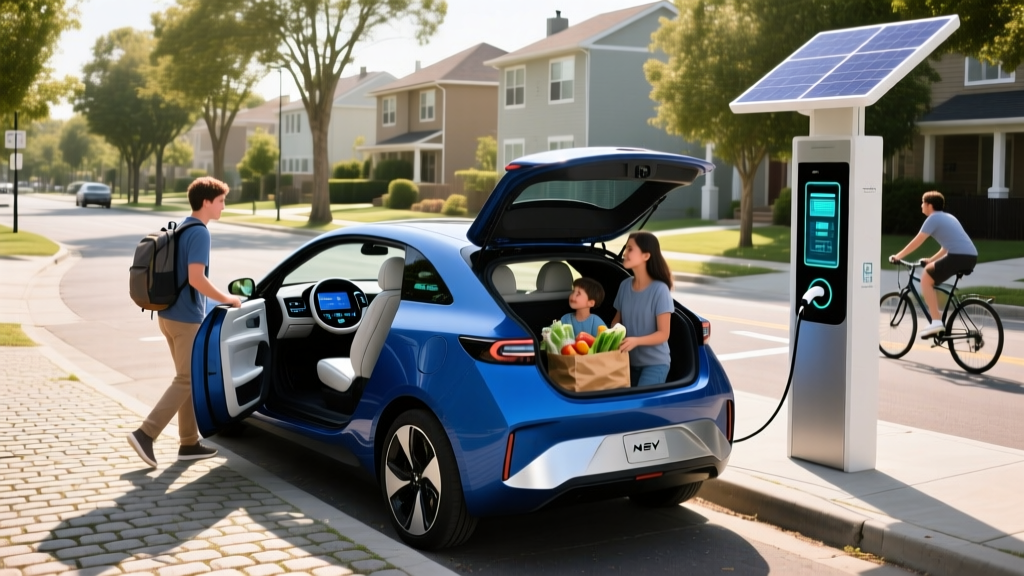
Neighborhood Electric Vehicles (NEVs) are federally regulated, low-speed electric vehicles capped at a top speed of 20–25 mph under FMVSS No. 500. They are street-legal on roads with speed limits up to 35 mph (varies by state), typically offer 30–60 miles of real-world range on a full charge, and cost between $8,000 and $20,000 before any incentives. NEVs are not highway-capable, do not qualify for the federal §30D clean vehicle credit, and are best suited for planned communities, campuses, short urban errands, and retirement neighborhoods. Think of them as street-legal golf carts with seatbelts, headlights, and VINs — not replacements for a full-size EV like a Tesla Model Y or Chevrolet Equinox EV.
NEV Specs: What You Actually Get for the Money
The NEV category is defined by federal safety standard FMVSS 500, which mandates a maximum speed of 25 mph and requires basic equipment: headlamps, turn signals, tail lamps, mirrors, parking brakes, windshields (glazed), VIN, and seat belts. What it does not require is crash testing, airbags, or the structural rigidity expected in a full-size passenger vehicle. That regulatory gap is why NEVs are inexpensive — and why understanding what you're buying matters.
| Spec Category | Typical NEV Range | Full-Size EV (e.g., Equinox EV) |
|---|---|---|
| Top Speed | 20–25 mph | 110–130 mph |
| EPA/Advertised Range | 30–60 miles | 300–319 miles |
| Battery Capacity | 6–15 kWh (lead-acid or LFP) | 85 kWh (NMC) |
| Charging (Level 1, 120V) | 6–10 hours (full) | ~50+ hours (full) |
| DC Fast Charging | Not available | Peak 150 kW, 10–80% in ~32 min |
| 0–25 mph | 6–12 seconds | N/A (0–60 in ~7.9 sec) |
| Cargo Capacity | Minimal (small bed or trunk) | 26–57 cu ft |
| Base MSRP | $8,000–$20,000 | ~$33,000–$43,000 |
| Federal Tax Credit (§30D) | Not eligible | Up to $7,500 (if eligible) |
| Safety (Crash Tested) | No | Yes (NHTSA/IIHS rated) |
The battery chemistry split in the NEV market is significant. Budget models ($8K–$12K) often use sealed lead-acid (SLA) batteries, which are heavier, offer fewer charge cycles (~300–500), and degrade noticeably within 2–3 years of regular use. Higher-end NEVs ($14K–$20K) increasingly ship with lithium iron phosphate (LFP) packs, which deliver 2,000+ cycles, weigh less, and tolerate daily 100% charging without the degradation concerns of NMC chemistry. If you're buying a NEV for daily use, LFP is worth the premium.
Where NEVs Are Legal: State-by-State Reality
Federal law sets the baseline — NEVs are limited to roads with speed limits of 35 mph or lower. But states can restrict or expand this. California, Florida, Texas, and Arizona have some of the most permissive NEV laws, with planned communities like The Villages (FL), Sun City (AZ), and Irvine (CA) effectively designed around them. Other states require additional registration steps, insurance minimums, or restrict NEVs to specific road types.
Critical ownership note: NEVs carry a Vehicle Identification Number (VIN) and must be registered and insured in most states, but they are typically excluded from standard auto insurance policies. You'll need a specialized low-speed vehicle (LSV) or NEV insurance policy, which averages $100–$300 annually depending on your state and driving record — far less than the $1,200–$2,000+ typical for a full-size EV, but a cost factor nonetheless.
Real Costs: NEV vs. Gas Car vs. Full-Size EV
The economic case for a NEV hinges entirely on your driving pattern. If your daily trips are under 15 miles round-trip on low-speed roads, the per-mile operating cost is difficult to beat. If you need highway access, climate control in extreme weather, or crash safety, a NEV is the wrong tool.
| Cost Factor | NEV (LFP Battery) | Gas Car (30 MPG) | Full-Size BEV |
|---|---|---|---|
| Purchase Price | $12,000–$18,000 | $25,000–$35,000 | $33,000–$55,000 |
| Federal Tax Credit | $0 | $0 | Up to $7,500 (§30D) |
| Fuel/Energy Cost per Mile | ~$0.02–$0.04 | ~$0.11–$0.15 | ~$0.03–$0.06 |
| Annual Insurance | $100–$300 | $1,000–$1,800 | $1,200–$2,200 |
| Annual Maintenance | $50–$150 | $500–$1,200 | $200–$500 |
| Battery Replacement (est.) | $1,500–$4,000 (year 5–8) | N/A | $8,000–$20,000 (year 12+) |
| 5-Year Total Cost (est.) | $14,000–$22,000 | $35,000–$48,000 | $32,000–$52,000 |
The NEV's 5-year total cost of ownership is genuinely the lowest of any motorized vehicle option — but only if it actually replaces trips you'd otherwise make in a car. A NEV sitting unused because your grocery store is on a 45 mph road is a $15,000 paperweight. Map your actual routes before purchasing.
Charging a NEV: Simple but Slow
NEVs charge exclusively on Level 1 (standard 120V household outlet). There is no Level 2 or DC fast charging capability on any production NEV as of 2026. This sounds limiting until you consider the battery size: a 10 kWh pack charging at 1.2 kW (typical 120V/10A draw) reaches full in roughly 8–9 hours. Plug in overnight, drive all day.
Real-world charging math for a typical NEV:
- Battery: 10 kWh usable (LFP)
- Charge rate: 1.2 kW (Level 1, 120V)
- Time 0–100%: ~8.5 hours
- Energy cost: ~$1.30 at $0.13/kWh national average
- Range added per hour: ~4–5 miles
For context, a full-size EV like the Hyundai Ioniq 5 charges at up to 240 kW on a DC fast charger, adding roughly 180 miles of range in 18 minutes (10–80%). The NEV charging experience is fundamentally different: slow, simple, and entirely home-dependent. If you lack access to a dedicated 120V outlet near your parking spot, a NEV becomes impractical.
Common NEV Misconceptions — Fact-Checked
| Myth | Fact |
|---|---|
| "NEVs qualify for the $7,500 federal EV tax credit." | False. The §30D credit requires vehicles to meet full FMVSS passenger vehicle standards. NEVs comply with FMVSS 500 (low-speed vehicles) and are excluded. See IRS §30D guidelines. |
| "NEVs are just golf carts." | Partially true in form, false in regulation. Golf carts are not street-legal by default and lack VINs. NEVs are federally classified low-speed vehicles with required safety equipment and full street registration. |
| "A NEV can replace my car." | Only if 100% of your driving is on roads ≤35 mph within a ~25-mile radius. Any highway, high-speed arterial, or long-distance trip requires a full-size vehicle. |
| "NEVs are unsafe because they lack airbags." | NEVs are not crash-tested and lack airbags, crumple zones, and electronic stability control. They are statistically more dangerous than full-size vehicles in any collision above 25 mph. This is the trade-off for the low price. |
| "NEV batteries last forever." | Lead-acid NEV batteries typically need replacement every 3–5 years ($1,500–$2,500). LFP batteries last 8–12 years with minimal degradation but cost $2,500–$4,000 to replace. |
Who Should Buy a NEV — Decision Framework
Choose a NEV If:
- You live in a planned community, retirement village, or small town where daily errands are on roads ≤35 mph
- Your round-trip driving is consistently under 30 miles
- You have access to a dedicated 120V outlet for overnight charging
- You already own or have access to a full-size vehicle for highway trips
- You want the lowest possible operating cost for local trips ($0.02–$0.04/mile)
- You prioritize low purchase price over crash safety
Choose a Full-Size EV or PHEV Instead If:
- You need highway access for commuting or road trips
- Your daily route includes roads posted above 35 mph
- You need crash-tested occupant protection, airbags, and modern ADAS
- You regularly carry more than 2 passengers or significant cargo
- You live in a region with harsh winters — NEVs typically lack cabin heating beyond a basic resistive unit, and cold temperatures cut range by 30–40%
- You want to claim the federal §30D tax credit (up to $7,500 on qualifying full-size EVs and PHEVs)
Real-World Ownership Considerations
Climate: NEVs with lead-acid batteries lose 25–40% of their range in freezing temperatures, and most lack effective cabin heating. LFP-equipped NEVs handle cold somewhat better but still suffer range reduction. If you live in the upper Midwest or Northeast, plan for a real-world winter range of 20–35 miles on a "50-mile" NEV.
Terrain: NEVs are low-power vehicles (typically 4–15 HP). Steep hills — even moderate grades — can reduce speed well below the 25 mph cap and strain the motor and battery. If your neighborhood has significant elevation changes, test-drive before buying.
Resale value: The NEV resale market is thin and highly localized. In communities like The Villages, FL, used NEVs hold value reasonably well. Outside those markets, expect 40–60% depreciation over 3 years, particularly on lead-acid models approaching battery-replacement age.
Dealer support: Unlike full-size EVs sold through established dealer networks (Ford, Hyundai, Chevrolet), many NEVs are sold direct-to-consumer or through small independent dealers. Warranty service can mean shipping the vehicle back to the manufacturer. Verify local service options before purchase.
FAQ: NEV Electric Vehicles
Do I need a driver's license to operate a NEV?
Yes, in nearly all states. NEVs are registered motor vehicles and require a valid driver's license, registration, and insurance. A few states have limited exceptions for private property or specific community roads, but assume you need a license.
Can I drive a NEV on a 40 mph road?
Federal law permits NEVs on roads with speed limits up to 35 mph. Some states allow local jurisdictions to permit NEVs on roads up to 45 mph, but this is the exception. Check your state's specific LSV/NEV statutes before assuming access.
How long does a NEV battery last?
Lead-acid: 3–5 years / 300–500 charge cycles before significant capacity loss. LFP: 8–12 years / 2,000+ cycles. Replacement costs range from $1,500 (SLA) to $4,000 (LFP), making battery chemistry a critical purchase decision.
Can I charge a NEV from a standard household outlet?
Yes — that's the only way to charge a NEV. All current production NEVs use a standard 120V plug (NEMA 5-15). A full charge takes 6–10 hours depending on battery size and state of charge. No special electrical installation is required beyond a dedicated, grounded outlet.
Are NEVs safe for children?
NEVs have seat belts but are not crash-tested and lack airbags, side-impact protection, and child-seat anchors (LATCH). They are not equivalent to a passenger car for child safety. Use your judgment based on road conditions and trip distance, and follow your state's child restraint laws.
What's the difference between a NEV and a golf cart?
A golf cart is not federally classified as a motor vehicle, typically lacks a VIN, and is not street-legal without local ordinance exceptions. A NEV (also called a Low-Speed Vehicle or LSV) is federally regulated under FMVSS 500, carries a VIN, and can be registered and insured for street use. Many "street-legal golf carts" sold today are technically NEVs with golf-cart styling.