Why the NEMA 14-50 Is the Gold Standard for Tesla Home Charging
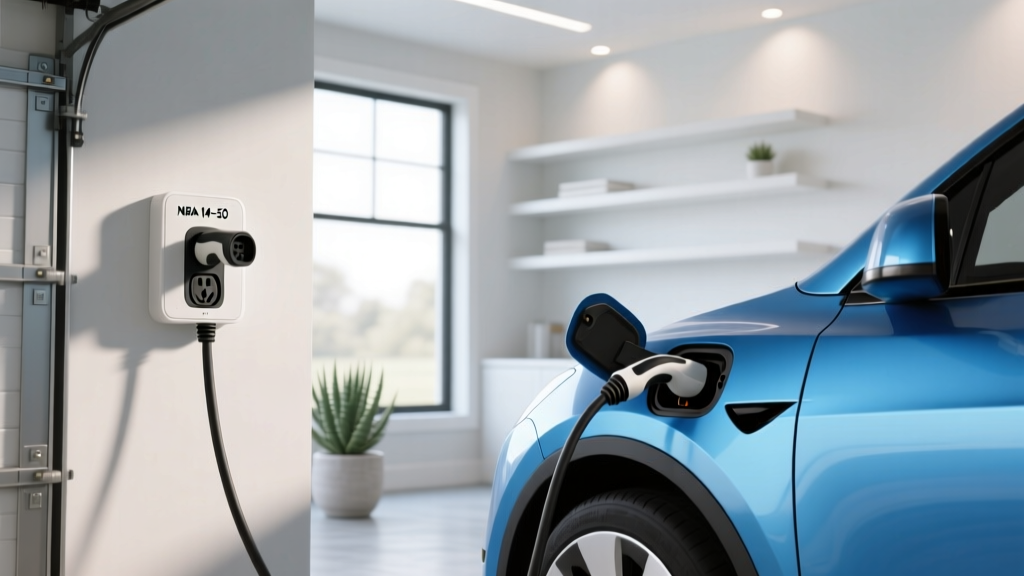
If you own a Tesla—or are about to take delivery of one—the single most impactful upgrade you can make isn't a software subscription or an aftermarket wheel. It's a NEMA 14-50 outlet in your garage. This 240-volt, 50-amp receptacle is the same type used by electric ranges and dryers, and it delivers enough power to fully recharge a Tesla Model 3 or Model Y overnight, every night, without the upfront cost of a hardwired wall connector.
In this guide, we break down exactly what a NEMA 14-50 outlet delivers for Tesla owners in 2026, how much installation costs, what charging speeds you can expect across the Tesla lineup, and how home charging intersects with real-world range, battery health, and federal tax credits. We'll also cover the electrical panel considerations that catch many new EV owners off guard.
What Is a NEMA 14-50 Outlet and Why Does It Matter for Tesla?
A NEMA 14-50 is a standardized 240-volt electrical receptacle rated for 50 amps. In EV charging terms, it enables Level 2 charging—the sweet spot between the painfully slow Level 1 (120V household outlet, roughly 3–5 miles of range per hour) and expensive DC fast charging infrastructure.
Here's the critical distinction every EV owner must internalize: kW (kilowatts) measures power—the rate at which energy flows into your car. kWh (kilowatt-hours) measures energy—the total capacity of your battery. A NEMA 14-50 outlet delivers up to 12 kW of power (at 48 amps continuous, per NEC 80% derating rules on a 50-amp circuit, though Tesla's Mobile Connector caps at 32 amps / ~7.7 kW on a 14-50). Your Tesla's battery holds between 57.5 kWh and ~82 kWh of energy depending on the model and trim.
| Tesla Model | Battery (kWh usable) | Max Mobile Connector Rate | Miles of Range/Hour | Full Charge Time (10–80%) |
|---|---|---|---|---|
| Model 3 RWD | 57.5 (LFP) | 7.7 kW (32A) | ~30 mi/hr | ~5.5 hours |
| Model 3 Long Range AWD | 75 (NMC) | 7.7 kW (32A) | ~30 mi/hr | ~7 hours |
| Model Y Long Range AWD | 75 (NMC) | 7.7 kW (32A) | ~28 mi/hr | ~7 hours |
| Model S Long Range | 95 (NMC) | 7.7 kW (32A) | ~26 mi/hr | ~9 hours |
| Model X Long Range | 95 (NMC) | 7.7 kW (32A) | ~24 mi/hr | ~9.5 hours |
Note: Tesla's Mobile Connector with the NEMA 14-50 adapter delivers a maximum of 32 amps (7.7 kW). To unlock the full 48 amps (11.5 kW) a 14-50 circuit can theoretically support, you would need a hardwired Tesla Wall Connector or a third-party Level 2 EVSE rated for 48A. The 14-50 outlet itself is not the bottleneck—the Mobile Connector is.
Real-World Charging: What a NEMA 14-50 Actually Delivers Overnight
Spec sheets tell one story; your Tuesday morning commute tells another. Let's ground this in reality.
A typical American drives roughly 37 miles per day (FHWA data). Even the most conservative Tesla model—the Model 3 RWD with its EPA-estimated 272 miles of range—can replenish a full day's driving in just over one hour on a NEMA 14-50. Plug in at 10 PM, and by 6 AM you've added roughly 240 miles of range. For 95% of daily driving scenarios, a NEMA 14-50 is functionally equivalent to never visiting a gas station.
EPA range estimates assume a mix of city and highway driving at moderate temperatures. In practice:
- Highway driving at 75+ mph: Expect 85–90% of EPA range (e.g., Model Y LR: ~280–295 real miles vs. 311 EPA)
- Cold weather (below 32°F): Expect 70–80% of EPA range due to cabin heating and battery resistance
- City/regenerative driving: Often meets or exceeds EPA estimates thanks to regen braking
A NEMA 14-50 replenishes enough overnight to cover these real-world variations for any commute under 150 miles round-trip.
NEMA 14-50 Installation: Costs, Electrical Panel Requirements, and Gotchas
This is where most Tesla owners encounter their first real decision point. Installing a NEMA 14-50 isn't as simple as swapping an outlet cover. Here's what's involved:
| Component | Cost Range | Notes |
|---|---|---|
| Electrician labor (2–4 hours) | $300–$800 | Varies by region; licensed electrician required |
| 50-amp double-pole breaker | $30–$60 | Must match your panel brand (Square D, Siemens, etc.) |
| 6-gauge copper wire (run) | $150–$600 | Depends on distance from panel to outlet location |
| NEMA 14-50 receptacle + box | $30–$60 | Use an industrial-grade receptacle (Hubbell, Bryant) |
| Permit & inspection | $50–$200 | Required in most jurisdictions; don't skip this |
| Electrical panel upgrade (if needed) | $1,500–$3,500 | Only if your panel lacks capacity or open slots |
| Total (no panel upgrade) | $560–$1,720 | Most homes with a 200A panel fall in this range |
The panel capacity gotcha: Your home's electrical panel has a maximum amperage rating—typically 100A in older homes and 200A in newer construction. A 50-amp EV circuit consumes a significant chunk of that capacity. If you already have an electric range (50A), electric dryer (30A), and electric water heater (30A) running simultaneously, a 100-amp panel may not have headroom for a 50-amp EV circuit. Your electrician will perform a load calculation to determine if your panel can handle it. If not, a panel upgrade to 200A or even 400A may be necessary—and that's where costs escalate.
Pro tip: If you're planning a panel upgrade anyway, consider having your electrician install a 60-amp circuit with a hardwired Tesla Wall Connector instead. It delivers 11.5 kW (48A continuous) versus the Mobile Connector's 7.7 kW on a 14-50—roughly 50% faster charging for a modest incremental cost during the panel work.
Tesla Lineup at a Glance: Range, Efficiency, and How a 14-50 Fits In
Here's the 2026 Tesla lineup with the specs that matter for home charging decisions. Data sourced from fueleconomy.gov and Tesla's official specifications.
| Spec | Model 3 RWD | Model 3 LR AWD | Model Y LR AWD | Model S LR | Model X LR |
|---|---|---|---|---|---|
| EPA Range | 272 mi | 341 mi | 311 mi | 402 mi | 335 mi |
| Battery (usable kWh) | 57.5 (LFP) | 75 (NMC) | 75 (NMC) | 95 (NMC) | 95 (NMC) |
| Efficiency (MPGe) | 132 MPGe | 125 MPGe | 117 MPGe | 120 MPGe | 104 MPGe |
| kWh/100 mi | 25 | 27 | 29 | 28 | 32 |
| 0–60 mph | 5.8 sec | 4.2 sec | 4.8 sec | 3.1 sec | 3.8 sec |
| Horsepower | 271 hp | 346 hp | 384 hp | 670 hp | 670 hp |
| Drivetrain | RWD | AWD (dual) | AWD (dual) | AWD (dual) | AWD (dual) |
| Max DC Fast Charge | 170 kW | 250 kW | 250 kW | 250 kW | 250 kW |
| 10–80% DCFC Time | ~25 min | ~18 min | ~20 min | ~25 min | ~28 min |
| Cargo (cu ft, seats folded) | 23 | 23 | 72 | 28 + frunk | 88 + frunk |
| Base MSRP | $38,990 | $44,990 | $47,990 | $74,990 | $79,990 |
| Battery Warranty | 8 yr/100k mi | 8 yr/120k mi | 8 yr/120k mi | 8 yr/150k mi | 8 yr/150k mi |
LFP vs. NMC: What Your Battery Chemistry Means for Home Charging
The Model 3 RWD uses a lithium iron phosphate (LFP) battery, while Long Range and Performance variants use nickel manganese cobalt (NMC). This matters for your NEMA 14-50 charging habits:
| Factor | LFP (Model 3 RWD) | NMC (Long Range / Performance) |
|---|---|---|
| Daily charge recommendation | 100% (Tesla recommends periodic full charges) | 80–90% daily; 100% only for trips |
| Degradation profile | Slower; more tolerant of high SoC | Faster at sustained high SoC |
| Cold-weather performance | More range loss in cold (~25–35%) | Moderate cold loss (~20–25%) |
| Energy density | Lower (heavier pack for same range) | Higher (lighter, more range per kg) |
| 14-50 overnight suitability | Excellent—charge to 100% nightly without worry | Set charge limit to 80%; schedule departure |
For NEMA 14-50 owners, the takeaway: if you have a Model 3 RWD with LFP, you can plug in every night and charge to 100% without accelerating degradation. For NMC owners, use Tesla's scheduled charging feature to start charging a few hours before departure and set the limit to 80%—you'll still wake up with 200+ miles, and your battery will last longer.
Federal Tax Credit: Does a Tesla + Home Charger Qualify?
Under current IRS §30D rules, several Tesla models qualify for up to $7,500 in federal EV tax credits, available as a point-of-sale transfer at the dealership (effectively reducing your purchase price). However, eligibility depends on multiple factors that change periodically. Always verify current status at irs.gov.
- MSRP caps: Vans/SUVs/pickups ≤ $80,000; sedans ≤ $55,000
- Buyer income limits: AGI ≤ $300k (joint), $225k (head of household), $150k (single)
- Battery sourcing: Critical minerals and battery components must meet escalating domestic/free-trade-partner thresholds
- Final assembly: Must occur in North America (all US-market Teslas qualify)
- Point-of-sale transfer: You can transfer the credit to the dealer for an upfront price reduction
| Model | Base MSRP | MSRP Cap Met? | Est. After $7,500 Credit |
|---|---|---|---|
| Model 3 RWD | $38,990 | Yes (sedan ≤ $55k) | ~$31,490 |
| Model 3 LR AWD | $44,990 | Yes (sedan ≤ $55k) | ~$37,490 |
| Model Y LR AWD | $47,990 | Yes (SUV ≤ $80k) | ~$40,490 |
| Model S LR | $74,990 | No (sedan cap $55k) | $74,990 (no credit) |
| Model X LR | $79,990 | Yes (SUV ≤ $80k) | ~$72,490 |
Home charger credit: Separately, the §30C Alternative Fuel Vehicle Refueling Property Credit may cover up to $1,000 of home EV charger installation costs—but only if you live in a qualifying census tract (typically rural or low-income areas). Check your eligibility at the IRS site. The NEMA 14-50 outlet installation itself may qualify if it's considered "refueling property."
NEMA 14-50 vs. Tesla Wall Connector: Which Should You Install?
This is the most common question new Tesla owners ask. Here's the honest comparison:
| Factor | NEMA 14-50 + Mobile Connector | Tesla Wall Connector (hardwired, 60A) |
|---|---|---|
| Max charge rate | 7.7 kW (32A) | 11.5 kW (48A) |
| Miles/hr (Model Y LR) | ~28 mi/hr | ~44 mi/hr |
| Equipment cost | $0 (included with Tesla) or ~$200 for Mobile Connector | ~$425 (Wall Connector unit) |
| Installation cost | $500–$1,500 | $600–$1,800 (hardwired, similar labor) |
| Portability | Yes—unplug and take it with you | No—permanently mounted |
| Wi-Fi / OTA updates | No (Mobile Connector is dumb) | Yes (firmware updates, power sharing) |
| Best for | Renters, budget installs, <100 mi daily driving | Homeowners, high-mileage days, future-proofing |
Our recommendation: If you own your home and have a 200-amp panel, spend the extra ~$200–$400 for a hardwired Wall Connector on a 60-amp circuit. The 50% faster charging speed matters more than you think—especially in winter when battery preconditioning draws power, or when you arrive home nearly empty after a road trip. If you rent, or your panel is tight on capacity, the NEMA 14-50 with the Mobile Connector is a perfectly capable solution that covers 90% of use cases.
Safety, Code Compliance, and Common Installation Mistakes
A NEMA 14-50 outlet handles serious current. Here's what separates a safe installation from a fire hazard:
- Use a commercial-grade receptacle. Residential-grade 14-50 outlets (the $12 kind at big-box stores) are designed for occasional oven use, not daily 32-amp EV charging for 8 hours. Hubbell, Bryant, and Cooper make industrial-grade receptacles ($40–$60) with better contact tension and heat resistance.
- Torque to spec. The #1 cause of melted 14-50 outlets in EV applications is loose terminal connections. Your electrician must use a torque screwdriver to manufacturer specifications.
- GFCI breaker considerations. The 2020 NEC requires GFCI protection for 14-50 outlets in garages. However, GFCI breakers can nuisance-trip with some EV chargers. If your jurisdiction enforces NEC 2020 or later, discuss this with your electrician—some EVSEs handle GFCI better than others.
- Never use an extension cord. If your outlet isn't close enough to where you park, have an electrician move the outlet or install a longer circuit run. Extension cords at 32 amps are a fire risk.
- Get a permit and inspection. Unpermitted electrical work can void your homeowner's insurance in the event of a fire. The inspection also catches installation errors before they become problems.
Who Should Rely on a NEMA 14-50—and Who Needs More?
- Your daily round-trip commute is under 120 miles
- You park in the same spot every night (consistent charging routine)
- You rent your home and need a semi-portable solution
- Your electrical panel has limited spare capacity (50A is the minimum viable circuit)
- You want the lowest upfront installation cost
- You regularly drive 150+ miles per day
- You live in extreme cold (Alaska, northern MN) where range loss and battery heating consume more energy
- You tow frequently (Model X or Cybertruck—towing can halve your range)
- You want to future-proof for larger battery packs or a second EV
- You plan to use power-sharing between two Wall Connectors on one circuit
Cost to Charge at Home vs. Gas: The NEMA 14-50 Economics
At the US average residential electricity rate of ~$0.16/kWh (EIA, 2025 data), fully charging a Model Y Long Range (75 kWh usable) costs roughly $12.00—yielding about 311 miles of range. That's $0.039 per mile.
Compare that to a comparable gas-powered SUV averaging 25 MPG at $3.40/gallon: $0.136 per mile. Over 15,000 miles per year, the Tesla charged on a NEMA 14-50 saves approximately $1,455 annually in fuel costs alone. Over five years, that's $7,275—more than enough to cover the installation cost of your outlet many times over.
Even against public DC fast charging (which averages $0.35–$0.50/kWh at networks like Electrify America and EVgo), home charging on a 14-50 is 60–70% cheaper per mile. The math overwhelmingly favors home charging.
Frequently Asked Questions
Can I install a NEMA 14-50 outlet myself?
Technically, yes—if you're experienced with 240V circuits. But we strongly recommend hiring a licensed electrician. A 50-amp circuit carries enough current to cause a serious fire if wired incorrectly, and most jurisdictions require a permit and inspection for new 240V circuits. DIY work that fails inspection or causes damage may void your homeowner's insurance.
Will a NEMA 14-50 outlet work with non-Tesla EVs?
Yes. The NEMA 14-50 is a universal standard. Any Level 2 EVSE (ChargePoint Home Flex, Emporia Vue, Grizzl-E, etc.) with a 14-50 plug will work. When Tesla opens its Supercharger network and more EVs adopt NACS connectors, the 14-50 outlet will remain the standard home charging receptacle regardless of which EV you drive.
How long does it take to fully charge a Tesla Model Y on a NEMA 14-50?
From 10% to 100%, expect roughly 9 hours for a Model Y Long Range (75 kWh battery at 7.7 kW charge rate). However, most owners rarely charge from empty—plug in at 40% remaining and you'll hit 80% in about 4 hours. Charging slows significantly above 90% as the battery management system balances cells.
Does charging on a NEMA 14-50 degrade my Tesla battery?
No more than any other Level 2 charging method. Battery degradation is driven primarily by sustained high state-of-charge, extreme temperatures, and DC fast charging frequency—not by the specific outlet type. For NMC batteries (Long Range models), set your charge limit to 80% for daily use. For LFP batteries (Model 3 RWD), Tesla recommends charging to 100% at least once per week.
Do I need a 200-amp electrical panel for a NEMA 14-50?
Not necessarily, but it helps. A 100-amp panel can support a 50-amp EV circuit if your other loads are modest (gas appliances, no electric heat). Your electrician will perform a NEC Article 220 load calculation to determine if your panel has sufficient capacity. If you have electric heat, an electric range, and an electric dryer on a 100-amp panel, you'll likely need an upgrade.
Is the NEMA 14-50 outlet covered by any tax credits?
Possibly. The §30C Alternative Fuel Vehicle Refueling Property Credit can cover up to $1,000 of home charging equipment and installation—but only if you live in an eligible census tract (generally non-urban or low-income communities). The outlet installation may qualify as "refueling property." Consult a tax professional and check the IRS §30C page for current eligibility maps.
Final Verdict: The NEMA 14-50 Is the Smartest First Upgrade for Any Tesla Owner
For the vast majority of Tesla owners, a NEMA 14-50 outlet delivers the best balance of charging speed, installation cost, and flexibility. At $500–$1,700 installed, it transforms your Tesla from a car you "refuel" into a car you simply wake up with—full every morning, for pennies per mile. The only scenario where we'd push you toward a hardwired Wall Connector instead is if you regularly deplete more than 200 miles in a day, live in extreme cold, or plan to add a second EV to your garage.
Pair a 14-50 with a Model 3 RWD at ~$31,490 after the federal tax credit, and you have the lowest total-cost-of-ownership vehicle in the Tesla lineup—backed by an 8-year/100,000-mile battery warranty and the most robust charging ecosystem in North America. The outlet is the easy part. The hard part is going back to a gas station after you've experienced it.