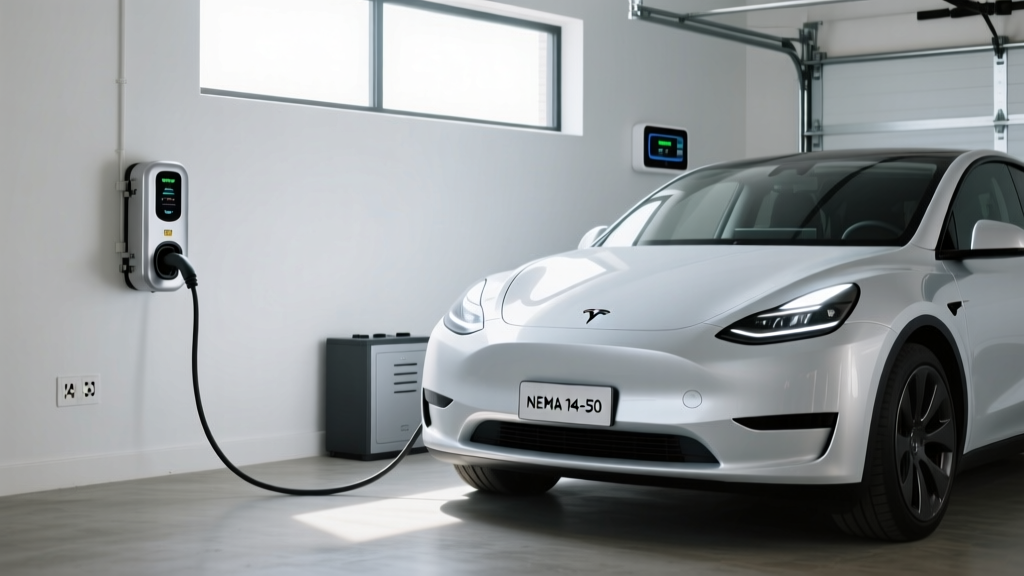
For most Tesla owners — or anyone about to take delivery of a Model 3, Model Y, Model S, or Model X — the single biggest upgrade to daily EV ownership isn't a software update or a wheel option. It's a 240-volt outlet in the garage. Specifically, the NEMA 14-50 outlet for Tesla has become the default home-charging target for millions of EV drivers because it delivers meaningful Level 2 speed without requiring a hardwired wall connector. But is it still the right call in 2026, and what does a proper installation actually cost?
Having charged Teslas and other EVs on everything from a 120V household plug to 350 kW DC fast chargers, I'll walk you through the real numbers: miles added per hour, the electrical panel headroom you'll need, the total installed cost, and where a NEMA 14-50 falls short versus a hardwired 48-amp or 60-amp Tesla Wall Connector.
What Is a NEMA 14-50 Outlet and Why Do Tesla Owners Want One?
A NEMA 14-50 is a 240-volt, 50-amp receptacle — the same type you'd find behind a large electric range or RV hookup. It has four prongs: two hot legs (120V each, 240V combined), a neutral, and a ground. For EV charging, you use only the two hot legs and the ground; the neutral goes unused.
Here's why it's popular with Tesla owners specifically:
- Plug-and-play flexibility: Tesla's Mobile Connector ships (or can be purchased separately) with an interchangeable NEMA 14-50 adapter. Plug it in at home, unplug it for road trips.
- Widely available: Many homes already have a 14-50 in the garage or laundry area. RV parks almost universally offer them.
- No permit-required (sometimes): In some jurisdictions, swapping an existing 14-50 receptacle doesn't trigger the same permitting as a hardwired EVSE install — though new 14-50 circuits almost always do.
- Decent speed: On a properly wired 50A circuit, a Tesla Mobile Connector pulls up to 32 amps continuous (the 80% NEC rule for plug-in loads), delivering roughly 7.7 kW.
The key distinction to understand: kW is power (the rate at which energy flows), while kWh is energy (the amount stored in your battery). A 7.7 kW charge rate filling an 82 kWh battery from 10% to 90% takes roughly 8.5 hours — overnight, not a pit stop.
Charging Speeds: NEMA 14-50 vs. Other Tesla Home Charging Options
The table below shows exactly what each home-charging configuration delivers across the current Tesla lineup. These figures assume a 240V supply and the vehicle's onboard charger accepting the full available current.
| Charging Method | Max Current | Power (kW) | Model 3 (mi/hr) | Model Y (mi/hr) | Model S/X (mi/hr) |
|---|---|---|---|---|---|
| 120V NEMA 5-15 (Level 1) | 12A | 1.4 kW | ~3-4 | ~3-4 | ~3-4 |
| 240V NEMA 14-50 (Mobile Connector) | 32A | 7.7 kW | ~30 | ~26-28 | ~28-30 |
| 240V NEMA 14-50 (Wall Connector, 48A) | 40A* | 9.6 kW | ~37 | ~33-35 | ~34-36 |
| Hardwired Wall Connector (48A) | 48A | 11.5 kW | ~44 | ~39-41 | ~40-42 |
| Hardwired Wall Connector (60A circuit) | 48A | 11.5 kW | ~44 | ~39-41 | ~40-42 |
*When a Wall Connector is plugged into a 14-50 outlet, NEC continuous-load rules cap it at 40A (80% of 50A). Hardwired installations on a 60A breaker can sustain 48A continuously.
The practical takeaway: a NEMA 14-50 outlet for Tesla delivers roughly 30 miles of range per hour on a Model 3 Long Range. For most owners who drive 30-50 miles daily, that's a full recharge in 1-2 hours. For heavy commuters or road-trip recoveries, a hardwired 48A Wall Connector cuts that time by a third.
Real-World Range Expectations for 2026 Tesla Models
Your charging setup only matters if you know how much energy you're actually putting back. Here's how the current Tesla lineup stacks up — EPA sticker numbers paired with what I've observed in real-world highway and cold-weather driving.
| Model / Trim | EPA Range | Real-World Highway (~70 mph) | Cold Weather (20°F) | kWh/100mi | MPGe |
|---|---|---|---|---|---|
| Model 3 RWD (LFP) | 272 mi | ~235-245 mi | ~200-215 mi | 25 | 132 |
| Model 3 Long Range AWD | 341 mi | ~290-310 mi | ~245-265 mi | 26 | 130 |
| Model 3 Performance | 315 mi | ~265-280 mi | ~220-240 mi | 28 | 119 |
| Model Y Long Range AWD | 320 mi | ~270-290 mi | ~230-250 mi | 28 | 120 |
| Model Y Performance | 293 mi | ~245-260 mi | ~210-225 mi | 30 | 111 |
| Model S Long Range | 402 mi | ~340-360 mi | ~290-320 mi | 28 | 120 |
| Model X Long Range | 335 mi | ~280-300 mi | ~240-260 mi | 33 | 102 |
Installation Costs: What Does a NEMA 14-50 Outlet Actually Cost?
This is where estimates vary wildly online, so let me give you the breakdown based on typical 2026 electrician rates and material costs. The total depends heavily on whether your electrical panel has capacity and how far the outlet is from the panel.
| Component | Simple Install (Panel Nearby) | Complex Install (Long Run / Panel Upgrade) |
|---|---|---|
| 50A double-pole breaker | $25-$50 | $25-$50 |
| 6 AWG copper wire (per foot) | $3-$5/ft (20-30 ft typical) | $3-$5/ft (50-80 ft) |
| NEMA 14-50 receptacle (industrial-grade) | $15-$45 | $15-$45 |
| Conduit, junction boxes, fittings | $30-$75 | $75-$200 |
| Electrician labor (2-4 hours @ $100-$175/hr) | $200-$500 | $500-$1,200 |
| Permit & inspection | $50-$150 | $50-$200 |
| Electrical panel upgrade (if needed, 200A) | Not needed | $1,500-$3,500 |
| Total estimated cost | $400-$900 | $2,000-$5,500+ |
Critical specification: Use an industrial-grade NEMA 14-50 receptacle (Hubbell 9450A or Cooper/Eaton equivalent), not a $10 residential-grade unit. EV charging draws near-maximum current for 6-10 hours straight — cheap receptacles have been documented overheating and melting under sustained EV loads. This is not a place to save $25.
Also insist your electrician uses a torque screwdriver to spec when terminating the wires. Loose connections on a 50A circuit are a fire risk, and most residential electricians don't torque to spec unless asked. The NEC has required this since 2017 (110.14(D)), but enforcement varies.
Does Your Electrical Panel Have Enough Capacity?
Before you call an electrician, check your panel's amperage rating. Most modern homes have a 200-amp main service. The NEC requires that your total calculated load not exceed 80% of the panel's rating for continuous loads.
Here's a rough check: a 50A circuit for EV charging draws 40A continuous (80% rule). If your home already runs central A/C (30-40A), an electric oven (40-50A), an electric dryer (30A), and an electric water heater (25A) simultaneously, you may be close to or over capacity. An electrician will perform a NEC Article 220 load calculation to determine whether your panel can handle the addition.
If you're short on capacity, you have three options:
- Panel upgrade to 200A or 325A — expensive ($1,500-$3,500) but future-proofs your home.
- Install a lower-amperage circuit — a 30A NEMA 14-30 outlet still delivers ~22 miles/hour on a Model 3, which covers most daily driving.
- Use an automated load-management device — products like the Emporia VUE or Span smart panel can dynamically throttle EV charging when other large loads kick on.
NEMA 14-50 vs. Hardwired Tesla Wall Connector: Which Should You Choose?
This is the decision most Tesla buyers agonize over. Here's my framework after installing both in different homes:
Choose NEMA 14-50 If:
- You want portability — take the Mobile Connector on road trips or to a second home
- You rent and want to take the outlet investment with you (the receptacle stays, but you keep the Mobile Connector)
- You already have a 14-50 in your garage for a welder, RV, or range
- Your panel is tight on capacity and you want to keep the option of a lower-amperage swap
- Budget is a priority — saves $200-$400 vs. a Wall Connector plus installation
Choose Hardwired Wall Connector If:
- You drive 60+ miles daily and need faster recovery (44 mi/hr vs. 30 mi/hr)
- You want the full 48A / 11.5 kW charge rate (requires 60A breaker)
- You value the integrated cable management and sleek garage appearance
- You want Wi-Fi-connected features: scheduled charging, energy tracking, OTA updates
- You plan to charge two Teslas simultaneously (Power Sharing feature)
One often-overlooked factor: the Tesla Mobile Connector is not designed for daily plug/unplug cycles as its primary use case. Tesla's own documentation recommends leaving it plugged into the 14-50 receptacle and treating it as a semi-permanent installation. If you need daily portability, the Wall Connector (which stays mounted) with a separate Mobile Connector in the trunk is the better setup.
Tesla Model Lineup: Specs, Pricing & Tax Credit Eligibility (2026)
If you're installing a NEMA 14-50 outlet for Tesla, you likely already own one or are about to. Here's where the 2026 lineup stands on pricing, eligibility for the IRS §30D federal EV tax credit, and key specs.
| Model | Base MSRP | §30D Credit Eligible? | Battery (kWh / Chemistry) | 0-60 mph | Warranty |
|---|---|---|---|---|---|
| Model 3 RWD | ~$38,990 | Partial — subject to critical-mineral & battery-component sourcing rules; buyer income caps apply ($150K single / $300K joint) | ~60 kWh / LFP | 5.8s | 8 yr / 100K mi (battery) 4 yr / 50K mi (vehicle) |
| Model 3 Long Range AWD | ~$45,990 | Same sourcing rules; MSRP cap for sedans = $55,000 | ~79 kWh / NMC | 4.2s | 8 yr / 120K mi (battery) 4 yr / 50K mi (vehicle) |
| Model Y Long Range | ~$46,990 | MSRP cap for SUVs = $80,000; sourcing & income rules apply | ~79 kWh / NMC | 4.8s | 8 yr / 120K mi (battery) 4 yr / 50K mi (vehicle) |
| Model S Long Range | ~$79,990 | Exceeds $55K sedan MSRP cap — NOT eligible | ~100 kWh / NMC | 3.1s | 8 yr / 150K mi (battery) 4 yr / 50K mi (vehicle) |
| Model X Long Range | ~$84,990 | Exceeds $80K SUV MSRP cap — NOT eligible | ~100 kWh / NMC | 3.8s | 8 yr / 150K mi (battery) 4 yr / 50K mi (vehicle) |
Tax credit caveats: The §30D credit is up to $7,500 but is split into two halves — $3,750 for critical-mineral sourcing and $3,750 for battery-component sourcing. As of 2026, vehicles with any battery components from a "foreign entity of concern" (FEOC) lose the component half. The point-of-sale transfer option lets dealers apply the credit at purchase if you meet income thresholds. Always verify current eligibility on fueleconomy.gov before buying, as sourcing rules tighten annually.
DC Fast Charging: What Happens Beyond Your Garage
A NEMA 14-50 handles overnight and daily charging, but road trips require DC fast charging. Here's the Tesla Supercharger and third-party DCFC picture in 2026:
| Model | Peak DC Rate | 10-80% Time | Connector | Notes |
|---|---|---|---|---|
| Model 3 RWD (LFP) | 170 kW | ~25 min | NACS (native) | LFP can charge to 100% regularly; slower peak than NMC |
| Model 3 Long Range | 250 kW | ~18-22 min | NACS (native) | Sustains high rate to ~55% SoC, then tapers |
| Model Y Long Range | 250 kW | ~20-24 min | NACS (native) | Precondition battery via nav for peak speed |
| Model S/X | 250 kW | ~22-27 min | NACS (native) | Larger battery = longer taper period |
Charge curve reality: Tesla's peak kW rating is just that — a peak. On a V3 Supercharger, a Model 3 Long Range might hit 250 kW briefly around 15-20% state of charge, but the rate tapers significantly above 60%. The 10-80% time is the more useful metric. Also: always navigate to a Supercharger via the car's built-in navigation to trigger battery preconditioning — arriving with a cold battery can cut your peak charge rate in half.
With Tesla's NACS connector now adopted by Ford, GM, Rivian, Volvo, and most major automakers, the Supercharger network is the dominant DC fast-charging infrastructure in North America. As of 2026, there are over 6,500 Supercharger stations in the U.S., and non-Tesla EVs can access them using the Tesla app or a built-in adapter in newer vehicles.
Standout Tech, Drawbacks & Who the NEMA 14-50 Setup Suits Best
Tesla's tech advantages remain real: the Tesla app provides granular charging control — scheduling, current limiting, energy-cost tracking, and remote preconditioning. Over-the-air updates continuously improve efficiency and add features. Tesla's Autopilot (standard) and Full Self-Driving Supervised (optional, ~$8,000) are SAE Level 2 driver-assistance systems — meaning you must remain engaged with hands on the wheel and eyes on the road at all times. They are not self-driving.
Notable drawbacks:
- Tesla's build quality, while improved, still shows more panel-gap variation than legacy automakers.
- The Model 3 Highland refresh removed ultrasonic parking sensors and the turn-signal stalk — polarizing changes that bother some owners daily.
- Tesla insurance premiums remain higher than average — shop quotes before purchasing.
- No Apple CarPlay or Android Auto — Tesla's proprietary infotainment is capable but closed.
Pros
- Best-in-class Supercharger network access
- Industry-leading efficiency (low kWh/mi)
- OTA updates add features post-purchase
- Strong resale value relative to most EVs
- NACS connector = future-proof
- Minimal maintenance costs vs. ICE vehicles
Cons
- Insurance costs 20-40% above segment average
- No CarPlay/Android Auto
- FSD Supervised is expensive and still requires full driver attention
- Service center wait times can be long in some regions
- Touchscreen-only controls for mirrors, glovebox, wipers
- Cold-weather range loss more pronounced without heat pump on older models
Who this setup suits best: A NEMA 14-50 outlet for Tesla is ideal for homeowners with a garage or covered parking spot, a 200A electrical panel with spare capacity, and a daily commute under 60 miles. It's the sweet spot for cost-conscious Tesla owners who want meaningful Level 2 speed without the $400-$800 premium of a Wall Connector and hardwired install. If you regularly drive 80+ miles per day or want the fastest possible home recovery, invest in the hardwired 60A Wall Connector instead.
Frequently Asked Questions
Can I install a NEMA 14-50 outlet myself?
Technically yes if you're experienced with electrical work, but I strongly recommend a licensed electrician. A 50A/240V circuit carries enough current to cause a serious fire if wired incorrectly. Most jurisdictions require a permit and inspection for new 240V circuits. The labor cost ($200-$500 for a straightforward run) is cheap insurance.
Will a NEMA 14-50 outlet for Tesla work with non-Tesla EVs?
Yes — any EV with a J1772 inlet (which is every non-Tesla EV sold in the U.S., and Teslas via the included J1772 adapter) can charge from a 14-50 outlet using a compatible EVSE. The Tesla Mobile Connector only works with Teslas (NACS), but third-party Level 2 chargers like the ChargePoint Home Flex or Emporia J1772 plug directly into a 14-50.
Is it safe to leave the Mobile Connector plugged into the 14-50 permanently?
Yes, and Tesla actually recommends this. The Mobile Connector is designed for semi-permanent installation. Use the cable organizer to keep it tidy, and avoid putting strain on the receptacle by letting the cable hang from the plug. If the connector body gets warm during charging (more than warm to the touch), have an electrician check the termination torque.
How much does it cost to charge a Tesla at home on a NEMA 14-50?
At the U.S. average residential electricity rate of ~$0.16/kWh (2026), fully charging a Model 3 Long Range (79 kWh) costs roughly $12.64 — equivalent to about $0.04-$0.05 per mile. Compare that to $0.12-$0.15 per mile for a 30 MPG gas car at $3.50/gallon. Over 15,000 miles/year, home EV charging saves $1,200-$1,600 annually on fuel.
Do I need a Tesla Wall Connector if I have a NEMA 14-50?
Not necessarily. The Mobile Connector on a 14-50 delivers 30 mi/hr — sufficient for most daily driving. Upgrade to a Wall Connector if you need faster charging (44 mi/hr), want Power Sharing for two vehicles, prefer integrated cable management, or want the 48A continuous rate that a hardwired 60A circuit provides.
Does a NEMA 14-50 outlet qualify for any tax incentives?
Possibly. The Residential Clean Energy Credit (IRC §25D) does not cover EV chargers for most taxpayers as of 2026. However, the Alternative Fuel Vehicle Refueling Property Credit (IRC §30C) offers up to $1,000 for home EV charging equipment installed in eligible census tracts (generally lower-income or non-urban areas). Check your census tract eligibility and consult a tax professional.