The Honest Short Answer
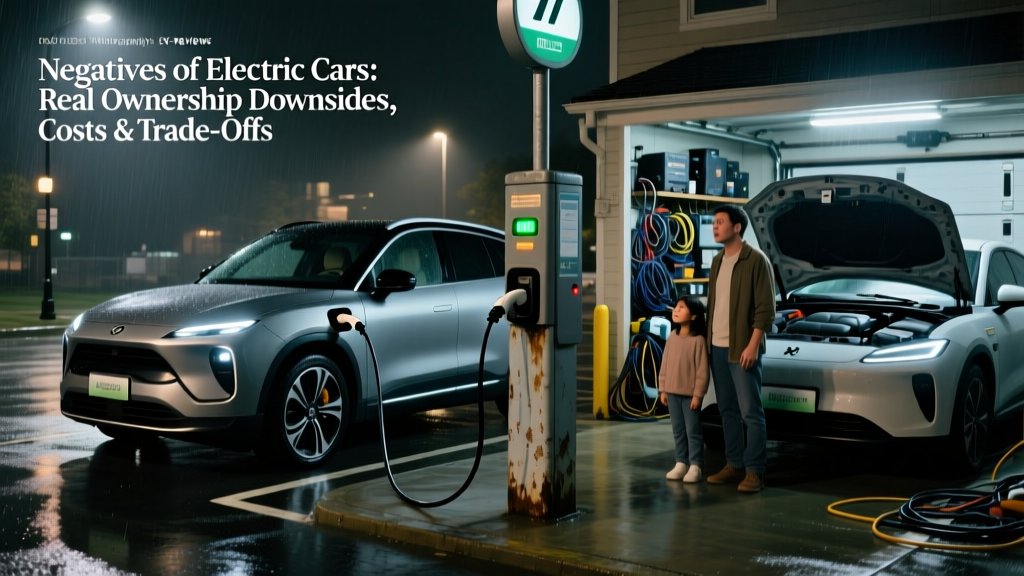
The main negatives of electric cars are not what you might expect. They're not about whether EVs "work" — they absolutely do for daily driving. The real downsides are practical and financial: higher upfront purchase prices (often $5,000–$15,000 more than comparable gas models), unreliable public charging infrastructure outside major metro areas, significant range loss in cold weather (20–40% below EPA estimates), higher insurance premiums (typically 15–25% more), expensive out-of-warranty battery replacements ($8,000–$22,000), and limited suitability for apartment dwellers without home charging access. For the right buyer with home charging and moderate climates, these negatives are manageable. For others, a hybrid or PHEV may be the smarter choice.
Higher Upfront Purchase Cost
Despite years of price cuts and new entrants, electric vehicles still carry a sticker-price premium over equivalent gas-powered cars. In 2026, the average transaction price for a new EV hovers around $53,000, compared to roughly $47,000 for internal-combustion vehicles, according to Kelley Blue Book data.
Consider a concrete comparison:
| Vehicle | Powertrain | Base MSRP (2026) | EPA Range / MPG |
|---|---|---|---|
| Honda Civic EX | 1.5L Turbo Gas | $28,000 | 36 MPG combined |
| Tesla Model 3 RWD | Battery Electric | $38,990 | 272 mi (EPA) |
| Toyota RAV4 LE | 2.5L Gas | $30,500 | 30 MPG combined |
| Hyundai Ioniq 5 SE | Battery Electric | $42,600 | 290 mi (EPA) |
| Toyota RAV4 Hybrid XLE | Hybrid (HEV) | $33,500 | 39 MPG combined |
The EV options cost $8,000–$14,000 more upfront. While the federal §30D clean vehicle credit can offset up to $7,500, eligibility is far from universal. You must meet income caps ($150K single / $300K joint), the vehicle must fall under MSRP caps ($55K for cars, $80K for SUVs/trucks), and the battery must satisfy critical-mineral and component sourcing requirements that change annually. Many popular EVs only qualify for the partial $3,750 credit — or none at all. Always verify current eligibility on fueleconomy.gov before counting on the savings.
Public Charging Is Still Unreliable and Uneven
Home charging is where EV ownership shines — plug in overnight, wake up with a "full tank." But roughly 30% of US households lack access to dedicated home charging (apartments, condos, street parking). For these buyers, public charging is a daily reality, and it remains the single biggest pain point in EV ownership.
Here's what public charging actually looks like in practice:
- Broken chargers: Industry studies consistently find 15–20% of non-Tesla public DC fast chargers are out of service at any given time.
- Payment fragmentation: You may need 4–6 different apps (ChargePoint, EVgo, Electrify America, Blink) to cover chargers in your area.
- Charging speed inconsistency: A station rated at 150 kW may deliver only 40–60 kW due to thermal throttling, shared power cabinets, or grid constraints.
- Cost variability: DC fast charging costs $0.30–$0.60/kWh in most markets — sometimes approaching the per-mile cost of a fuel-efficient gas car.
Tesla's Supercharger network remains the most reliable (uptime above 99%), and the NACS connector adoption by Ford, GM, Hyundai, and others has improved access. But if you live in a rural area or an apartment without charging, this is a genuine negative that no amount of marketing can erase.
Cold-Weather Range Loss Is Real and Measurable
If you live in Minnesota, Michigan, New England, or anywhere with sustained sub-freezing winters, this negative hits hard. EV batteries lose efficiency in cold temperatures due to increased internal resistance and the energy cost of heating the cabin (gas cars get cabin heat "free" from engine waste heat).
Real-World Cold-Weather Range Data
Testing by AAA and independent reviewers shows the following average range loss at 20°F compared to 75°F baseline:
- Without heat pump: 30–41% range reduction
- With heat pump: 20–30% range reduction
- Example — Tesla Model Y Long Range: EPA 310 mi → expect ~210–240 mi in sustained 20°F driving with cabin heat
- Example — Hyundai Ioniq 5 (heat pump equipped): EPA 290 mi → expect ~200–230 mi in similar conditions
DC fast charging also slows significantly in cold weather unless the battery is preconditioned. A car that charges 10–80% in 18 minutes at 70°F might take 35–45 minutes at 15°F without preconditioning. If cold-weather commuting is your reality, you need to budget for 25–35% less range than the EPA sticker and consider a larger battery pack than you'd need in a warm climate.
Total Cost of Ownership: Where EVs Save and Where They Don't
EV advocates often claim lower total cost of ownership (TCO). This is sometimes true — but it depends heavily on your electricity rate, driving volume, local gas prices, and whether you qualify for tax credits. Here's a realistic 5-year breakdown comparing a typical EV against a comparable gas car, assuming 15,000 miles/year:
| Cost Category | EV (e.g., Tesla Model 3) | Gas Car (e.g., Honda Civic) |
|---|---|---|
| Purchase price (after credit) | $35,240 (assuming $3,750 credit) | $28,000 |
| Fuel/Energy (5 years) | $3,750 (home charging at $0.14/kWh) | $9,375 ($3.50/gal at 33 MPG) |
| Maintenance (5 years) | $2,100 (tires, cabin filter, fluid top-offs) | $4,500 (oil, filters, brakes, transmission fluid) |
| Insurance (5 years) | $10,500 ($2,100/yr avg) | $8,250 ($1,650/yr avg) |
| Depreciation (5 years) | $18,000 (higher EV depreciation) | $13,500 |
| 5-Year Total | $69,590 | $63,625 |
In this scenario, the gas car still costs roughly $6,000 less over five years. The EV wins on fuel and maintenance but loses on purchase price, insurance, and depreciation. If you qualify for the full $7,500 credit, charge at very low off-peak rates, or drive 20,000+ miles per year, the math can flip — but it's not automatic.
Insurance is a particularly under-discussed negative. EVs cost more to insure because they have higher repair costs (specialized body shops, battery protection requirements, expensive sensor arrays). Major insurers quote EV premiums 15–25% higher than equivalent gas vehicles.
Common EV Misconceptions — Myth vs. Fact
| Myth | Fact |
|---|---|
| "EV batteries need replacing every 5 years" | Modern NMC and LFP batteries are warrantied for 8 years/100,000 miles at 70%+ capacity retention. Real-world data shows ~10–15% degradation at 150,000 miles for liquid-cooled packs. |
| "EVs are worse for the environment because of electricity generation" | Even on coal-heavy grids, lifecycle emissions for EVs are 50–70% lower than gas cars per the Union of Concerned Scientists. On clean grids, the advantage is 80%+. |
| "You can't take road trips in an EV" | You can, but you must plan around DC fast chargers every 150–200 miles and accept 20–40 minute stops. Road trips take 15–25% longer than in a gas car. |
| "EVs are slow" | Most EVs are quicker than comparable gas cars due to instant torque. A Tesla Model 3 RWD does 0–60 in 5.8 seconds; a base Camry takes 7.6 seconds. |
| "The power grid can't handle EVs" | Most charging happens overnight during off-peak hours when grid capacity is underutilized. Utilities are upgrading distribution transformers, but widespread simultaneous fast-charging in one neighborhood can strain local infrastructure. |
Who Should (and Shouldn't) Buy an EV: A Decision Framework
Choose a Battery EV (BEV) If:
- You have access to Level 2 home charging (garage, driveway, or workplace)
- Your daily commute is under 80 miles round-trip
- You live in a moderate climate or are willing to accept cold-weather range loss
- You qualify for the §30D tax credit (check income and vehicle sourcing requirements)
- You want the lowest per-mile "fuel" cost and minimal scheduled maintenance
Choose a Plug-In Hybrid (PHEV) If:
- You have home charging but also take frequent road trips beyond 300 miles
- You want 25–45 miles of electric-only commuting with gas-engine backup
- You live in an extreme cold-weather climate where range loss is a dealbreaker
- You're not ready to commit to charging logistics for long-distance travel
Choose a Conventional Hybrid (HEV) If:
- You have no home charging access and rely on street parking or apartments
- You want maximum MPG without any plug-in behavior change
- Your budget is under $35,000 and you need proven long-term reliability
Stick With Gas (For Now) If:
- You regularly tow heavy loads (trailers, boats) over long distances — EV towing range drops 40–50%
- You live in a rural charging desert with no reliable DC fast chargers within 50 miles
- Your annual mileage is very low (under 6,000 miles/year) — fuel savings won't offset the purchase premium
Frequently Asked Questions
Do electric cars lose value faster than gas cars?
Currently, yes. EV depreciation has been steeper than gas cars, partly due to rapid price cuts by manufacturers (especially Tesla), evolving battery technology, and uncertain long-term battery replacement costs. A 3-year-old EV may retain 45–55% of its value versus 55–65% for a comparable gas car. This gap is narrowing as the market matures but remains a real negative for buyers who plan to sell within 3–5 years.
What happens if an EV battery fails out of warranty?
Out-of-warranty battery replacement costs range from $8,000 for smaller packs (e.g., Nissan Leaf) to $22,000+ for large packs (e.g., GMC Hummer EV). However, catastrophic battery failure is rare. Most degradation is gradual — you'll see reduced range over time, not sudden failure. Federal law mandates that EV batteries carry a minimum warranty of 8 years/100,000 miles, and many manufacturers warranty to 70% capacity retention.
Are EVs more expensive to repair after a collision?
Generally, yes. EVs require specialized high-voltage safety training for body shops, and minor rear-end collisions can trigger battery-pack inspection or replacement protocols that add thousands to a repair bill. Insurance data shows average EV collision repair costs are 20–30% higher than equivalent gas vehicles. This is a key reason EV insurance premiums are elevated.
Can I charge an EV from a standard 120V outlet?
Yes, but Level 1 charging (120V) delivers only about 1.0–1.4 kW, adding roughly 3–5 miles of range per hour. For a 75 kWh battery, a full charge from empty takes 50+ hours. Level 1 is viable only for low-mileage drivers (under 30 miles/day) or as a backup. For practical daily use, a 240V Level 2 home charger (7–11.5 kW, adding 25–45 miles/hour) is strongly recommended. Installation typically costs $800–$2,500 depending on panel capacity and wiring distance.
Do electric cars cost more to register?
In many states, yes. To compensate for lost gas-tax revenue, over 30 US states impose additional annual EV registration fees ranging from $50 (Colorado) to $225 (Ohio). Some states also add fees for PHEVs. Check your state's DMV for current EV registration surcharges — they can add $100–$225/year to your ownership cost.