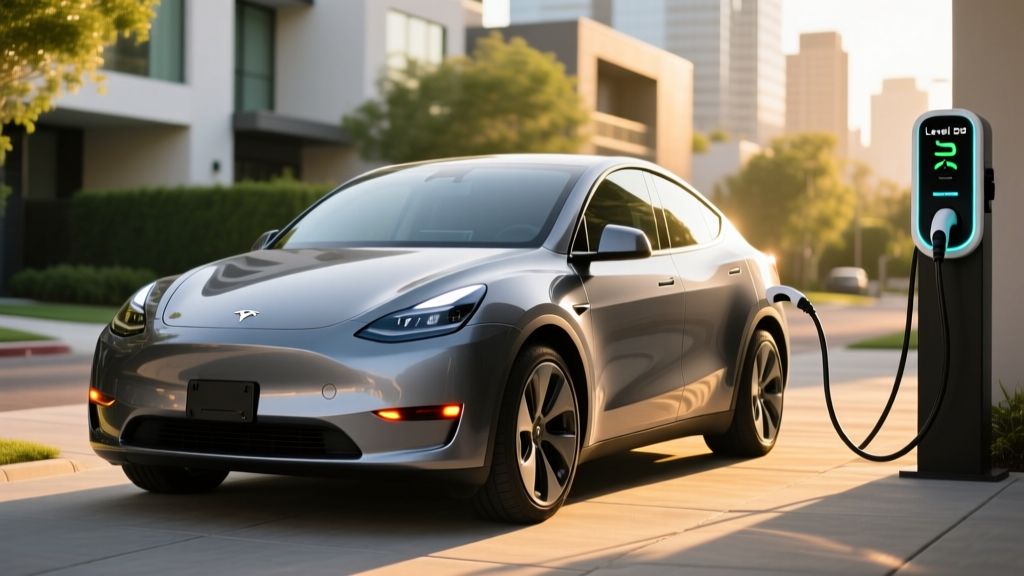
The Tesla Model Y remains one of the best-selling electric vehicles in the United States, and for 2026 it picks up a subtle but highly requested aesthetic option: Nardo Grey. Borrowed from Audi's iconic paint palette and now available through Tesla's expanded color lineup (and widely replicated via premium PPF/wrap shops), Nardo Grey gives the Model Y a flat, cement-grey finish that transforms its visual character without altering its class-leading efficiency. But paint is only skin-deep. This review breaks down the 2026 Tesla Model Y Long Range AWD — the volume trim — with exact figures on range, charging speed, cost, and daily usability so you can decide if this EV earns a spot in your driveway.
Quick Verdict: Who the Nardo Grey Model Y Is For
The 2026 Model Y Long Range AWD is built for the efficiency-minded family that road-trips regularly, commutes in stop-and-go traffic, and wants access to the most reliable DC fast-charging network in North America. The Nardo Grey aesthetic appeals to buyers who find Tesla's standard palette too conservative. If you need three rows, tow more than 3,500 lbs, or want a luxury badge, look to the Rivian R1S, Ford F-150 Lightning, or BMW iX instead.
| Spec | Value |
|---|---|
| EPA Range | 320 miles |
| Battery (usable) | ~75 kWh, NMC (nickel manganese cobalt) |
| Drivetrain | Dual-motor AWD |
| Horsepower | 384 hp (combined) |
| 0–60 mph | 4.8 seconds |
| Max DC Fast Charge | 250 kW (peak) |
| 10–80% DC Time | ~27 minutes |
| Level 2 Home Rate | 11.5 kW (~44 mi/hr) |
| Efficiency | 122 MPGe combined / 28 kWh/100 mi |
| Cargo (rear seats up) | 30.2 cu ft |
| Cargo (rear seats folded) | 72.0 cu ft |
| Base MSRP | $44,990 (before incentives) |
| Battery Warranty | 8 years / 120,000 miles |
Range and Efficiency: EPA vs. Real World
The EPA rates the 2026 Model Y Long Range AWD at 320 miles on a full charge. That number is achieved under the EPA's mixed driving cycle, which blends city and highway segments at moderate temperatures. In practice, your results will vary based on speed, climate, and terrain.
- City / suburban commuting (under 50 mph): 310–340 mi — regenerative braking recaptures energy in stop-and-go traffic, often exceeding the EPA estimate.
- Highway cruising (70–75 mph): 255–280 mi — aerodynamic drag dominates at sustained speed; expect roughly a 12–18% reduction from the sticker.
- Cold weather (below 32°F / 0°C): 220–260 mi — battery chemistry slows, cabin heating draws significant power. Preconditioning while plugged in mitigates some loss.
- Hot weather with A/C (above 95°F): 285–310 mi — less impactful than cold, but cabin cooling still costs range.
The heat pump, standard on the refreshed Model Y, recovers waste heat from the drivetrain to warm the cabin — a meaningful efficiency gain over resistive heating in winter climates.
At 28 kWh per 100 miles (combined), the Model Y is among the most efficient midsize electric crossovers on the market. For comparison, the Ford Mustang Mach-E Extended Range AWD returns roughly 34 kWh/100 mi, and the Hyundai Ioniq 5 AWD sits around 30 kWh/100 mi. Efficiency translates directly into lower charging costs and more miles per stop.
Charging Speed: Home, Destination, and DC Fast
Charging is where Tesla's vertical integration continues to pay dividends. The Model Y supports the NACS (North American Charging Standard) connector natively — no adapter needed at Tesla Superchargers, which now number over 6,500 stalls in the U.S. alone.
| Charging Level | Power | Miles Added per Hour | Typical Use Case |
|---|---|---|---|
| Level 1 (120V household) | ~1.4 kW | ~5 mi/hr | Emergency / overnight trickle |
| Level 2 (240V home, 48A) | 11.5 kW | ~44 mi/hr | Daily home charging |
| Level 2 (public, variable) | 6.6–19.2 kW | 25–72 mi/hr | Workplace, shopping, hotels |
| DC Fast (Supercharger V3) | 250 kW peak | ~162 mi in 15 min | Road trips |
| DC Fast (CCS via adapter) | Up to 250 kW | Varies by station | Non-Tesla networks (EA, EVgo) |
DC fast-charge reality check: The 250 kW peak rate applies only at a low state of charge (roughly 10–20%) and at a V3 or V4 Supercharger stall with the battery preconditioned. The charge curve tapers significantly above 60% SoC, and drops sharply past 80%. A 10–80% session takes approximately 27 minutes. If you routinely charge to 90%+ on road trips, budget 40–50 minutes total.
Home charging: Most Model Y owners install a Tesla Wall Connector on a 60-amp circuit, delivering 11.5 kW (48 amps continuous). This adds roughly 44 miles of range per hour, meaning a full overnight session (8–10 hours) replenishes the entire battery. Installation costs typically range from $800–$2,000 depending on panel proximity and local permitting. Always consult a licensed electrician for final specs.
Performance and Drivetrain
The dual-motor AWD powertrain delivers 384 combined horsepower and 360 lb-ft of torque. The 0–60 mph sprint completes in 4.8 seconds — brisk enough to merge confidently onto any freeway and quick by any crossover standard. The Performance trim (if available in your market) drops that to roughly 3.5 seconds but sacrifices about 15 miles of range and carries a higher MSRP.
Regenerative braking is aggressive enough to enable one-pedal driving in most city scenarios. Tesla removed the user-adjustable regen setting in recent software updates, so the system manages deceleration automatically. New EV drivers typically adapt within a week.
Pricing, Trims, and Federal Tax Credit
The 2026 Model Y lineup is streamlined. Here is the current MSRP structure before any incentives:
| Trim | MSRP | Est. After §30D Credit* |
|---|---|---|
| Long Range AWD | $44,990 | $37,490 |
| Performance AWD | $49,990 | $42,490 |
*Federal §30D credit eligibility requires meeting MSRP caps (SUVs: ≤$80,000), buyer income limits (AGI ≤$150K single / $300K joint), and battery critical-mineral/sourcing thresholds. Credit can now be transferred to the dealer at point of sale as an instant discount. Verify current eligibility at IRS.gov before purchase. Rules are subject to change.
The Nardo Grey paint option (or equivalent premium grey) typically adds $1,500–$2,000 to the MSRP depending on Tesla's current color pricing. If sourced through a third-party paint-protection film (PPF) or vinyl wrap, expect $2,500–$5,000 installed for a quality Nardo Grey finish that also shields the factory paint.
Federal tax credit checklist (§30D):
- Vehicle MSRP ≤ $80,000 (SUV classification — Model Y qualifies)
- Buyer modified AGI ≤ $150,000 (single) / $225,000 (head of household) / $300,000 (joint)
- Battery components and critical minerals must meet phased-in sourcing requirements (percentage thresholds increase annually through 2032)
- Credit is non-refundable but transferable to the dealer as a point-of-sale discount
- State and local incentives vary — check your jurisdiction's energy office or DSIRE database
Interior, Cargo, and Technology
The Model Y interior is minimal by design. A single 15.4-inch touchscreen handles infotainment, climate, navigation, and vehicle settings. There is no instrument cluster — speed and range data appear in the upper-left corner of the main display. Build quality on the 2026 refresh has improved noticeably: tighter panel gaps, acoustic glass on all doors, and ventilated front seats are now standard on Long Range trims.
Cargo capacity: 30.2 cubic feet behind the second row, expanding to 72.0 cu ft with the 60/40 split rear seats folded. The front trunk (frunk) adds 4.1 cu ft of secure, weather-sealed storage — ideal for charging cables or a gym bag. Rear legroom measures 41.6 inches, sufficient for adults on long trips.
Technology highlights:
- Tesla's native navigation with real-time Supercharger routing and battery preconditioning
- Over-the-air (OTA) software updates adding features post-purchase
- Sentry Mode dashcam recording with USB storage
- Doggie Mode, Camp Mode, and Theater Mode for niche use cases
- HEPA air filtration (Bioweapon Defense Mode)
Driver Assistance: Autopilot and FSD (Supervised)
Tesla Autopilot and Full Self-Driving (Supervised) are Level 2 driver-assistance systems, not autonomous driving. The driver must remain fully attentive, keep hands on the steering wheel, and be prepared to take over at any moment. No consumer Tesla vehicle is self-driving. Only Level 4 robotaxi services (Waymo, Zoox) operate without a human driver in geofenced areas.
Standard Autopilot includes Traffic-Aware Cruise Control and Autosteer (lane centering on divided highways). The optional FSD (Supervised) package ($8,000 or $99/month subscription as of 2026) adds automatic lane changes, Navigate on Autopilot, traffic-light and stop-sign recognition, and a city-streets steering mode. FSD has improved substantially with Tesla's end-to-end neural-network approach, but it still requires active supervision and can make unpredictable decisions in construction zones, complex intersections, and adverse weather. NHTSA continues to monitor Tesla's ADAS performance through its Standing General Order on crash reporting.
- Drive the car without your attention — you are the responsible operator at all times
- Navigate all road types flawlessly — rural roads, unmapped areas, and temporary construction zones remain problematic
- Replace a sober, alert driver — impairment or inattention with FSD engaged has been a factor in multiple NHTSA-investigated crashes
Warranty and Long-Term Ownership
Tesla's warranty coverage for the 2026 Model Y:
- Basic vehicle: 4 years / 50,000 miles
- Battery and drive unit: 8 years / 120,000 miles (Long Range AWD), with a minimum 70% capacity retention threshold
The NMC battery pack in the Long Range AWD is proven technology. Real-world degradation data from Tesla's fleet suggests approximately 10–12% capacity loss over the first 150,000 miles, with the curve flattening significantly thereafter. To maximize longevity, Tesla recommends daily charging to 80–90% for NMC packs (unlike LFP packs, which tolerate 100% daily charges). Battery replacement, should it be needed out of warranty, currently runs $12,000–$16,000 including labor at Tesla service centers.
Maintenance costs are low relative to ICE vehicles: no oil changes, no spark plugs, no transmission fluid. Cabin air filter replacement ($60–$120 every 2–3 years), tire rotation, and wiper fluid constitute the bulk of scheduled service. Tire wear is higher than average due to the vehicle's weight (~4,400 lbs) and instant torque — budget for a set of four all-season or EV-specific tires every 30,000–40,000 miles ($800–$1,400).
Pros and Cons
- Class-leading efficiency (28 kWh/100 mi) maximizes every kWh
- Access to the Supercharger network — the most reliable DC fast-charging system in North America
- Strong real-world range (255–280 mi highway) reduces road-trip stop frequency
- OTA updates continuously add features and refine performance
- Spacious cargo area (72 cu ft) with practical frunk
- Strong resale value relative to most EV competitors
- Nardo Grey aesthetic sets it apart from the ubiquitous white/black fleet
- Minimalist interior lacks physical controls — climate and mirror adjustments are screen-only
- No Apple CarPlay or Android Auto — Tesla's native infotainment only
- FSD (Supervised) costs $8,000 extra and still requires full driver attention
- Ride quality is firm; road noise is improved but still present on rough surfaces
- Insurance premiums run 15–30% higher than comparable ICE crossovers
- Third-row seat (optional) is cramped — suitable only for small children
- Nardo Grey may require PPF or wrap, adding $2,500–$5,000 to total cost
How It Compares: Model Y vs. Key Rivals
The midsize electric crossover segment is crowded. Here is how the Model Y Long Range AWD stacks up against three primary competitors:
| Attribute | Tesla Model Y LR AWD | Ford Mach-E ER AWD | Hyundai Ioniq 5 AWD | BMW iX xDrive50 |
|---|---|---|---|---|
| EPA Range | 320 mi | 290 mi | 266 mi | 324 mi |
| Efficiency (kWh/100mi) | 28 | 34 | 30 | 35 |
| Max DC Charge | 250 kW | 150 kW | 233 kW | 200 kW |
| 10–80% Time | ~27 min | ~45 min | ~18 min | ~34 min |
| 0–60 mph | 4.8 sec | 5.1 sec | 5.1 sec | 4.4 sec |
| Starting MSRP | $44,990 | $48,995 | $49,950 | $87,250 |
| Charging Network | NACS (native) | NACS (2025+) | CCS (NACS adapter avail.) | CCS (NACS adapter avail.) |
The Model Y's efficiency and Supercharger access remain its strongest advantages. The Ioniq 5 charges faster on paper (18-minute 10–80%), but its CCS connector requires an adapter for NACS stations, and its shorter range means more stops on long trips. The Mach-E is a compelling alternative with a more traditional interior layout, but its slower DC charging and lower efficiency are notable trade-offs. The BMW iX is a luxury-tier option with a premium cabin and strong range, but it costs nearly twice as much.
Is the Nardo Grey Tesla Model Y Worth Buying?
- You road-trip frequently and want the most reliable fast-charging network
- You prioritize efficiency and want to minimize cost per mile
- You need practical cargo space (72 cu ft) without moving to a full-size SUV
- You are comfortable with a screen-centric, minimalist interior
- You want Apple CarPlay / Android Auto (consider the Mach-E or Ioniq 5)
- You need genuine third-row seating for adults (Rivian R1S or Kia EV9)
- You tow more than 3,500 lbs regularly (F-150 Lightning or R1T)
- You want a luxury interior with physical controls (BMW iX or Genesis GV60)
The Nardo Grey aesthetic is a matter of personal taste, but it does make the Model Y visually distinctive in a sea of Pearl White and Solid Black examples. Combined with the 2026 refresh's improved build quality, strong real-world range, and unmatched charging infrastructure, the Model Y Long Range AWD continues to set the benchmark in its segment — not because it does everything perfectly, but because it does the things that matter most (efficiency, charging, practicality) better than anything else at this price point.
Frequently Asked Questions
What is the real-world range of the Nardo Grey Tesla Model Y?
The EPA rates the 2026 Model Y Long Range AWD at 320 miles. Expect 255–280 miles at sustained highway speeds (70–75 mph), 310–340 miles in city driving with regenerative braking, and 220–260 miles in freezing temperatures. The Nardo Grey paint or wrap has no measurable effect on range.
How fast does the Model Y charge at home and on the road?
On a home Level 2 charger (11.5 kW / 48A), the Model Y adds about 44 miles of range per hour — enough to fully recharge overnight. On a Tesla V3 Supercharger, it peaks at 250 kW and charges from 10–80% in approximately 27 minutes, though the charge curve tapers significantly above 80%.
Does the 2026 Model Y qualify for the $7,500 federal EV tax credit?
The Model Y (classified as an SUV) falls under the $80,000 MSRP cap and is eligible for up to $7,500 under IRS §30D — provided the buyer meets income limits ($150K single / $300K joint AGI) and the vehicle's battery meets critical-mineral and component sourcing thresholds. The credit can be transferred to the dealer at point of sale. Verify current eligibility at IRS.gov before purchasing, as sourcing rules tighten annually.
How much does the Model Y cost after incentives?
The Long Range AWD starts at $44,990. After the maximum $7,500 federal credit, the effective price drops to approximately $37,490. Additional state incentives (e.g., California's CVRP, Colorado's state credit) may reduce cost further. Nardo Grey paint or a quality wrap adds $1,500–$5,000 depending on source.
Is the Nardo Grey color a factory Tesla option or a wrap?
Tesla has expanded its color offerings for 2026, and grey tones (including Quicksilver and Stealth Grey) are available from the factory depending on your market. A true "Nardo Grey" — the flat, non-metallic cement grey popularized by Audi — is most commonly achieved through a premium vinyl wrap or paint-protection film (PPF) applied by a certified installer. Factory grey options are metallic and differ in tone from classic Nardo Grey.
Is FSD (Supervised) worth buying on the Model Y?
FSD (Supervised) at $8,000 or $99/month is a personal calculation. The system has improved with Tesla's end-to-end neural network, handling most city streets and highways competently. However, it remains a Level 2 system requiring constant driver supervision. If you commute in heavy traffic daily and value reduced cognitive load, it may be worthwhile. If you expect autonomous driving, it will not meet that expectation. The standard Autopilot (included) handles highway cruising and traffic jams well for most drivers.
What is the 5-year total cost of ownership vs. a gas crossover?
Over 5 years and 75,000 miles, the Model Y Long Range AWD costs approximately $0.04–$0.06 per mile to "fuel" (home charging at $0.13/kWh national average) vs. $0.12–$0.15 per mile for a 25 MPG gas crossover at $3.50/gallon. Combined with lower maintenance (no oil, spark plugs, or transmission service) and the federal tax credit, the Model Y typically breaks even with a comparably priced gas SUV within 3–4 years despite higher insurance premiums. See fueleconomy.gov for personalized calculations.