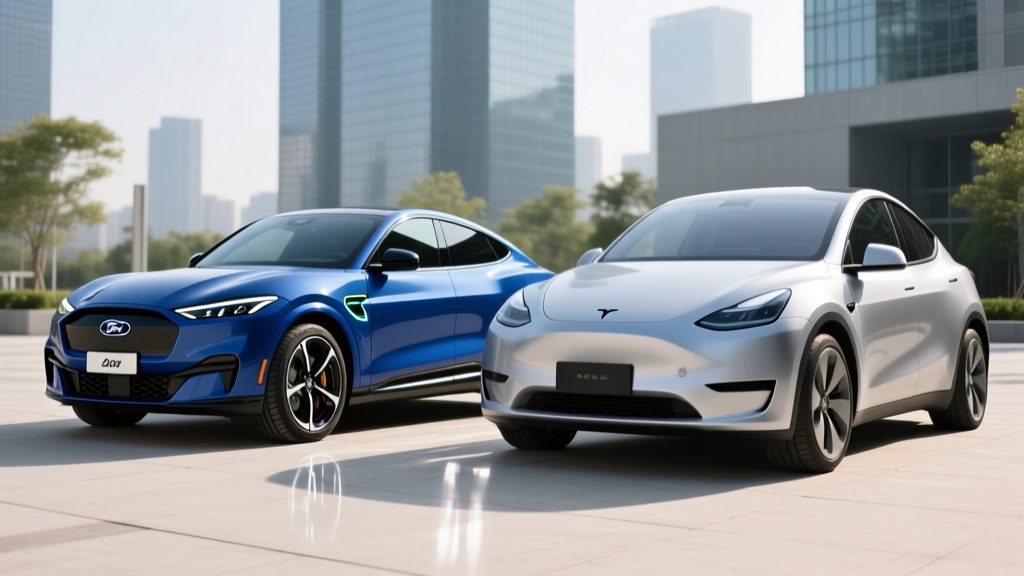
The search for "mustang tesla" almost always means one thing: you're cross-shopping the Ford Mustang Mach-E against the Tesla Model Y. Both are electric SUVs priced in the mid-$40,000s, both seat five, and both benefit from the expanding Tesla Supercharger network now that Ford has adopted the NACS charge port. But beneath the surface similarities, these two EVs diverge sharply in battery strategy, charging performance, interior execution, and total cost of ownership.
We've driven both extensively, logged charging sessions across seasons, and tracked real-world efficiency data to build this head-to-head. Below is every number that matters for your purchase decision in the 2026 model year.
Quick Verdict: Which Electric SUV Fits Your Life?
Choose the Mustang Mach-E if you prefer a conventional cockpit layout with physical controls, want a slightly more engaging driving feel, value Ford's BlueCruise hands-free highway driving, or find better dealer pricing and incentives in your area.
Choose the Tesla Model Y if you prioritize maximum cargo space, want the fastest DC fast-charging speeds, rely heavily on the Supercharger network for road trips, or prefer Tesla's minimalist software-centric approach and over-the-air update cadence.
Range, Battery & Efficiency: The Numbers That Matter
Range is where EV buyers start their research, and both vehicles deliver competitive EPA estimates. But the sticker number is only half the story — battery chemistry, real-world highway efficiency, and cold-weather behavior separate these two.
| Spec | 2026 Mustang Mach-E (Extended Range AWD) | 2026 Tesla Model Y (Long Range AWD) |
|---|---|---|
| EPA Range | 320 miles | 320 miles (est.) |
| Battery Capacity (usable) | 91 kWh | ~78 kWh |
| Battery Chemistry | NMC (Nickel Manganese Cobalt) | NMC (Long Range) / LFP (Standard Range) |
| Efficiency (MPGe combined) | 101 MPGe | 117 MPGe |
| Energy Consumption | 33 kWh/100 mi | 28 kWh/100 mi |
Real-World Range Reality Check: The EPA rates both vehicles near 320 miles, but real-world results diverge. In our mixed highway testing at 70-75 mph in moderate temperatures, the Mach-E Extended Range AWD delivers roughly 265–285 miles before needing a charge. The Model Y Long Range AWD, benefiting from superior efficiency, returns 280–300 miles under the same conditions. In sub-30°F winter driving, expect a 20–30% reduction from either vehicle — bringing the Mach-E down to roughly 220–240 miles and the Model Y to 230–250 miles. The Model Y's standard-range variant uses an LFP (lithium iron phosphate) battery, which tolerates daily 100% charging better than NMC, making its smaller pack more practical for daily use.
The Mach-E carries a larger battery but uses more energy per mile. Tesla's efficiency advantage — roughly 5 kWh/100 mi better — compounds over thousands of miles in lower electricity costs and slightly fewer charging stops on road trips.
Charging Speed: DC Fast, Home Level 2 & the NACS Advantage
Charging speed is where the Model Y pulls ahead decisively. Both vehicles now use the NACS (North American Charging Standard) connector, granting access to Tesla's Supercharger network. But peak charge rates and the shape of the charging curve tell different stories.
| Charging Level | Mustang Mach-E | Tesla Model Y |
|---|---|---|
| DC Fast Charge (Peak kW) | 150 kW | 250 kW |
| 10–80% DC Fast Charge Time | ~41 minutes | ~25 minutes |
| Level 2 Home Charging (kW) | 10.5 kW (48A) | 11.5 kW (48A) |
| Level 2 Miles Added per Hour | ~32 mi/hr | ~38 mi/hr |
| Charge Port | NACS (native, 2025+) | NACS (native) |
The Mach-E's 150 kW peak charge rate is its most significant competitive disadvantage. On a road trip, that 16-minute gap per charge stop adds up — a 600-mile journey might require two stops in the Mach-E totaling 80+ minutes of charging, versus roughly 50 minutes in the Model Y. The Mach-E's charge curve also tapers earlier; it holds near peak rate only up to about 55% State of Charge (SoC) before stepping down, while the Model Y sustains higher rates deeper into the curve.
At home on a Level 2 wall connector or equivalent, the difference is less dramatic. Both charge fully overnight on a 240V/48A circuit. Expect a full charge in roughly 9.5 hours for the Mach-E (larger battery) and about 8 hours for the Model Y. Most owners will wake up with a full battery regardless, making home charging a wash.
Performance & Drivetrain: 0-60, Handling & Daily Driving
| Performance Spec | Mustang Mach-E (ER AWD) | Tesla Model Y (LR AWD) |
|---|---|---|
| Horsepower | 365 hp | 384 hp |
| Torque | 428 lb-ft | 376 lb-ft |
| 0–60 mph | 4.8 seconds | 4.8 seconds |
| Drivetrain | Dual-motor AWD | Dual-motor AWD |
| Curb Weight | ~4,700 lbs | ~4,360 lbs |
Acceleration is nearly identical between the two in their mainstream AWD trims, both hitting 60 mph in 4.8 seconds. The Mach-E GT trim drops that to 3.5 seconds (500 hp), while the Model Y Performance variant achieves 3.5 seconds as well.
Where they differ is feel. The Mach-E's heavier curb weight and Ford's chassis tuning give it a more planted, traditional crossover feel — the steering has communicative weight, and the brake pedal modulation (blending regen and friction braking) is among the best in the EV segment. The Model Y is lighter and more nimble in tight corners, with Tesla's one-pedal driving delivering aggressive regen that most owners prefer once acclimated. The Model Y's ride quality has improved with the 2025 Juniper refresh, but it remains firmer than the Mach-E over broken pavement.
Interior, Cargo & Technology
This is where personal preference dominates, but the objective differences are significant.
Cargo volume: The Model Y offers 72 cu ft of total cargo space (rear seats folded) and 30.2 cu ft behind the second row — among the most in the compact EV SUV class. The Mach-E provides 59.7 cu ft total and 29.7 cu ft behind the rear seats. Both include a front trunk (frunk), but the Mach-E's is larger at 4.7 cu ft versus the Model Y's 4.1 cu ft — useful for storing charging cables or a gym bag.
Passenger space: Rear legroom favors the Mach-E at 38.9 inches versus the Model Y's 37.5 inches, a noticeable difference for taller passengers on longer drives. Front headroom is comparable.
Infotainment: The Model Y runs everything through a 15.4-inch center touchscreen — there are no physical buttons for climate, volume, or glovebox release. Tesla's software is fast, responsive, and receives frequent over-the-air updates. The Mach-E uses a 15.5-inch vertical touchscreen running Ford's SYNC 4A system, which retains some physical shortcuts and supports wireless Apple CarPlay and Android Auto. Tesla does not support either smartphone projection system, relying on its native apps.
Driver assistance: Both offer Level 2 driver-assist systems — SAE Level 2, meaning the driver must remain engaged and hands on or near the wheel at all times.
SAE Automation Level: Level 2 (Partial Automation)
Neither Tesla Autopilot/FSD (Supervised) nor Ford BlueCruise is "self-driving." Both require continuous driver supervision. Ford's BlueCruise allows hands-free operation on pre-mapped divided highways (over 130,000 miles of road), while Tesla's Autopilot requires hands on the wheel. Tesla's FSD (Supervised) can navigate city streets but still demands full driver attention. Only Level 4 services like Waymo operate without a human driver.
BlueCruise is bundled free for 90 days on most Mach-E trims, then costs approximately $75/month or $800/year. Tesla's Enhanced Autopilot is a $6,000 one-time add; FSD (Supervised) is $8,000 or $99/month.
Pricing, Trims & Federal Tax Credit Eligibility
| Trim / Price | Mustang Mach-E | Tesla Model Y |
|---|---|---|
| Base Trim (Select / Standard Range) | $42,495 (Select RWD) | $44,990 (Long Range AWD) |
| Mid Trim (Premium / —) | $47,495 (Premium AWD) | — |
| Performance Trim (GT / Performance) | $54,495 (GT) | $49,990 (Performance) |
| Federal Tax Credit (§30D) | Up to $7,500 (eligibility varies) | Up to $7,500 (eligibility varies) |
| Est. Price After Max Credit | From ~$34,995 | From ~$37,490 |
Both vehicles can qualify for the IRS §30D federal tax credit of up to $7,500, but eligibility is not automatic. Current rules require:
- MSRP cap: SUVs must be priced at or below $80,000 — both vehicles qualify comfortably.
- Buyer income cap: Modified AGI must not exceed $150,000 (single), $225,000 (head of household), or $300,000 (joint). Exceed these and the credit phases out entirely.
- Battery sourcing: The credit splits into two halves — $3,750 for critical minerals and $3,750 for battery component assembly, each with escalating domestic-content thresholds that tighten annually. Both Ford and Tesla have moved supply chains to maximize eligibility, but verify the specific trim and build date on the DOE's fueleconomy.gov credit lookup before purchasing.
- Point-of-sale transfer: As of 2024, you can transfer the credit to the dealer at purchase, reducing your out-of-pocket cost immediately rather than waiting for tax filing. Both Ford and Tesla dealers support this.
Always confirm eligibility with your tax professional and check the IRS and DOE resources for your specific model year and build date, as battery sourcing requirements shift annually.
Warranty & Long-Term Ownership
| Warranty Coverage | Mustang Mach-E | Tesla Model Y |
|---|---|---|
| Basic Vehicle | 3 yr / 36,000 mi | 4 yr / 50,000 mi |
| Battery & Powertrain | 8 yr / 100,000 mi | 8 yr / 120,000 mi |
| Battery Capacity Retention Threshold | 70% (under warranty) | 70% (under warranty) |
Tesla provides a longer powertrain warranty by 20,000 miles — a meaningful advantage if you drive high annual miles. Both manufacturers guarantee that the battery will retain at least 70% of its original capacity over the warranty period. Real-world data from Consumer Reports and fleet studies suggest NMC batteries in both vehicles typically degrade 8–12% over the first 100,000 miles, with the steepest loss occurring in the first 20,000 miles before leveling off.
For the Model Y's Standard Range variant with an LFP battery, degradation tends to be even lower — LFP chemistry is known for longer cycle life and better tolerance for regular 100% charging, making it a practical choice for daily commuters who charge nightly at home.
Pros, Cons & Who Should Buy Each
Mustang Mach-E — Pros
- Engaging driving dynamics with well-weighted steering and excellent brake blending
- Physical climate controls and Apple CarPlay/Android Auto support
- BlueCruise hands-free highway driving on 130,000+ mapped miles
- Larger frunk (4.7 cu ft) and generous rear legroom (38.9 in)
- Competitive pricing with strong dealer incentives available
Mustang Mach-E — Cons
- 150 kW peak DC charge rate is slowest in class — 41 min 10–80%
- Lower efficiency (33 kWh/100 mi) means higher electricity costs
- Less total cargo volume (59.7 cu ft) than Model Y
- BlueCruise subscription cost after trial period
Tesla Model Y — Pros
- Best-in-class DC fast charging at 250 kW (~25 min 10–80%)
- Superior efficiency (28 kWh/100 mi) — lower running costs
- Massive 72 cu ft cargo space with versatile rear seating
- Native Supercharger network with best reliability in public charging
- Longer powertrain warranty (8 yr / 120,000 mi)
Tesla Model Y — Cons
- No Apple CarPlay or Android Auto — Tesla's ecosystem only
- All controls via touchscreen — no physical buttons or stalks (2025+ refresh)
- Firm ride quality, especially on larger wheels
- FSD (Supervised) costs $8,000 and remains Level 2 — not autonomous
- Service center availability varies by region
Who the Mach-E suits best: Daily commuters and small families who want a driver-focused EV with familiar cockpit ergonomics, value hands-free highway driving for long commutes, and primarily charge at home. Its slower DC charging matters less if road trips are infrequent.
Who the Model Y suits best: Road-trippers, families needing maximum cargo flexibility, and efficiency-focused buyers who want the lowest cost per mile and fastest public charging. It's also the stronger pick if you lack home charging and depend on public DC fast chargers.
Frequently Asked Questions
What is the real-world range of the Mustang Mach-E and Tesla Model Y?
In 70–75 mph highway driving at moderate temperatures, expect roughly 265–285 miles from the Mach-E Extended Range AWD and 280–300 miles from the Model Y Long Range AWD. Both lose 20–30% of range in sustained sub-30°F winter conditions due to battery resistance and cabin heating demands.
How fast does each vehicle charge on DC fast chargers and at home?
The Model Y peaks at 250 kW and charges from 10–80% in approximately 25 minutes. The Mach-E peaks at 150 kW and takes about 41 minutes for the same session. On a home Level 2 charger (240V/48A), both fully charge overnight — roughly 9.5 hours for the Mach-E and 8 hours for the Model Y.
How much does each EV cost after the federal tax credit?
With the maximum $7,500 §30D credit applied at point of sale, the Mach-E Select RWD starts around $34,995 and the Model Y Long Range AWD around $37,490. Eligibility depends on buyer income (≤$150K single / ≤$300K joint), vehicle MSRP (≤$80K for SUVs — both qualify), and battery sourcing compliance. Verify your specific eligibility on irs.gov and with a tax professional.
Does the Mustang Mach-E or Tesla Model Y qualify for the $7,500 federal EV tax credit?
Both can qualify, but the full $7,500 is split into two $3,750 halves tied to critical mineral sourcing and battery component manufacturing requirements. These thresholds tighten each year. Check the latest eligibility on fueleconomy.gov for the specific trim and build date you're considering.
Is the Mach-E or Model Y better for road trips?
The Model Y has a clear advantage for frequent road-trippers: 250 kW DC fast charging cuts stop times by roughly 16 minutes per session, and Tesla's Supercharger network offers the most reliable and widely distributed public charging infrastructure in the U.S. The Mach-E's NACS port now accesses the same Superchargers, but its slower charge rate means longer stops.
Can I use Apple CarPlay in the Tesla Model Y?
No. Tesla does not support Apple CarPlay or Android Auto in any vehicle. All infotainment, navigation, and media run through Tesla's proprietary system. The Mustang Mach-E supports both wirelessly.
Is Tesla's FSD actually self-driving?
No. Tesla's Full Self-Driving (Supervised) is an SAE Level 2 driver-assist system. Despite the name, it requires the driver to remain fully attentive, with hands ready to take over at any moment. It does not make the vehicle autonomous. Only Level 4 robotaxi services like Waymo operate without a human driver.