Quick Verdict: Practical Enough for Most Buyers, But Not Class-Leading
The Ford Mustang Mach-E remains one of the most recognizable electric crossovers on the market, and its 2026 model year brings minor refinements to an already solid package. But for buyers cross-shopping midsize electric SUVs, the Ford Mustang Mach-E trunk space is a frequent question — and the answer is nuanced. With 29.7 cubic feet behind the rear seats and a modest front trunk (frunk), the Mach-E offers adequate cargo capacity for daily life, though it falls short of rivals like the Hyundai Ioniq 5 and Tesla Model Y in total volume. This review breaks down exactly what fits, how the cargo area is configured, and whether the Mach-E's overall package — range, charging, tech, and price — compensates for its trunk limitations.
| Spec | Select (RWD) | Premium AWD | GT |
|---|---|---|---|
| EPA Range | 250 mi (Std Range) / 320 mi (Ext Range) | 290 mi (Ext Range) | 280 mi (Ext Range) |
| Battery (usable) | 70 kWh (LFP) / 91 kWh (NMC) | 91 kWh (NMC) | 91 kWh (NMC) |
| Max DC Fast Charge | 150 kW | 150 kW | 150 kW |
| 10–80% DCFC Time | ~33 min (Ext Range) | ~36 min | ~36 min |
| Level 2 Home Charge | 10.5 kW (~30 mi/hr) | 10.5 kW (~30 mi/hr) | 10.5 kW (~30 mi/hr) |
| 0–60 mph | 6.3 sec (RWD Ext) | 5.2 sec | 3.5 sec |
| Horsepower | 266 hp | 346 hp | 480 hp |
| Drivetrain | RWD (single motor) | AWD (dual motor) | AWD (dual motor) |
| EPA Efficiency | 101 MPGe / 33 kWh/100mi | 98 MPGe / 34 kWh/100mi | 84 MPGe / 40 kWh/100mi |
| Base MSRP | $39,995 | $46,995 | $57,995 |
Ford Mustang Mach-E Trunk Space: Dimensions & What Actually Fits
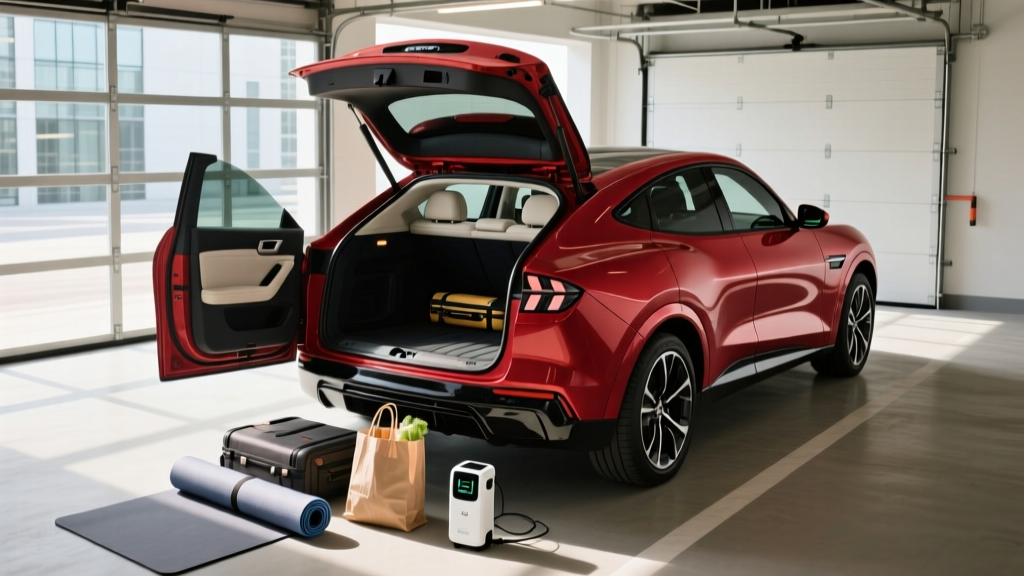
The headline number: 29.7 cubic feet of cargo volume behind the rear seats, expanding to 59.7 cubic feet with the 60/40-split rear seats folded flat. Ford also includes a front trunk (frunk) with approximately 4.7 cubic feet of space — enough for a charging cable bag, a small soft cooler, or a laptop backpack, but not a full grocery run.
The cargo area itself is reasonably shaped with a wide, flat load floor when the seats are down. However, the rear cargo opening is somewhat narrow compared to the Hyundai Ioniq 5 or Kia EV6, which can make loading bulky items like a large dog crate or a full-size bicycle (with the front wheel removed) a tighter squeeze. The load height is moderate — you won't strain to lift a 40-pound bag of dog food in, but it's higher than a sedan's trunk.
Real-World Cargo Test: What We Fit Inside
- 4 large suitcases (28-inch rollers): Fit behind rear seats with room to spare for a duffel
- Full-size stroller (UPPAbaby Vista-style): Fits behind rear seats, but tight — you'll angle it in
- Two mountain bikes (front wheels removed, seats folded): Fit, but handlebars require careful positioning
- Costco haul (2 flat boxes, 4 bags, a case of water): All fits behind rear seats comfortably
- Dog crate (36-inch): Fits behind rear seats lengthwise in the Premium and GT trims
How It Compares to Key Competitors
| Vehicle | Behind Rear Seats | Max (Seats Folded) | Frunk |
|---|---|---|---|
| Ford Mustang Mach-E | 29.7 cu ft | 59.7 cu ft | 4.7 cu ft |
| Hyundai Ioniq 5 | 27.2 cu ft | 59.3 cu ft | 0.85 cu ft |
| Tesla Model Y | 30.2 cu ft | 72.1 cu ft | 4.1 cu ft |
| Kia EV6 | 24.4 cu ft | 50.2 cu ft | 0.7 cu ft |
| Volkswagen ID.4 | 30.3 cu ft | 64.2 cu ft | None |
The Mach-E lands in the middle of this pack. The Tesla Model Y's superior max cargo volume (72.1 cu ft) makes it the clear pick for buyers who regularly haul large loads, while the Ioniq 5's hatchback-style opening compensates for its slightly lower behind-seat number. The Mach-E's 4.7-cu-ft frunk is the largest in this comparison, which is a genuine practical advantage for stowing dirty or smelly items (wet gear, takeout) away from the main cabin.
EPA Range vs. Real-World: What to Actually Expect
EPA Estimated Range: Up to 320 miles (Select RWD with Extended Range battery)
Real-World Expectation: Expect 260–290 miles in mixed driving. Sustained highway speeds of 70–75 mph reduce range to roughly 240–265 miles. In cold weather (below 30°F), anticipate a 20–30% reduction, dropping effective range to 180–220 miles for the Extended Range battery.
The 2026 Mach-E continues to offer Standard Range (70 kWh usable, LFP chemistry) and Extended Range (91 kWh usable, NMC chemistry) battery packs. The EPA's official ratings for the Extended Range RWD Select trim top out at 320 miles, which is competitive for the segment.
In real-world highway testing, the Mach-E Extended Range AWD consistently delivers 260–280 miles before requiring a charge stop at 70 mph in moderate temperatures (55–75°F). The LFP Standard Range battery is more resilient to cold-weather degradation and can be charged to 100% daily without accelerating degradation — a practical advantage for commuters who need every mile each morning. The NMC Extended Range pack should be charged to 80% for daily use and saved to 100% only for road trips.
Charging Speed: DC Fast Charging & Home Level 2
The Mach-E's DC fast-charging architecture peaks at 150 kW on Extended Range models. That puts it a generation behind the Hyundai Ioniq 5 and Kia EV6, which both support up to 235–240 kW on 800-volt architectures. On a 150 kW charger, the Mach-E Extended Range charges from 10–80% in approximately 33–36 minutes, with a noticeable taper above 80% that extends a 10–100% session to roughly 55 minutes.
| Charging Level | Power | Speed | Notes |
|---|---|---|---|
| Level 1 (120V outlet) | 1.2 kW | ~3 mi/hr | Emergency/trickle only; full charge takes days |
| Level 2 (240V home) | 10.5 kW | ~30 mi/hr | Full overnight charge in ~9–10 hours (Ext Range) |
| DC Fast Charge | 150 kW peak | 10–80% in ~33–36 min | Tapers significantly above 80%; preconditioning recommended |
At home on a Level 2 charger (48-amp circuit, 10.5 kW), the Extended Range battery refills from empty in roughly 9–10 hours — fine for overnight charging but slower than the Ioniq 5's 10.9 kW onboard charger. Ford's Mobile Power Cord is included and can handle both 120V and 240V outlets, though most buyers will want a dedicated wall-mounted Level 2 unit. Budget $500–$1,500 for a quality Level 2 home charger and $800–$2,000 for professional electrical installation, depending on whether your panel needs an upgrade.
Charging-curve reality check: The Mach-E sustains its peak 150 kW rate only briefly — typically between 10–30% State of Charge. From 30–60%, it settles around 100–120 kW, and above 80%, it drops to under 40 kW. This is normal for 400-volt architectures but means you won't see 150 kW on the display for long. Always precondition the battery via the FordPass app before arriving at a DC fast charger for optimal speeds.
Performance, Efficiency & Driving Impressions
Even the base Select RWD with 266 hp and a 6.3-second 0–60 time feels brisk in everyday driving, with the instant torque delivery that defines the EV experience. The Premium AWD bumps output to 346 hp and drops the 0–60 to 5.2 seconds — genuinely quick for a family crossover. The GT trim's 480 hp and 3.5-second 0–60 puts it in sports-car territory, though at the cost of efficiency (84 MPGe vs. 101 MPGe for the RWD).
Ride quality is firm but controlled, with well-damped suspension that handles rough pavement without crashing. Steering is direct if somewhat numb, and the low center of gravity keeps body lean minimal in corners. Regenerative braking offers multiple levels adjustable via steering-wheel paddles, and one-pedal driving mode is strong enough to bring the car to a complete stop in most traffic situations.
Efficiency for the Extended Range RWD is rated at 101 MPGe combined (33 kWh per 100 miles) per fueleconomy.gov. That translates to roughly $0.10–$0.14 per mile on average residential electricity rates ($0.16/kWh national average), or about $5.50–$7.50 for a full home charge — a significant savings over the $14–$18 a comparable gas crossover would cost for the same distance.
Pricing, Trims & Federal Tax Credit Eligibility
The 2026 Mustang Mach-E lineup starts at $39,995 for the Select RWD with Standard Range and climbs to $57,995 for the GT. Here's the trim breakdown:
| Trim | Base MSRP | §30D Credit Eligibility | Effective Price (est.) |
|---|---|---|---|
| Select RWD (Std Range) | $39,995 | Likely eligible (up to $7,500) | ~$32,495 |
| Select RWD (Ext Range) | $45,995 | Likely eligible (up to $7,500) | ~$38,495 |
| Premium AWD (Ext Range) | $46,995 | Likely eligible (up to $7,500) | ~$39,495 |
| GT (Ext Range AWD) | $57,995 | Likely eligible (up to $7,500) | ~$50,495 |
Federal tax credit details: Under current IRS §30D rules, the Mach-E is expected to qualify for up to the full $7,500 federal tax credit in 2026, as it meets the MSRP cap ($80,000 for SUVs/crossovers) and Ford has made progress on North American battery sourcing requirements. However, buyer income caps apply: modified adjusted gross income must not exceed $150,000 (single), $225,000 (head of household), or $300,000 (joint). The credit can be transferred to the dealer at the point of sale as an immediate purchase-price reduction, which is the most practical way to capture it. Always verify current eligibility with your tax professional and the IRS before purchasing, as battery-sourcing rules tighten periodically.
Tech, Safety & Driver Assistance
The Mach-E's centerpiece is its 15.5-inch vertical touchscreen running Ford's SYNC 4A system with wireless Apple CarPlay and Android Auto. The interface is responsive and logically organized, though some climate controls are buried in the touchscreen rather than having dedicated physical buttons — a common complaint. A 10.2-inch digital instrument cluster provides speed, range, and navigation info behind the steering wheel.
Ford's Co-Pilot360 suite of driver-assistance features comes standard across all trims and includes:
- Adaptive cruise control with stop-and-go
- Lane-centering assist
- Automatic emergency braking with pedestrian detection
- Blind-spot monitoring with rear cross-traffic alert
- Evasive steering assist
The available BlueCruise hands-free highway driving system (subscription-based, ~$75/month or $2,100 for a multi-year plan after the initial trial) enables hands-off driving on pre-mapped divided highways. BlueCruise is an SAE Level 2 system — the driver must remain attentive and the system monitors via a driver-facing camera. It is not self-driving and will disengage if you look away from the road for extended periods. In practice, BlueCruise performs well on long highway stretches, reducing fatigue significantly, but it cannot handle construction zones, unmapped roads, or severe weather.
ADAS Reminder: BlueCruise and all Mach-E driver-assist features are SAE Level 2. You are the driver at all times. Keep your eyes on the road, your hands ready to resume control, and never rely on these systems in construction zones, unmapped areas, or adverse weather.
Warranty & Long-Term Ownership
Ford covers the Mach-E with a 3-year/36,000-mile bumper-to-bumper warranty and an 8-year/100,000-mile battery and powertrain warranty. The battery warranty guarantees that the pack will retain at least 70% of its original capacity during the coverage period. If degradation drops below that threshold, Ford will repair or replace the battery at no cost.
For long-term ownership, the LFP Standard Range battery is expected to show slower degradation over its lifespan compared to NMC, with many LFP packs projected to retain 85–90% capacity after 150,000 miles. The NMC Extended Range pack typically retains 80–85% after the same mileage based on industry data. Replacement cost for a Mach-E battery pack, should it be needed out of warranty, currently ranges from $12,000–$18,000 depending on the pack size — though costs continue to decline year over year.
Pros & Cons
Pros
- Engaging driving dynamics; GT trim is genuinely fast
- Largest frunk in its competitive set (4.7 cu ft)
- BlueCruise hands-free highway driving is well-executed
- Strong federal tax credit eligibility reduces effective price
- LFP Standard Range battery allows daily 100% charging
- Attractive styling that stands out in the EV crossover segment
Cons
- Trunk space (29.7 cu ft) trails Tesla Model Y and VW ID.4
- 150 kW peak DC charging is slower than 800V rivals
- Climate controls buried in touchscreen — no physical knobs
- GT trim efficiency drops significantly (84 MPGe)
- Rear-seat legroom (38.1 in) is average, not generous
- BlueCruise requires ongoing subscription after trial period
Who Should Buy the Mustang Mach-E?
The 2026 Mustang Mach-E is best suited for:
- Commuters and couples who prioritize driving enjoyment and styling over maximum cargo volume
- Buyers who want a recognizable, sporty design rather than the minimalist EV aesthetic of a Tesla or Hyundai
- Hands-free highway enthusiasts who value BlueCruise for long commutes
- Budget-conscious EV shoppers who can capture the full $7,500 tax credit, bringing the Select RWD under $33,000
It's less ideal for large families who regularly pack the cargo area to the roof, buyers in extreme cold climates who need maximum range buffer, or road-trippers who want the fastest possible DC charging at every stop.
Frequently Asked Questions
What is the real-world range of the Ford Mustang Mach-E?
The EPA rates the Extended Range RWD at 320 miles, but real-world mixed driving typically yields 260–290 miles. Sustained highway driving at 75 mph drops this to about 240–265 miles, and cold weather (below 30°F) can reduce range by 20–30%, bringing effective winter range to 180–220 miles for the Extended Range pack.
How fast does the Mach-E charge at home and on DC fast chargers?
On a home Level 2 charger (240V, 10.5 kW), the Mach-E gains about 30 miles of range per hour, fully charging the Extended Range battery overnight in ~9–10 hours. On DC fast chargers, it peaks at 150 kW and charges from 10–80% in approximately 33–36 minutes, though the rate tapers significantly above 80%.
How much does the Mustang Mach-E cost after the federal tax credit?
If you qualify for the full $7,500 §30D credit (subject to income caps of $150K single / $300K joint), the Select RWD Standard Range drops from $39,995 to an effective ~$32,495. The Premium AWD falls to approximately $39,495. The credit can be applied as a point-of-sale reduction at participating dealers.
Is the Mustang Mach-E worth buying vs. the Tesla Model Y or Hyundai Ioniq 5?
The Mach-E wins on driving engagement, frunk space, and traditional dealership service access. The Model Y wins on max cargo volume (72.1 cu ft), Supercharger network access, and software. The Ioniq 5 wins on DC charging speed (800V architecture, 10–80% in ~18 min) and interior space efficiency. Choose based on which trade-off matters most for your use case.
Does the 2026 Mach-E qualify for the $7,500 federal EV tax credit?
The Mach-E is expected to qualify for up to $7,500 under current §30D rules, as its MSRP is well under the $80,000 SUV cap and Ford has worked to meet North American battery-sourcing requirements. However, buyer income limits apply, and sourcing rules are subject to change. Verify eligibility on the IRS clean vehicle credits page and consult a tax professional before purchase.
How much trunk space does the Mustang Mach-E actually have?
The Mach-E provides 29.7 cubic feet behind the rear seats and 59.7 cubic feet with the seats folded flat, plus a 4.7-cubic-foot front trunk. This is adequate for weekly groceries, luggage for four, or a full-size stroller, but less than the Tesla Model Y (30.2/72.1 cu ft) and VW ID.4 (30.3/64.2 cu ft) for maximum hauling.