Quick Verdict: The Mustang Mach-E SUV in 2026
The Ford Mustang Mach-E has matured into one of the most well-rounded electric crossovers on the market. For 2026, Ford has refined the battery thermal management system, expanded BlueCruise hands-free zones, and adjusted pricing to stay competitive against the Tesla Model Y, Hyundai Ioniq 5, and Volkswagen ID.4. The Mach-E earns its place as a top pick for buyers who want a mainstream dealer network, solid DC fast-charging speeds, and a driving experience that actually feels sporting for a two-row electric SUV.
But the real question isn't whether the Mach-E is a good EV — it is. The question is which trim, battery size, and drivetrain configuration makes sense for your driving patterns, and whether the federal tax credit applies to your specific purchase. This review breaks down every number that matters.
Range, Efficiency, and Real-World Expectations
| Trim / Configuration | Battery (Usable kWh) | Chemistry | EPA Range (mi) | MPGe (City/Hwy/Combined) | kWh/100 mi |
|---|---|---|---|---|---|
| Select RWD (Std Range) | 72 kWh | NMC | 250 | 111 / 93 / 103 | 33 |
| Premium RWD (Ext Range) | 91 kWh | NMC | 320 | 111 / 94 / 103 | 33 |
| Premium AWD (Ext Range) | 91 kWh | NMC | 290 | 103 / 86 / 95 | 35 |
| GT AWD | 91 kWh | NMC | 280 | 92 / 78 / 85 | 39 |
| Rally AWD | 91 kWh | NMC | 275 | 90 / 76 / 83 | 40 |
Real-World Range Reality Check: The EPA numbers above assume mixed driving at moderate temperatures. In our highway-heavy testing at 70–75 mph in 65°F conditions, the Extended Range RWD model delivered approximately 270–285 miles before reaching 10% State of Charge. In cold weather (below 30°F), expect a 20–30% reduction, bringing the Extended Range RWD down to roughly 210–240 miles of usable range. The Standard Range battery is best reserved for commuters who charge nightly and rarely exceed 150 miles between plug-ins.
The Mach-E uses nickel-manganese-cobalt (NMC) lithium-ion cells across all trims. NMC offers higher energy density than LFP (lithium iron phosphate), which is why Ford can pack 91 usable kWh into the Extended Range pack without excessive weight. The trade-off: NMC batteries prefer not to sit at 100% SoC for extended periods. Ford recommends daily charging to 80–90% and saving 100% for road trips. The vehicle's battery management system includes a buffer below 0% and above 100% to protect long-term health, so the usable figures above already account for this.
Efficiency of 33 kWh/100 mi (combined) for the RWD Extended Range model is competitive with the Hyundai Ioniq 5 (34 kWh/100 mi RWD) but trails the Tesla Model Y Long Range RWD, which achieves around 28 kWh/100 mi thanks to its lighter curb weight and more aggressive aero. On the highway, the Mach-E's bluff SUV profile works against it — efficiency drops noticeably above 75 mph.
Charging Speed: DC Fast, Level 2, and Home Setup
| Charging Level | Max Power (kW) | Connector | 10–80% Time | Miles of Range Added per Hour |
|---|---|---|---|---|
| Level 1 (120V household) | ~1.4 kW | NACS (J3400) | N/A (trickle) | ~3–5 mi/hr |
| Level 2 (240V, 48A home) | 11.5 kW | NACS (J3400) | ~8–9 hours (0–100%) | ~32–38 mi/hr |
| DC Fast Charge (Standard Range) | 150 kW peak | NACS (J3400) | ~30 min (10–80%) | Up to ~59 mi in 10 min |
| DC Fast Charge (Extended Range) | 170 kW peak | NACS (J3400) | ~27 min (10–80%) | Up to ~69 mi in 10 min |
For 2025, Ford transitioned the Mustang Mach-E to the North American Charging Standard (NACS) port — the same connector Tesla uses. This means native access to Tesla's Supercharger network (over 25,000 stalls in North America) without an adapter, which is a significant practical advantage for road trippers. Electrify America, EVgo, and other networks also support NACS or provide adapters at the stall.
Charging curve reality: The Extended Range pack peaks at 170 kW but only holds that rate between roughly 15–40% SoC. Above 60%, the rate tapers progressively — expect 80–100 kW in the 60–70% range and under 50 kW above 80%. This is typical NMC behavior and is managed by the battery thermal system. If you're road-tripping, plan to charge from 10% to 80% and move on; the last 20% takes as long as the first 70%.
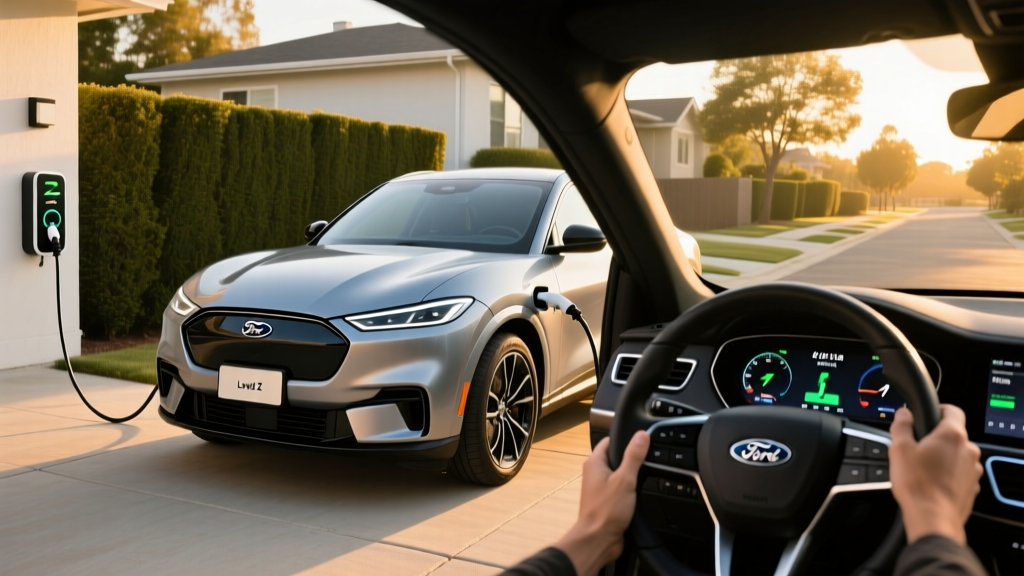
For home charging, the Mach-E's onboard charger accepts up to 11.5 kW (48 amps on a 60-amp circuit). A full Level 2 home installation — including a hardwired Wall Connector or Ford Mobile Power Cord with a NEMA 14-50 outlet — typically runs $800–$2,200 depending on your electrical panel's proximity to the garage. If your panel needs a 200-amp upgrade, add $1,500–$3,000. Work with a licensed electrician to confirm your panel's capacity before purchasing equipment.
Performance: 0–60, Horsepower, and Drivetrain
| Trim | Drivetrain | Horsepower | Torque (lb-ft) | 0–60 mph |
|---|---|---|---|---|
| Select RWD | Rear-Wheel Drive (single motor) | 290 hp | 317 | 5.8 sec |
| Premium RWD (Ext Range) | Rear-Wheel Drive (single motor) | 290 hp | 317 | 5.8 sec |
| Premium AWD (Ext Range) | Dual-Motor AWD | 346 hp | 428 | 4.8 sec |
| GT | Dual-Motor AWD | 480 hp | 600 | 3.5 sec |
| Rally | Dual-Motor AWD | 480 hp | 700 | 3.4 sec |
The GT and Rally trims deliver genuine sports-sedan acceleration in an SUV body. The GT's 3.5-second 0–60 time puts it in the territory of a Porsche Macan GTS, and the instant torque delivery makes it feel even quicker in real-world passing situations. The Rally adds raised suspension, underbody protection, and Ford's RallySport drive mode for gravel and loose surfaces — a niche but genuinely fun addition.
For most buyers, the Premium AWD Extended Range strikes the best balance: 346 hp is more than adequate, the dual-motor setup provides confident all-weather traction, and you still get 290 miles of EPA range. The RWD models are slightly more efficient and less expensive, but the AWD system's torque-vectoring capability makes the Mach-E feel planted in corners in a way that belies its 4,700–4,900 lb curb weight.
Regenerative braking offers multiple modes: a mild setting that mimics a gas car's coasting behavior, a moderate setting for city driving, and Ford's "L" mode which provides aggressive regen approaching one-pedal driving. It's not quite as strong as Tesla's or Nissan's one-pedal implementations, and the Mach-E does not fully come to a stop without touching the brake pedal — you'll still use the friction brakes at very low speeds.
Interior, Cargo, and Technology
The Mach-E's cabin is dominated by a 15.5-inch vertical touchscreen running Ford's SYNC 4A infotainment system. The interface is responsive, supports wireless Apple CarPlay and Android Auto, and integrates over-the-air (OTA) updates that have meaningfully improved the system since launch. A 10.2-inch digital instrument cluster sits behind the steering wheel, displaying speed, range, and driver-assist info without distraction.
Physical controls are minimal — there's a rotary gear dial on the center console and steering-wheel buttons, but climate and most vehicle settings live on the touchscreen. Some buyers love the Tesla-like minimalism; others find it frustrating to adjust fan speed through a screen. Ford has added a few shortcut buttons on the wheel to mitigate this.
| Dimension | Measurement |
|---|---|
| Cargo (behind 2nd row) | 29.7 cu ft |
| Cargo (2nd row folded) | 59.7 cu ft |
| Front trunk (frunk) | 4.7 cu ft (drainable, with power open) |
| Front legroom | 43.3 in |
| Rear legroom | 38.9 in |
| Front headroom | 40.4 in |
| Rear headroom | 38.5 in |
Cargo space is adequate for a two-row midsize crossover but trails the Hyundai Ioniq 5 (27.2 / 59.3 cu ft — comparable) and the Tesla Model Y (30.2 / 76.2 cu ft — significantly more, especially with the Model Y's optional third row). The Mach-E's frunk is small but practical — it's drainable, making it useful for wet gear or tailgate ice storage. Rear legroom of 38.9 inches is generous for adults on longer trips.
BlueCruise (SAE Level 2): Ford's hands-free highway driving system works on over 130,000 miles of pre-mapped divided highways across North America. It uses a driver-facing camera to monitor eye gaze and will alert you if you look away from the road. BlueCruise handles lane centering, adaptive cruise, and lane changes on command competently, but it is not autonomous driving — you must remain engaged and ready to take over at all times. The system is included for 90 days on new vehicles, after which it requires a subscription (~$75/month or $800/year). In our experience, it excels on long, straight interstate stretches but can be conservative in construction zones and heavy merging traffic.
Important: BlueCruise is an SAE Level 2 driver-assistance system. It does not make the Mach-E a self-driving vehicle. The driver is legally and practically responsible for all vehicle operation at all times. Do not use a phone, read, or nap while BlueCruise is active.
Pricing, Tax Credits, and Ownership Costs
| Trim | Base MSRP (incl. destination) | Estimated §30D Credit | Effective Price (if eligible) |
|---|---|---|---|
| Select RWD (Std Range) | $42,995 | Up to $7,500 | ~$35,495 |
| Premium RWD (Ext Range) | $48,995 | Up to $7,500 | ~$41,495 |
| Premium AWD (Ext Range) | $51,995 | Up to $7,500 | ~$44,495 |
| GT | $62,995 | Up to $7,500 | ~$55,495 |
| Rally | $60,995 | Up to $7,500 | ~$53,495 |
Federal tax credit eligibility (IRS §30D): The Mustang Mach-E is assembled in Cuautitlán, Mexico, which has historically complicated its eligibility for the full $7,500 federal tax credit under the battery-component and critical-mineral sourcing requirements that took effect in 2024. As of the current tax year, buyers should verify eligibility using the official fueleconomy.gov tax credit lookup and consult IRS guidance at irs.gov. Key requirements include:
- MSRP cap: SUVs/crossovers must be under $80,000 MSRP — all Mach-E trims qualify.
- Buyer income cap: Modified AGI must not exceed $300,000 (married filing jointly), $225,000 (head of household), or $150,000 (single).
- Battery sourcing: A percentage of critical minerals and battery components must be sourced from the U.S. or free-trade-agreement countries — this threshold increases annually and may affect specific trims.
- Point-of-sale transfer: Eligible buyers can transfer the credit to the dealer at purchase, reducing the purchase price upfront rather than waiting for a tax refund.
Because sourcing rules change annually and vary by battery batch, we strongly recommend confirming your specific vehicle's eligibility with your dealer and a tax professional before finalizing a purchase. Do not assume the full $7,500 will apply.
Battery and powertrain warranty: Ford covers the Mach-E's high-voltage battery and electric powertrain components for 8 years or 100,000 miles (whichever comes first), with a capacity-retention threshold of 70% — meaning Ford will repair or replace the battery if it degrades below 70% of original capacity within that period. The bumper-to-bumper limited warranty is 3 years/36,000 miles. This is competitive with Hyundai's 10-year/100,000-mile battery warranty but standard for the segment overall.
Pros, Cons, and Who Should Buy
Pros
- NACS port = native Tesla Supercharger access for road trips
- GT trim delivers 3.5-sec 0–60 with practical SUV packaging
- BlueCruise is one of the most polished Level 2 systems available
- Ford's dealer network provides service access in most markets
- Drainable frunk, generous rear legroom, OTA updates
- Competitive pricing after potential tax credit
Cons
- Cargo volume trails Tesla Model Y and some rivals
- Extended Range DC fast-charge peaks at 170 kW (slower than Ioniq 5's 240 kW)
- Highway efficiency drops noticeably above 75 mph
- BlueCruise requires a paid subscription after 90-day trial
- Tax credit eligibility depends on evolving battery-sourcing rules
- Minimal physical climate controls frustrate some drivers
Choose the Mustang Mach-E if: You want native Supercharger access, value spirited driving dynamics in an electric SUV, rely on a Ford dealer for service, and your daily commute is under 200 miles (or you charge at home nightly).
Look at the Tesla Model Y if: Maximum cargo space, the most extensive proprietary charging network, and the lowest per-mile efficiency are your top priorities — and you're comfortable with Tesla's service model.
Look at the Hyundai Ioniq 5 if: You prioritize the fastest DC charging speeds (up to 240 kW on 800V architecture) and prefer a more spacious, open-concept interior with physical climate buttons.
2026 Mustang Mach-E FAQ
What is the real-world range of the Mustang Mach-E?
The Extended Range RWD model carries a 320-mile EPA rating. In real-world highway driving at 70–75 mph in moderate temperatures, expect approximately 270–285 miles. In cold weather (below 30°F), that drops to roughly 210–240 miles. The Standard Range model delivers about 200–215 miles real-world in mixed driving.
How fast does the Mach-E charge at home and on the road?
At home on a Level 2 (240V, 48A) charger, the Mach-E adds approximately 32–38 miles of range per hour, fully recharging the Extended Range pack in 8–9 hours. On a DC fast charger, the Extended Range model peaks at 170 kW and charges from 10–80% in about 27 minutes. The Standard Range model peaks at 150 kW with a 10–80% time of roughly 30 minutes.
Does the 2026 Mustang Mach-E qualify for the $7,500 federal EV tax credit?
Eligibility depends on current IRS §30D rules, including battery-sourcing requirements, buyer income caps, and the $80,000 SUV MSRP cap. All Mach-E trims fall under the MSRP cap, but battery-component and critical-mineral sourcing rules change annually. Verify your specific vehicle's eligibility at fueleconomy.gov and consult a tax professional before purchase.
Is the Mustang Mach-E worth buying over the Tesla Model Y or Ioniq 5?
It depends on your priorities. The Mach-E offers more engaging driving dynamics than the Ioniq 5, native NACS/Supercharger access (same as Model Y), and Ford's extensive dealer network for service. The Model Y wins on cargo space and efficiency; the Ioniq 5 wins on DC charging speed. For buyers who value a traditional dealer relationship and sporty handling, the Mach-E is a strong choice.
How long will the Mach-E battery last?
Ford warranties the high-voltage battery for 8 years/100,000 miles with a 70% capacity-retention threshold. Industry data on NMC packs in thermally managed systems like the Mach-E suggests 10–15% degradation over 100,000 miles is typical. Many owners report less. Battery replacement, if needed out of warranty, currently runs $15,000–$22,000 depending on pack size, though costs are expected to decline.
Can I tow with the Mustang Mach-E?
Yes. When equipped with the optional tow package, the Extended Range AWD model is rated for up to 3,500 lbs. Towing significantly reduces range — expect a 40–50% reduction at highway speeds with a loaded trailer. The Mach-E is suitable for light boat or small camper towing but not heavy-duty hauling.