Quick Verdict: The Mustang Mach-E Premium in 2026
The 2026 Ford Mustang Mach-E Premium remains one of the most balanced electric SUVs on the market — blending usable range, competent fast-charging, and a well-equipped cabin without the six-figure price tag. The Premium trim sits in the sweet spot of the lineup, adding luxury and technology features over the Select while avoiding the GT's performance-tax on range and efficiency. For buyers who want a daily-driver EV that handles road trips without constant charging stops, the Mach-E Premium continues to make a compelling case.
But with the Hyundai Ioniq 5, Tesla Model Y, and Chevrolet Equinox EV all competing fiercely in this segment, the Mach-E needs to justify its price with more than a pony badge. Here's the data-driven breakdown of what you're actually getting.
Range, Battery, and Real-World Efficiency
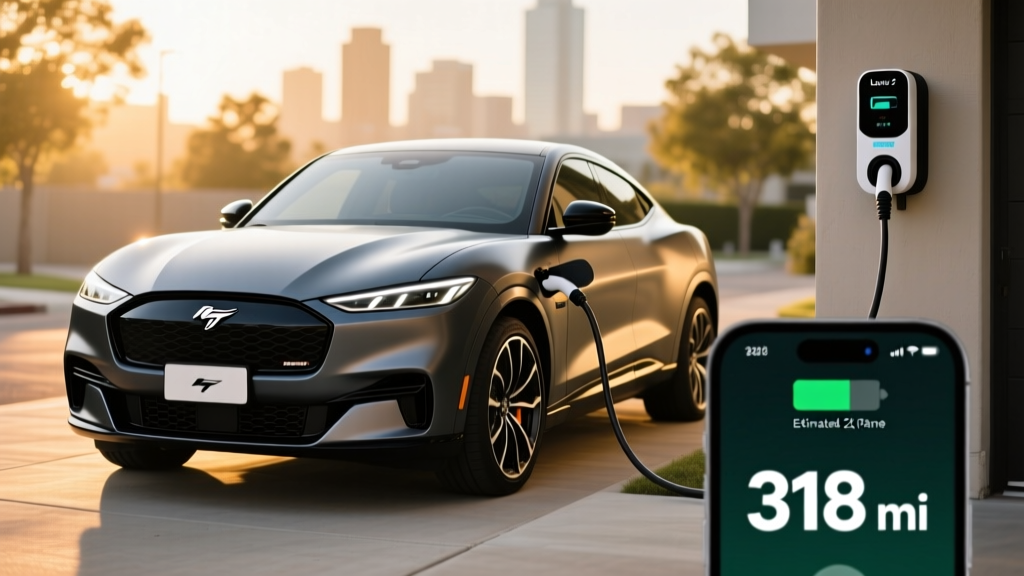
EPA Estimated: 320 miles (Extended Range RWD) | 290 miles (Extended Range AWD)
Real-World Highway (70 mph): ~255–280 miles
Cold Weather (below 32°F): ~220–250 miles (expect 20–30% reduction)
Mixed Commute (city/suburban): ~290–310 miles
The 2026 Mustang Mach-E Premium with the Extended Range battery carries an NMC (nickel manganese cobalt) lithium-ion pack with 91 kWh of usable capacity (approximately 98 kWh gross). Ford continues with NMC chemistry rather than LFP in the Premium, which delivers higher energy density and better cold-weather performance than LFP alternatives, though it comes with a slightly higher degradation curve over 10+ years.
The Standard Range battery (approximately 72 kWh usable) is also available on the Premium trim, yielding an EPA-estimated 250 miles (RWD) or 230 miles (AWD). For most buyers outside of tight-budget scenarios, the Extended Range is the better long-term ownership choice — the extra 70 miles of EPA range translates to fewer charging stops on road trips and less range anxiety in winter.
| Spec | SR RWD | ER RWD | ER AWD |
|---|---|---|---|
| EPA Range | 250 mi | 320 mi | 290 mi |
| Usable Battery | ~72 kWh (NMC) | ~91 kWh (NMC) | ~91 kWh (NMC) |
| Horsepower | 266 hp | 266 hp | 346 hp |
| Torque | 387 lb-ft | 387 lb-ft | 428 lb-ft |
| 0-60 mph | 6.3 sec | 6.1 sec | 5.1 sec |
| MPGe (Combined) | 101 MPGe | 103 MPGe | 96 MPGe |
| Efficiency | 33 kWh/100mi | 32 kWh/100mi | 35 kWh/100mi |
| Drivetrain | Single Motor RWD | Single Motor RWD | Dual Motor AWD |
Efficiency is a strong suit. At 32 kWh/100 miles for the ER RWD, the Mach-E Premium matches or slightly beats the Tesla Model Y Long Range (33 kWh/100mi) and is notably more efficient than the heavier Ford F-150 Lightning. According to fueleconomy.gov, this translates to roughly $550–$650 in annual electricity costs for 15,000 miles of driving at national average electricity rates — about one-third the fuel cost of a comparable gas SUV.
Charging Speed: DC Fast, Level 2, and Level 1
Charging remains one of the Mach-E's stronger competitive attributes. Ford's adoption of the NACS (North American Charging Standard) connector means the Mach-E can access Tesla Supercharger stations natively — a significant advantage over CCS-only competitors now that the Supercharger network has opened to NACS-equipped vehicles.
| Charging Level | Power / Rate | Speed (Miles Added) | Time |
|---|---|---|---|
| DC Fast Charge (Peak) | 150 kW max | ~590 mi/hr at peak | 10–80% in ~36 min (ER) |
| DC Fast Charge (Avg 10-80%) | ~115 kW sustained | ~450 mi/hr average | ~36 min (ER) |
| Level 2 (Home, 48A) | 11.5 kW | ~37 mi/hr | 0–100% in ~9.5 hr (ER) |
| Level 2 (Home, 32A) | 7.7 kW | ~25 mi/hr | 0–100% in ~14 hr (ER) |
| Level 1 (120V, 12A) | 1.4 kW | ~4 mi/hr | ~65 hr (ER, 0–100%) |
Charging curve reality check: The Mach-E Premium Extended Range peaks at approximately 150 kW between 10–25% State of Charge (SoC). From 25–60%, it sustains roughly 120–135 kW, then tapers to 80–90 kW through 80%, and drops sharply above 80%. This is why the 10–80% time of ~36 minutes is the meaningful metric — not the peak kW number. Plan road-trip stops around the 10–80% window for the fastest throughput.
The onboard charger's 11.5 kW capacity (48 amps) is competitive for home Level 2 charging. With a properly installed 60-amp circuit and a hardwired Level 2 station (like a ChargePoint Home Flex or Ford Connected Charge Station), you'll add roughly 37 miles of range per hour — enough to fully replenish overnight. A licensed electrician should evaluate your panel capacity before installation; a 200-amp service panel is typically required.
Preconditioning tip: Use the FordPass app or in-car navigation to route to a DC fast charger. The Mach-E will precondition the battery to optimal temperature, which can shave 5–10 minutes off your charging session in cold weather. Skipping preconditioning in winter can reduce peak charge rates by 30–40%.
Performance and Driving Dynamics
The Mach-E Premium Extended Range AWD delivers 346 horsepower and 428 lb-ft of torque, good for a 0–60 mph time of approximately 5.1 seconds. The RWD models make 266 hp and 387 lb-ft, reaching 60 mph in about 6.1 seconds (ER). These are respectable numbers that place the Mach-E Premium in the "quick but not extreme" category — adequate for confident highway merging and passing without the range sacrifice of the GT models.
Driving dynamics are where the Mach-E name earns some credibility. Ford tuned the suspension for a balance of comfort and engagement, with a lower center of gravity than most crossovers thanks to the floor-mounted battery pack. Steering is direct, and the regenerative braking offers multiple levels, including a one-pedal driving mode that can bring the car to a complete stop without touching the brake pedal.
Ride quality is firm but well-damped. Road noise is reasonably isolated, though some owners report more tire noise on coarse-pavement highways than in the Hyundai Ioniq 5. The Mach-E's 39.4 inches of front legroom and 38.9 inches of rear legroom make it comfortable for four adults, with the rear seat accommodating taller passengers better than some competitors in the segment.
Interior, Cargo, and Technology
The Premium trim elevates the cabin with ActiveX synthetic leather upholstery, a heated steering wheel, heated front seats, a panoramic fixed glass roof, and a 10.2-inch digital instrument cluster alongside Ford's 15.5-inch vertically oriented SYNC 4A touchscreen. The large portrait screen handles navigation, media, climate controls, and vehicle settings — though the reliance on touchscreen for climate adjustments remains a common complaint among traditionalists.
Cargo space measures 29.7 cubic feet behind the rear seats and 59.7 cubic feet with the rear seats folded. The front trunk (frunk) adds 4.7 cubic feet of lockable, drainable storage — useful for charging cables, groceries, or wet gear. Total cargo capacity is competitive but slightly trails the Tesla Model Y (76 cu ft max) and Hyundai Ioniq 5 (63 cu ft max behind front seats).
Standout tech features on the Premium trim:
- Ford BlueCruise 1.5: Hands-free driving on pre-qualified divided highways (SAE Level 2 — driver must remain attentive and eyes on road). Includes lane centering, adaptive cruise, and automatic lane changes on compatible roads.
- Phone As A Key (PAAK): Unlock, start, and drive using your smartphone via Bluetooth.
- Wireless Apple CarPlay and Android Auto with wireless charging pad.
- Ford Power-Up: Over-the-air software updates that can add features, improve efficiency, and update maps without a dealer visit.
- Intelligent Range: Uses cloud data, weather, and driving habits to predict remaining range more accurately than a simple %-based gauge.
Ford BlueCruise is an SAE Level 2 driver-assistance system. It requires continuous driver supervision — your eyes must remain on the road, and you must be prepared to take over immediately. A driver-facing camera monitors attention. It is not comparable to Level 4 autonomous services like Waymo. Do not use in construction zones, unmapped roads, or adverse weather beyond the system's stated limits.
Pricing, Tax Credits, and Ownership Costs
| Configuration | MSRP | Est. Federal Credit* | Effective Price |
|---|---|---|---|
| Premium SR RWD | $42,495 | Up to $7,500 | ~$34,995 |
| Premium ER RWD | $47,495 | Up to $7,500 | ~$39,995 |
| Premium ER AWD | $50,495 | Up to $7,500 | ~$42,995 |
*Federal tax credit eligibility depends on IRS §30D requirements. Confirm current-year rules at irs.gov before purchasing.
The Mustang Mach-E Premium falls under the $80,000 MSRP cap for SUVs under the §30D federal tax credit rules, meaning all trims are price-eligible. However, full $7,500 credit eligibility depends on several factors:
- Buyer income caps: Modified AGI must not exceed $150,000 (single), $225,000 (head of household), or $300,000 (joint filing).
- Battery component sourcing: A percentage of battery components must be manufactured or assembled in North America, and critical minerals must meet sourcing thresholds. These percentages increase annually — verify current-year compliance on the IRS eligible vehicle list.
- Point-of-sale transfer: As of 2024+, you can transfer the credit to the dealer at purchase, reducing your out-of-pocket cost immediately rather than waiting for a tax refund. The dealer handles the IRS registration.
- No prior credit usage: The credit is non-refundable and applies once per vehicle VIN; you cannot claim it if you've already exceeded the per-taxpayer credit limit for the year.
5-Year Ownership Cost Estimate (ER RWD, 15,000 mi/yr):
| Category | Est. 5-Year Cost |
|---|---|
| Purchase (after $7,500 credit) | ~$39,995 |
| Electricity (home charging, $0.14/kWh avg) | ~$3,360 |
| Insurance (avg) | ~$11,500 |
| Maintenance (tires, cabin filter, wipers) | ~$1,800 |
| Depreciation (est. 45%) | ~$18,000 |
| Total 5-Year Cost | ~$74,655 |
Insurance costs for the Mach-E Premium tend to run 10–20% higher than a comparably priced gas SUV, which is typical for EVs due to higher repair costs after collision. Shop multiple carriers — some insurers offer EV-specific discounts.
Warranty and Battery Longevity
Ford backs the 2026 Mustang Mach-E with the following warranty coverage:
- Battery & Electric Powertrain: 8 years / 100,000 miles
- Bumper-to-Bumper: 3 years / 36,000 miles
- Powertrain (non-electric): 5 years / 60,000 miles
- Corrosion Perforation: 5 years / unlimited miles
The battery warranty guarantees that the high-voltage pack will retain at least 70% of its original capacity over the 8-year/100,000-mile term. Based on industry data from similar NMC packs, real-world degradation for the Mach-E typically runs 8–12% over the first 100,000 miles — meaning most owners will see 88–92% State of Health (SoH) by the end of the warranty period. NMC chemistry degrades slightly faster than LFP in the first few years but tends to stabilize, and the Mach-E's active liquid thermal management system helps mitigate extreme-temperature degradation.
Full battery replacement outside of warranty is estimated at $15,000–$20,000 including labor, though this cost is expected to decline as battery manufacturing scales. Most owners will trade or sell the vehicle before a replacement becomes necessary.
Pros, Cons, and the Competition
- NACS connector = native Tesla Supercharger access
- Strong real-world efficiency (32 kWh/100mi ER RWD)
- BlueCruise hands-free highway driving included
- Frunk + competitive cargo space for a coupe-SUV
- Comprehensive 8-yr/100,000-mi battery warranty
- Comfortable ride with engaging handling
- DC fast-charging (150 kW peak) trails Hyundai Ioniq 5 (240 kW) and Kia EV6 (239 kW)
- Climate controls buried in touchscreen — no physical knobs
- Insurance premiums higher than gas equivalents
- Rear visibility compromised by coupe-like roofline
- Panoramic glass roof has no shade — cabin can get warm in summer
- No NHTSA 5-star overall rating (check nhtsa.gov for latest scores)
Is it worth buying vs. key competitors?
The Mach-E Premium competes directly with the Tesla Model Y Long Range (~$47,990, 320 mi EPA, 250 kW DC charging, broader Supercharger ecosystem), the Hyundai Ioniq 5 Limited (~$52,600, 305 mi EPA, 240 kW DC charging with 10–80% in ~18 min), and the Chevrolet Equinox EV 3RS (~$43,900, 319 mi EPA, 150 kW DC charging).
- You want native NACS/Supercharger access without an adapter
- You value hands-free highway driving (BlueCruise) as standard equipment
- You prefer a more traditional SUV driving position and ride quality over the Ioniq 5's futuristic approach
- Ford's dealer and service network is convenient in your area
- Fastest possible DC charging is your priority → Hyundai Ioniq 5 or Kia EV6 (18-min 10–80%)
- Maximum cargo space matters → Tesla Model Y (76 cu ft)
- Budget is the top factor → Chevrolet Equinox EV (lower MSRP, similar range)
Frequently Asked Questions
What is the real-world range of the 2026 Mustang Mach-E Premium?
The EPA rates the Extended Range RWD at 320 miles and the AWD at 290 miles. In real-world highway driving at 70 mph, expect approximately 255–280 miles. In cold weather below freezing, plan for 220–250 miles. City and suburban driving with regenerative braking can return close to the EPA sticker.
How fast does the Mach-E Premium charge at home and on the road?
On a DC fast charger, the Mach-E Premium peaks at 150 kW and charges from 10–80% in approximately 36 minutes. At home on a 48-amp Level 2 charger (11.5 kW), you'll add about 37 miles of range per hour, fully recharging the Extended Range battery overnight in roughly 9.5 hours. On a standard 120V outlet (Level 1), expect about 4 miles per hour — suitable only for topping off.
How much does the Mach-E Premium cost after federal tax credits?
The 2026 Premium ER RWD starts at $47,495 MSRP. If you qualify for the full $7,500 federal tax credit under IRS §30D (income caps, battery sourcing, and MSRP rules apply), the effective price drops to approximately $39,995. Use the point-of-sale transfer option to apply the credit at purchase rather than waiting for tax season. Verify eligibility at irs.gov and consult a tax professional for your specific situation.
Does the 2026 Mustang Mach-E Premium qualify for the $7,500 federal EV tax credit?
The Mach-E Premium is under the $80,000 SUV MSRP cap, making it price-eligible. Whether you receive the full $7,500, a partial $3,750, or nothing depends on your income (must be under $150K single / $300K joint), the battery's North American component sourcing percentages for the current tax year, and critical mineral requirements. Ford has worked to localize battery supply chains, but the exact credit amount can change as IRS sourcing thresholds tighten annually. Check the IRS eligible vehicle list for the definitive answer at time of purchase.
Is the Mach-E Premium good for road trips and towing?
Road trips are viable with planning. The 320-mile EPA range (ER RWD) and NACS Supercharger access make long-distance travel practical, though the 150 kW peak charge rate means slightly longer stops than an Ioniq 5. The Mach-E Premium is rated to tow up to 1,500 pounds with the factory tow package — adequate for a small trailer or bike rack but not for heavy boat or camper towing. Towing significantly reduces range (expect a 30–50% reduction depending on trailer weight and aerodynamics).
How does BlueCruise compare to Tesla Autopilot?
Both are SAE Level 2 systems requiring driver supervision. BlueCruise allows hands-off driving on approximately 130,000+ miles of pre-mapped divided highways in the US and Canada, monitored by a driver-facing camera. Tesla's Autopilot/FSD (Supervised) requires hands on the wheel (or torque input) and does not permit hands-off operation. BlueCruise is more limited in geographic scope but genuinely hands-free where enabled; Tesla's system is more universally available but demands more physical engagement.