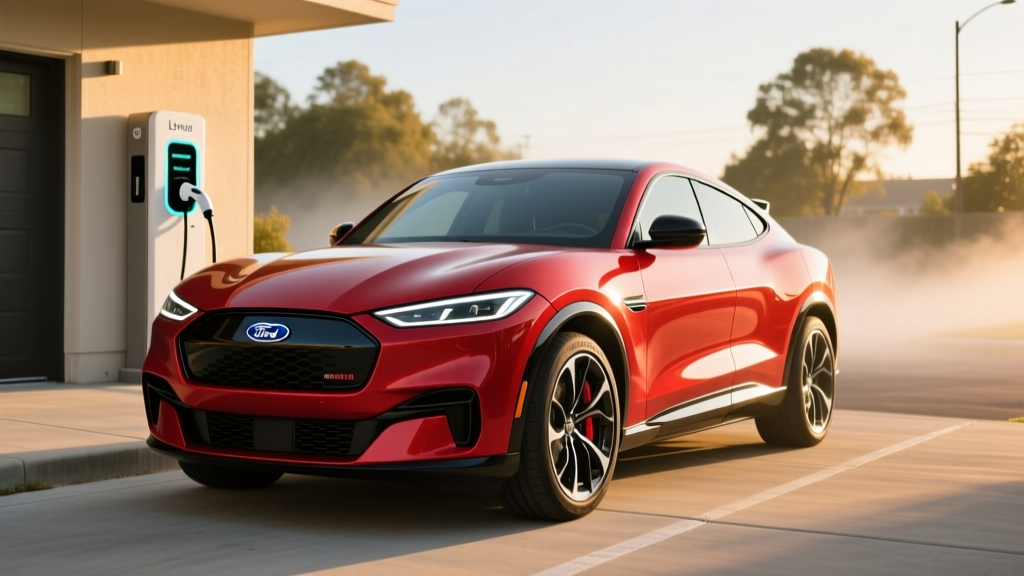
The Real Math Behind a 2026 Mustang Mach-E Lease
Leasing a 2026 Ford Mustang Mach-E sounds compelling: aggressive monthly payments, access to the latest tech, and the ability to drive a 300+ mile EV without committing to long-term depreciation risk. But the sticker payment is only one piece of the puzzle. To determine whether a Mustang Mach-E lease actually saves you money, we need to model the full five-year ownership experience — factoring in federal incentives, energy costs, insurance premiums, maintenance, and what happens when the battery ages.
This analysis uses the 2026 Ford Mustang Mach-E Select (base) and Premium trims as our benchmarks, with real figures from the EPA, Ford's official spec sheets, and IRS §30D guidelines. No marketing fluff — just the numbers that matter.
2026 Mustang Mach-E: Core Specs at a Glance
| Specification | Select (Std Range) | Premium (Ext Range RWD) | GT (Ext Range AWD) |
|---|---|---|---|
| Base MSRP | $42,995 | $51,995 | $59,995 |
| EPA Range | 250 mi | 320 mi | 290 mi |
| Real-World Range (highway/cold) | ~200–220 mi | ~260–290 mi | ~235–265 mi |
| Battery Capacity (usable) | 70 kWh (LFP) | 91 kWh (NMC) | 91 kWh (NMC) |
| DC Fast Charge Peak | 150 kW | 150 kW | 150 kW |
| 10–80% DC Fast Charge | ~28 min | ~38 min | ~38 min |
| Level 2 (240V) Charge Rate | 10.5 kW | 10.5 kW | 10.5 kW |
| Horsepower | 266 hp | 290 hp | 480 hp |
| 0–60 mph | 6.1 sec | 5.5 sec | 3.5 sec |
| Combined MPGe | 101 MPGe | 105 MPGe | 84 MPGe |
| Battery/Powertrain Warranty | 8 yr / 100,000 mi | 8 yr / 100,000 mi | 8 yr / 100,000 mi |
How Much Does a Mustang Mach-E Lease Actually Cost Per Month?
As of early 2026, Ford's lease offers on the Mach-E Select typically run $399–$479/month with $3,500–$4,500 due at signing for a 36-month, 10,500-mile/year term. The Premium trim with Extended Range usually lands in the $499–$589/month range. These figures vary by region, dealer, credit tier, and available lease cash.
The critical lease question: does the federal tax credit apply to a lease? Under IRS §30D, the clean vehicle credit technically goes to the vehicle owner — which in a lease is the leasing company (Ford Motor Credit). However, most manufacturers, including Ford, pass this credit through as "lease cash" or a capitalized cost reduction, effectively lowering your monthly payment. This is not guaranteed by law — it's a business decision by the automaker — so always confirm with your dealer that the credit is being applied to your specific lease deal.
Federal Tax Credit Eligibility: Do You Qualify?
The 2026 federal EV tax credit under IRS §30D offers up to $7,500, but eligibility depends on a matrix of requirements that change annually. Here's the current checklist:
- ✓ Income Caps (Modified AGI): $300,000 joint filers / $225,000 head of household / $150,000 single
- ✓ MSRP Caps: $80,000 for SUVs, vans, pickups / $55,000 for sedans and other body styles (Mach-E qualifies as SUV)
- ✓ Battery Sourcing: Minimum percentage of critical minerals and battery components must be sourced from the US or FTA partners — percentages increase each year through 2029
- ✓ North American Final Assembly: Vehicle must be assembled in North America (Mach-E is assembled in Cuautitlán, Mexico — this satisfies USMCA requirements)
- ✓ Point-of-Sale Transfer: As of 2024, eligible buyers can transfer the credit to the dealer at purchase, receiving it as an immediate price reduction rather than waiting for a tax refund. For leases, the leasing company claims the credit and typically passes savings through.
- ✗ Foreign Entity of Concern (FEOC) Restriction: Vehicles with battery components from certain foreign entities (primarily China, Russia, North Korea, Iran) are disqualified — this restriction has tightened significantly for 2025–2026 model years
For a Mach-E lease specifically: The leasing company (Ford Credit) is the legal purchaser and claims the credit. Ford has historically passed the full $7,500 as lease cash on qualifying Mach-E trims, but confirm this for your exact model year and trim, as battery sourcing compliance can shift with supply chain changes.
5-Year Total Cost of Ownership: Mach-E vs. Gas Competitor
To put a Mustang Mach-E lease in context, we modeled five years of ownership against a comparable gas SUV — the 2026 Ford Edge ST-Line (AWD, 2.0L turbo, 250 hp, EPA 24 MPG combined, ~$46,000 MSRP). We assumed 12,000 miles/year, national average electricity at $0.16/kWh, and gasoline at $3.65/gallon.
| Cost Category | Mach-E Premium (Ext Range RWD) | Ford Edge ST-Line (AWD) |
|---|---|---|
| Purchase/Lease (5 yr equivalent) | $31,200 ($520/mo × 60)* | $33,600 ($560/mo × 60) |
| Fuel/Energy (60,000 mi) | $4,570 | $9,125 |
| Maintenance (5 yr) | $1,800 | $4,200 |
| Insurance (5 yr avg) | $12,600 | $9,900 |
| Tax Credit Applied | −$7,500 | $0 |
| Estimated Depreciation (5 yr) | $18,500 | $14,200 |
| Total 5-Year Cost | $61,170 | $71,025 |
| Cost Per Mile | $1.02/mi | $1.18/mi |
*Lease-equivalent monthly cost annualized over 5 years for comparison. Actual lease terms are typically 36 months; this model assumes a second lease or purchase at comparable rates.
Charging vs. Gas: The Per-Mile Math
The Mach-E Premium Extended Range achieves approximately 3.0–3.3 kWh/mile (roughly 105 MPGe combined). At the national average residential rate of $0.16/kWh, that works out to roughly $0.076 per mile for home charging.
By comparison, the Ford Edge at 24 MPG combined and $3.65/gallon costs $0.152 per mile — almost exactly double.
The savings widen if you have access to free workplace charging, utility off-peak rates (often $0.08–$0.10/kWh overnight), or solar panels. They narrow if you rely heavily on DC fast charging networks like Electrify America or EVgo, where rates typically run $0.35–$0.55/kWh, pushing per-mile cost to $0.11–$0.17. For the TCO model above, we assumed 85% home charging and 15% public DC fast charging.
Maintenance Savings: Where EVs Actually Win
| Service Item | Mach-E Cost | Gas SUV Cost |
|---|---|---|
| Oil Changes | $0 | $600–$900 |
| Transmission Fluid | $0 | $150–$250 |
| Brake Pads/Rotors | $200–$400 (regen extends life 2–3×) | $800–$1,400 |
| Engine Air Filter | $0 | $100–$200 |
| Cabin Air Filter | $150 | $150 |
| Coolant Service | $0 (sealed system, no scheduled change) | $200–$350 |
| Tire Rotation/Replacement | $1,200–$1,600 (EVs wear tires ~15% faster due to weight/torque) | $1,000–$1,400 |
| Software Updates/Recalls | $0 (OTA) | $0 |
| Total Estimated | $1,550–$2,150 | $3,000–$4,650 |
The Mach-E's regenerative braking system does most of the deceleration work, dramatically reducing brake pad wear. Many Mach-E owners report original brake pads at 60,000+ miles. The trade-off: EVs are heavier and produce more instant torque, which accelerates tire wear. Budget for tire replacement one interval sooner than you would on a comparable gas vehicle.
Insurance Cost Reality: The Uncomfortable Truth
EV insurance premiums run 15–30% higher than equivalent gas vehicles. For the Mach-E, expect average annual premiums of $2,400–$2,700 for a 35-year-old driver with a clean record, compared to $1,900–$2,100 for a gas Edge.
Why the premium? Three factors:
- Higher repair costs: EV-specific components (battery packs, power electronics, sensors) are expensive to replace after collision damage
- Specialized labor: Fewer certified EV repair shops means higher labor rates and longer repair times
- Total loss thresholds: Battery damage that would be a minor repair on a gas car can trigger a total-loss declaration on an EV, as battery replacement costs $12,000–$20,000+
Shop around — some insurers (Geico, Progressive, State Farm) have started offering EV-specific policies with competitive rates. Bundling home and auto, maintaining a clean driving record, and opting for higher deductibles can narrow the gap significantly.
Depreciation and Resale Value: What to Expect
EV depreciation has been steeper than gas vehicles over the past three years, driven by rapid price cuts from Tesla and other manufacturers, improving battery tech making older models less desirable, and general market uncertainty about long-term battery health.
The Mach-E has held value better than some competitors — 3-year depreciation averages around 38–45%, compared to 30–35% for a gas Edge. However, this gap is narrowing as the EV market matures and buyers become more comfortable with used EVs.
Lease advantage: With a lease, depreciation risk belongs to Ford Motor Credit, not you. If residual values drop further, you simply walk away at lease end. If they hold or improve, you have the option to purchase at the contracted residual price. This makes a Mustang Mach-E lease particularly attractive during periods of market volatility.
Decision Framework: Is a Mach-E Lease Right for You?
Choose a Mach-E lease if:
- You drive 10,000–12,000 miles/year (fits standard lease terms)
- You have reliable Level 2 home charging access
- You qualify for the federal tax credit (under income/MSRP caps)
- You want to avoid long-term depreciation risk during a volatile EV market
- You prefer upgrading to new tech every 3 years
Consider purchasing or a different vehicle if:
- You drive 15,000+ miles/year (excess mileage penalties of $0.15–$0.25/mi add up fast)
- You lack home charging and would rely entirely on public infrastructure
- Your modified AGI exceeds §30D income caps ($150K single / $300K joint)
- You plan to keep the vehicle 7+ years (purchase and hold makes more financial sense)
- You live in an area with extreme cold (below 0°F regularly) without a garage — range loss will be significant
Frequently Asked Questions
How much does it really cost to own a Mustang Mach-E over 5 years?
Based on our analysis of the 2026 Mach-E Premium Extended Range RWD, expect approximately $61,170 over five years, or $1.02 per mile — roughly $10,000 less than a comparably equipped gas SUV over the same period. The savings come primarily from fuel ($4,555 less) and maintenance ($2,400 less), partially offset by higher insurance ($2,700 more).
Can I get the $7,500 tax credit on a Mach-E lease?
The credit goes to the leasing company, but Ford has historically passed the full amount through as lease cash, reducing your monthly payment. Confirm with your dealer that the credit is being applied to your specific deal, as battery sourcing compliance can vary by trim and production date. Income and MSRP caps still apply to the end consumer in practice.
How much do I save on fuel and maintenance?
Over 60,000 miles, expect roughly $4,555 in fuel savings (charging at $0.076/mi vs. gas at $0.152/mi) and $2,000–$2,500 in maintenance savings (no oil changes, reduced brake wear). Combined, that's approximately $6,500–$7,000 in operational savings over five years.
Are EVs more expensive to insure?
Yes — typically 15–30% more. For the Mach-E, budget $2,400–$2,700/year vs. $1,900–$2,100 for a comparable gas SUV. Higher repair costs, specialized labor, and battery replacement expenses drive the premium. Shop multiple insurers and consider EV-specific policies to minimize the gap.
How well does the Mach-E hold its value?
The Mach-E depreciates approximately 38–45% over three years — steeper than comparable gas SUVs but better than some EV competitors. Leasing transfers depreciation risk to Ford Credit, making it an attractive option during this period of rapid EV market evolution. The 8-year/100,000-mile battery warranty also supports used-market confidence.
What if I exceed my lease mileage?
Most Mach-E leases allow 10,500 or 12,000 miles per year. Excess mileage charges typically run $0.15–$0.25 per mile. If you drive more than 14,000 miles annually, purchasing or choosing a higher-mileage lease (if available) will be more cost-effective.