Quick Verdict: The Performance EV That Doubles as a Daily Driver
The 2026 Ford Mustang Mach-E GT occupies a specific niche in the electric crossover market: it's the variant that prioritizes acceleration and chassis tuning while retaining the practicality that makes the standard Mach-E a competent family hauler. With dual-motor all-wheel drive, up to 480 horsepower (with the Performance Upgrade), and an EPA-estimated range that now stretches past 300 miles on the right configuration, the GT asks whether you really need to sacrifice efficiency for speed.
After extensive seat time in the Mach-E GT across highway commutes, cold-weather conditions, and repeated DC fast-charging sessions, the answer is nuanced. The GT delivers genuine sports-sedan acceleration in a crossover package, but buyers should understand the real-world trade-offs — particularly around range at sustained highway speeds and the charging-curve behavior that affects road-trip planning. Here's every number that matters.
Range, Battery, and Real-World Efficiency
The 2026 Mach-E GT is equipped with Ford's extended-range battery pack, which uses an NMC (nickel-manganese-cobalt) lithium-ion chemistry with a usable capacity of approximately 91 kWh (gross capacity ~98 kWh). NMC chemistry favors energy density over cycle life compared to LFP, which is the right trade-off for a performance-oriented vehicle where weight and packaging matter.
| Specification | Value |
|---|---|
| Battery Chemistry | NMC (Nickel-Manganese-Cobalt) |
| Usable Battery Capacity | ~91 kWh |
| EPA Estimated Range (GT, AWD) | 280–310 miles (config dependent) |
| EPA Estimated Range (GT Perf. Upgrade) | ~280 miles |
| Combined MPGe | 84–90 MPGe |
| Energy Consumption | ~37–40 kWh/100 mi |
| Drivetrain | Dual-Motor AWD |
According to fueleconomy.gov, the Mach-E GT's combined efficiency sits in the mid-80s MPGe, which translates to roughly 37–40 kWh consumed per 100 miles driven. That's competitive with the Tesla Model Y Performance but trails the Hyundai Ioniq 5's more efficiency-focused tuning.
Charging Speed: DC Fast, Level 2, and the Curve Reality
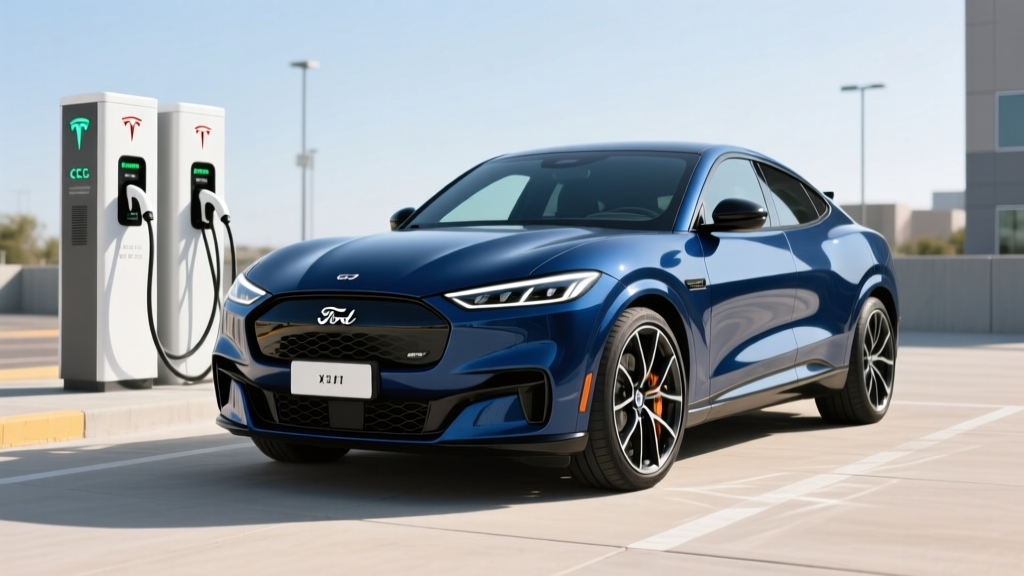
Charging speed is where the Mach-E GT has seen meaningful improvement over earlier model years. The 2026 GT supports a peak DC fast-charge rate of up to 150 kW on compatible CCS stations (and via NACS adapter at Tesla Superchargers, as Ford has transitioned to the North American Charging Standard for new vehicles).
| Charging Level | Power / Rate | Time / Recovery |
|---|---|---|
| Level 1 (120V household) | ~1.4 kW | ~3–4 miles of range per hour |
| Level 2 (240V home, 48A) | ~11.5 kW | ~28–30 miles per hour; 0–100% in ~9 hrs |
| DC Fast Charge (peak) | Up to 150 kW | 10–80% in approximately 40–45 minutes |
| DC Fast Charge (sustained avg.) | ~90–110 kW avg. | ~150 miles added in 30 minutes |
Understanding the charge curve: The Mach-E GT's peak 150 kW rate is achieved at a low state of charge (roughly 10–25% SoC) under ideal thermal conditions. As the battery fills past 50%, the charge rate tapers progressively — by 80% SoC, you're typically seeing 50–60 kW. This is standard NMC behavior and not unique to Ford, but it means your average charging speed on a road trip is closer to 100 kW, not the peak 150 kW figure. Ford's battery thermal management system does precondition the pack when a DC fast-charger is set as your navigation destination, which helps you hit peak rates sooner upon arrival.
For home charging, a Level 2 wall connector on a 60-amp circuit (delivering 48 amps continuous to the vehicle) replenishes roughly 30 miles of range per hour. A full overnight charge from 20% to 100% takes about 8–9 hours, which suits most daily-driving patterns. Ford provides a mobile charge cord with the vehicle that handles both 120V and 240V outlets, though dedicated wall units from ChargePoint, Emporia, or Ford's own Connected Charge Station offer faster, safer, and more reliable daily charging.
Performance: 0–60, Horsepower, and the GT Experience
The Mach-E GT is where the Mustang badge earns its keep. The dual-motor all-wheel-drive powertrain produces 480 horsepower and 634 lb-ft of torque when equipped with the optional GT Performance Upgrade (which includes a performance-tuned suspension, upgraded brakes, and a specific drive calibration). The standard GT tune delivers 480 hp and 600 lb-ft.
| Metric | GT (Standard) | GT Performance Upgrade |
|---|---|---|
| Horsepower | 480 hp | 480 hp |
| Torque | 600 lb-ft | 634 lb-ft |
| 0–60 mph | ~3.8 seconds | ~3.3 seconds |
| Drivetrain | Dual-Motor AWD | Dual-Motor AWD |
| Top Speed | 130 mph (electronically limited) | 150 mph |
| Suspension | Adaptive dampers (comfort-biased) | MagneRide adaptive (track-tuned) |
The 0–60 mph time of approximately 3.3 seconds (Performance Upgrade) puts the Mach-E GT in the company of the Porsche Taycan 4S and Tesla Model Y Performance. Where the Mach-E GT distinguishes itself is chassis composure — the MagneRide dampers on the Performance Upgrade manage body roll through corners with a firmness that feels genuinely sports-sedan-like, without the harshness that plagues some competitors. The steering is precise if slightly numb, and the brake pedal feel (blending regenerative and friction braking) is among the better implementations in the EV segment.
One honest limitation: sustained high-speed driving (repeated hard acceleration or track use) will thermally limit the battery and reduce power output. The Mach-E GT is a fast grand tourer, not a track car, and Ford's software will protect the battery at the cost of peak performance if you push it too hard for too long.
Interior, Cargo, and Technology
Inside, the Mach-E GT shares its cabin architecture with the broader Mach-E lineup but adds GT-specific sport seats with synthetic suede inserts, a flat-bottom steering wheel, and aluminum pedal covers. The centerpiece remains the 15.5-inch portrait-oriented touchscreen running Ford's latest SYNC 4A infotainment system with wireless Apple CarPlay and Android Auto.
Passenger and cargo dimensions:
- Front legroom: 43.3 inches
- Rear legroom: 38.9 inches
- Cargo volume (rear seats up): 29.7 cu ft
- Cargo volume (rear seats folded): 59.7 cu ft
- Front trunk (frunk): 4.7 cu ft (drainable, useful for wet gear)
Rear-seat space is adequate for adults on shorter trips but falls short of the Hyundai Ioniq 5's class-leading rear legroom. The cargo area is competitive with the Tesla Model Y, though the Model Y's deeper under-floor storage gives it an edge in total utility. The Mach-E's frunk is small but practical — it's drainable, making it useful for muddy shoes, ice, or wet charging cables.
Driver-assistance technology: The Mach-E GT comes equipped with Ford Co-Pilot360 Active 2.0, which includes adaptive cruise control with stop-and-go, lane-centering assist, and evasive steering assist. Ford's BlueCruise hands-free highway driving system is available on pre-qualified divided highways (SAE Level 2 — the driver must remain attentive, with a camera monitoring eye gaze). BlueCruise works well on long interstate stretches but is not autonomous driving; it will disengage in construction zones, on non-mapped roads, and in adverse weather. Expect a subscription cost after the initial trial period expires.
Pricing, Trim Levels, and Federal Tax Credit Eligibility
The 2026 Mustang Mach-E GT starts at an MSRP of approximately $59,995 (including destination charge) for the standard GT trim. The GT Performance Upgrade adds roughly $5,000–$6,000, pushing a well-equipped example past $67,000 before options. A fully loaded GT Performance Upgrade with premium paint, panoramic roof, and the BlueCruise subscription bundle can approach $70,000.
| Trim | Base MSRP (incl. dest.) | Typical As-Tested |
|---|---|---|
| GT (Standard) | ~$59,995 | $62,000–$64,000 |
| GT Performance Upgrade | ~$65,995 | $67,000–$70,000 |
The Mach-E GT's eligibility for the up-to-$7,500 federal EV tax credit under IRS §30D depends on several factors that change periodically:
- MSRP cap: SUVs/crossovers must have an MSRP at or below $80,000 — the Mach-E GT qualifies.
- Buyer income cap: Modified AGI must not exceed $150,000 (single), $225,000 (head of household), or $300,000 (joint filers).
- Battery sourcing: Critical minerals and battery components must meet phased-in percentage thresholds from US or FTA-partner countries. Ford has worked to localize Mach-E battery supply, but eligibility can shift model year to model year.
- Point-of-sale transfer: As of 2024+, eligible buyers can transfer the credit to the dealer at purchase, reducing the out-of-pocket price directly rather than waiting for a tax refund.
If you qualify for the full $7,500 credit and apply it at point of sale, a base Mach-E GT effectively drops to roughly $52,495 — a significant price adjustment that makes it competitive with a similarly equipped Tesla Model Y Performance or Hyundai Ioniq 5 N.
Warranty and Long-Term Ownership
Ford backs the Mach-E GT with the following warranty coverage:
- Battery warranty: 8 years / 100,000 miles (whichever comes first), covering defects and capacity loss below 70% of original capacity.
- Electric powertrain warranty: 8 years / 100,000 miles, covering motors, onboard charger, and related components.
- Bumper-to-bumper: 3 years / 36,000 miles.
- Roadside assistance: 5 years / 60,000 miles.
The 70% capacity retention threshold is standard for the industry (matching Hyundai, Tesla, and Volkswagen). Real-world NMC degradation data from earlier Mach-E model years suggests most owners will see approximately 8–12% capacity loss over the first 100,000 miles under normal use patterns, well within the warranty floor. Battery replacement cost, should it be needed out of warranty, is estimated at $15,000–$22,000 depending on labor and pack availability — a figure worth considering for high-mileage buyers planning long-term ownership.
Pros, Cons, and Who Should Buy the Mach-E GT
✓ Pros
- Genuine sub-3.5-second 0–60 mph (Performance Upgrade)
- Competitive real-world range for a performance EV (~260+ mi highway)
- MagneRide chassis tuning is a class highlight
- BlueCruise hands-free highway assist reduces fatigue
- Qualifies for §30D credit (MSRP under $80K cap)
- Drainable frunk is a practical touch
- Over-the-air updates continue to improve the vehicle
✗ Cons
- 150 kW peak DC charge rate trails 800V competitors (Ioniq 5: 240 kW, Taycan: 270 kW)
- 10–80% charge time of ~40–45 min is slow for road trips
- Rear seat space is tighter than Ioniq 5 and Model Y
- BlueCruise requires a subscription after trial
- Touchscreen-heavy interior lacks physical climate controls
- Thermal limiting under sustained hard driving
- Insurance premiums run 15–25% above gas crossover averages
Who the Mach-E GT Is For
Best fit: Performance-oriented drivers who want a daily-drivable electric crossover with real acceleration, a compliant ride, and enough range for a 200-mile round-trip commute. The GT makes sense if you value chassis dynamics and want something that feels distinctly different from a Tesla Model Y.
Consider alternatives if: You prioritize the fastest possible road-trip charging (look at Hyundai Ioniq 5 or Kia EV6 with 800V architecture), need maximum rear-seat and cargo space (Model Y wins), or want a true track-capable EV (Porsche Taycan, though at a much higher price).
Frequently Asked Questions
What is the real-world range of the Mustang Mach-E GT?
The EPA rates the 2026 Mach-E GT at up to 310 miles (standard GT tune, AWD). Real-world highway driving at 70+ mph typically yields 250–275 miles. In cold weather below 30°F, expect 200–230 miles of usable range before needing to charge. The GT Performance Upgrade reduces range by roughly 20–30 miles due to stickier tires and more aggressive calibration.
How fast does the Mach-E GT charge at home and on the road?
On a Level 2 home charger (240V, 48A), the Mach-E GT adds approximately 28–30 miles of range per hour, with a full charge taking about 8–9 hours. On a DC fast charger, it peaks at 150 kW but averages closer to 100 kW over a session, reaching 10–80% in approximately 40–45 minutes. This is slower than 800V competitors like the Ioniq 5 (10–80% in ~18 minutes at 240 kW).
Does the 2026 Mustang Mach-E GT qualify for the $7,500 federal tax credit?
It can, but eligibility depends on your income (AGI caps apply), the vehicle's battery-sourcing compliance in the current model year, and the MSRP being under $80,000 (which the GT satisfies). Always check fueleconomy.gov and the IRS clean vehicle credits page for the most current eligibility data before purchasing. The credit can be transferred to the dealer at point of sale to reduce your purchase price directly.
Is the Mach-E GT worth buying over the Tesla Model Y Performance?
The Mach-E GT offers a more engaging driving experience with superior ride quality (especially with MagneRide), a more traditional (and for some, more intuitive) interior layout, and competitive performance. The Model Y Performance counters with faster Supercharger charging, access to the most reliable DC fast-charging network, a more spacious rear seat, and generally lower long-term software friction. If driving dynamics matter most, the Mach-E GT edges ahead. If charging convenience and interior space are priorities, the Model Y is the pragmatic pick.
What's the biggest drawback of the Mach-E GT?
The most significant limitation is DC fast-charge speed. At a peak of 150 kW and an average closer to 100 kW, the Mach-E GT takes roughly 40–45 minutes to go from 10–80% — nearly double the time of 800V competitors. For buyers who road-trip frequently, this adds meaningful time at charging stops and is the single biggest trade-off to weigh.
How long will the Mach-E GT battery last?
Ford warranties the battery for 8 years or 100,000 miles against capacity loss below 70%. Based on NMC degradation trends observed in earlier Mach-E models and comparable EVs, most owners will see 8–12% capacity loss over 100,000 miles under normal conditions. Proper care — avoiding frequent 100% charges, minimizing DC fast-charging in extreme heat, and using scheduled charging to reduce time spent at high SoC — can help preserve long-term battery health.