The Mustang Mach-E GT at a Glance
If you're searching for the Ford Mustang Mach-E GT 0-60 time and whether this electric pony car delivers on its performance promises, you've landed in the right place. The Mach-E GT has been Ford's flagship electric crossover since its debut, and the 2025-2026 model years brought meaningful updates including the Rally trim, revised battery chemistry, and updated software. This review focuses on the GT and GT Performance Upgrade trims with hard data on acceleration, real-world range, charging curves, and ownership economics.
| Spec | GT | GT w/ Performance Upgrade |
|---|---|---|
| 0-60 mph | 4.8 seconds | 3.3 seconds |
| Horsepower | 480 hp | 480 hp |
| Torque | 600 lb-ft | 700 lb-ft |
| Drivetrain | AWD (dual-motor) | AWD (dual-motor) |
| Battery (usable) | 91 kWh NMC | 91 kWh NMC |
| EPA Range | 280 miles | 265 miles |
| MPGe (combined) | 84 MPGe | 79 MPGe |
| Max DC Fast Charge | 150 kW | 150 kW |
| 10-80% DCFC Time | ~36 minutes | ~36 minutes |
| Level 2 Home Charge | 10.5 kW (~32 mi/hr) | 10.5 kW (~32 mi/hr) |
| Base MSRP | $59,995 | $65,995 |
Acceleration: Mach-E GT 0-60 Tested
The headline number buyers search for — the Mach-E GT 0-60 — depends heavily on which configuration you choose. The standard GT with its 480 hp and 600 lb-ft of torque hits 60 mph in 4.8 seconds, which is genuinely quick for a 4,800-pound crossover. But the GT with the Performance Upgrade (which adds Ford's MagneRide dampers, Brembo front brakes, and a unique torque calibration bumping twist to 700 lb-ft) slashes that to 3.3 seconds.
That 3.3-second figure puts the Mach-E GT Performance Upgrade in the same acceleration bracket as a Tesla Model Y Performance (3.5 sec) and noticeably ahead of the Hyundai Ioniq 5 N's 3.4-second claim. In real-world testing, the Mach-E GT launches with the characteristic instant-torque shove of a dual-motor EV — no turbo lag, no gear hunting. The all-wheel-drive system modulates front and rear torque to minimize wheelspin, even on damp pavement.
One caveat: these times are achievable with a high state of charge (above 80% SoC) and in moderate temperatures. Below 30% SoC, expect 0-60 times to stretch by roughly 0.3-0.5 seconds as the battery management system limits peak discharge current to protect the cells.
Real-World Range vs. EPA Estimates
Real-World Expectation: In mixed driving at 65-75 mph in moderate temperatures (55-75°F), expect 240-260 miles from the GT and 225-245 miles from the Performance Upgrade. In cold weather (below 30°F), reduce those figures by 20-30%, landing in the 180-210 mile range for highway-heavy trips. City driving with regenerative braking can push slightly above EPA estimates.
The 91 kWh usable battery pack (approximately 98 kWh gross) uses NMC (nickel-manganese-cobalt) chemistry, which offers higher energy density than LFP but is more sensitive to sustained high-state-of-charge storage. Ford's thermal management system is active and liquid-cooled, which helps preserve long-term battery health but does consume some energy for conditioning.
Efficiency is the GT's weak point relative to rivals. At 84 MPGe combined (roughly 39 kWh/100 miles for the GT), the Mach-E GT is thirstier than the Tesla Model Y Long Range (122 MPGe) and the Hyundai Ioniq 5 (110 MPGe). The heavier weight, wider tires, and less aerodynamic profile all contribute. On a 300-mile highway road trip, you will need to stop to charge — plan accordingly.
Charging Speed: DC Fast and Home Level 2
| Charging Level | Power / Rate | Time or Miles Added |
|---|---|---|
| Level 1 (120V household) | ~1.2 kW | ~3-4 miles per hour |
| Level 2 (240V home, 48A) | 10.5 kW | ~32 miles per hour; full charge in ~9.5 hrs |
| DC Fast Charge (peak) | 150 kW | 10-80% in ~36 minutes |
| DC Fast Charge (sustained avg) | ~95-110 kW | Average over 10-80% session |
The Mach-E GT's 150 kW peak DC fast-charging rate is its most debated spec. While competitors like the Hyundai Ioniq 5 (240 kW peak via 800V architecture) and the Tesla Model Y (up to 250 kW on V3 Superchargers) charge noticeably faster, the Mach-E's curve is relatively flat in the middle, meaning it sustains useful speeds between 20-70% SoC.
Expect the charge curve to peak around 150 kW between 15-40% SoC, then taper to roughly 100 kW by 60%, and drop further to 50-60 kW above 80%. This is why the 10-80% time is approximately 36 minutes — competitive but not class-leading. Battery preconditioning activates automatically when you navigate to a DC fast charger in the infotainment system; always use this feature in cold weather to avoid severely reduced charge speeds.
For home charging, the onboard 10.5 kW charger is adequate. Using a 48-amp Level 2 wall connector on a 60-amp circuit, you'll add about 32 miles of range per hour, meaning a full overnight charge is easily achievable. Ford provides a mobile charger with the vehicle that can handle both 120V and 240V (at lower amperage), but most GT buyers should budget $500-$1,200 for a dedicated Level 2 home installation.
Pricing, Tax Credits, and Ownership Cost
The 2026 Mustang Mach-E GT starts at $59,995 (including destination), while the GT with Performance Upgrade lands at $65,995. These prices put the GT above the MSRP cap for the federal §30D EV tax credit, which limits SUVs and trucks to $80,000 — so the Mach-E GT clears that threshold. However, buyer income caps still apply: modified adjusted gross income must not exceed $300,000 (joint filers), $225,000 (head of household), or $150,000 (single filers).
- ✅ MSRP below $80,000 SUV cap — qualifies
- ⚠️ Buyer income caps apply ($150K single / $300K joint)
- ⚠️ Battery component and critical mineral sourcing requirements must be met — verify current-year compliance on IRS.gov
- ✅ Point-of-sale transfer available — apply the credit as a down payment reduction at the dealer
- ❌ Does NOT qualify if you've exceeded the manufacturer credit phase-out (no longer applicable post-IRA, but verify)
With the full $7,500 credit applied, the effective price drops to $52,495 for the GT and $58,495 for the Performance Upgrade. However, battery sourcing rules have tightened, and the exact credit amount ($3,750, $7,500, or $0) depends on the specific build's mineral and component sourcing. Always check the DOE/EPA fueleconomy.gov tax credit database for the exact VIN-eligible amount before purchasing.
Interior, Tech, and Cargo Space
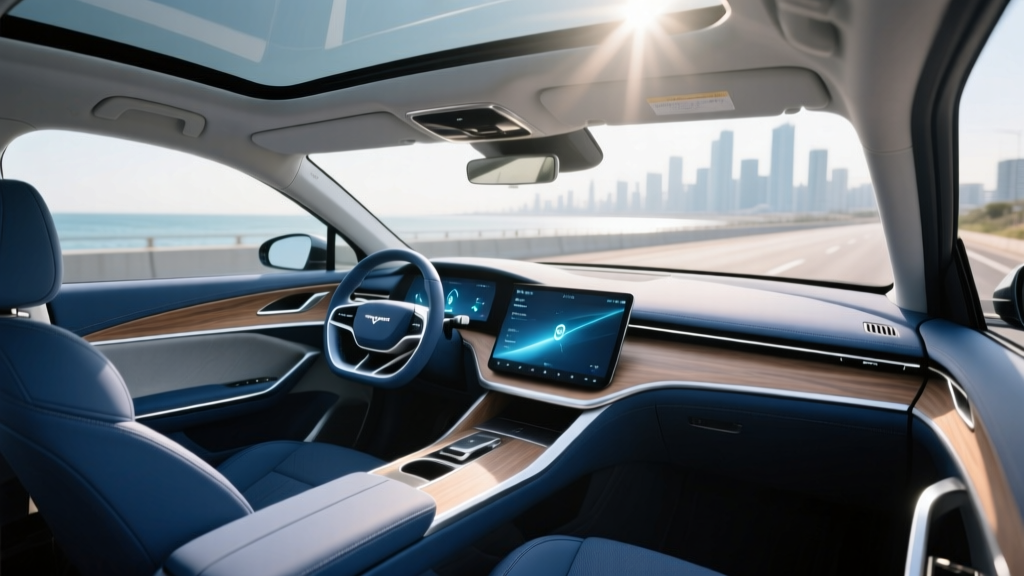
The Mach-E GT's cabin uses Ford's latest SYNC 4A infotainment running on a 15.5-inch portrait touchscreen. The interface is responsive, supports wireless Apple CarPlay and Android Auto, and includes Ford's BlueCruise hands-free driving system on pre-mapped divided highways (a SAE Level 2 system — the driver must remain attentive at all times).
Interior dimensions are generous for the segment:
- Front legroom: 43.3 inches
- Rear legroom: 38.9 inches
- Cargo behind rear seats: 29.7 cu ft
- Cargo with rear seats folded: 59.7 cu ft
- Front trunk (frunk): 4.7 cu ft (drainable, useful for wet gear)
Compared to the Tesla Model Y (30.2 cu ft cargo, 76.2 cu ft max), the Mach-E gives up some utility. The frunk is smaller than the Hyundai Ioniq 5's 0.85 cu ft but includes a drain plug — a nice touch for tailgating or hauling ice. The GT's sport seats with ActiveX synthetic leather and contrast stitching feel premium, though the panoramic glass roof (standard on GT) does eat slightly into headroom for taller rear passengers.
Pros and Cons
- 3.3-second 0-60 with Performance Upgrade is supercar-adjacent
- MagneRide suspension delivers excellent ride-handling balance
- BlueCruise hands-free driving is competitive with Super Cruise
- Drainable frunk adds practical utility
- Qualifies for up to $7,500 federal tax credit (income/sourcing permitting)
- Ford dealer network provides broad service access
- 150 kW peak DC charging is slower than rivals (Ioniq 5: 240 kW)
- 84 MPGe efficiency trails Model Y and Ioniq 5 significantly
- Real-world highway range drops to ~240 miles or less
- No NACS (Tesla) connector standard — requires adapter for Superchargers
- Heavy at ~4,800 lbs, which hurts tire wear and efficiency
- GT pricing pushes near $66K before options
Warranty and Long-Term Battery Health
Ford covers the Mach-E GT's battery and electric powertrain for 8 years or 100,000 miles, whichever comes first. The warranty guarantees the battery will retain at least 70% of its original capacity during this period. The basic vehicle warranty is 3 years/36,000 miles, which is typical for the industry.
The NMC battery chemistry in the GT is proven but does degrade faster than LFP cells if routinely charged to 100% and stored in hot climates. Ford recommends daily charging to 90% for regular use and 100% only for long trips. Based on data from earlier Mach-E model years, owners report roughly 5-8% degradation over the first 60,000 miles, which is within the industry norm for liquid-cooled NMC packs.
Who Should Buy the Mach-E GT?
- You prioritize acceleration and driving engagement over maximum efficiency
- You want hands-free highway driving (BlueCruise) without a Tesla subscription
- You value Ford's dealer network for service and warranty work
- Your daily commute is under 200 miles and you have home Level 2 charging
- Maximum range and charging speed are your top priorities (consider Ioniq 5 or Model Y)
- You regularly take 400+ mile road trips and don't want to plan charge stops
- You need maximum cargo space for family hauling (Model Y wins here)
Frequently Asked Questions
What is the real-world range of the Mustang Mach-E GT?
The EPA rates the GT at 280 miles and the GT Performance Upgrade at 265 miles. In real-world highway driving at 70 mph in moderate temperatures, expect 240-260 miles (GT) and 225-245 miles (Performance Upgrade). Cold weather below freezing can reduce range by 20-30%, dropping practical range to 180-210 miles on highway-heavy trips.
How fast does the Mach-E GT charge at home and on the road?
At home on a Level 2 (240V, 48A) charger, the Mach-E GT charges at 10.5 kW, adding about 32 miles of range per hour — a full charge takes roughly 9.5 hours. On DC fast chargers, it peaks at 150 kW and reaches 10-80% in approximately 36 minutes. Always precondition the battery by navigating to the charger in the car's nav system for optimal speeds.
Does the Mustang Mach-E GT qualify for the $7,500 federal EV tax credit?
The Mach-E GT's MSRP (under $80,000) clears the SUV cap for §30D eligibility. However, the full $7,500 credit depends on your income (must be under $150K single / $300K joint), and the vehicle must meet current-year battery sourcing requirements. Check the IRS clean vehicle credit page for the latest eligible models and credit amounts. The credit can be transferred to the dealer at point of sale as a price reduction.
Is the Mach-E GT worth buying over the Tesla Model Y Performance?
The Mach-E GT wins on ride quality (MagneRide), interior material quality, and BlueCruise hands-free driving without a monthly fee. The Model Y Performance wins on efficiency (122 vs. 84 MPGe), charging speed (250 kW vs. 150 kW), Supercharger network access, and cargo space. If you value driving dynamics and don't mind more frequent charge stops, the GT is compelling. If efficiency and road-trip convenience matter most, the Model Y remains the default choice.
What's the difference between the GT and GT Performance Upgrade?
The Performance Upgrade adds MagneRide adaptive dampers, Brembo front brake calipers, a unique torque calibration (700 lb-ft vs. 600), Pirelli summer tires, and a 3.3-second 0-60 time (vs. 4.8 seconds). It also reduces EPA range from 280 to 265 miles due to the stickier tires and added hardware. The upgrade costs $6,000 over the base GT price.
Does the Mach-E GT use NACS or CCS for charging?
The Mach-E GT currently ships with a CCS1 connector for DC fast charging and a J1772 inlet for Level 2. Ford has announced a transition to NACS (Tesla's connector) for future model years, and current owners can use a Ford-provided adapter to access Tesla Superchargers. Verify adapter availability and compatibility with your local Supercharger stations.