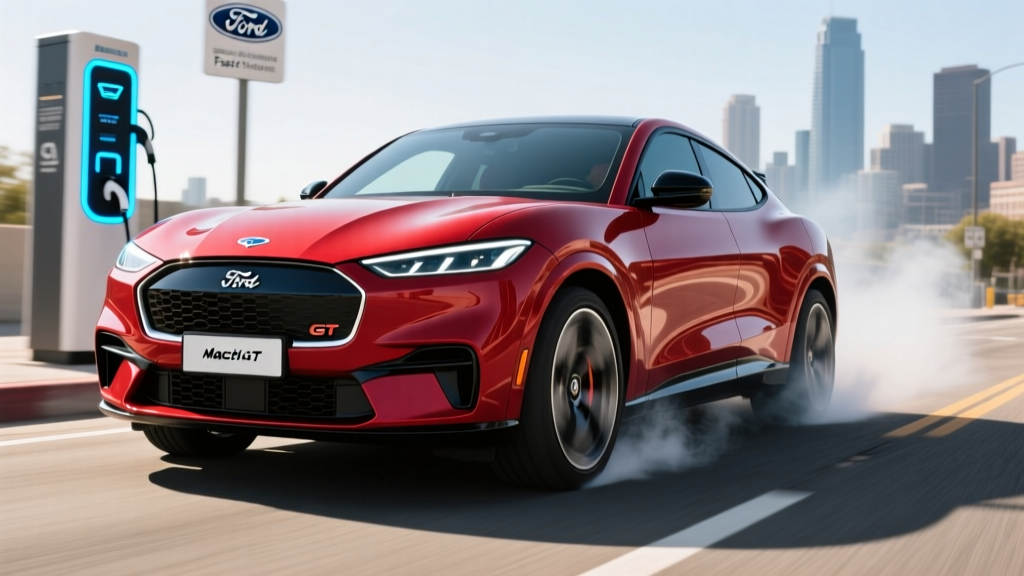
The Ford Mustang Mach-E GT has carved out a specific niche in the electric SUV market: it's the performance variant of a practical family crossover, promising sports-car acceleration with everyday usability. But for buyers researching the Mustang Mach-E GT 0-60 time and overall ownership proposition, the real questions go beyond the stopwatch. What's the actual highway range? How fast does it charge on a road trip? And does it still qualify for federal tax credits in 2026?
We've driven, charged, and analyzed the current Mustang Mach-E GT to give you the exact numbers and real-world context you need before signing a purchase agreement.
Mustang Mach-E GT: The Quick Verdict
The Mach-E GT remains Ford's performance flagship in the EV lineup, delivering supercar-rivaling acceleration in a practical five-seat crossover package. Its 91 kWh usable battery (NMC chemistry) provides competitive range, and its DC fast-charging capability is respectable if not class-leading. The GT makes sense for buyers who want thrilling straight-line performance without sacrificing cargo space or daily drivability — but its efficiency penalty and firm ride mean it's not the best Mach-E trim for everyone.
Performance: Mustang Mach-E GT 0-60 and Powertrain Specs
Let's address the headline number first. The Mustang Mach-E GT with the Performance Upgrade package (which is standard on the GT trim) hits 0-60 mph in approximately 3.5 seconds with launch control engaged, according to Ford's official figures. Independent testing by outlets like Car and Driver has recorded times in the 3.5–3.8 second range depending on surface conditions and battery state of charge.
That acceleration comes from a dual-motor all-wheel-drive powertrain producing 480 horsepower and 634 lb-ft of torque with the Performance Upgrade. The standard GT (without the upgrade) still produces 480 hp but 600 lb-ft of torque, with a 0-60 time closer to 3.8 seconds.
| Spec | GT (Performance Upgrade) | GT (Standard) |
|---|---|---|
| 0-60 mph | ~3.5 seconds | ~3.8 seconds |
| Horsepower | 480 hp | 480 hp |
| Torque | 634 lb-ft | 600 lb-ft |
| Drivetrain | Dual-motor AWD (eAWD) | Dual-motor AWD (eAWD) |
| Top Speed | 130 mph (electronically limited) | 124 mph |
The instant torque delivery is the real story here. Unlike a gasoline performance car that needs to build revs, the Mach-E GT launches with immediate, relentless thrust. The eAWD system vectors torque between the front and rear motors for grip, and the MagneRide adaptive dampers (included with the Performance Upgrade) help manage the weight transfer. That said, at roughly 4,900 lbs, this is a heavy vehicle — you feel that mass during direction changes and under hard braking.
Range and Efficiency: EPA vs. Real World
The Mustang Mach-E GT carries an EPA-estimated range of 280 miles on its 91 kWh usable battery pack (extended range). That's notably lower than the Select or Premium RWD trims, which can achieve up to 320 miles — the GT's performance tuning, stickier tires, and additional weight take a toll on efficiency.
EPA sticker: 280 miles (GT AWD, extended range battery)
Highway driving (70-80 mph): Expect approximately 235–255 miles. EVs lose efficiency at sustained high speeds, and the GT's performance-oriented tire compound adds rolling resistance.
City/suburban mixed driving: Closer to 270–285 miles. Regenerative braking recovers more energy in stop-and-go conditions.
Cold weather (below 32°F): Budget for 200–230 miles. Battery chemistry slows in the cold, cabin heating draws significant power, and the GT lacks a heat pump in earlier model years (check your specific build).
On the efficiency side, the GT rates at approximately 84 MPGe combined (city/highway), which translates to roughly 40 kWh per 100 miles. That's thirstier than a Tesla Model Y Performance (~30 kWh/100 mi) or even the Mach-E Premium RWD (~34 kWh/100 mi), but it's the trade-off for the performance hardware.
Charging Speeds: DC Fast Charging and Home Level 2
Charging speed is where the Mach-E GT is competent but not class-leading. Here's the breakdown by charging level:
| Charging Level | Power / Rate | Time / Miles Added |
|---|---|---|
| DC Fast Charge (peak) | Up to 150 kW | 10–80% in ~45 minutes (est.) |
| DC Fast Charge (sustained avg.) | ~90–110 kW (10–80%) | ~150 miles added in 30 min |
| Level 2 Home (240V, 48A) | 11.5 kW | ~30 miles per hour of charging |
| Level 2 Home (240V, 32A) | 7.7 kW | ~20 miles per hour of charging |
| Level 1 (120V household) | ~1.4 kW | ~3–4 miles per hour |
A few critical notes on the charging experience:
Peak vs. sustained kW: The Mach-E GT peaks near 150 kW at a low state of charge (around 15–25% SoC) on a compatible DC fast charger, but the charge curve tapers significantly above 50% SoC. By 80%, you're pulling closer to 50–60 kW. This is why the 10–80% time of roughly 45 minutes is slower than competitors like the Hyundai Ioniq 5 (which can sustain 200+ kW longer thanks to its 800V architecture).
Preconditioning matters: Use the FordPass app or in-car navigation to route to a DC fast charger. This triggers battery preconditioning, warming the pack to optimal temperature for faster charging. Without preconditioning — especially in cold weather — your peak charge rate could be cut in half.
Home charging reality: With a 48-amp Level 2 home charger on a 60-amp circuit (the recommended setup), you'll add roughly 30 miles of range per hour. A full overnight charge (8–10 hours) easily replenishes the entire battery. Most GT owners who charge at home will rarely need public DC fast charging except on road trips.
Battery Chemistry, Warranty, and Longevity
The Mach-E GT uses an NMC (nickel manganese cobalt) lithium-ion battery with 91 kWh of usable capacity (gross capacity is approximately 98 kWh, with a buffer to protect longevity). NMC chemistry offers higher energy density than LFP (lithium iron phosphate), which is why Ford uses it in the extended-range packs — but it's more sensitive to sustained high states of charge.
Longevity best practice: For daily driving, set your charge limit to 80% (roughly 224 miles of range). Reserve 100% charges for road trips. This significantly slows long-term degradation.
Ford provides an 8-year/100,000-mile battery and powertrain warranty that covers the high-voltage battery if it falls below approximately 70% of original capacity. This is the industry-standard warranty length, matching most competitors. Ford has not published large-scale degradation data specific to the Mach-E, but early owner reports and third-party analyses suggest typical degradation of 5–8% over the first 60,000 miles — well within the warranty threshold.
Pricing, Trims, and Federal Tax Credit Eligibility
Here's where the Mach-E GT gets complicated from a purchase-decision standpoint.
| Trim | MSRP (approx.) | Drivetrain | EPA Range |
|---|---|---|---|
| Select (RWD, std. range) | ~$39,995 | RWD | ~250 mi |
| Premium (RWD, ext. range) | ~$46,995 | RWD | ~320 mi |
| Premium (eAWD, ext. range) | ~$49,995 | AWD | ~290 mi |
| GT (eAWD, ext. range) | ~$55,995 | AWD | ~280 mi |
| GT Perf. Upgrade | ~$59,995 | AWD | ~270 mi |
| Rally | ~$61,995 | AWD | ~265 mi |
Federal tax credit (§30D) status: As of 2026, the Mustang Mach-E's eligibility for the full $7,500 federal EV tax credit depends on several factors that shift with supply-chain rules. Key requirements under current IRS guidelines include:
- MSRP cap: SUVs must have an MSRP at or below $80,000. All Mach-E trims qualify on price.
- Buyer income cap: Modified AGI must not exceed $150,000 (single), $225,000 (head of household), or $300,000 (joint). Check IRS §30D rules for current limits.
- Battery sourcing: A percentage of critical minerals and battery components must be sourced from the U.S. or free-trade-agreement countries. This threshold increases annually, and specific eligibility can change mid-year. Ford builds the Mach-E in Cuautitlán, Mexico, and battery sourcing has been a moving target.
- Point-of-sale transfer: If eligible, you can transfer the credit to the dealer at purchase for an immediate price reduction, rather than waiting to claim it on your tax return.
Bottom line on the credit: Check fueleconomy.gov and confirm with your Ford dealer at the time of purchase whether the specific Mach-E GT you're buying qualifies for the full $7,500, partial credit, or none. Do not assume eligibility based on last year's rules.
Interior, Cargo, and Daily Livability
The Mach-E GT's cabin is driver-focused with a 15.5-inch vertical touchscreen running Ford's SYNC 4A infotainment system, a 10.2-inch digital instrument cluster, and a minimalist center console with a floating armrest and wireless charging pad. Build quality is solid, with soft-touch materials on the dash and door uppers, though some lower panels use harder plastics that don't quite match the price point.
Cargo space: 29.7 cubic feet behind the rear seats, expanding to 59.7 cubic feet with the 60/40 rear seats folded. The front trunk (frunk) adds 4.7 cubic feet with a drain plug — useful for ice and beverages at a tailgate. Total cargo volume is competitive with the Tesla Model Y but trails the Hyundai Ioniq 5 with its flat-load floor.
Passenger space: Front legroom is generous at 43.3 inches. Rear legroom measures 38.9 inches — adequate for adults on shorter trips but tighter than a Model Y or Ioniq 5 for tall passengers on long drives. The panoramic glass roof (standard on GT) adds an airy feel but slightly reduces headroom.
Towing: The Mach-E GT is rated for up to 2,700 lbs of towing capacity with the factory hitch — enough for a small utility trailer or a pair of dirt bikes, but not a camper. Towing will reduce range by 30–50% depending on the load.
Driver Assistance and Technology
The Mach-E GT comes equipped with Ford Co-Pilot360 Assist 2.0, which includes adaptive cruise control with stop-and-go, lane centering, evasive steer assist, and intersection assist. This is a SAE Level 2 driver-assistance system — meaning you must keep your hands on the wheel and eyes on the road at all times. It is not self-driving.
BlueCruise availability: Ford's hands-free BlueCruise (still Level 2, but allows hands-off on pre-mapped divided highways) is available on the Mach-E GT, either included for a trial period or as a subscription. As of 2026, BlueCruise covers over 130,000 miles of qualified highways in the U.S. It works well on long interstate stretches but disengages for construction zones, complex interchanges, and non-divided roads. Expect a subscription cost of approximately $75/month or $800/year after any complimentary trial expires.
Infotainment strengths: Wireless Apple CarPlay and Android Auto are standard. The large vertical screen is responsive and well-organized. Over-the-air (OTA) updates continue to add features — Ford has pushed updates improving charging navigation, range estimation, and drive-mode customization.
Notable tech drawbacks: The Mach-E still lacks a physical volume knob (it's a touch-sensitive slider on the screen, which is frustrating while driving). Phone-as-a-key can be inconsistent, and some owners report Bluetooth connectivity quirks that OTA updates haven't fully resolved.
Pros and Cons: The Honest Assessment
Pros
- Thrilling 3.5-second 0-60 with instant torque delivery
- Competitive 280-mile EPA range for a performance AWD EV
- Practical cargo space (29.7 cu ft rear + frunk)
- BlueCruise hands-free highway driving available
- MagneRide adaptive dampers balance comfort and sportiness
- Strong OTA update track record improving the vehicle over time
Cons
- DC fast charging peaks at 150 kW — slower than Hyundai/Kia 800V rivals
- Efficiency penalty: ~40 kWh/100 mi is thirsty for the segment
- Rear seat legroom is tighter than Model Y or Ioniq 5
- No physical volume knob; touch-slider is distracting
- Federal tax credit eligibility is uncertain and changes frequently
- Firm ride on 20-inch wheels over rough pavement
Is the Mustang Mach-E GT Worth Buying vs. Competitors?
The Mach-E GT competes in a crowded performance EV SUV space. Here's how it stacks up:
vs. Tesla Model Y Performance: The Model Y is quicker (3.5s 0-60), has a vastly superior Supercharger network, and offers more rear-seat and cargo space. But the Mach-E GT has a more premium interior feel, better ride quality with MagneRide, and many buyers prefer Ford's build quality and dealer support. If charging infrastructure is your top priority, Tesla still wins.
vs. Hyundai Ioniq 5 N: The Ioniq 5 N is the enthusiast's choice — it simulates gear shifts, has an 800V architecture for dramatically faster DC charging (10–80% in ~18 minutes), and offers a more playful driving character. But it sacrifices range (~240 mi EPA), has less cargo space, and commands a higher price (~$66,000+). If raw driving engagement matters more than daily practicality, the Ioniq 5 N edges ahead.
vs. Kia EV6 GT: Similar to the Ioniq 5 N with 800V fast charging and a 3.4-second 0-60, the EV6 GT is also quicker to charge but slightly less practical in cargo space. Pricing is comparable.
- You want sub-4-second acceleration with a comfortable, quiet ride for daily commuting
- You value a premium interior and strong dealer service network
- You primarily charge at home and take occasional road trips
- BlueCruise hands-free driving appeals to you for long highway commutes
- DC fast-charging speed is critical (road-trip heavy) — consider Ioniq 5 N or EV6 GT
- Maximum range and efficiency are your priority — consider the Mach-E Premium RWD (320 mi)
- You need maximum rear-seat and cargo space — consider the Tesla Model Y
Frequently Asked Questions
What is the real-world range of the Mustang Mach-E GT?
The EPA rates the GT at 280 miles (extended range AWD). In real-world highway driving at 70–80 mph, expect 235–255 miles. In cold weather below freezing, plan for 200–230 miles. City driving with regenerative braking can approach or slightly exceed the EPA estimate.
How fast does the Mustang Mach-E GT charge?
On a DC fast charger, the GT peaks at approximately 150 kW, with a 10–80% charge taking roughly 45 minutes. At home on a 48-amp Level 2 charger (240V), it adds about 30 miles of range per hour, fully replenishing the battery overnight in 8–10 hours. Always precondition the battery via navigation routing for optimal DC charge speeds.
Does the Mustang Mach-E GT qualify for the federal EV tax credit?
Eligibility under IRS §30D depends on current battery-sourcing rules, your income (AGI caps apply), and the MSRP cap (all trims fall under the $80,000 SUV limit). Battery component and critical-mineral sourcing requirements tighten annually, so eligibility can change. Verify current status at fueleconomy.gov and with your dealer before purchase.
Is the Mach-E GT worth the premium over the Premium trim?
If acceleration and driving excitement are priorities, yes — the GT's 480 hp, MagneRide suspension, and performance tuning are transformative. But you sacrifice roughly 40 miles of EPA range and pay $6,000–$10,000 more. If you want a comfortable, efficient daily driver and don't care about 0-60 times, the Premium eAWD is the smarter financial pick.
How reliable is the Mustang Mach-E GT?
Ford has issued several recalls and service bulletins for early Mach-E models (including high-voltage battery contactor issues on 2021–2022 models). Current model years have addressed most of these. Check NHTSA for recall status on any specific VIN. Long-term battery degradation data is still accumulating, but the 8-year/100,000-mile warranty provides a solid backstop.
Can I tow with the Mustang Mach-E GT?
Yes, the GT is rated for up to 2,700 lbs with the available factory hitch. Expect range to drop by 30–50% while towing depending on trailer weight and aerodynamics. This is adequate for a small utility trailer or bike rack but not for larger campers or boats.