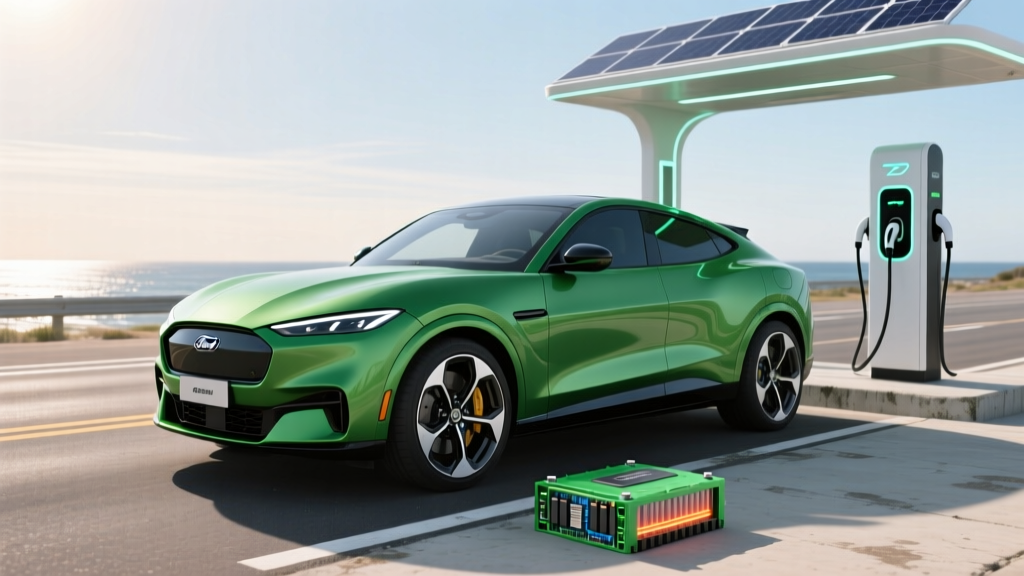
If you've been searching for a Mach-E Green, you're likely referring to the Equestrian Green exterior paint option available on select trims of the Ford Mustang Mach-E. This deep, metallic forest green has become one of the most sought-after colors in Ford's EV lineup, and for good reason — it pairs a distinctive aesthetic with one of the most well-rounded electric crossovers on the market. Below, we break down everything you need to know about the 2026 Mustang Mach-E, with a focus on what buying one in Equestrian Green actually looks like in terms of specs, pricing, charging, and real-world ownership.
Quick Verdict: The Mach-E in Equestrian Green
The Mustang Mach-E remains one of the strongest electric SUVs in its class for 2026. It offers competitive range (up to 320 miles EPA on the Extended Range RWD), brisk acceleration, a refined ride, and access to Ford's growing integration with the Tesla Supercharger network via NACS. The Equestrian Green colorway is available on Premium and GT trims and adds a premium, understated look that stands out in a sea of white and black EVs. Its main drawbacks are a somewhat firm ride on larger wheels and a cargo area that trails some competitors.
Range, Efficiency, and Real-World Expectations
| Configuration | EPA Range | Real-World Expectation |
|---|---|---|
| Standard Range RWD (75.7 kWh) | 250 mi | ~215-230 mi highway; ~195 mi cold weather (30°F) |
| Extended Range RWD (91 kWh) | 320 mi | ~270-290 mi highway; ~240 mi cold weather |
| Extended Range AWD (91 kWh) | 290 mi | ~250-265 mi highway; ~220 mi cold weather |
| GT (91 kWh, AWD) | 280 mi | ~240-255 mi highway; ~210 mi cold weather |
Source: fueleconomy.gov. Real-world figures reflect highway driving at 70-75 mph and cold-weather testing at approximately 30°F. Highway driving reduces range by 10-15% compared to EPA combined; cold temperatures add an additional 15-25% reduction due to battery resistance and cabin heating demands.
The Mach-E's efficiency on the Extended Range RWD model is rated at approximately 101 MPGe combined (33 kWh/100 mi), which is competitive with the Hyundai Ioniq 5 and slightly behind the Tesla Model Y. The AWD and GT models sacrifice some efficiency for traction and power, landing around 90-93 MPGe combined.
Battery, Chemistry, and Charging Speed
The 2026 Mustang Mach-E uses two battery pack sizes:
- Standard Range: 75.7 kWh usable capacity, NMC (nickel-manganese-cobalt) lithium-ion chemistry
- Extended Range: 91 kWh usable capacity, NMC lithium-ion chemistry
Ford has stuck with NMC chemistry across the Mach-E lineup, prioritizing energy density over the lower cost and longer cycle life of LFP (lithium iron phosphate). This means you get more range per pound, but Ford recommends keeping daily charge limits around 80-90% for long-term battery health — unlike LFP packs (found in the base Tesla Model Y) that tolerate regular 100% charging.
| Charging Level | Power / Rate | Time / Miles Added |
|---|---|---|
| Level 1 (120V household) | ~1.4 kW | ~3-4 miles per hour |
| Level 2 (240V, 48A home charger) | 11.5 kW | ~30-34 miles per hour; 0-100% in ~9.5 hours (ER) |
| DC Fast Charge (Standard Range) | Peak 150 kW | 10-80% in ~36 minutes |
| DC Fast Charge (Extended Range) | Peak 150 kW | 10-80% in ~40 minutes |
Charging curve reality: The Mach-E's DC fast-charging peaks at approximately 150 kW but sustains that rate only between roughly 10-50% state of charge. Above 60%, the curve tapers significantly — dropping to under 80 kW by 70% SoC and below 40 kW past 85%. This means the advertised 10-80% time is achievable, but charging from 80-100% on DC fast charging is painfully slow and not recommended. For road trips, plan your stops around the 10-80% window for maximum efficiency.
The Mach-E now ships with a native NACS (Tesla) charge port on 2025+ models, giving direct access to Tesla Supercharger V3 and V4 stations without an adapter. This is a significant practical advantage over CCS-only competitors, as the Supercharger network remains the most reliable public DC fast-charging infrastructure in the U.S.
Performance and Drivetrain
| Trim | Drivetrain | Horsepower | Torque (lb-ft) | 0-60 mph |
|---|---|---|---|---|
| Select / Premium (SR RWD) | Rear-Wheel Drive | 266 hp | 317 | 6.1 sec |
| Premium (ER RWD) | Rear-Wheel Drive | 290 hp | 317 | 5.8 sec |
| Premium (ER AWD) | Dual-Motor AWD | 346 hp | 428 | 4.8 sec |
| GT | Dual-Motor AWD | 480 hp | 600 | 3.5 sec |
The GT model's 3.5-second 0-60 time puts it in genuine sports-car territory, though the lighter, more agile Tesla Model Y Performance still edges it out at around 3.3 seconds. For most buyers, the Premium AWD's 4.8-second run is more than adequate and comes with the range benefit of the 91 kWh pack.
Pricing, Trims, and Federal Tax Credit
| Trim | Base MSRP | Est. After §30D Credit* |
|---|---|---|
| Select (SR RWD) | $42,995 | $35,495 |
| Premium (ER RWD) | $48,995 | $41,495 |
| Premium (ER AWD) | $51,995 | $44,495 |
| GT (ER AWD) | $62,995 | $55,495 |
*Federal tax credit estimate assumes full $7,500 §30D credit eligibility. Per IRS guidelines, eligibility requires:
- Buyer income caps: Modified AGI ≤ $150,000 (single) / $300,000 (joint)
- MSRP cap: SUVs/vans ≤ $80,000 (all Mach-E trims qualify)
- Battery sourcing: Critical minerals and battery components must meet phased percentage thresholds from U.S. or FTA-partner countries — verify current-year compliance at purchase
- Point-of-sale transfer: The $7,500 credit can now be transferred to the dealer at purchase, reducing your out-of-pocket cost immediately rather than waiting for tax filing
Important: Battery sourcing requirements tighten annually. The Mach-E's NMC battery supply chain has been progressively shifting to meet §30D critical-mineral and component thresholds, but specific eligibility can change mid-year. Always confirm with your dealer and consult a tax professional before relying on the credit.
The Equestrian Green exterior color is typically a $0-395 no-cost or low-cost option on Premium and GT trims. A well-equipped Premium AWD with Equestrian Green, panoramic roof, and Ford BlueCruise typically lands around $54,000-$56,000 before incentives.
Interior, Cargo, and Technology
The Mach-E's interior centers on a large 15.5-inch portrait touchscreen running Ford's SYNC 4A system with wireless Apple CarPlay and Android Auto. The vertical screen dominates the dash and handles climate controls — a design choice that draws mixed reactions. Physical knobs and buttons are minimal, though a volume knob does remain at the screen's base.
Cargo and passenger dimensions:
- Cargo volume (rear seats up): 29.7 cu ft
- Cargo volume (rear seats folded): 59.7 cu ft
- Front trunk (frunk): 4.7 cu ft with drain plug — useful for wet gear or ice
- Rear legroom: 38.1 inches
- Front headroom: 40.4 inches
The 29.7 cu ft behind the second row trails the Tesla Model Y (~30.2 cu ft) and significantly trails the Hyundai Ioniq 5 (~32.5 cu ft). If maximum cargo capacity is your priority, the Mach-E isn't the class leader. The frunk, while small, is a practical addition for charging cables or groceries.
Driver assistance: The Mach-E comes standard with Ford Co-Pilot360 2.0 (automatic emergency braking, lane-keeping, blind-spot monitoring, rear cross-traffic alert). Available BlueCruise (a SAE Level 2 hands-free highway driving system) works on over 130,000 miles of pre-mapped divided highways. BlueCruise allows hands-off driving but requires eyes-on attention — the driver monitoring camera will issue warnings and eventually disengage if you look away.
Ford BlueCruise is an SAE Level 2 driver-assistance system. You must remain alert, keep your eyes on the road, and be prepared to take over steering and braking at any moment. It is not a Level 4 autonomous system like Waymo. Do not use your phone, nap, or turn around while BlueCruise is active.
Pros and Cons
Pros
- Competitive EPA range (up to 320 mi on ER RWD)
- Native NACS port — direct Tesla Supercharger access
- GT trim delivers genuine sports-car acceleration (3.5s 0-60)
- BlueCruise hands-free highway driving on mapped routes
- Distinctive Equestrian Green colorway available at little to no extra cost
- Strong safety ratings (IIHS Top Safety Pick)
- Point-of-sale tax credit transfer reduces upfront cost
Cons
- DC fast charging peaks at 150 kW — slower than Ioniq 5 (240 kW) and Model Y (250 kW)
- Cargo space trails key competitors
- Firm ride quality on GT and 20-inch wheel packages
- Portrait touchscreen climate controls frustrate some drivers
- NMC battery requires charge-limit discipline for longevity (unlike LFP)
- Extended Range models take ~40 min for 10-80% DC fast charge
Who the Mach-E Green Is Best For
Choose the Mustang Mach-E in Equestrian Green if:
- You want a stylish, distinctive EV crossover that doesn't look like every other white SUV in the parking lot
- You frequently drive on highways covered by BlueCruise and value hands-free comfort on long commutes
- You need Tesla Supercharger access but prefer Ford's build quality and driving dynamics over the Model Y
- You want a family-friendly EV with strong safety ratings, adequate range for road trips, and available AWD for four-season climates
Look elsewhere if:
- Maximum DC fast-charging speed is your top priority (consider the Hyundai Ioniq 5 or Kia EV6 at 240+ kW)
- You need maximum cargo space (the Ioniq 5 or Volkswagen ID.4 offer more)
- You want an LFP battery for carefree daily 100% charging (base Tesla Model Y RWD)
Warranty and Long-Term Ownership
Ford backs the Mach-E with:
- Battery warranty: 8 years / 100,000 miles (whichever comes first), covering defects and capacity loss below 70% of original capacity
- Powertrain warranty: 5 years / 60,000 miles
- Bumper-to-bumper: 3 years / 36,000 miles
- Roadside assistance: 5 years / 60,000 miles
The 70% retention threshold on the battery warranty is industry standard, matching most competitors. Ford's NMC packs have shown moderate degradation in real-world use — owners typically report 5-8% capacity loss over the first 50,000 miles, which is within normal parameters. Keeping daily charges between 20-80% and using preconditioning before DC fast charging will help maximize long-term battery health.
Frequently Asked Questions
What is the real-world range of the Mach-E Green?
On the Extended Range RWD model, expect approximately 270-290 miles in real-world highway driving and around 240 miles in cold weather (30°F or below). The EPA sticker says 320 miles, but that's a combined city/highway cycle under moderate temperatures. The AWD and GT trims will return 240-265 miles in real-world highway use.
How fast does the Mach-E charge at home and on DC fast chargers?
At home on a 240V Level 2 charger (48 amps / 11.5 kW), the Extended Range pack charges from empty to full in about 9.5 hours, adding roughly 30-34 miles of range per hour. On DC fast chargers, the Mach-E peaks at 150 kW and completes a 10-80% charge in approximately 36-40 minutes depending on battery size. This is adequate but slower than competitors like the Ioniq 5 (240 kW peak, ~18 minutes 10-80%).
Does the Mustang Mach-E qualify for the $7,500 federal tax credit?
Most Mach-E trims are eligible for the full $7,500 §30D federal tax credit, provided the buyer meets income requirements (≤$150K single / ≤$300K joint) and the vehicle's battery sourcing meets current-year critical-mineral and component thresholds. All trims fall under the $80,000 SUV MSRP cap. The credit can be transferred to the dealer at point of sale, reducing your purchase price immediately. Verify eligibility at purchase via IRS.gov and consult a tax professional.
Is the Mach-E worth buying vs. the Tesla Model Y and Hyundai Ioniq 5?
It depends on your priorities. The Mach-E offers a more traditional, car-like driving experience with strong build quality, BlueCruise, and now native Supercharger access. The Tesla Model Y wins on charging speed, cargo space, and software ecosystem. The Hyundai Ioniq 5 dominates on DC fast-charging speed (240 kW) and interior space but lacks native NACS (requires an adapter for Superchargers). If you value Ford's dealer network, driving dynamics, and the Equestrian Green aesthetic, the Mach-E holds its own.
What are the biggest pros and cons of the Mach-E in Equestrian Green?
Pros include up to 320 miles of EPA range, native NACS/Supercharger access, strong GT performance, BlueCruise, and a distinctive colorway. Cons include 150 kW peak DC charging (slower than rivals), below-average cargo space, and NMC battery care requirements. The Equestrian Green color itself is a no-cost or low-cost option and doesn't affect performance or range.
Is Equestrian Green available on all Mach-E trims?
For the 2026 model year, Equestrian Green is typically offered on Premium and GT trims. It may not be available on the base Select trim. Color availability can vary by model year and production batch, so confirm with your dealer when ordering.