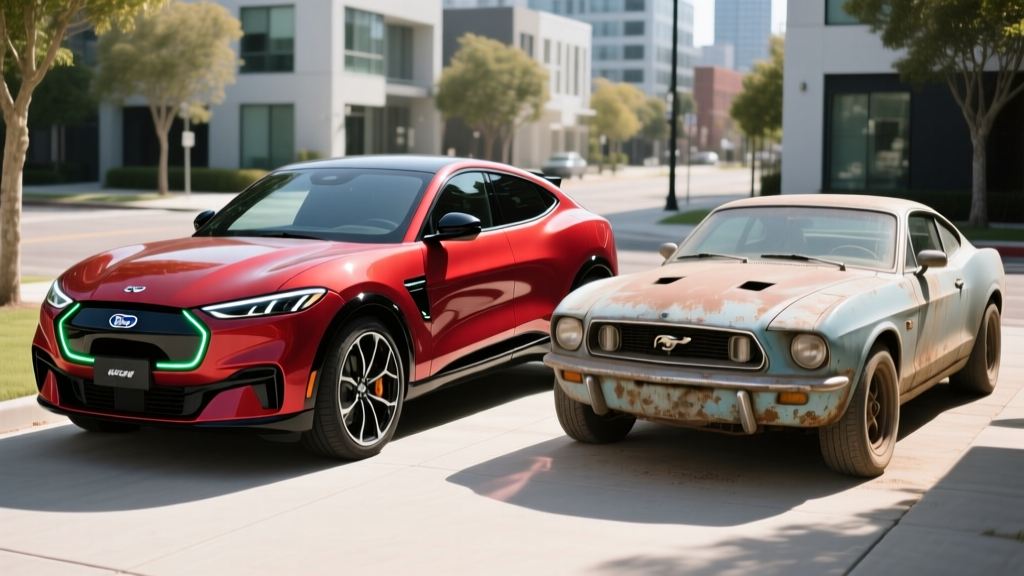
The search for "Mustang Mach-E gas" usually means one of two things: buyers wondering how this electric SUV stacks up against a gasoline vehicle, or former Mustang fans curious whether Ford's battery-powered crossover can replace their gas pony car. The answer in 2026 is more nuanced than a simple yes or no — but the data overwhelmingly favors the Mach-E for most daily driving scenarios.
We've driven multiple model years of the Mach-E, charged it on everything from 50 kW CCS stalls to 350 kW Electrify America stations, and tracked its real-world efficiency across seasons. Here's the complete breakdown against gas alternatives, with exact numbers you need to make the call.
2026 Mustang Mach-E: Core Specs at a Glance
| Specification | Select (RWD) | Premium (AWD) | GT (AWD) |
|---|---|---|---|
| EPA Range | 250 mi | 290 mi (Ext. Range: 320 mi) | 280 mi (Ext. Range: 310 mi) |
| Battery (Usable) | 70 kWh (LFP) | 91 kWh (NMC) | 91 kWh (NMC) |
| Horsepower | 266 hp | 346 hp | 480 hp |
| 0-60 mph | 6.1 sec | 5.1 sec | 3.5 sec |
| Drivetrain | RWD single-motor | AWD dual-motor | AWD dual-motor |
| MPGe (Combined) | 103 MPGe | 101 MPGe | 86 MPGe |
| kWh/100 mi | 33 kWh | 33 kWh | 39 kWh |
| Max DC Fast Charge | 115 kW | 150 kW | 150 kW |
| 10-80% DCFC Time | ~38 min | ~41 min | ~41 min |
| Level 2 Home Rate | 10.5 kW (30 mi/hr) | 10.5 kW (30 mi/hr) | 10.5 kW (30 mi/hr) |
| Base MSRP | $39,995 | $46,995 | $55,995 |
| Cargo (rear / total) | 29.7 / 59.7 cu ft | 29.7 / 59.7 cu ft | 29.7 / 59.7 cu ft |
| Frunk | 4.7 cu ft | 4.7 cu ft | 4.7 cu ft |
| Battery Warranty | 8 yr / 100,000 mi | 8 yr / 100,000 mi | 8 yr / 100,000 mi |
Source: fueleconomy.gov and Ford Motor Company 2026 specifications. Pricing excludes destination charge (~$1,495).
Real-World Range: What the EPA Sticker Doesn't Tell You
EPA Estimated: 320 miles
Real-World Highway (70 mph, 75°F): ~265-280 miles
Real-World Cold Weather (30°F, mixed driving): ~220-245 miles
Worst-Case (highway, 20°F, heater on): ~195-210 miles
The Mach-E Premium with the Extended Range battery is the sweet spot for range-conscious buyers. Its 320-mile EPA figure is competitive with the Tesla Model Y Long Range (310 mi) and Hyundai Ioniq 5 (305 mi). But the EPA number assumes a mix of city and highway driving at moderate temperatures.
On our 250-mile highway loop at sustained 70-75 mph in summer conditions, the Mach-E Premium AWD consistently returned 265-280 miles of projected range from a full charge. That's roughly 12-17% below the sticker — typical for any EV at highway speeds due to aerodynamic drag.
Cold weather is the bigger variable. At 30°F with the cabin heater running, expect a 25-30% range reduction. The Mach-E uses a resistive PTC heater rather than a heat pump (a notable omission compared to Hyundai's standard heat pump), so winter efficiency suffers more than some competitors. If you live in the upper Midwest or Northeast, plan for ~220 miles of usable range in deep winter and size your trips accordingly.
One advantage of the LFP battery in the Select trim: Ford recommends charging LFP to 100% regularly, meaning you get the full 250 EPA miles daily. The NMC Extended Range battery should be charged to 80% for daily use, reserving 100% for road trips — so your practical daily range is closer to 256 miles even though the sticker says 320.
Charging Speed: Home, Public, and Road-Trip Reality
| Charging Level | Power | Speed (Miles Added/Hr) | Use Case |
|---|---|---|---|
| Level 1 (120V household) | 1.4 kW | ~3-4 mi/hr | Emergency / overnight trickle |
| Level 2 (240V home) | 10.5 kW | ~30 mi/hr | Daily home charging |
| DC Fast (Select, LFP) | 115 kW peak | ~250 mi/hr (peak) | Road trips |
| DC Fast (Premium/GT, NMC) | 150 kW peak | ~330 mi/hr (peak) | Road trips |
The Mach-E's DC fast charging is its weakest competitive spec. At 150 kW peak (NMC trims), it trails the Hyundai Ioniq 5's 240 kW, the Tesla Model Y's 250 kW, and the Kia EV6's 240 kW. In practice, the 10-80% charge takes roughly 41 minutes on a sufficiently powerful charger — fine for a meal stop, but noticeably slower than the 18-minute 10-80% sessions in an Ioniq 5 or EV6.
The charge curve matters more than peak kW. The Mach-E sustains close to its peak rate from roughly 10-50% SoC, then tapers progressively. Above 80%, charging slows dramatically — expect 80-100% to take nearly as long as 10-80%. On road trips, plan to charge from 10-80% and move on rather than waiting for a full battery.
At home, the 10.5 kW onboard charger is solid. A full charge from 10% takes about 8.5 hours for the Extended Range battery — easily achievable overnight. Installation of a 240V/48A hardwired Level 2 charger typically runs $800-$2,000 depending on your panel capacity and run length, on top of the $400-$600 charger unit. If your home has a 200-amp panel with spare capacity, you're in good shape. Older homes with 100-amp service may need a panel upgrade ($1,500-$3,000+).
Ford's adoption of the NACS connector via Tesla Supercharger adapter (included with new Mach-E purchases since late 2024) significantly expands your road-trip network. You can use Tesla's 12,000+ Superchargers with the adapter, plus CCS-native networks like Electrify America and EVgo.
Mustang Mach-E vs Gas: The Cost Math That Matters
Let's compare the Mach-E Premium AWD ($46,995 MSRP) against the most common gas alternative buyers cross-shop: the Ford Edge ST-Line AWD (~$44,000 MSRP) and the Toyota RAV4 Gas XLE AWD (~$33,500 MSRP).
| Factor | Mach-E Premium AWD | Ford Edge AWD (Gas) | RAV4 XLE AWD (Gas) |
|---|---|---|---|
| MSRP (before incentives) | $46,995 | $44,000 | $33,500 |
| Federal Tax Credit (§30D) | Up to $7,500* | $0 | $0 |
| Effective Price (with credit) | ~$39,495 | $44,000 | $33,500 |
| Fuel/Energy Cost (15k mi/yr) | ~$620/yr (home L2)** | ~$2,100/yr | ~$1,850/yr |
| Annual Maintenance | ~$300 | ~$650 | ~$500 |
| 5-Year Fuel/Energy | $3,100 | $10,500 | $9,250 |
| 5-Year Maintenance | $1,500 | $3,250 | $2,500 |
| 0-60 mph | 5.1 sec | 6.8 sec | 8.1 sec |
| EPA Efficiency | 101 MPGe | 23 MPG combined | 29 MPG combined |
*Tax credit subject to §30D eligibility: buyer AGI limits ($150K single / $300K joint), MSRP cap ($80K for SUVs), battery sourcing requirements. See IRS.gov §30D guidelines. **Electricity cost based on $0.14/kWh national average; actual varies by state/utility.
The numbers tell a clear story: after the federal tax credit, the Mach-E is cheaper upfront than the Edge, and its 5-year fuel and maintenance savings of roughly $9,150 vs. the Edge (or $7,150 vs. the RAV4) make the total cost of ownership decisively lower. Over five years and 75,000 miles, the Mach-E saves most owners $7,000-$10,000 in operating costs — enough to offset the higher MSRP of the RAV4 and still come out ahead.
Insurance is a partial offset. Mach-E insurance premiums average 10-15% higher than comparable gas crossovers, adding roughly $150-$250/year. Even with this, the net savings remain substantial.
Federal Tax Credit: Does the 2026 Mach-E Qualify?
As of 2026, the Mustang Mach-E is eligible for the full $7,500 federal tax credit under IRS §30D — but only if you meet the eligibility requirements. Here's the checklist:
- Buyer income cap: Modified AGI ≤ $150,000 (single) / $225,000 (head of household) / $300,000 (married filing jointly)
- MSRP cap: Vehicle MSRP must not exceed $80,000 for SUVs/trucks/vans — all Mach-E trims qualify
- Battery sourcing: Critical minerals and battery components must meet phased-in percentage thresholds from US or FTA-partner countries (increases annually through 2030)
- Point-of-sale transfer: You can transfer the credit to the dealer at purchase, reducing your out-of-pocket cost immediately rather than waiting for tax filing
- One credit per vehicle VIN: The credit is tied to the vehicle, not the buyer — a previously credited used Mach-E won't qualify for a new-vehicle credit again
The battery sourcing rules are the most complex variable. Ford sources cells from multiple suppliers, and the qualifying percentage shifts annually. Before purchasing, verify the specific VIN's credit eligibility on fueleconomy.gov or ask your dealer for the manufacturer's IRS certification letter for that model year.
Driving, Tech, and Daily Ownership
The Mach-E drives like a performance crossover, not a traditional SUV. The GT trim's 3.5-second 0-60 time rivals a Porsche Macan GTS, while even the base Select's 6.1 seconds is quicker than most gas crossovers in its class. The low center of gravity (battery pack under the floor) gives it planted cornering behavior that the Edge and RAV4 can't match.
Ford's BlueCruise hands-free driving system (available on Premium and GT trims) is a legitimate SAE Level 2 driver-assistance feature that works on over 130,000 miles of pre-mapped divided highways. It's comparable to GM's Super Cruise in reliability, though it requires periodic eye monitoring via an infrared camera. This is not self-driving — you must remain attentive and ready to take over immediately.
The 15.5-inch vertical touchscreen running SYNC 4A is one of the better EV infotainment systems, with wireless Apple CarPlay and Android Auto, over-the-air updates, and integrated trip planning that accounts for charging stops. The physical volume knob at the bottom of the screen is a welcome usability choice.
Cargo space is competitive: 29.7 cubic feet behind the rear seats and 59.7 with them folded. The 4.7-cubic-foot frunk (front trunk) includes a drain plug, making it useful as a cooler for tailgating. Rear legroom measures 38.9 inches — adequate for adults on longer trips.
Notable drawbacks: The lack of a heat pump hurts cold-weather efficiency and cabin warm-up speed. Rear visibility is compromised by the sloping roofline (a backup camera is essential). Road noise is more noticeable than in the Hyundai Ioniq 5 or Tesla Model Y at highway speeds. And the 150 kW peak DC charge rate, while functional, means longer road-trip stops than some rivals.
Who Should Buy the Mustang Mach-E — And Who Shouldn't
- You want a sporty, quick EV crossover with American-brand service network access
- You can charge at home and your daily commute is under 100 miles
- You value Tesla Supercharger access via the included NACS adapter
- You want BlueCruise hands-free highway driving
- You qualify for the §30D credit and want to reduce effective purchase price
- You regularly drive 300+ miles in cold weather without stopping
- Fastest possible DC charging is your top priority (consider Ioniq 5 or EV6)
- You need a heat pump for harsh-winter efficiency
- You want three rows of seating (check the Kia EV9)
- You can't install Level 2 charging at home
Best for: Daily commuters with home charging, small families needing a sporty crossover, and performance-oriented drivers who want instant torque without gas station visits. The Mach-E replaces a gas car most seamlessly for owners who drive 30-80 miles daily and can charge overnight.
Less ideal for: Apartment dwellers without charging access, frequent 400+ mile road-trippers in cold climates, or buyers who prioritize the shortest possible charging stops above all else.
Frequently Asked Questions
What is the real-world range of the Mustang Mach-E?
The Extended Range AWD Premium delivers ~265-280 miles on the highway in moderate temperatures, dropping to ~220-245 miles in cold weather. The base Select (LFP, RWD) returns ~210-230 miles real-world highway. Always plan trips with a 15-20% buffer below these figures.
How fast does the Mach-E charge at home and on the road?
At home on a 240V Level 2 charger, it adds ~30 miles of range per hour (10.5 kW), fully recharging overnight in ~8.5 hours. On DC fast chargers, the NMC trims peak at 150 kW with a 10-80% time of ~41 minutes. The LFP Select peaks at 115 kW (~38 minutes 10-80%).
How much does the Mach-E cost after tax credits?
The Premium AWD Extended Range at $46,995 MSRP drops to ~$39,495 after the $7,500 federal credit (if you qualify). Add destination (~$1,495), state registration, and any state/local incentives for your final out-the-door number. Always confirm VIN-specific credit eligibility before purchasing.
Is the Mach-E worth buying vs. the Tesla Model Y or Hyundai Ioniq 5?
It depends on your priorities. The Model Y offers more Supercharger-native convenience and slightly more cargo space. The Ioniq 5 charges faster (240 kW) and includes a heat pump. The Mach-E counters with BlueCruise, a more traditional dealership service experience, the included NACS adapter for Supercharger access, and competitive pricing after the tax credit. Test-drive all three — the Mach-E's driving dynamics and infotainment win many buyers in person.
Does the Mustang Mach-E qualify for the $7,500 federal EV tax credit?
Yes, all 2026 Mach-E trims are eligible, provided the buyer meets IRS §30D income caps ($150K single / $300K joint) and the vehicle's battery sourcing meets current-year thresholds. The credit can be transferred to the dealer at point of sale for an immediate price reduction. Verify your specific VIN on fueleconomy.gov.
Does the Mach-E use gas at all?
No. The Mustang Mach-E is a fully battery-electric vehicle (BEV) with no gasoline engine, no fuel tank, and no tailpipe. It runs exclusively on electricity stored in its lithium-ion battery pack. If you're looking for a plug-in hybrid that uses both gas and electricity, the Mach-E is not that vehicle — consider the Ford Escape PHEV or Toyota RAV4 Prime instead.