The Mach-E's Frunk: Dimensions, Drain, and Daily Use
The Mustang Mach-E frunk is one of the most talked-about storage features in the electric SUV segment, and for good reason. Ford designed the front trunk (frunk) with a drain plug, making it one of the few in the industry that can double as a tailgate cooler or wet-storage compartment. But how much space does it actually offer, and how does it stack up against the Tesla Model Y, Hyundai IONIQ 5, and other rivals when you factor in total cargo volume, range, charging, and price?
This review covers the 2026 Ford Mustang Mach-E from a cargo-and-practicality perspective first, then rounds out the full ownership picture with range, charging, performance, pricing, and tax-credit eligibility. If you've been searching for specifics on the Mustang Mach-E frunk and whether it's genuinely useful beyond marketing photos, you're in the right place.
| Spec | Select (RWD) | Premium AWD | GT |
|---|---|---|---|
| EPA Range | ~250 mi (Std Range) / ~320 mi (Ext Range) | ~290 mi (Ext Range) | ~280 mi (Ext Range) |
| Battery (usable) | ~70 kWh (LFP, Std) / ~91 kWh (NMC, Ext) | ~91 kWh (NMC) | ~91 kWh (NMC) |
| Frunk Volume | 4.7 cu ft (drainable) | ||
| Rear Cargo (behind 2nd row) | 29.7 cu ft | ||
| Total Cargo (seats folded) | 59.7 cu ft | ||
| 0-60 mph | ~6.1 sec (RWD Ext) | ~5.1 sec | ~3.3 sec |
| Horsepower | 266 hp (RWD Std) | 346 hp | 480 hp |
| Max DC Fast Charge | ~150 kW | ~150 kW | |
| 10-80% DC Time | ~38-45 min (varies by pack) | ||
| Level 2 Home Charge Rate | 10.5 kW (~30 mi/hr) | ||
| EPA Efficiency | ~100 MPGe (RWD Ext) | ~93 MPGe | ~84 MPGe |
| Base MSRP | ~$39,995 | ~$46,995 | ~$57,995 |
| Battery/Powertrain Warranty | 8 years / 100,000 miles | ||
Mustang Mach-E Frunk: What Makes It Stand Out
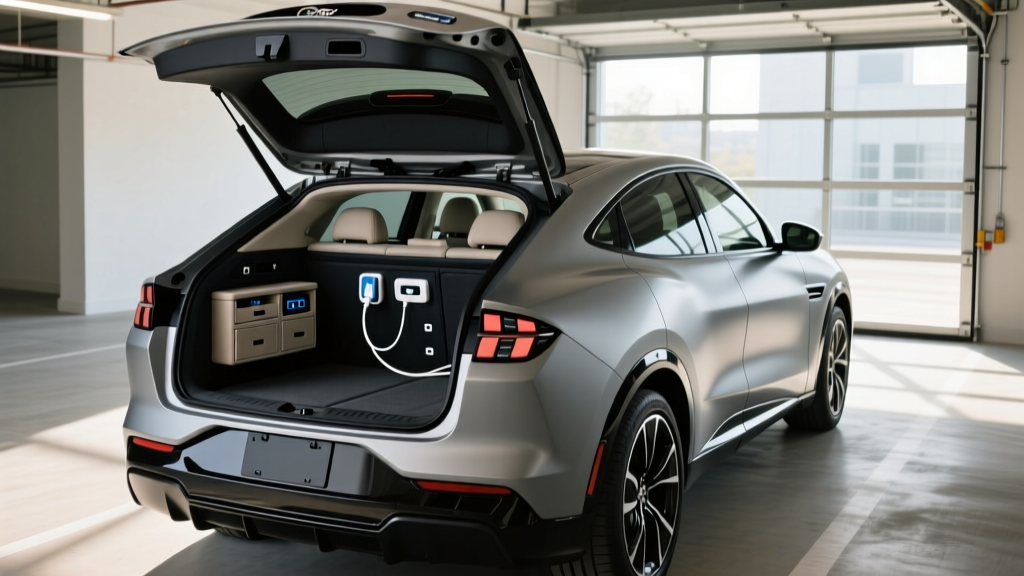
The 2026 Mustang Mach-E frunk offers 4.7 cubic feet of front-trunk storage. That number sounds modest until you compare it to the competition and consider its unique features:
- Drainable design: A built-in drain plug at the bottom of the frunk lets you fill it with ice for tailgating, rinse out muddy gear, or store wet items without worrying about pooling water. Ford markets this as the "Mega Power Frunk" on higher trims, and it's a genuinely useful differentiator.
- Latching system: The frunk opens via the key fob, the FordPass app, or the touchscreen. It uses a soft-close latch rather than a powered lift, which keeps weight down but means you need to push it closed manually.
- Real-world fit test: In practice, the 4.7 cu ft space comfortably holds a standard carry-on suitcase, a couple of grocery bags, or a medium cooler. It will not fit a full-size stroller or large duffel bag — those belong in the rear cargo area.
Compared to the Tesla Model Y's 4.1 cu ft frunk, the Mach-E gives you slightly more volume. The Hyundai IONIQ 5's frunk is smaller at roughly 0.85 cu ft (it sacrifices front storage for a more compact hood design), while the Rivian R1S offers a far larger 11.1 cu ft frunk — though at a much higher price point.
Total Cargo and Passenger Space
The frunk is only part of the story. The Mach-E's rear cargo area behind the second row provides 29.7 cubic feet, expanding to 59.7 cubic feet with the 60/40 split rear seats folded. That's competitive for the midsize electric SUV class:
- Tesla Model Y: 30.2 cu ft rear / 76.2 cu ft total
- Hyundai IONIQ 5: 27.2 cu ft rear / 59.3 cu ft total
- Volkswagen ID.4: 30.3 cu ft rear / 64.2 cu ft total
The Model Y wins on total volume, largely due to its longer roofline and lower load floor. But the Mach-E's rear seat legroom — 38.9 inches — is generous and comparable to the Model Y's 41.6 inches (though Tesla's measurement benefits from a longer wheelbase). Front-seat headroom in the Mach-E is excellent at 40.4 inches, and the cabin feels airy thanks to the available panoramic glass roof.
Owner tip: The Mach-E's cargo floor is relatively high due to the battery pack underneath. Loading heavy items requires more lifting than in a Model Y. If you regularly haul bulky gear, consider a cargo organizer for the rear and reserve the frunk for smaller, frequently accessed items like charging cables, a first-aid kit, or groceries you want to keep separate from the main cabin.
Range, Efficiency, and Real-World Expectations
The 2026 Mustang Mach-E with the Extended Range battery and RWD carries an EPA estimate of approximately 320 miles. In real-world highway driving at 70-75 mph, expect roughly 260-280 miles before needing to charge. In cold weather (below 30°F), range can drop by 15-25%, bringing usable range down to roughly 230-260 miles depending on cabin heating use and terrain. City driving with regenerative braking recovers more energy, often matching or slightly exceeding the EPA sticker.
The Standard Range RWD models use an LFP (lithium iron phosphate) battery pack of approximately 70 kWh usable. LFP chemistry trades some energy density for longer cycle life, better thermal stability, and the ability to charge to 100% regularly without accelerating degradation. If you're a daily commuter who can charge at home every night and rarely road-trips beyond 200 miles, the LFP Standard Range pack is an excellent, durable choice.
The Extended Range models use an NMC (nickel manganese cobalt) pack of approximately 91 kWh usable. NMC offers higher energy density — hence the longer range — but Ford recommends keeping daily charges to around 80-90% to preserve long-term battery health. For road-trippers and those in colder climates, the Extended Range NMC pack provides the buffer needed for highway and winter driving.
Efficiency across trims ranges from roughly 84 to 103 MPGe (combined), or about 32-40 kWh per 100 miles, according to fueleconomy.gov. The RWD Extended Range is the efficiency champion of the lineup. Adding AWD and more horsepower (as in the GT) costs you roughly 15-20% in efficiency.
Charging Speed: DC Fast and Home Level 2
Charging is where Mach-E buyers should pay close attention, because Ford's DC fast-charging speeds lag behind some competitors.
| Charging Level | Power / Rate | Speed (miles added) | Notes |
|---|---|---|---|
| Level 1 (120V household) | ~1.4 kW | ~3-4 mi/hr | Emergency/top-off only |
| Level 2 (240V home, Ford Mobile Power Cord or wall unit) | 10.5 kW | ~30 mi/hr | Full charge overnight (~10 hrs for Ext Range) |
| DC Fast Charge (public CCS/NACS) | Peak ~150 kW | ~100-130 mi in 15 min | 10-80% in ~38-45 min; tapers above 80% |
The Mach-E's peak DC fast-charge rate of ~150 kW is adequate but not class-leading. The Hyundai IONIQ 5 and Kia EV6, built on 800V architectures, can peak at 230-240 kW and achieve 10-80% in roughly 18 minutes. The Tesla Model Y on V3 Superchargers peaks around 250 kW with a similar 15-20 minute 10-80% window.
Charging curve reality: The Mach-E sustains close to its peak rate from roughly 10-50% state of charge, then tapers progressively. Above 80%, charging slows dramatically — often below 40 kW — as the battery management system protects cell longevity. On a road trip, plan your stops around 10-80% windows rather than topping off to 100%, which can add 30+ extra minutes at the charger.
For 2026, the Mach-E comes equipped with the NACS (North American Charging Standard) port, giving it native access to Tesla's Supercharger network — the most reliable and widespread DC fast-charging network in the U.S. This is a significant practical advantage over CCS-only vehicles that still rely on adapters or third-party networks with more variable uptime.
At home, a Level 2 wall connector at 10.5 kW will replenish roughly 30 miles of range per hour, meaning a full overnight charge (8-10 hours) easily covers the Extended Range battery from empty. Most owners who charge nightly at home will rarely, if ever, need to use public charging for daily driving.
Performance and Drivetrain
The Mach-E lineup spans from efficient daily-driver territory to genuine performance-SUV acceleration:
- Select RWD (Standard Range): 266 hp, 317 lb-ft torque, 0-60 in ~6.5 seconds. Adequate for commuting and merging; not thrilling.
- Premium AWD (Extended Range): 346 hp, 428 lb-ft, 0-60 in ~5.1 seconds. The sweet spot for most buyers — confident passing power with all-weather traction.
- GT (AWD, Extended Range): 480 hp, 634 lb-ft (with Performance Upgrade), 0-60 in ~3.3 seconds. Genuinely quick, rivaling the Porsche Macan EV and Tesla Model Y Performance.
All trims use a single-speed reduction gear — no traditional transmission. Regenerative braking is adjustable via a steering-wheel paddle, and the strongest regen setting enables near one-pedal driving in city traffic. The Mach-E's ride quality is firm but well-damped, with a lower center of gravity than a gas SUV thanks to the floor-mounted battery pack.
Pricing, Trims, and Federal Tax Credit Eligibility
The 2026 Mustang Mach-E is offered in four main trims:
| Trim | Base MSRP | Est. Federal Credit (§30D) | Est. Net Price |
|---|---|---|---|
| Select (RWD, Std Range) | ~$39,995 | Up to $7,500* | ~$32,495 |
| Premium (RWD, Ext Range) | ~$44,995 | Up to $7,500* | ~$37,495 |
| Premium (AWD, Ext Range) | ~$46,995 | Up to $7,500* | ~$39,495 |
| GT (AWD, Ext Range) | ~$57,995 | Up to $7,500* | ~$50,495 |
* Federal tax credit eligibility under IRS §30D depends on buyer income limits (AGI caps: $150K single / $300K joint), vehicle MSRP caps ($80K for SUVs), and battery critical-mineral and component sourcing requirements that change annually. The credit can be transferred to the dealer at point of sale as a price reduction. Verify current-year eligibility at irs.gov or with a tax professional.
As-tested pricing for a well-equipped Premium AWD with the BlueCruise subscription and panoramic roof typically lands in the $49,000-$52,000 range before any credits. Destination charges add approximately $1,395.
The Mach-E qualifies as an SUV under IRS MSRP cap rules (limit: $80,000), so all trims clear the price ceiling. However, the battery-sourcing requirements for critical minerals and components tighten each year. Ford has worked to localize its battery supply chain, but buyers should confirm the specific vehicle's VIN eligibility on the IRS clean vehicle credit list before purchase.
Tech, Safety, and Driver Assistance
The 2026 Mach-E runs Ford's latest SYNC 4A infotainment system on a 15.5-inch vertical touchscreen — one of the largest in the segment. Wireless Apple CarPlay and Android Auto are standard. Over-the-air (OTA) updates continue to refine the software, adding features and fixing bugs post-purchase.
Ford BlueCruise is the Mach-E's Level 2 hands-free driving system, operational on over 130,000 miles of pre-mapped divided highways in the U.S. and Canada. A driver-facing camera monitors your eyes to ensure attention. BlueCruise handles steering, acceleration, and braking on qualified roads, and it can execute hands-free lane changes on newer model years.
Ford BlueCruise is a Level 2 driver-assistance system per SAE classification. The driver must remain alert and ready to take over at any moment. This is not autonomous or "self-driving" capability. Only Level 4 services (like Waymo robotaxis operating in geofenced urban areas) qualify as driverless.
Safety ratings are strong: the Mach-E has earned top marks from both NHTSA (5-star overall) and IIHS (Top Safety Pick+ in prior model years). Standard safety features include automatic emergency braking with pedestrian detection, blind-spot monitoring, rear cross-traffic alert, lane-keeping assist, and evasive steering assist.
Notable drawbacks: The Mach-E's large touchscreen replaces most physical controls, which some drivers find distracting. Climate controls are buried in the screen rather than accessible via knobs. The panoramic glass roof, while beautiful, has no retractable shade — it relies on electrochromic tinting that doesn't fully block bright sunlight. And the 150 kW peak DC charge rate, while functional, is increasingly outpaced by competitors on 800V platforms.
Who the Mustang Mach-E Suits Best
- You want a mainstream electric SUV with strong dealer support, a drainable frunk for active lifestyles, and native Tesla Supercharger access.
- Your daily commute is under 100 miles round-trip and you can charge at home on Level 2.
- You value hands-free highway driving (BlueCruise) and a large, modern infotainment screen.
- You live in a region with moderate winters where the Extended Range battery provides adequate buffer.
- You road-trip frequently and need the fastest possible DC charging — look at the Hyundai IONIQ 5 or Kia EV6.
- You need maximum cargo volume — the Tesla Model Y offers more total space.
- You want a physical key fob with traditional buttons and knobs — the Mach-E is heavily screen-dependent.
Pros and Cons
- Drainable 4.7 cu ft frunk is best-in-class for wet/messy storage
- Native NACS port for Tesla Supercharger access
- Strong safety ratings (NHTSA 5-star, IIHS Top Safety Pick+)
- BlueCruise hands-free driving on 130,000+ miles of highway
- LFP option on Standard Range for daily-charge durability
- Competitive pricing after potential §30D credit
- 150 kW peak DC charging lags behind 800V competitors (230-240 kW)
- Total cargo volume (59.7 cu ft) trails Tesla Model Y (76.2 cu ft)
- Climate controls are touchscreen-only — no physical knobs
- Panoramic glass roof lacks a retractable shade
- Higher trims (GT) push into premium-EV pricing territory
Frequently Asked Questions
What is the real-world range of the 2026 Mustang Mach-E?
The Extended Range RWD model carries an EPA estimate of ~320 miles. Real-world highway driving at 70-75 mph yields approximately 260-280 miles. In cold weather below 30°F, expect 230-260 miles depending on heating use and terrain. The Standard Range LFP model delivers roughly 200-210 miles real-world.
How fast does the Mustang Mach-E charge?
On a DC fast charger, the Mach-E peaks at ~150 kW and charges from 10-80% in approximately 38-45 minutes. At home on a Level 2 (240V) charger at 10.5 kW, you'll add about 30 miles of range per hour, fully recharging overnight in 8-10 hours.
How much does the 2026 Mach-E cost after tax credits?
The base Select RWD starts at ~$39,995. If you qualify for the full $7,500 federal credit under §30D (subject to income caps, MSRP limits, and battery-sourcing rules), the effective price drops to ~$32,495. A well-equipped Premium AWD typically lands around $39,500-$44,000 after credits. Confirm eligibility for your specific VIN at irs.gov.
Is the Mustang Mach-E worth buying vs. the Tesla Model Y or Hyundai IONIQ 5?
The Mach-E excels with its drainable frunk, native Supercharger access, BlueCruise, and strong dealer network. The Model Y offers more cargo space and faster charging. The IONIQ 5 charges significantly faster (18 min 10-80%) but has a smaller frunk and no native NACS port (adapter required). Your choice depends on priorities: cargo volume (Model Y), charging speed (IONIQ 5), or frunk utility and hands-free driving (Mach-E).
Does the Mustang Mach-E qualify for the federal EV tax credit?
The Mach-E is eligible for up to $7,500 under IRS §30D, provided the buyer meets income limits ($150K single / $225K head of household / $300K joint AGI), the vehicle MSRP is under $80,000 (all trims qualify as an SUV), and the battery meets current-year critical-mineral and component sourcing thresholds. The credit can be applied as a point-of-sale price reduction at the dealer. Always verify eligibility for the specific model year and VIN before purchasing.
What is the Mustang Mach-E battery warranty?
Ford covers the Mach-E's high-voltage battery and electric powertrain components for 8 years or 100,000 miles, whichever comes first. The warranty covers defects and capacity loss below a specified threshold (typically 70% state of health). The rest of the vehicle carries a 3-year/36,000-mile bumper-to-bumper warranty and a 5-year/60,000-mile powertrain warranty for non-EV components.
Can I use the Mustang Mach-E frunk as a cooler?
Yes. The frunk's built-in drain plug allows you to fill it with ice for tailgating or store wet/messy items. Ford designed it with a sealed, washable liner. Just be sure to close the drain plug before filling, and drain it after use to prevent standing water.