The Ford Mustang Mach-E has been a staple of the electric crossover segment since its launch, but one feature continues to generate outsized search interest: the Mustang Mach-E frunk. Officially called the Mega Power Frunk on higher trims, this front trunk is more than a party trick — it's a drainable, lockable storage compartment that solves real problems for EV buyers transitioning from gas SUVs. But how practical is it really, and does the rest of the Mach-E's package hold up in 2026's increasingly competitive EV market?
We've spent extensive time with the current-generation Mach-E to answer that question and every other that matters to buyers: real-world range, charging speeds, tax credit eligibility, and how it stacks up against the Hyundai Ioniq 5, Tesla Model Y, and Chevrolet Blazer EV. Here's the complete breakdown.
The Mustang Mach-E Frunk: Dimensions, Features, and Real-World Use
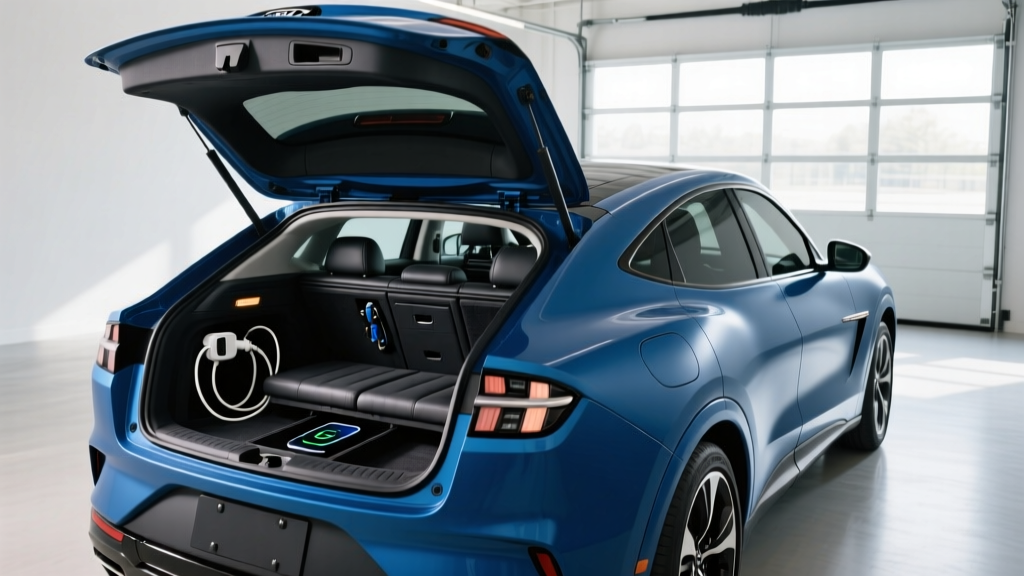
Let's address the keyword head-on. The Mustang Mach-E frunk provides 4.7 cubic feet of storage space ahead of the firewall — one of the larger front trunks in the EV crossover segment. For context, that's roughly equivalent to a medium soft-sided cooler or two carry-on bags laid flat.
What elevates the Mach-E frunk beyond simple volume is its feature set:
- Drainable floor: A built-in drain plug lets you hose it out — ideal for muddy gear, wet wetsuits, or tailgate ice storage.
- Mega Power Frunk (GT and Premium trims): Adds a powered open/close mechanism with a key fob and dashboard button.
- Lockable and weather-sealed: Contents stay secure and dry, unlike an open truck bed.
- Flat load floor: The frunk floor sits flush with the opening, so items slide in without a lip to clear.
In practice, owners report using the frunk most often for charging cables (keeping them out of the main cargo area), gym bags, groceries that might leak, and outdoor gear. The drain plug is the standout differentiator — no other EV in this price class offers a hoseable front compartment.
Total Cargo and Passenger Space
The frunk is just one piece of the storage puzzle. Here's the full cargo and interior picture:
| Measurement | Ford Mustang Mach-E | Tesla Model Y | Hyundai Ioniq 5 |
|---|---|---|---|
| Frunk (cu ft) | 4.7 | 4.1 | 0.85 |
| Rear cargo behind 2nd row (cu ft) | 29.7 | 30.2 | 27.2 |
| Max cargo, seats folded (cu ft) | 59.7 | 72.1 | 59.3 |
| Front legroom (in) | 43.3 | 41.8 | 41.7 |
| Rear legroom (in) | 38.9 | 41.6 | 39.4 |
The Mach-E trails the Model Y in max cargo volume by over 12 cubic feet with seats folded — a meaningful gap if you regularly haul large items. Rear legroom is adequate for adults but tighter than the Model Y's class-leading space. Where the Mach-E wins is the frunk advantage: nearly four cubic feet more than the Ioniq 5 and a half-cubic-foot edge over the Model Y, with the added utility of that drain plug.
Range, Battery, and Efficiency
EPA Estimated Range: Up to 320 miles (Select RWD with Extended Range battery)
Real-World Highway: Expect 260–285 miles at 70–75 mph in moderate temperatures
Cold-Weather (below 30°F): Expect 210–250 miles depending on cabin heat usage and driving style
AWD and GT trims sacrifice 20–40 miles of range for performance and traction.
The 2026 Mach-E lineup uses two battery packs across its trims:
- Standard Range: ~70 kWh usable, LFP (lithium iron phosphate) chemistry — lower energy density but longer cycle life and no degradation anxiety from daily 100% charging.
- Extended Range: ~91 kWh usable, NMC (nickel manganese cobalt) chemistry — higher energy density for maximum range, but Ford recommends keeping SoC between 20–80% for daily use to preserve longevity.
| Spec | Select RWD Std Range | Premium RWD Ext Range | GT AWD Ext Range |
|---|---|---|---|
| Battery (usable kWh) | ~70 (LFP) | ~91 (NMC) | ~91 (NMC) |
| EPA Range (miles) | 250 | 320 | 280 |
| MPGe (combined) | 101 | 101 | 84 |
| kWh/100 mi | 33 | 33 | 40 |
| Horsepower | 266 | 290 | 480 |
| 0–60 mph (sec) | 6.3 | 6.1 | 3.5 |
| Drivetrain | RWD (single motor) | RWD (single motor) | AWD (dual motor) |
Efficiency across the lineup is competitive. The RWD trims achieve roughly 33 kWh per 100 miles, which translates to about 3 miles per kWh — respectable for a 4,800-pound crossover. The GT's 40 kWh/100mi reflects its performance tuning and AWD drivetrain losses.
According to fueleconomy.gov, the Mach-E Premium RWD's 101 MPGe combined places it mid-pack among electric SUVs, trailing the Ioniq 5's 114 MPGe but matching the Model Y Long Range RWD.
Charging Speed: DC Fast and Home Level 2
Charging speed remains a top buyer concern, and the Mach-E delivers solid — if not class-leading — performance.
| Charging Level | Rate / Speed | Details |
|---|---|---|
| Level 1 (120V household) | ~1.4 kW / ~4 mi/hr | Emergency/trickle only; full charge in 60+ hours |
| Level 2 (240V home) | 10.5 kW / ~32 mi/hr | Full charge in ~9–10 hours (Extended Range); Ford Mobile Power Cord included |
| DC Fast Charge (peak) | 150 kW (Std Range) / 150 kW (Ext Range) | 10–80% in ~38 minutes (Ext Range); ~33 min (Std Range) |
The Mach-E's DC fast-charging peak of 150 kW is its most notable limitation versus competitors. The Hyundai Ioniq 5 peaks at 240 kW on an 800V architecture, achieving 10–80% in roughly 18 minutes. The Tesla Model Y can accept up to 250 kW at V3 Superchargers, hitting 10–80% in about 25 minutes. On a long road trip, the Mach-E's 38-minute 10–80% session means noticeably longer stops.
One important note on the charging curve: the Mach-E sustains near-peak power up to roughly 55% SoC before tapering. If you arrive at a charger at 10% SoC, you'll see strong speeds through the mid-range, but the final 20% (80–100%) is slow — as is typical for all EVs. Plan your road-trip stops around 10–80% sessions and skip topping off to 100% unless it's your final destination.
At home, the 10.5 kW Level 2 onboard charger is competitive. A full overnight charge is easily achievable, and most owners will add 200+ miles of range during an 8-hour sleep window. The Ford Mobile Power Cord ships with the vehicle and handles both 120V and 240V outlets, though a dedicated Level 2 wallbox (typically $500–$800 for equipment plus $800–$2,000 for electrician installation) is the recommended setup for daily convenience.
Pricing, Trims, and Federal Tax Credit Eligibility
| Trim | Base MSRP (2026) | Drivetrain | Est. After §30D Credit |
|---|---|---|---|
| Select (Std Range, RWD) | $39,995 | RWD | ~$32,495* |
| Premium (Ext Range, RWD) | $48,995 | RWD | ~$41,495* |
| Premium (Ext Range, AWD) | $51,995 | AWD | ~$44,495* |
| GT (Ext Range, AWD) | $59,995 | AWD | ~$52,495* |
*Estimated after-tax-credit prices assume full $7,500 federal credit eligibility. Actual credit amount depends on your individual tax situation, battery sourcing compliance, and income limits.
- MSRP Cap: SUVs/crossovers must have an MSRP at or below $80,000 (all Mach-E trims qualify).
- Income Cap: Modified AGI must not exceed $150,000 (single), $225,000 (head of household), or $300,000 (married filing jointly).
- Battery Sourcing: The vehicle must meet critical mineral and battery component requirements that tighten annually. Ford has worked to qualify the Mach-E, but sourcing rules change — verify current eligibility at IRS.gov's qualified vehicle list before purchasing.
- Point-of-Sale Transfer: As of 2024, you can transfer the credit to the dealer at purchase, reducing your out-of-pocket cost immediately rather than waiting for tax filing.
Technology, Driver Assists, and Interior
The Mach-E's cabin centers on a 15.5-inch vertical touchscreen running Ford's SYNC 4A system. Wireless Apple CarPlay and Android Auto are standard. The interface is responsive, and the large screen handles navigation, media, and vehicle settings without excessive menu diving — though some climate controls are buried in the touchscreen rather than physical buttons, which draws mixed reviews from owners.
Standard driver-assistance features under the Ford Co-Pilot360 2.0 suite include:
- Adaptive cruise control with stop-and-go
- Lane-keeping system with lane-centering
- Automatic emergency braking with pedestrian detection
- Blind-spot monitoring with rear cross-traffic alert
- Evasive steering assist
Available BlueCruise enables hands-free driving on pre-mapped divided highways (over 130,000 miles of compatible roads in the US and Canada). A driver-facing camera monitors eye attention, and the system handles steering, acceleration, and braking within its operational domain.
BlueCruise is a Level 2 driver-assistance system. The driver must remain attentive and ready to take over at any time. This is not autonomous or self-driving capability. Only Level 4 services like Waymo operate without a human driver in the loop.
Interior materials are a mixed bag. The Mach-E uses a mix of soft-touch surfaces and hard plastics that, while durable, don't quite match the premium feel of a similarly priced BMW iX or even the refreshed Tesla Model Y interior. Heated front seats and a heated steering wheel are standard on most trims. The panoramic fixed glass roof (standard on Premium and GT) floods the cabin with light but adds no ventilation option.
Warranty and Ownership Costs
| Coverage | Term |
|---|---|
| Basic Vehicle Warranty | 3 years / 36,000 miles |
| Powertrain Warranty | 5 years / 60,000 miles |
| EV Battery Components | 8 years / 100,000 miles (capacity retention ≥70%) |
| Corrosion Perforation | 5 years / unlimited miles |
| Roadside Assistance | 5 years / 60,000 miles |
The 8-year/100,000-mile battery warranty with a 70% capacity retention floor is standard for the industry and matches competitors like Hyundai and Tesla. Ford's battery degradation data from vehicles now in their fourth and fifth model years suggests most Mach-E owners will retain well above 85% capacity at 100,000 miles under normal use — a reassuring data point for used buyers and long-term owners alike.
Insurance costs for the Mach-E tend to run 10–20% higher than a comparable gas-powered Ford Escape, reflecting the EV repair-cost premium that insurers still apply. Expect annual premiums in the $1,600–$2,400 range depending on your state, driving record, and trim level.
Pros, Cons, and Who Should Buy the Mach-E
- Best-in-class frunk with drain plug (4.7 cu ft)
- Competitive real-world range up to ~285 highway miles (Ext Range RWD)
- BlueCruise hands-free highway driving is well-implemented
- GT trim delivers 3.5-sec 0–60 performance
- All trims fall under the $80K MSRP cap for §30D credit
- Comfortable ride quality; quiet cabin at speed
- DC fast charging peaks at 150 kW — slower than Ioniq 5, Model Y
- Rear cargo volume trails Model Y by 12+ cu ft with seats folded
- Climate controls buried in touchscreen
- Interior materials don't fully justify the price point
- No front trunk (frunk) power open/close on base Select trim
- Rear legroom tighter than some competitors
- Commuters and daily drivers who want a comfortable, well-equipped crossover with home charging and don't frequently road-trip beyond 250 miles.
- Outdoor enthusiasts who'll use the drainable frunk for muddy boots, wet gear, or tailgate supplies.
- Performance seekers (GT trim) who want a 3.5-second 0–60 electric daily driver.
- Ford loyalists who prefer a legacy dealer network for service over Tesla's direct-to-consumer model.
Frequently Asked Questions
What is the real-world range of the Mustang Mach-E?
The EPA rates the Extended Range RWD Mach-E at 320 miles, but real-world highway driving at 70–75 mph typically yields 260–285 miles in moderate weather. In cold conditions below 30°F, expect 210–250 miles due to battery resistance and cabin heating demands. The Standard Range RWD delivers about 210–225 miles real-world highway.
How fast does the Mustang Mach-E charge at home and on the road?
At home on a 240V Level 2 charger, the Mach-E charges at up to 10.5 kW, adding roughly 32 miles of range per hour — a full overnight charge is standard. On DC fast chargers, it peaks at 150 kW, reaching 10–80% in approximately 38 minutes for the Extended Range battery. This is adequate but trails the Ioniq 5's 18-minute 10–80% capability.
How much does the Mustang Mach-E cost after federal tax credits?
With the full $7,500 §30D credit applied at point of sale, the Select RWD starts around $32,495 and the GT AWD drops to approximately $52,495. Eligibility requires meeting IRS income caps ($150K single / $300K joint), the $80K MSRP limit (all trims qualify), and current-year battery sourcing requirements. Always verify on the IRS qualified vehicles page before purchase.
Is the Mustang Mach-E worth buying versus the Tesla Model Y or Hyundai Ioniq 5?
The Mach-E is a strong choice if you prioritize a comfortable ride, a practical drainable frunk, BlueCruise highway assist, and Ford's dealer network. Choose the Model Y if you need maximum cargo space (72 cu ft) and access to the Supercharger network. Choose the Ioniq 5 if fast DC charging (18-minute 10–80%) and a more distinctive design matter most. None is objectively "best" — it depends on your use case.
Does the Mustang Mach-E frunk have a drain plug on all trims?
Yes, the drainable floor is standard across all Mach-E trims. However, the powered open/close feature (branded Mega Power Frunk) is available on Premium and GT trims — the base Select trim uses a manual release.
What is the Mustang Mach-E's battery warranty?
Ford covers the EV battery components for 8 years or 100,000 miles, whichever comes first, with a guaranteed capacity retention of at least 70%. Real-world data from early Mach-E owners suggests most packs retain 85%+ capacity at the 100,000-mile mark under normal charging habits.