The Mach-E at a Glance: Quick Verdict
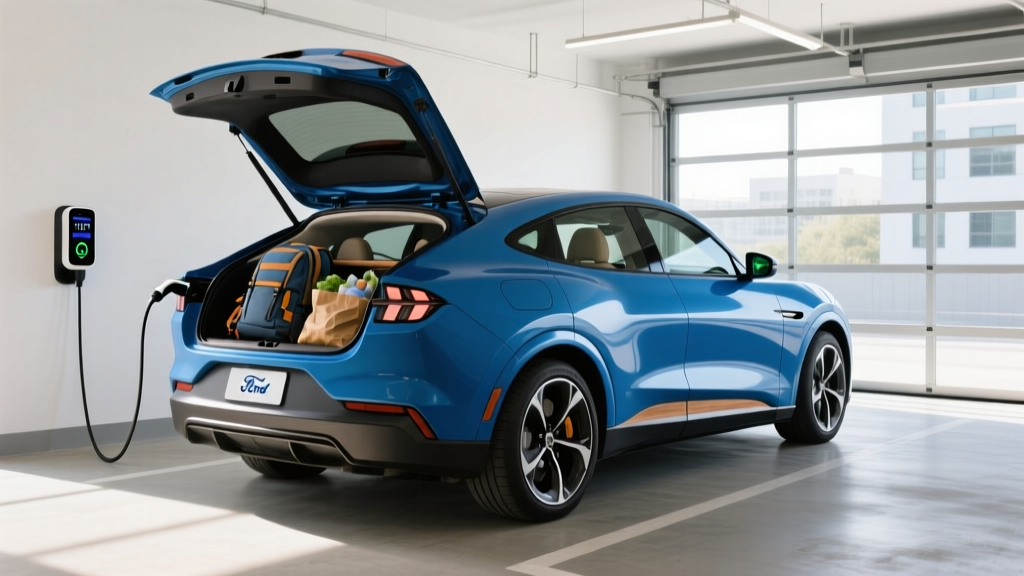
The Ford Mustang Mach-E remains one of the most practical electric SUVs for buyers who need genuine utility without sacrificing driving dynamics. For the 2026 model year, Ford has refined the powertrain lineup, standardized the extended-range battery across more trims, and kept the Mach-E competitive against the Tesla Model Y and Hyundai Ioniq 5. But the headline for many crossover shoppers is the Mustang Mach-E cargo space — a class-competitive 29.7 cubic feet behind the rear seats, expanding to 59.7 cubic feet with the rear seats folded, plus a front trunk (frunk) that adds usable storage for charging cables or groceries.
This review covers every number that matters: real-world range expectations, DC fast-charge curves, battery chemistry, federal tax credit eligibility under current IRS §30D rules, and how the Mach-E stacks up against rivals when it comes to hauling people and cargo.
| Specification | Select RWD | Premium AWD (Ext. Range) | GT |
|---|---|---|---|
| EPA Range | 250 mi | 320 mi | 280 mi |
| Battery (usable) | 70 kWh (LFP) | 91 kWh (NMC) | 91 kWh (NMC) |
| Horsepower | 266 hp | 346 hp | 480 hp |
| 0-60 mph | 6.3 sec | 5.1 sec | 3.5 sec |
| DC Fast Charge (peak) | 150 kW | 150 kW | 150 kW |
| 10-80% Time | ~36 min | ~45 min | ~45 min |
| Level 2 Home Charge | 10.5 kW (~33 mi/hr) | 10.5 kW (~33 mi/hr) | 10.5 kW (~33 mi/hr) |
| Base MSRP | $39,995 | $46,995 | $55,995 |
| MPGe (combined) | 101 MPGe | 101 MPGe | 86 MPGe |
Sources: EPA fueleconomy.gov, Ford Motor Company 2026 spec sheets.
Mustang Mach-E Cargo Space: Dimensions That Matter
Cargo versatility is where the Mach-E earns its crossover credentials. Here's the full dimensional breakdown:
- Cargo behind rear seats: 29.7 cu ft
- Cargo with rear seats folded: 59.7 cu ft
- Front trunk (frunk): 4.7 cu ft (drainable, with a built-in shelf divider)
- Rear legroom: 38.9 inches
- Front headroom: 40.4 inches
- Rear headroom: 38.2 inches
- Front shoulder room: 57.6 inches
- Rear shoulder room: 55.6 inches
The 29.7 cu ft figure behind the second row is competitive with the Tesla Model Y (30.2 cu ft) and significantly larger than the Hyundai Ioniq 5's 27.2 cu ft. The frunk is a genuine differentiator — its drainable design means you can load it with ice for tailgating or rinse it out after hauling muddy gear. The Ioniq 5 offers a small frunk, but the Model Y's frunk is comparable in size.
With the 60/40 split rear seats folded flat, the 59.7 cu ft total is enough for a full set of golf bags, several large suitcases, or the equivalent of a mid-size dresser. The load floor is relatively flat, though there is a slight lip at the cargo opening that can make sliding heavy items in and out less convenient than in the Model Y's more open hatch design.
Cargo vs. Competitors at a Glance
| Model | Behind 2nd Row | Seats Folded | Frunk |
|---|---|---|---|
| Ford Mustang Mach-E | 29.7 cu ft | 59.7 cu ft | 4.7 cu ft |
| Tesla Model Y | 30.2 cu ft | 72.1 cu ft | 4.1 cu ft |
| Hyundai Ioniq 5 | 27.2 cu ft | 59.3 cu ft | 0.85 cu ft |
| VW ID.4 | 30.3 cu ft | 64.2 cu ft | None |
The Model Y's advantage with seats folded comes from its longer, more wagon-like roofline. For everyday cargo with passengers aboard, the Mach-E holds its own.
Real-World Range: What the EPA Sticker Doesn't Tell You
The 2026 Mach-E Premium AWD with the Extended Range battery carries an EPA-estimated 320 miles. That number is achieved under mixed driving conditions with moderate climate control use. Here's what to expect in practice:
Real-World Range Expectations — Mach-E Premium AWD (Ext. Range)
- EPA Combined: 320 miles
- Highway (70-80 mph, mild weather): ~260-280 miles
- City/Suburban mixed (moderate climate): ~290-310 miles
- Cold weather (below 32°F, heater on): ~210-250 miles
- Highway + cold weather (worst case): ~195-225 miles
The 91 kWh NMC pack gives the Extended Range models a buffer, but highway speeds above 75 mph and winter temperatures compound range loss significantly. Preconditioning the battery while plugged in before departure recovers some of that winter deficit by warming the cells without drawing from the pack.
The Select RWD with the 70 kWh LFP battery rates at 250 miles EPA. LFP chemistry offers superior longevity and can be charged to 100% daily without degradation concerns — a practical advantage for commuters who can charge at home nightly. Expect roughly 200-215 miles highway and as low as 160-180 miles in deep winter with this pack.
The GT trim's 280-mile EPA rating reflects the performance-oriented powertrain's higher energy consumption. Aggressive driving can push real-world range below 200 miles on a single charge.
Charging Speed: DC Fast, Level 2, and the Charge Curve Reality
The 2026 Mach-E peaks at 150 kW on DC fast charging across all trims. This is a meaningful limitation compared to the Hyundai Ioniq 5's 240 kW peak or the Tesla Model Y's ~250 kW capability on V3 Superchargers. On a road trip, that translates to longer stops.
| Charge Level | Power | Select (70 kWh) | Premium Ext. Range (91 kWh) |
|---|---|---|---|
| Level 1 (120V household) | ~1.4 kW | ~3-4 mi/hr | ~3-4 mi/hr |
| Level 2 (240V, 48A) | 10.5 kW | ~33 mi/hr (full in ~7 hr) | ~33 mi/hr (full in ~9 hr) |
| DC Fast Charge (peak) | 150 kW | 10-80% in ~36 min | 10-80% in ~45 min |
| DC Fast (sustained avg) | ~90-110 kW | ~36 min real-world | ~45 min real-world |
The charge curve matters more than the peak number. The Mach-E's 150 kW peak is typically sustained from roughly 10-40% State of Charge (SoC), after which it tapers progressively — dropping to around 100 kW near 60% and below 50 kW above 80%. This is why the 10-80% time for the Extended Range model stretches to approximately 45 minutes despite the 150 kW headline figure.
For home charging, the onboard 10.5 kW charger is adequate for overnight replenishment. A Level 2 wall connector on a 60-amp circuit (48 amps continuous) will add roughly 33 miles of range per hour, easily covering a full day's commute overnight. Installation of a 240V/60A circuit typically costs $800-$2,000 depending on your panel capacity and run length — budget for a licensed electrician and a possible panel upgrade if you're running a 200-amp service with limited headroom.
The Mach-E uses the CCS1 connector for DC fast charging and J1772 for Level 2 AC. Ford has confirmed NACS adapter compatibility, enabling access to Tesla's Supercharger network — a significant advantage for road-trip charging reliability.
Performance and Drivetrain Breakdown
The 2026 Mach-E lineup spans from efficient daily-driver to genuine performance SUV:
- Select RWD: 266 hp, single rear motor, 0-60 in 6.3 seconds. Adequate for merging and passing, with the efficiency advantage of rear-wheel drive.
- Premium AWD (Extended Range): 346 hp, dual motor, 0-60 in 5.1 seconds. The sweet-spot trim — confident acceleration, all-weather traction, and the longest range in the lineup.
- GT: 480 hp, dual motor with performance tuning, 0-60 in 3.5 seconds. Genuinely quick, but the energy consumption penalty is real — 86 MPGe combined vs. 101 MPGe on lesser trims.
All trims feature regenerative braking with a one-pedal driving mode. The Mach-E's brake blending is among the smoother implementations in the segment, with a natural pedal feel that doesn't require a long adaptation period. The GT's MagneRide adaptive suspension (standard on GT, optional on Premium) provides a noticeable improvement in ride composure over rough pavement.
Pricing, Trims, and Federal Tax Credit Eligibility
| Trim | Base MSRP | As-Tested (typical) | Est. §30D Credit | Effective Price |
|---|---|---|---|---|
| Select RWD | $39,995 | $42,500 | Up to $7,500* | ~$32,495* |
| Premium RWD (Ext.) | $44,995 | $48,200 | Up to $7,500* | ~$37,495* |
| Premium AWD (Ext.) | $46,995 | $50,400 | Up to $7,500* | ~$39,495* |
| GT | $55,995 | $60,500 | Up to $7,500* | ~$48,495* |
*Tax credit eligibility depends on multiple factors under IRS §30D rules. Requirements include:
§30D Federal EV Tax Credit Checklist
- Buyer income caps: AGI ≤ $150,000 (single), ≤ $225,000 (head of household), ≤ $300,000 (joint)
- MSRP cap: SUVs/crossovers must be ≤ $80,000 — all Mach-E trims qualify
- Battery sourcing: Critical minerals and battery components must meet phased-in domestic/free-trade-partner thresholds (percentages increase annually through 2029)
- Assembly: Vehicle must undergo final assembly in North America — the Mach-E is built in Cuautitlán, Mexico (qualifying)
- Point-of-sale transfer: Eligible buyers can apply the credit as an instant rebate at the dealer rather than waiting for tax filing
Important: Battery-sourcing requirements change annually and can shift mid-year. Always verify current eligibility on fueleconomy.gov and consult a tax professional before relying on the credit for purchase decisions.
Efficiency, Battery Chemistry, and Long-Term Ownership
The Mach-E's efficiency varies meaningfully by trim. The Select RWD achieves 101 MPGe combined (roughly 33 kWh per 100 miles), while the GT drops to 86 MPGe (~39 kWh/100 mi). For context, the Tesla Model Y Long Range AWD achieves approximately 111 MPGe combined — a measurable advantage in operating cost over thousands of miles.
| Attribute | LFP (Select RWD) | NMC (Premium, GT) |
|---|---|---|
| Energy Density | Lower (heavier pack for same kWh) | Higher (more range per kg) |
| Usable Capacity | 70 kWh | 91 kWh |
| Daily Charging to 100% | Yes — recommended | No — limit to 80-90% for longevity |
| Cold-Weather Performance | Moderate range loss | Better low-temp performance |
| Cycle Life | 3,000+ cycles | 1,500-2,000 cycles |
| Degradation (est. 8 yr) | ~5-8% | ~8-12% |
The LFP pack in the Select trim is a smart pick for buyers who charge nightly at home and prioritize long-term battery health over maximum range. The NMC packs in the Premium and GT deliver more range and better cold-weather output but benefit from daily charge limits of 80-90% to minimize degradation.
Warranty coverage: Ford provides an 8-year/100,000-mile battery and powertrain warranty across all trims, with a capacity retention threshold of 70% — meaning Ford will repair or replace the battery if it degrades below 70% of original capacity within the warranty period. The vehicle limited warranty is 3 years/36,000 miles bumper-to-bumper.
Tech, Safety, and Driver Assistance
The 2026 Mach-E features Ford's SYNC 4A infotainment system on a 15.5-inch vertical touchscreen. The interface is responsive, supports wireless Apple CarPlay and Android Auto, and includes over-the-air (OTA) update capability for both infotainment and powertrain software.
Ford's BlueCruise hands-free driving system is available on Premium and GT trims (and as part of an option package on Select). BlueCruise is a SAE Level 2 driver-assistance system — it handles steering, acceleration, and braking on pre-mapped divided highways, but the driver must remain attentive and keep eyes on the road. A driver-facing camera monitors engagement. BlueCruise is not autonomous driving; it requires active supervision at all times.
BlueCruise Limitations
- Operates only on pre-qualified sections of divided highways (~130,000+ miles mapped in the US and Canada)
- Requires driver eye monitoring — system will disengage and alert if attention lapses
- Does not handle construction zones, unmapped roads, or complex urban intersections
- Hands-free does not mean "eyes-off" or "mind-off" — this is not Level 3 or Level 4 autonomy
Standard safety equipment includes Ford Co-Pilot360 2.0: automatic emergency braking with pedestrian detection, blind-spot monitoring, rear cross-traffic alert, lane-keeping assist, and evasive steering assist. The Mach-E earned an IIHS Top Safety Pick designation and a 5-star overall rating from NHTSA.
Notable drawbacks: The Mach-E's panoramic glass roof lacks a retractable shade, which can make the cabin uncomfortably warm in summer (a clip-on aftermarket shade is a common owner fix). Rear visibility is compromised by thick C-pillars and a high-mounted rear window — the standard rearview camera helps, but a 360-degree camera is only available on higher trims. The absence of a rear wiper on the hatchback glass is a persistent complaint in rain and snow.
Pros
- Competitive 29.7 cu ft cargo + drainable frunk
- LFP battery option for daily 100% charging
- BlueCruise hands-free on mapped highways
- NACS adapter for Supercharger access
- Strong 8-yr/100k-mi battery warranty
- Qualifies for up to $7,500 federal credit (all trims under MSRP cap)
Cons
- 150 kW DC peak lags Ioniq 5 (240 kW) and Model Y (~250 kW)
- 10-80% charge time of ~45 min is slow for road trips
- No glass roof shade; cabin heat buildup in summer
- No rear wiper on hatch glass
- Model Y offers significantly more cargo with seats folded (72.1 vs 59.7 cu ft)
- GT energy consumption (86 MPGe) raises operating costs
Who Should Buy the 2026 Mustang Mach-E?
Choose the Mach-E If:
- Commuter with home charging: The LFP Select at ~$32,500 (after credit) is a strong value, and daily 100% charging maximizes the 250-mile range for round-trip commutes under 100 miles.
- Family needing cargo versatility: 29.7 cu ft plus the frunk handles strollers, groceries, and road-trip luggage for a family of four comfortably.
- BlueCruise interest without Tesla: If you want hands-free highway driving but prefer Ford's dealer network and build quality, the Mach-E Premium with BlueCruise is compelling.
- Supercharger access matters: With the NACS adapter, Mach-E owners can tap Tesla's industry-leading charging network on road trips.
Consider Alternatives If:
- Road trips are frequent: The 150 kW peak charge rate means 45-minute stops vs. ~25 minutes in a Model Y or Ioniq 5. If you drive 300+ miles weekly, the slower charging adds up.
- Maximum cargo is priority: The Model Y's 72.1 cu ft with seats folded is a class-leading advantage for buyers who regularly haul large items.
- Budget is the top factor: The base Select is compelling after the tax credit, but the Hyundai Ioniq 5 SE starts lower and charges faster.
Frequently Asked Questions
What is the real-world range of the 2026 Ford Mustang Mach-E?
The Premium AWD with Extended Range battery is EPA-rated at 320 miles. In real-world highway driving at 70-80 mph in mild weather, expect 260-280 miles. In cold weather below 32°F with the heater running, range drops to approximately 210-250 miles. The Select RWD with the LFP battery rates at 250 miles EPA; expect 200-215 highway and 160-180 in deep winter.
How fast does the Mach-E charge at home and on DC fast chargers?
On a Level 2 home charger (240V, 48A), the Mach-E charges at 10.5 kW, adding roughly 33 miles of range per hour. A full charge from empty takes about 7 hours for the 70 kWh pack and 9 hours for the 91 kWh pack. On DC fast chargers, it peaks at 150 kW and charges from 10-80% in approximately 36 minutes (Select) to 45 minutes (Premium/GT). This is slower than the Ioniq 5's ~18-minute 10-80% time at 240 kW.
How much does the Mach-E cost after federal tax credits?
The 2026 Mach-E Select starts at $39,995 MSRP. With the full $7,500 federal tax credit under §30D (if you meet income, sourcing, and assembly requirements), the effective price drops to approximately $32,495. Higher trims also qualify — the GT at $55,995 MSRP comes to roughly $48,495 after the credit. Always verify current sourcing eligibility on fueleconomy.gov and consult a tax professional.
Is the Mach-E worth buying vs. the Tesla Model Y or Hyundai Ioniq 5?
The Mach-E competes well on cargo space (29.7 cu ft), build quality, and driver-assist features. The Model Y wins on maximum cargo with seats folded (72.1 cu ft) and charging speed (~250 kW peak). The Ioniq 5 wins on DC fast-charge speed (240 kW, ~18 min 10-80%) and starts at a lower price. The Mach-E's advantages are its frunk, BlueCruise, Ford dealer network, and NACS adapter access to Superchargers. It's a strong pick if you value driving refinement and cargo practicality over raw charging speed.
Does the 2026 Mach-E qualify for the $7,500 federal EV tax credit?
All 2026 Mach-E trims fall under the $80,000 MSRP cap for SUVs and are assembled in North America (Cuautitlán, Mexico), meeting two key requirements. Full credit eligibility depends on your income (AGI caps of $150K/$225K/$300K depending on filing status) and the battery's critical-mineral and component sourcing, which must meet annual thresholds set by the IRS. The credit can be applied as a point-of-sale rebate at the dealership. Verify current-year sourcing compliance on fueleconomy.gov before purchasing.
What's the biggest drawback of the Mustang Mach-E?
The 150 kW DC fast-charge peak is the most consequential limitation. On road trips, 45-minute 10-80% stops feel noticeably longer than competitors. Other complaints include the glass roof without a shade (summer heat buildup), the absence of a rear hatch wiper, and the GT's 86 MPGe efficiency that raises per-mile charging costs.