The Quick Answer: Who Builds EVs in America?
As of 2026, Tesla remains the most committed EV manufacturer to US industry by nearly every measurable metric: four vehicle assembly plants on US soil, two domestic battery cell factories (with LFP production ramping in Nevada), a vertically integrated supply chain, and the largest American EV workforce. However, Hyundai Motor Group (including Kia) is closing the gap fast thanks to its $7.6 billion Metaplant America in Georgia and a new domestic battery joint venture with SK On. Ford rounds out the top three with its retooled US assembly lines and BlueOval Battery Park in Michigan, though its EV division has posted significant operating losses.
If you're buying an EV and want your dollars supporting American manufacturing, this guide breaks down exactly what each automaker is investing, where their batteries come from, and which models actually qualify for the federal §30D tax credit under current IRS rules.
How We Measure "Committed to US Industry"
Marketing claims about "building in America" are easy to make and hard to verify. To cut through the noise, we evaluate commitment across five concrete, data-backed dimensions:
- Vehicle assembly footprint: Number and scale of US-based final assembly plants producing battery electric vehicles.
- Battery cell manufacturing: Domestic gigafactory capacity in gigawatt-hours (GWh), including joint ventures. Battery sourcing is the single most critical factor for §30D tax-credit eligibility under the IRS critical-minerals and battery-component rules.
- Supply-chain localization: Percentage of battery components and critical minerals sourced from the US or FTA partners.
- Capital investment: Total announced and deployed investment in US EV facilities since 2020.
- Workforce and job creation: Direct US employees in EV production, including battery plants.
No single metric tells the full story. A company might assemble vehicles in the US but import every battery cell from China or South Korea, disqualifying its models from tax credits. Conversely, a company might build batteries here but assemble vehicles abroad. We weight all five factors.
The Contenders: US Investment Scorecard
Here's how the top five contenders stack up across measurable commitments to American EV manufacturing as of early 2026:
| Metric | Tesla | Hyundai/Kia | Ford | GM | Rivian |
|---|---|---|---|---|---|
| US Vehicle Assembly Plants | 2 (Fremont, Austin) | 1 (Savannah, GA — ramping) | 3+ retooled (Dearborn, Cuautitlán*, Flat Rock) | 4 (Orion, Spring Hill, Lansing, Wentzville) | 1 (Normal, IL) |
| US Battery Cell Plants | 2 (Sparks NV, Austin TX) | 1 JV with SK On (GA, ramping) | 3 BlueOval SK JVs (KY ×2, TN) | 4 Ultium Cells JVs (OH, TN, MI, IN) | 0 (sourcing externally) |
| Est. US Battery Capacity (2026) | ~110 GWh | ~35 GWh | ~70 GWh | ~80 GWh | N/A |
| Announced US EV Investment (2020–2026) | $15B+ | $7.6B (Metaplant) + $6B battery | $11.4B | $35B (global EV, ~$20B US) | $5B+ |
| Models Qualifying for §30D Credit | Model Y, Model 3, Model X, Cybertruck (varies) | Ioniq 5 (GA-built), EV9 (GA-built) | F-150 Lightning, select others | Equinox EV, Blazer EV, Silverado EV | R1T, R1S (varies by sourcing) |
*Cuautitlán is in Mexico — included for geographic proximity to US supply chain but does not count as US assembly for domestic metrics.
Key takeaway: Tesla leads in vertical integration and battery capacity, GM leads in total capital committed and number of battery JVs, and Hyundai/Kia is the fastest-growing challenger with the newest purpose-built EV factory on US soil.
Battery Sourcing: The Real Differentiator for Tax Credits
Under current IRS §30D rules, the $7,500 federal tax credit splits into two $3,750 halves:
- $3,750 for critical minerals — extracted or processed in the US or an FTA partner country, or recycled in North America.
- $3,750 for battery components — manufactured or assembled in North America, with increasing percentage thresholds each year.
Vehicles with battery components from a "foreign entity of concern" (FEOC) — effectively China, Russia, North Korea, and Iran — are disqualified entirely. This rule has reshaped which automakers can offer credits and which cannot.
Common Misconceptions About US-Made EVs and Tax Credits
| Myth | Fact |
|---|---|
| "If it's assembled in the US, it gets the full $7,500 credit." | Final assembly in North America is required, but battery sourcing determines whether you get $0, $3,750, or the full $7,500. A US-assembled car with Chinese battery components gets nothing. |
| "Tesla is the only company that qualifies." | As of 2026, GM's Ultium-based vehicles (Equinox EV, Blazer EV), Ford's F-150 Lightning, and Hyundai's Georgia-built Ioniq 5 and EV9 also qualify for partial or full credits depending on trim and sourcing. |
| "Point-of-sale transfer means instant savings for everyone." | You can transfer the credit to the dealer for an upfront price reduction, but you must meet income caps ($150K single / $300K joint for new vehicles) and the vehicle must be under the MSRP cap ($55K cars / $80K SUVs, vans, trucks). Source: IRS. |
| "LFP batteries are always from China." | Historically true, but Tesla now produces LFP cells at its Nevada gigafactory, and Ford's BlueOval Battery Park in Michigan is ramping LFP production using CATL technology licensing — not direct Chinese supply. |
Cost of Ownership: US-Built EV vs. Gas Car
Commitment to US manufacturing matters for the economy, but buyers also need to know whether these domestically produced EVs save money. Here's a five-year cost comparison for three popular US-built EVs versus their closest gas-powered competitors:
| Cost Factor | Tesla Model Y (Austin) LR AWD | Toyota RAV4 Gas AWD | Hyundai Ioniq 5 (GA-built) SEL | Honda CR-V Gas AWD | Ford F-150 Lightning XLT | Ford F-150 Gas XLT |
|---|---|---|---|---|---|---|
| MSRP (2026) | $44,990 | $33,500 | $43,500 | $35,200 | $55,995 | $43,500 |
| §30D Tax Credit | −$7,500 | $0 | −$7,500 | $0 | −$7,500 | $0 |
| Effective Purchase Price | $37,490 | $33,500 | $36,000 | $35,200 | $48,495 | $43,500 |
| Fuel/Energy (5 yr, 75K mi) | $4,200 (electric) | $8,750 (gas) | $4,400 (electric) | $8,900 (gas) | $5,100 (electric) | $11,250 (gas) |
| Maintenance (5 yr) | $1,800 | $3,500 | $1,900 | $3,600 | $2,100 | $4,200 |
| Insurance (5 yr est.) | $9,500 | $7,200 | $8,800 | $7,000 | $10,200 | $7,800 |
| 5-Year Total Cost | $52,990 | $52,950 | $51,100 | $54,700 | $65,895 | $66,750 |
Assumptions: $0.14/kWh home charging, $3.50/gal gas, 15,000 mi/yr, national avg insurance premiums. Actual costs vary by state, utility rate, and driving profile. Source: fueleconomy.gov and manufacturer MSRP data.
The verdict: Over five years, US-built EVs with full §30D credits achieve near-parity or beat gas equivalents on total cost — even with higher insurance premiums. The Ioniq 5 beats the CR-V by $3,600 over five years. The F-150 Lightning saves nearly $900 despite its higher sticker. The Model Y and RAV4 are effectively a wash, with the Tesla offering far more performance and tech for the same money.
Real-World Ownership: What First-Time Buyers Need to Know
Choosing an EV from a US-committed manufacturer isn't just about the badge — it's about whether the vehicle fits your daily life. Here are the practical factors that determine satisfaction:
Home Charging Access
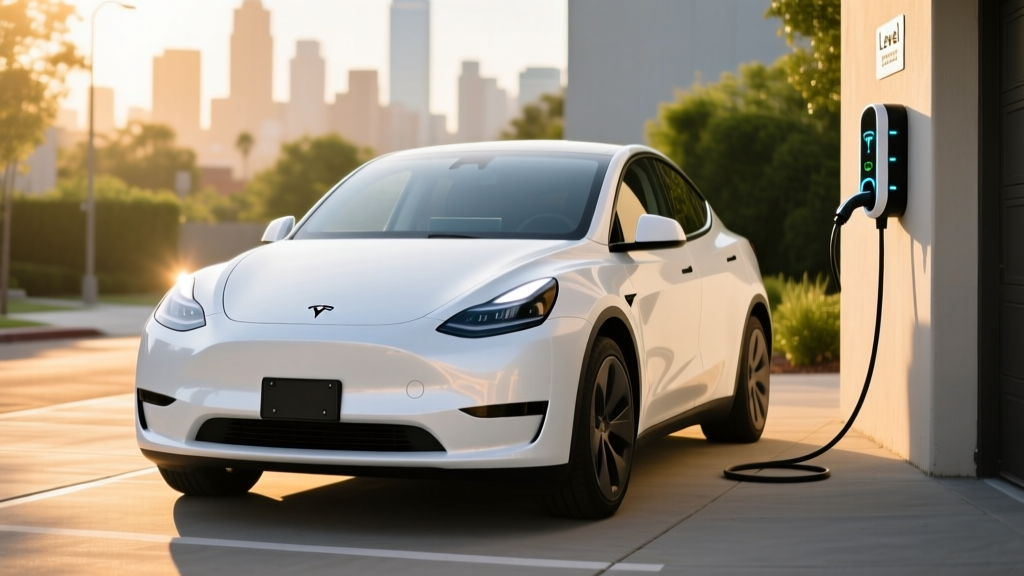
Over 80% of EV charging happens at home. If you have a garage or driveway where a Level 2 (240V) charger can be installed, ownership is seamless. Expect to pay $800–$2,500 for a quality Level 2 unit plus electrician installation, depending on whether your electrical panel needs an upgrade (a 200-amp panel is standard; older homes with 100-amp service may need a $1,500–$3,000 upgrade).
If you live in an apartment or rely on street parking, your experience depends heavily on your local public charging infrastructure. Tesla Superchargers remain the most reliable network, and with the NACS connector now standard across the industry, non-Tesla EVs from Ford, GM, Hyundai, and Rivian can access them using adapters.
Climate and Range Reality
EPA range estimates assume moderate conditions. In real-world use:
- Highway driving at 75+ mph: Expect 10–15% less than EPA range.
- Cold weather (below 32°F): Expect 20–30% range loss without preconditioning, due to cabin heating demands and reduced battery efficiency. EVs with heat pumps (standard on Hyundai Ioniq 5, Tesla Model Y) mitigate this by 5–10%.
- Mixed suburban driving in mild weather: You'll often match or exceed EPA estimates thanks to regenerative braking.
Charging Speed Matters
Not all DC fast charging is equal. A vehicle that peaks at 250 kW but sustains that rate for only 5 minutes before tapering may charge slower overall than one peaking at 180 kW with a flatter charge curve. For reference:
- Hyundai Ioniq 5 (84 kWh, NMC): Peaks at ~240 kW, 10–80% in ~18 minutes on a 350 kW charger — one of the fastest in its class.
- Tesla Model Y Long Range (~75 kWh): Peaks at ~250 kW, 10–80% in ~22 minutes at V3 Superchargers.
- Ford F-150 Lightning (extended range, 131 kWh): Peaks at ~150 kW, 10–80% in ~41 minutes — the large battery trades speed for range (EPA 320 mi).
Decision Framework: Which US-Built EV Is Right for You?
Use this framework to match your situation to the right domestically produced EV:
- Choose Tesla (Model Y or Model 3) if: You want the most reliable DC fast-charging network access, the longest proven track record of US battery manufacturing, and the best software/OTA update experience. Best for tech-forward buyers who drive frequently and road-trip often. Caveat: build quality variability and limited dealer service infrastructure.
- Choose Hyundai Ioniq 5 or Kia EV6 (Georgia-built) if: You want ultra-fast 800V charging architecture, a traditional dealership service experience, and strong §30D eligibility. Best for first-time EV buyers transitioning from gas cars who want a familiar ownership model. The Ioniq 5's heat pump makes it a strong pick for cold-climate buyers.
- Choose Ford F-150 Lightning if: You need a full-size truck for work or towing, want V2H (vehicle-to-home) backup power capability, and value Ford's extensive US dealer network for service. Best for truck buyers who want to eliminate $4,000+/year in fuel costs. Caveat: charging speed is slower than passenger EVs due to the massive battery.
- Choose GM (Equinox EV, Blazer EV, Silverado EV) if: You want the widest range of body styles from a legacy automaker with the largest US factory footprint. GM's Ultium platform offers competitive range (EPA 319 mi on Equinox EV) and a growing domestic battery supply chain through four Ultium Cells joint-venture plants.
- Choose Rivian (R1T, R1S) if: You want a premium adventure-oriented EV built in Illinois with best-in-class off-road capability. Best for outdoors-oriented buyers who can absorb a higher purchase price. Caveat: Rivian does not yet manufacture its own battery cells in the US, relying on external suppliers.
The Bottom Line for American EV Buyers
If your priority is maximizing US manufacturing impact with every dollar, Tesla still leads — its vertical integration from cell production to final assembly is unmatched. But the gap is narrowing. Hyundai's Metaplant America in Savannah represents the most modern purpose-built EV factory in the country, and GM's Ultium Cells network will produce more domestic battery capacity than any competitor once all four plants reach full output.
For buyers, the practical implication is this: more manufacturers building batteries in the US means more models qualifying for the §30D tax credit, which means lower effective prices across the board. When you shop, always verify current credit eligibility on the fueleconomy.gov tax credit lookup tool — sourcing requirements shift as automakers retool supply chains.
Frequently Asked Questions
Does buying a US-built EV guarantee the full $7,500 tax credit?
No. US final assembly is one requirement, but the vehicle must also meet battery-component sourcing thresholds, critical-minerals requirements, MSRP caps ($55,000 for sedans; $80,000 for SUVs, trucks, and vans), and buyer income limits ($150,000 single / $300,000 joint filers). Always confirm eligibility at the point of sale and consult a tax professional. Current rules are published by the IRS.
Are Tesla's US batteries really made in America?
Yes, partially. Tesla produces NCA and NMC cells at its Nevada gigafactory (Panasonic partnership) and has begun LFP cell production at a new line. However, Tesla also sources LFP cells from CATL (China) for certain Model 3 Standard Range variants, which can affect credit eligibility by trim. Always check the specific trim's credit status before purchasing.
Which automaker has the most US EV factory jobs?
Tesla employs approximately 40,000+ workers across its Fremont and Austin vehicle plants plus Nevada and Texas battery operations. GM's EV-related US workforce is growing rapidly across four assembly plants and four battery JVs, estimated at 25,000+ and climbing. Ford's EV division (Model e) employs roughly 10,000 in dedicated EV roles, with additional workers in retooled legacy plants.
If I can't install a home charger, should I still buy an EV?
It depends on your local public charging infrastructure and daily driving distance. If you drive under 40 miles per day and have reliable Level 2 public chargers near your home or workplace, EV ownership is viable. If you live in a charging desert or regularly drive over 200 miles, a PHEV (plug-in hybrid) like the Toyota RAV4 Prime may be a better bridge option — you get 42 miles of electric-only range for daily commuting with a gas engine for longer trips.
Will US-built EVs get cheaper as more battery plants come online?
Likely yes, modestly. Domestic battery production reduces shipping costs, avoids certain tariffs, and qualifies vehicles for tax credits — all of which lower effective prices. However, raw material costs (lithium, nickel, cobalt) remain the dominant price driver. Expect gradual price compression of 3–5% over the next two to three years as supply scales, rather than dramatic price drops.