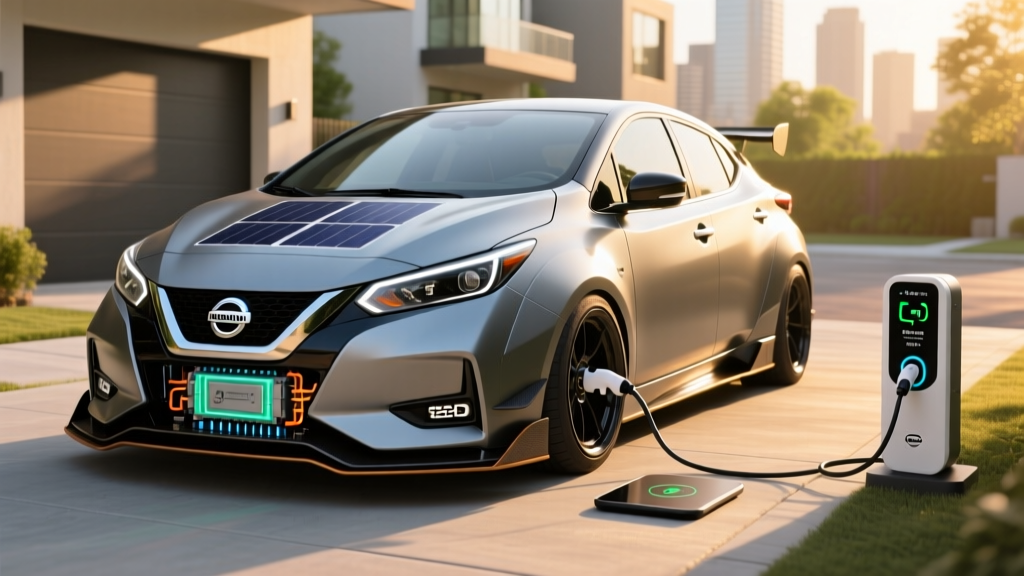
The Nissan Leaf holds a special place in EV history as the world's first mass-market battery-electric vehicle, but as the platform ages into its second decade, a growing community of owners is turning to aftermarket solutions to keep it relevant. The phrase modified Nissan Leaf covers a wide spectrum — from simple software tweaks that unlock hidden battery capacity to full battery-pack transplants and charging-port conversions. In 2026, with Nissan still selling the Leaf in limited markets and a third-generation model on the horizon, the modification scene has matured into a practical ecosystem for owners who want more range, faster charging, and modern connector compatibility without buying a new EV.
This guide breaks down the most common Leaf modifications, what they actually do to your range and charging profile, what the stock 2025–2026 Leaf delivers from the factory, and whether investing in mods makes financial sense versus trading up.
The Stock 2025–2026 Nissan Leaf: Baseline Specs
Before evaluating any modification, you need to understand what Nissan delivers from the factory. The final-generation Leaf (sold through 2025 in the U.S. and continuing in select markets into 2026) comes in two battery configurations:
| Specification | Leaf S (40 kWh) | Leaf SV Plus (62 kWh) |
|---|---|---|
| Usable Battery Capacity | ~38 kWh (NMC) | ~59 kWh (NMC) |
| EPA Estimated Range | 149 miles | 212 miles |
| Motor Output | 110 kW / 147 hp | 160 kW / 214 hp |
| 0–60 mph | ~7.9 seconds | ~6.5 seconds |
| Drivetrain | FWD (single motor) | FWD (single motor) |
| Max DC Fast Charge | 50 kW (CHAdeMO) | 100 kW (CHAdeMO) |
| 10–80% DC Fast Charge | ~45 minutes | ~45 minutes |
| Level 2 Onboard Charger | 6.6 kW | 6.6 kW |
| MPGe (Combined) | 111 MPGe | 104 MPGe |
| Efficiency | 30 kWh/100 mi | 32 kWh/100 mi |
| Cargo Volume | 23.6 cu ft | 23.6 cu ft |
| Rear Legroom | 33.5 in | 33.5 in |
| Base MSRP (2025) | $28,140 | $36,190 |
| Battery Warranty | 8 yr / 100,000 mi | 8 yr / 100,000 mi |
The CHAdeMO Problem: Why Owners Modify
The single biggest motivator for Leaf modification in 2026 is the charging connector. The Leaf remains the last holdout using CHAdeMO for DC fast charging in a market that has decisively moved to NACS (Tesla's North American Charging Standard) and, to a lesser extent, CCS1. As of late 2025, Electrify America has removed most CHAdeMO connectors from new installations, and Tesla Superchargers — the largest fast-charging network — never supported CHAdeMO natively.
This means a stock Leaf owner in 2026 faces a shrinking public charging infrastructure. The modification community has responded with several solutions, each with significant trade-offs.
The CHAdeMO-to-NACS Adapter Route
As of early 2026, no commercially available CHAdeMO-to-NACS adapter exists that safely handles the protocol translation between CHAdeMO's CAN-bus communication and NACS/CCS signaling. CHAdeMO uses a fundamentally different communication protocol than CCS or NACS, making a simple pin adapter impossible. Several companies have announced prototypes, but none have reached production with UL certification.
The Full Charge-Port Swap
Specialist shops — primarily in Europe and Japan, with a handful in North America — offer complete charge-port replacements that swap the CHAdeMO inlet for a CCS2 or NACS inlet. This involves:
- Replacing the physical inlet and wiring harness
- Installing a protocol-conversion module (typically CAN-bus bridge hardware)
- Recalibrating the onboard charger communication
- Cost: $3,000–$5,500 depending on shop and region
These swaps remain gray-market in the U.S. and may affect insurance coverage and crash-safety certifications. Nissan does not endorse or support these modifications.
Battery Modifications: Capacity Upgrades and Replacements
The Leaf's battery is the second major modification target. Nissan's NMC (nickel-manganese-cobalt) chemistry degrades noticeably over time — early 24 kWh Leafs routinely show 20–30% capacity loss after 8–10 years, and even the 62 kWh packs show measurable degradation by year 5 in hot climates due to the Leaf's passive (air-cooled) thermal management system.
Option 1: OEM Battery Replacement
Nissan offers official battery replacements through certified dealers:
- 40 kWh replacement: ~$6,500–$8,500 (parts and labor)
- 62 kWh replacement: ~$9,000–$12,000 (parts and labor)
This restores the vehicle to factory specification but does not increase capacity beyond original design.
Option 2: Aftermarket Battery Pack Upgrade
Companies like Muxsan (Netherlands) and independent EV shops offer battery upgrade kits that replace the original modules with higher-capacity cells. Common upgrade paths:
- 24 kWh → 40 kWh (using newer Nissan modules)
- 30 kWh → 40 kWh or 62 kWh
- 40 kWh → 62 kWh (the most popular upgrade for SV-trim owners)
Costs range from $4,500 to $9,000 depending on the upgrade path and whether refurbished or new modules are used. These upgrades can restore or exceed original range, but they require specialized tools, CAN-bus reprogramming, and carry no factory warranty.
Option 3: Cell-Level Module Replacement
For owners with degraded packs, replacing individual degraded modules (rather than the entire pack) costs $1,500–$3,500 but requires identifying which specific modules have failed using Leaf Spy Pro or similar diagnostic tools. This is the most cost-effective option for moderate degradation but requires significant DIY skill or a specialist shop.
Software Modifications: Leaf Spy and BMS Tweaks
The most accessible entry point into the modified Nissan Leaf world is software. The Leaf's Battery Management System (BMS) logs detailed health data that Nissan's factory infotainment doesn't surface. The community-standard tools:
Leaf Spy Pro
This OBD-II diagnostic app (paired with a compatible Bluetooth dongle, ~$30–$50) reads:
- Individual cell voltages and temperature differentials
- State of Health (SoH) percentage — the single most important metric for used Leaf buyers
- Actual usable kWh vs. factory capacity
- Charge/discharge cycle count
- DC fast-charge count (a degradation indicator)
BMS Reset / Capacity Recalibration
After a battery replacement or module swap, the BMS must be recalibrated to recognize the new capacity. Specialist tools like the Leaf BMS Reset Tool (~$200–$400) or services offered by EV shops can perform this recalibration. Without it, the car's range estimator (the "Guess-O-Meter") and charge-limit logic will operate on outdated capacity data.
Performance Software Tweaks
Unlike ICE vehicles, the Leaf's motor controller is not commonly remapped for power gains. The 160 kW motor in the SV Plus is already near its thermal limit given the passive cooling system. Attempting to push more power risks motor overheating and inverter failure. The modification community generally advises against performance ECU tunes for the Leaf.
Charging Speed After Modifications
| Parameter | Stock Leaf SV Plus | After CCS/NACS Port Swap |
|---|---|---|
| Max DC Fast Charge Rate | 100 kW (CHAdeMO) | 100 kW (protocol-limited) |
| Peak Sustained Rate (10–50%) | ~70–85 kW | ~70–85 kW |
| 10–80% DC Charge Time | ~45 minutes | ~45 minutes |
| Charge Taper Above 80% | Drops to ~20 kW | Drops to ~20 kW |
| Level 2 Home Charging | 6.6 kW (~22 mi/hr) | 6.6 kW (~22 mi/hr) |
| Level 1 (120V) Trickle | 1.4 kW (~4 mi/hr) | 1.4 kW (~4 mi/hr) |
| Network Access | CHAdeMO stations (shrinking) | CCS/NACS networks (expanding) |
The critical insight: a charge-port swap does not make the Leaf charge faster. The Leaf's DC fast-charging bottleneck is its battery thermal management, not the connector. The passively cooled NMC pack heats up during fast charging, and the BMS throttles charge speed to protect the cells. This is why the Leaf's 10–80% time remains around 45 minutes regardless of connector type — and why sequential fast charges ("Rapidgate") see progressively slower speeds as pack temperature rises.
Cost-Benefit Analysis: Modify vs. Replace
| Scenario | Estimated Cost | Resulting Range | Charging Network Access |
|---|---|---|---|
| Keep stock 2018 Leaf (62 kWh, degraded 15%) | $0 | ~180 mi real-world | CHAdeMO only |
| Battery module refresh + Leaf Spy | $2,500–$4,000 | ~200 mi real-world | CHAdeMO only |
| Full 62 kWh OEM battery replacement | $9,000–$12,000 | ~212 mi EPA | CHAdeMO only |
| CCS/NACS port swap (no battery work) | $3,000–$5,500 | No change | Modern networks |
| Battery refresh + port swap | $6,000–$9,000 | ~200 mi + modern access | Modern networks |
| Trade in for 2026 Hyundai Ioniq 5 (base) | $38,000–$42,000 (after credit) | 303 mi EPA | NACS, 10–80% in 18 min |
| Trade in for 2026 Chevy Equinox EV (base) | $28,000–$33,000 (after credit) | 319 mi EPA | NACS/CCS, 10–80% in ~30 min |
The math gets complicated when you factor in the federal EV tax credit under IRS §30D. A new EV purchase may qualify for up to $7,500 (subject to MSRP caps of $55,000 for cars, buyer income limits of $150,000 single / $300,000 joint, and battery critical-mineral sourcing requirements). That credit makes a new Equinox EV or Ioniq 5 significantly more competitive against sinking $6,000–$9,000 into a decade-old platform.
However, for owners who paid off their Leaf long ago, have home Level 2 charging, and drive primarily in urban areas with modest daily mileage, a $2,500–$4,000 battery refresh extends a reliable commuter car for 5+ more years at a fraction of new-car costs.
Federal Tax Credit and Modified Leafs
- New EVs: Up to $7,500 credit; vehicle MSRP must be ≤$55,000 (cars) or ≤$80,000 (SUVs/trucks); buyer AGI ≤$150K single / $300K joint
- Used EVs: Up to $4,000 or 30% of sale price (whichever is less); vehicle must be ≤$25,000; buyer AGI ≤$75K single / $150K joint
- Battery sourcing: Increasingly strict critical-mineral and battery-component requirements from designated trade partners
- Point-of-sale transfer: Eligible buyers can transfer the credit to the dealer for an immediate price reduction
Critical for Leaf modifiers: Battery replacements and charge-port swaps do NOT qualify for any federal tax credit. The §30D credit applies only to the purchase of a new or used qualifying EV, not to aftermarket parts or service. Some states offer separate incentives for EV battery replacement — check your state energy office. Consult a tax professional for your specific eligibility.
Who Should Modify a Nissan Leaf — and Who Shouldn't
Modify Your Leaf If:
- You own a 2016–2023 Leaf outright and it's paid off
- Your daily commute is under 80 miles round-trip
- You have reliable home Level 2 charging
- You live in a market with remaining CHAdeMO infrastructure or rarely road-trip
- A $3,000–$5,000 investment keeps you out of a $35,000+ new car payment
- You're comfortable with DIY diagnostics (Leaf Spy) or have a trusted EV shop
Don't Modify — Buy New If:
- You rely on public DC fast charging for weekly road trips
- Your Leaf's SoH is below 70% and you need a full pack replacement ($9K+)
- You qualify for the full $7,500 federal credit on a new EV
- You need 250+ miles of real-world range
- You want modern ADAS features (the Leaf's ProPILOT Assist is a generation behind)
- You want warranty coverage on your battery investment
Pros and Cons of the Modified Nissan Leaf
Pros
- Battery refresh for $2,500–$4,000 restores 5+ years of commuter use
- Leaf Spy gives unprecedented battery transparency vs. any stock EV
- Proven, simple platform — easy to work on compared to newer EV architectures
- Enormous community knowledge base (mynissanleaf.com, SpeakEV forums)
- Low total cost of ownership when purchased used and refreshed
- 62 kWh pack's 212 EPA miles remains adequate for most daily driving
Cons
- CHAdeMO charging standard is effectively dead in North America
- Passive air cooling causes Rapidgate on sequential fast charges
- No heat pump — severe range loss in cold weather (25–35% drop)
- Port-swap mods are gray-market, may void insurance and safety certifications
- No LFP battery option — NMC degradation continues without active thermal management
- 100 kW peak DC charge rate is slow vs. 2026 standards (250–350 kW common)
- ProPILOT Assist is basic Level 2 — no lane-change assist or advanced ADAS
Frequently Asked Questions
What is the real-world range of a modified Nissan Leaf?
A 62 kWh Leaf SV Plus with a refreshed battery (SoH above 95%) delivers the EPA-rated 212 miles in mixed city/highway driving. In real-world highway use at 70 mph, expect 170–190 miles. In freezing temperatures, that drops to 140–160 miles. A 40 kWh Leaf with refreshed modules delivers roughly 135–149 miles mixed, 110–125 highway.
How fast does a modified Leaf charge at home and on DC fast chargers?
Home Level 2 charging at 6.6 kW adds roughly 22 miles per hour — a full charge from 10% takes about 9–10 hours on the 62 kWh model. DC fast charging peaks at 100 kW on the SV Plus (50 kW on the 40 kWh), but sustained rates average 70–85 kW from 10–50%, tapering significantly above 80%. A 10–80% session takes approximately 45 minutes regardless of connector type.
Does a modified Nissan Leaf qualify for the federal EV tax credit?
No. Battery replacements, charge-port swaps, and other aftermarket modifications do not qualify for the IRS §30D federal EV tax credit. That credit applies only to the purchase of qualifying new or used EVs. However, if you trade in your modified Leaf toward a new qualifying EV, you may be eligible for up to $7,500 depending on the new vehicle's MSRP, your income, and battery-sourcing requirements. Always verify current rules at irs.gov and consult a tax professional.
Is it worth modifying a Leaf versus buying a new EV?
It depends on your budget and use case. A $3,000–$5,000 battery refresh on a paid-off Leaf is the most cost-effective way to maintain a reliable EV commuter for 5+ more years. But if you need fast-charging access for road trips, modern ADAS, 300+ mile range, or warranty protection, a new EV like the Chevy Equinox EV (~$33,000 after federal credit) or Hyundai Ioniq 5 (~$38,000 after credit) offers a dramatically better ownership experience.
Can I convert my Leaf's CHAdeMO port to NACS or CCS?
Technically yes, through specialist shops that perform full charge-port swaps with protocol-conversion hardware, at a cost of $3,000–$5,500. However, these modifications are not OEM-approved, may affect vehicle insurance and safety certification, and do not increase charging speed (the Leaf's battery thermal management remains the bottleneck). No plug-and-play CHAdeMO-to-NACS adapter exists as of 2026.
How do I check my Leaf's battery health before modifying?
Use Leaf Spy Pro with an OBD-II Bluetooth dongle to read your battery's State of Health (SoH) percentage. An SoH above 85% means the pack is in good shape and may only need individual module replacement. Below 70% SoH, a full pack replacement or upgrade is typically more cost-effective. Also check the number of DC fast-charge sessions logged — higher counts correlate with accelerated degradation on the Leaf's passively cooled battery.
Sources: EPA Fuel Economy — Nissan Leaf, IRS §30D EV Tax Credit, NHTSA — Nissan Leaf Safety Ratings