The Tesla Model Y Performance has long occupied a specific niche in the EV market: a practical, dual-motor crossover that happens to accelerate like a sports car. For 2026, Tesla continues to refine the platform with the Juniper refresh, tightening panel gaps, upgrading the interior, and tweaking efficiency. But the headline number remains the same — a blistering 0-60 mph time of 3.5 seconds in a five-seat SUV that can still haul groceries, kids, and weekend gear.
This review puts the 2026 Model Y Performance under the microscope: real-world range versus the EPA sticker, actual DC fast-charging behavior (not just peak kW), tax-credit eligibility under current IRS §30D rules, and whether it still earns its premium over competitors like the Hyundai Ioniq 5 N and Ford Mustang Mach-E GT.
2026 Tesla Model Y Performance: Core Specifications
| Spec | Value |
|---|---|
| EPA Range | 280 miles |
| Battery (usable) | ~79 kWh, NMC chemistry |
| Drivetrain | Dual-motor AWD |
| Horsepower | ~456 hp (combined) |
| 0-60 mph | 3.5 seconds |
| Top Speed | 155 mph |
| Max DC Fast Charge | 250 kW (peak) |
| 10-80% DC Fast Charge | ~25 minutes |
| Level 2 Home Charge (11.5 kW) | ~44 mi/hr |
| Efficiency (EPA) | 111 MPGe / 30 kWh/100mi |
| Cargo (rear seats up) | 30.2 cu ft |
| Cargo (rear seats folded) | 72.1 cu ft |
| Frunk | 4.1 cu ft |
| Base MSRP | $52,490 (before destination) |
| Battery Warranty | 8 years / 120,000 miles |
| Basic Warranty | 4 years / 50,000 miles |
Real-World Range: What the EPA Sticker Doesn't Tell You
The 2026 Model Y Performance carries an EPA-estimated range of 280 miles, down from the Long Range variant's 320+ miles. The deficit comes from stickier performance tires, a more aggressive drive calibration, and slightly heavier components. But EPA numbers are generated under controlled laboratory conditions — real-world results depend heavily on how and where you drive.
- City / mixed commuting (55-65°F): 265-280 mi — regen braking helps recover energy in stop-and-go traffic.
- Highway cruising (70-75 mph, 65°F): 235-255 mi — aerodynamic drag dominates at speed; efficiency drops to roughly 33-35 kWh/100mi.
- Cold weather (20-30°F, highway): 195-220 mi — battery resistance increases, cabin heating draws power. The heat pump helps, but expect 20-30% range loss.
- Hot weather (95°F+, A/C max): 245-265 mi — thermal management and cabin cooling reduce efficiency modestly.
Source: fueleconomy.gov EPA data, combined with independent real-world highway testing.
The Model Y Performance uses a nickel-manganese-cobalt (NMC) battery pack with approximately 79 kWh of usable capacity. NMC chemistry offers higher energy density than LFP (lithium iron phosphate), which is why Tesla reserves it for Long Range and Performance variants. The trade-off: Tesla recommends daily charging to 80-90% to preserve long-term cell health, whereas LFP packs can be charged to 100% daily without concern. For a Performance buyer, this means your practical daily range is closer to 225-250 miles at 80-90% state of charge.
Charging Speed: DC Fast, Level 2, and the Charge-Curve Reality
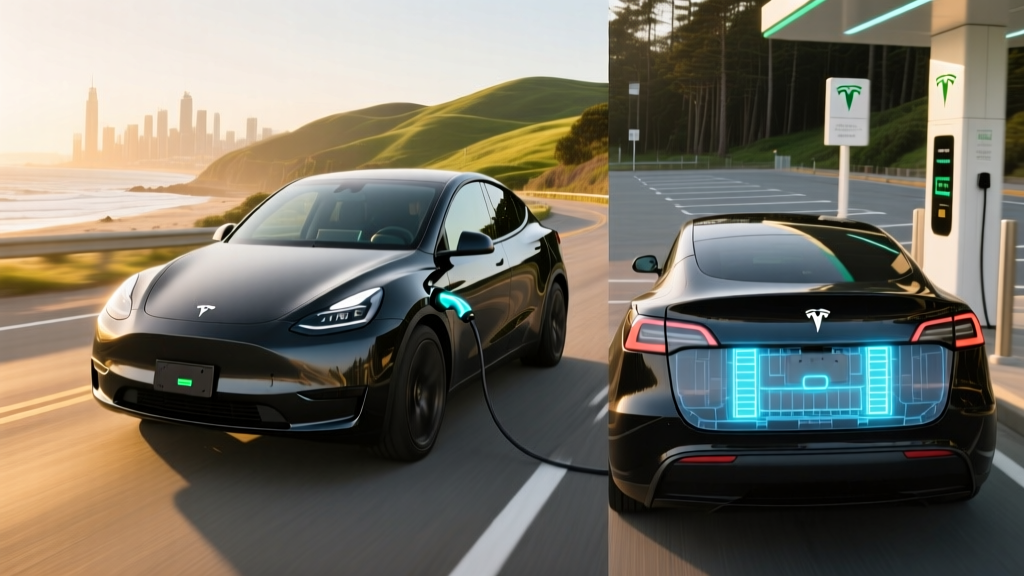
Charging speed is where the Model Y's 250 kW peak rate needs context. Like every EV, the Performance variant does not sustain peak power for the entire session. The charge curve tapers significantly as the battery fills, and temperature plays a major role.
| Charging Method | Power (kW) | Speed | Notes |
|---|---|---|---|
| DC Fast (Tesla Supercharger V3/V4) | Up to 250 kW peak | ~160 mi in 15 min (10-50%); 10-80% in ~25 min | Peak only at low SoC and optimal battery temp; tapers sharply above 60% |
| DC Fast (CCS adapter, EA/others) | Up to 250 kW peak | Similar to Supercharger, network-dependent | Tesla includes CCS adapter; third-party networks vary in reliability |
| Level 2 (Tesla Wall Connector, 48A) | 11.5 kW | ~44 mi/hr; full charge in ~7-8 hr | Requires 60A circuit; ideal for overnight |
| Level 2 (generic J1772 w/ NACS adapter) | Up to 11.5 kW | ~44 mi/hr (if charger supports 48A) | Many public L2 stations are 7.2 kW (~30 mi/hr) |
| Level 1 (120V household) | ~1.4 kW | ~3-4 mi/hr | Emergency/trickle only; ~80+ hr for full charge |
The charge-curve reality: On a V3 Supercharger with a preconditioned battery, the Model Y Performance will pull close to 250 kW between roughly 10-30% state of charge. From 30-60%, expect 150-180 kW. Above 60%, the rate tapers to under 100 kW, and above 80% it drops below 50 kW. This is why Tesla's navigation system routes you to arrive at chargers with a preconditioned battery — without preconditioning, cold-soaked batteries can cut peak charge rates by 40-50%.
For home charging, the Tesla Wall Connector at 48 amps (11.5 kW) adds roughly 44 miles of range per hour, meaning a full 10-100% charge takes about 7-8 hours. This requires a dedicated 60-amp circuit and a 240V outlet or hardwired connection. Budget $500-$1,500 for professional installation depending on your panel capacity and run length — a 200-amp electrical panel upgrade can add $1,500-$3,000 if your home needs one.
Performance: The 3.5-Second 0-60 and What It Feels Like
The Tesla Model Y Performance 0-60 time of 3.5 seconds is achieved through a dual-motor all-wheel-drive layout producing approximately 456 combined horsepower. The front induction motor handles efficiency and regenerative braking duties, while the rear permanent-magnet motor delivers the thrust. Tesla's traction control software modulates torque between axles in milliseconds, which is how a 4,400-lb SUV launches without drama.
In practice, the instant torque delivery makes the Model Y Performance feel quicker than its 3.5-second number suggests — there's no transmission lag, no turbo spool-up. The car hits 30 mph in roughly 1.5 seconds, and the shove in your back doesn't let up until about 80 mph, where the single-speed reduction gearing starts to feel its limits. Track Mode (available on the Performance trim) adjusts stability control, regen, and torque distribution for closed-course driving, though this is a crossover, not a track car.
Compared to key rivals: the Hyundai Ioniq 5 N does 0-60 in 3.4 seconds with a more engaging chassis, while the Ford Mustang Mach-E GT Performance Edition clocks 3.5 seconds but with a heavier, less refined feel. The Model Y's advantage is that it delivers this performance while maintaining best-in-class efficiency and access to the Supercharger network.
Pricing, Trims, and Federal Tax Credit Eligibility
The 2026 Model Y Performance starts at a base MSRP of $52,490 (before the $1,390 destination fee), placing the total at $53,880. Tesla rarely offers traditional trim levels — instead, you select paint color, wheels, and interior, then optionally add Enhanced Autopilot ($6,000) or Full Self-Driving Supervised ($8,000).
| Configuration | MSRP | Est. Federal Credit | Effective Price |
|---|---|---|---|
| Performance (base, white paint, 19" wheels) | $53,880 | Up to $7,500* | ~$46,380 |
| Performance + red paint + 21" Überturbine wheels | $57,380 | Up to $7,500* | ~$49,880 |
| Performance + FSD Supervised | $61,880 | Up to $7,500* | ~$54,380 |
*Federal tax credit eligibility under IRS §30D is subject to multiple requirements. As of 2026, the key rules include:
- MSRP cap: SUVs/crossovers must have an MSRP at or below $80,000 — the Model Y Performance qualifies.
- Buyer income cap: Modified adjusted gross income must not exceed $150,000 (single), $225,000 (head of household), or $300,000 (married filing jointly).
- Battery sourcing: The full $7,500 credit requires meeting both critical-mineral and battery-component sourcing thresholds, which have tightened annually. Tesla has worked to onshore supply chains, but the exact credit amount ($3,750 or $7,500) can change based on current IRS guidance.
- Point-of-sale transfer: Since 2024, buyers can transfer the credit to the dealer at purchase, reducing the upfront cost rather than waiting for a tax refund.
Check the latest eligibility details on IRS.gov §30D before purchasing, as battery-sourcing rules are updated periodically.
Interior, Tech, and Driver Assistance
The Juniper-refreshed Model Y interior is noticeably improved over pre-2025 models. Soft-touch materials replace hard plastics on the dashboard and door panels, ambient lighting is standard, and the 15.4-inch center touchscreen runs an updated version of Tesla's infotainment OS. Rear passengers now get an 8-inch touchscreen for climate and entertainment control — a welcome addition for family duty.
Standard tech highlights:
- 15.4" front touchscreen with navigation, streaming, and gaming
- 8" rear touchscreen for climate and media
- Premium 17-speaker audio with immersive sound
- Ventilated front seats, heated rear seats
- Power-folding second row, panoramic glass roof
- HEPA air filtration with Bioweapon Defense Mode
- Over-the-air software updates
Driver assistance: Basic Autopilot (traffic-aware cruise control and lane centering) comes standard. Enhanced Autopilot ($6,000) adds automatic lane changes, navigate-on-autopilot, and smart summon. Full Self-Driving Supervised ($8,000) adds traffic-light and stop-sign recognition with city-street autosteer.
All Tesla driver-assist features, including FSD Supervised, are classified as SAE Level 2 automation. This means the driver must remain fully attentive, keep hands on or near the wheel, and be prepared to take over at any moment. Tesla's cabin camera monitors driver engagement. This is fundamentally different from SAE Level 4 robotaxi services like Waymo, which operate without a human driver in geofenced areas.
Who Should Buy the Model Y Performance?
- You want sports-sedan acceleration in a practical family crossover
- You take frequent road trips and value the Supercharger network
- You need 280+ miles of range with optional DC fast-charging at 250 kW
- You prioritize over-the-air updates and a minimal, tech-forward cabin
- You want a more engaging, driver-focused chassis (look at the Ioniq 5 N)
- You need physical buttons and a traditional instrument cluster
- You prefer Apple CarPlay/Android Auto (not available in Tesla)
- You want a longer warranty — Hyundai offers 10-year/100,000-mi battery coverage
The Model Y Performance is best suited for performance-oriented commuters and active families who regularly drive 30-80 miles daily and take 2-4 road trips per year. With 30.2 cu ft of cargo space behind the second row (72.1 cu ft folded) plus the 4.1 cu ft frunk, it handles strollers, ski gear, and Costco runs without breaking a sweat. Towing capacity is rated at 3,500 lbs — adequate for a small utility trailer or a pair of dirt bikes, but not a boat.
Pros and Cons
- 3.5-second 0-60 mph in a practical 5-seat SUV
- Access to the 60,000+ stall Tesla Supercharger network
- Best-in-class efficiency at 111 MPGe
- Over-the-air updates continuously add features
- Spacious cargo area (72.1 cu ft) + frunk
- Strong resale value relative to EV competitors
- 280-mi EPA range trails the Long Range variant by 40+ miles
- No Apple CarPlay or Android Auto
- FSD Supervised costs $8,000 and remains Level 2
- Ride quality is firm on 21" Überturbine wheels
- NMC battery recommends 80-90% daily charge limit
- Limited service center availability in some regions
Frequently Asked Questions
What is the real-world range of the 2026 Model Y Performance?
Expect 235-255 miles on the highway in mild weather, 265-280 miles in city driving, and as low as 195-220 miles in cold weather (20-30°F) at highway speeds. The EPA sticker says 280 miles, but highway driving and temperature significantly impact real-world results.
How fast does the Model Y Performance charge at home and on the road?
On a Tesla V3/V4 Supercharger, it peaks at 250 kW and charges from 10-80% in approximately 25 minutes with a preconditioned battery. At home on a Level 2 Wall Connector (11.5 kW / 48A), it adds about 44 miles per hour, reaching a full charge overnight in 7-8 hours.
Does the 2026 Model Y Performance qualify for the $7,500 federal tax credit?
It can, but eligibility depends on your income (≤$300,000 MFJ), the vehicle's MSRP (must be ≤$80,000 for SUVs — it qualifies), and current battery-sourcing requirements under IRS §30D. The credit amount may be $3,750 or $7,500 depending on critical-mineral and component sourcing rules in effect at purchase. Verify on IRS.gov before buying.
Is the Model Y Performance worth it over the Long Range?
If you value the 3.5-second 0-60 and track mode, yes. If range is your priority, the Long Range AWD gives you 320+ EPA miles for less money and nearly identical daily usability. The Performance trim costs roughly $5,000 more and sacrifices about 40 miles of range for the acceleration advantage and performance brakes.
What is the battery warranty on the Model Y Performance?
Tesla covers the battery and drive unit for 8 years or 120,000 miles, whichever comes first, with a minimum 70% capacity retention guarantee. If degradation drops below 70% within the warranty period, Tesla will repair or replace the pack at no cost.
How does the Model Y Performance compare to the Hyundai Ioniq 5 N?
The Ioniq 5 N matches the 0-60 time (3.4s) and offers a more engaging, sport-tuned chassis with simulated gear shifts and a 10-year/100,000-mile battery warranty. However, the Model Y Performance wins on efficiency (111 MPGe vs ~97 MPGe), Supercharger network access, and cargo space. Choose the Ioniq 5 N for driving fun; choose the Model Y for daily practicality and road-trip charging ease.