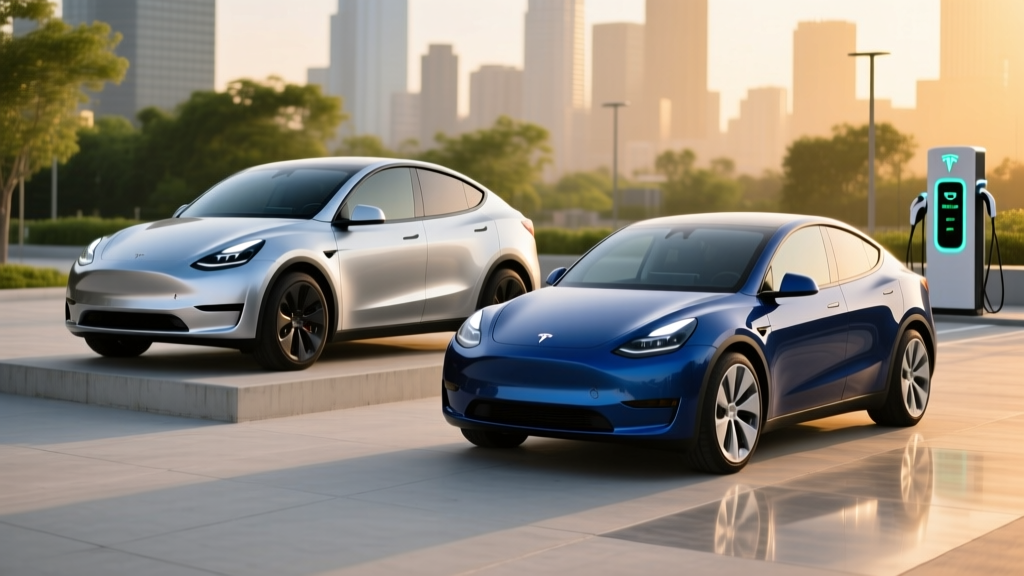
Tesla's two volume sellers — the Model 3 sedan and Model Y crossover — share a platform, a powertrain philosophy, and a Supercharger ecosystem. But for buyers in 2026, the differences in cargo space, ride height, pricing, and real-world highway range matter far more than the spec sheet suggests. If you've been searching "model y or model 3," this is the data-driven breakdown you need.
Below, we reconcile Tesla's EPA sticker numbers with what you'll actually see on a road trip, map out exactly how fast each charges on DC fast-charging and at home, and walk through the IRS §30D federal tax credit rules that determine whether you'll save $7,500 at the point of sale — or nothing at all.
Side-by-Side Spec Table: Model 3 vs Model Y (2026)
| Spec | Model 3 Long Range AWD | Model Y Long Range AWD |
|---|---|---|
| EPA Range | 363 mi | 327 mi |
| Battery (usable / chemistry) | ~75 kWh / NMC (CATL LG) | ~75 kWh / NMC |
| Efficiency | 132 MPGe (25 kWh/100 mi) | 122 MPGe (28 kWh/100 mi) |
| Max DC Fast Charge | 250 kW (peak) | 250 kW (peak) |
| 10–80% DCFC Time | ~25 min | ~27 min |
| Level 2 Home Charge (48A) | 11.5 kW (~44 mi/hr) | 11.5 kW (~39 mi/hr) |
| 0–60 mph | 4.2 sec | 4.8 sec |
| Horsepower | ~346 hp (dual-motor) | ~384 hp (dual-motor) |
| Drivetrain | AWD (dual-motor) | AWD (dual-motor) |
| Cargo (rear seats up / folded) | 23 cu ft / 64 cu ft | 34 cu ft / 76 cu ft |
| Rear Legroom | 35.3 in | 37.0 in |
| Base MSRP | $47,740 | $50,630 |
| Battery Warranty | 8 yr / 120,000 mi | 8 yr / 120,000 mi |
Real-World Range: What the EPA Sticker Doesn't Tell You
The Model 3's aerodynamic sedan profile gives it a measurable edge at highway speed. The Model Y's taller, bluff-body crossover shape creates more drag above 65 mph, which is why its EPA figure drops 36 miles despite sharing a nearly identical battery pack. According to fueleconomy.gov, the Model 3 Long Range achieves 132 MPGe combined versus 122 MPGe for the Model Y Long Range.
For city-heavy commuters who do most driving under 45 mph, the gap narrows considerably. Regenerative braking recovers more energy in stop-and-go traffic, and both vehicles will approach their EPA combined figures in urban use. The range penalty is almost entirely a highway-speed and cold-weather story.
Charging Speed: DC Fast, Level 2, and the Charge Curve
| Charging Level | Model 3 Long Range | Model Y Long Range |
|---|---|---|
| Level 1 (120V / 12A) | ~1.4 kW (~4 mi/hr) | ~1.4 kW (~3.5 mi/hr) |
| Level 2 (240V / 48A) | 11.5 kW (~44 mi/hr) | 11.5 kW (~39 mi/hr) |
| DC Fast Charge (peak) | 250 kW (CCS/NACS) | 250 kW (CCS/NACS) |
| DC 10–80% Time | ~25 minutes | ~27 minutes |
| DC 10–50% Time | ~14 minutes | ~15 minutes |
Both vehicles peak at 250 kW on a V3 Tesla Supercharger or any compatible CCS/NACS DC fast charger. But peak kW is not sustained kW — and this is where buyers get misled by marketing. The charge curve holds near 250 kW only between roughly 10% and 30% state of charge. By 50% SoC, the rate tapers to approximately 150 kW; by 80%, it drops below 60 kW. This is standard for NMC lithium-ion chemistry and thermal management limits.
Practical takeaway: On a road trip, plan stops around the 10–80% window. Charging from 80% to 100% at a DC fast charger can take as long as the 10–80% session — it's only worth it if you're about to leave the charger for the night. Preconditioning the battery (the car does this automatically when you navigate to a Supercharger) is essential for hitting peak charge rates; arriving at a fast charger with a cold battery can cut your charge speed in half.
For home charging, a 48-amp Level 2 wall connector on a 60-amp circuit delivers 11.5 kW to both vehicles. That's roughly 44 miles of range per hour for the Model 3 and 39 miles per hour for the Model Y. A full overnight session (8 hours) adds 310–350 miles — enough to replenish either battery completely. Installation of a 240V/60A circuit typically runs $800–$2,000 depending on panel proximity and local permitting. (Have a licensed electrician confirm your panel's spare capacity before committing to a 60A circuit.)
Pricing, Trims, and the 2026 Federal Tax Credit
| Trim | MSRP | §30D Credit Eligibility | Effective Price (if eligible) |
|---|---|---|---|
| Model 3 Long Range AWD | $47,740 | Likely eligible (under $55K cap) | ~$40,240 |
| Model 3 Performance | $54,990 | Likely eligible (under $55K cap) | ~$47,490 |
| Model Y Long Range AWD | $50,630 | Likely eligible (under $80K SUV cap) | ~$43,130 |
| Model Y Performance | $54,490 | Likely eligible (under $80K SUV cap) | ~$46,990 |
The IRS §30D clean vehicle credit offers up to $7,500, but eligibility hinges on three moving targets that change annually. As of 2026, the key rules — per irs.gov — are:
- MSRP cap: Sedans (Model 3) must be under $55,000; SUVs/trucks/vans (Model Y) must be under $80,000. All current Model 3 and Model Y trims fall under their respective caps.
- Buyer income cap: Modified adjusted gross income must not exceed $150,000 (single), $225,000 (head of household), or $300,000 (joint filers).
- Battery sourcing: A percentage of critical minerals and battery components must be sourced from the U.S. or FTA-partner countries. Tesla's North American battery supply chain has improved compliance, but specific VIN-level eligibility can shift — always verify via the IRS VIN-check tool or your dealer before purchase.
- Point-of-sale transfer: You can transfer the credit to the dealer at purchase, reducing your out-of-pocket cost immediately rather than waiting for tax filing.
Important: Consult a tax professional before relying on the credit. Sourcing requirements have tightened annually since the Inflation Reduction Act, and a vehicle eligible in January may not be in December if supply chains shift.
Performance, Efficiency, and Daily Drivability
The Model 3 Long Range AWD hits 60 mph in 4.2 seconds with roughly 346 combined horsepower from its dual-motor setup. The Model Y Long Range, despite weighing about 300 pounds more and producing slightly more power (~384 hp), takes 4.8 seconds to 60 — still briskly quick for a family crossover.
Where the Model 3 separates itself is efficiency. At 25 kWh per 100 miles (combined), it's one of the most efficient EVs in its class. The Model Y consumes 28 kWh/100 mi — a 12% penalty that compounds on road trips. Over 15,000 miles of annual driving at the U.S. average electricity rate of ~$0.17/kWh, the Model 3 costs roughly $638 per year to charge at home versus $714 for the Model Y. Compared to a 28-mpg gas sedan at $3.40/gallon, both save $1,100–$1,200 annually in fuel.
Ride quality has improved on the refreshed Model 3 (post-2024 "Highland" update), with better sound insulation and more compliant suspension tuning. The Model Y received its own "Juniper" refresh with similar improvements. Both now ride more comfortably than pre-2024 versions, though the Model 3's lower center of gravity and lighter weight give it a sportier feel through corners.
Cargo, Passenger Space, and Practicality
This is where the model y or model 3 decision usually crystallizes:
- Model 3: 23 cu ft trunk (rear seats up), 64 cu ft with seats folded. Rear legroom is 35.3 inches — adequate for adults on shorter trips but snug for tall passengers on long drives. The trunk opening is a conventional sedan lid, limiting what you can load.
- Model Y: 34 cu ft behind the second row, 76 cu ft with seats folded. The hatchback opening is wide and tall — you can load a full-size bicycle without removing the front wheel. Rear legroom is 37.0 inches. An optional third row (small, best for children under 5'4") adds seating for seven at a ~$3,000 premium.
If you regularly carry rear-seat passengers, haul bulky cargo, or want the option of a small third row, the Model Y's crossover packaging wins decisively. If you commute solo or with one passenger and prioritize driving dynamics and efficiency, the Model 3 is the sharper tool.
Tech, Driver Assistance, and Warranty
Both vehicles share Tesla's 15.4-inch center touchscreen running the same software stack: navigation, streaming, over-the-air updates, and the Tesla app ecosystem. There is no traditional instrument cluster; all driving information lives on the center screen.
FSD (Supervised) remains a $8,000 add-on (or $99/month subscription as of 2026). It adds automatic lane changes, traffic-light and stop-sign recognition, and enhanced navigate-on-autopilot. Real-world performance varies widely by geography and road complexity — it excels on well-marked highways but can struggle in construction zones, unmapped areas, and adverse weather.
Tesla's warranty covers the battery and drive unit for 8 years or 120,000 miles (whichever comes first) on Long Range models, with a minimum 70% capacity retention threshold. The basic vehicle limited warranty is 4 years / 50,000 miles. According to NHTSA, both vehicles have earned 5-star overall safety ratings in recent model years.
Pros, Cons, and the Decision Framework
Model 3 — Pros
- Best-in-class efficiency (25 kWh/100 mi)
- Longest EPA range in the Tesla lineup (363 mi)
- Lower starting price ($47,740)
- Sharper handling, lighter feel
- Faster DC charging per mile added
Model 3 — Cons
- Tight rear legroom (35.3 in)
- Sedan trunk limits cargo versatility
- No third-row or hatchback option
- Less headroom for tall rear passengers
Model Y — Pros
- 34 cu ft cargo (76 cu ft folded) — hatchback versatility
- Generous rear legroom (37.0 in)
- Optional third-row seating
- Higher ride height, easier entry/exit
- Better visibility from elevated seating position
Model Y — Cons
- Lower EPA range (327 mi) and efficiency
- ~$2,900 higher starting price
- Heavier, less engaging to drive
- Higher charging cost per mile
Decision Framework: Model Y or Model 3?
Choose the Model 3 if: You commute solo or with one passenger, prioritize maximum range and efficiency, want the lowest price, and rarely haul bulky cargo. It's the efficiency champion and the better road-trip EV for two.
Choose the Model Y if: You have kids or regularly carry rear-seat adults, need hatchback cargo versatility, want the option of a third row, or prefer a higher seating position. It's the family hauler and the more practical daily driver for households.
Frequently Asked Questions
What is the real-world range of the Model 3 and Model Y?
The Model 3 Long Range delivers approximately 300–320 miles on a highway trip in mild weather; the Model Y Long Range, about 275–295 miles. In freezing cold, subtract 15–25%. City driving with regenerative braking will get you closer to the EPA combined figures of 363 and 327 miles, respectively.
How fast do they charge at home and on the road?
Both peak at 250 kW on DC fast chargers, adding roughly 200 miles in 15 minutes (10–50% SoC). A full 10–80% session takes about 25–27 minutes. At home on a 48-amp Level 2 charger, expect 39–44 miles of range per hour — a full charge overnight.
Does the Model 3 or Model Y qualify for the $7,500 federal tax credit?
As of 2026, both fall under the IRS §30D MSRP caps ($55K for sedans, $80K for SUVs). Eligibility also depends on your income (under $150K single / $300K joint), battery-sourcing compliance, and VIN-level verification. Always check the IRS clean vehicle tool and consult a tax professional before purchase.
Is a Tesla worth buying vs. the Hyundai Ioniq 5, BMW i4, or Ford Mustang Mach-E?
Tesla's advantages remain the Supercharger network (though competitors now access it via NACS adapters), class-leading efficiency, and over-the-air update cadence. Competitors like the Ioniq 5 offer faster 10–80% charge times (~18 min at 350 kW chargers), more traditional interiors with physical controls, and in some cases lower pricing. If public charging access and software ecosystem matter most, Tesla still leads. If you value interior variety, faster peak charging, or brand diversity, cross-shop aggressively.
How long will the battery last?
Tesla's NMC batteries are warranted for 8 years / 120,000 miles with a minimum 70% capacity retention. Real-world degradation data from high-mileage Tesla owners suggests approximately 10–12% capacity loss at 100,000 miles under normal use (avoiding frequent 100% charges and DC fast-charging exclusively). A full battery replacement out of warranty costs approximately $12,000–$16,000 as of 2026, though most owners will never need one within the vehicle's practical lifespan.