The Tesla Model Y remains one of the best-selling electric vehicles in the United States, and for 2026, the Long Range dual-motor variant continues to anchor the lineup. With a refreshed Juniper-generation cabin, revised suspension tuning, and the transition to the NACS (North American Charging Standard) connector now fully integrated, the Model Y Long Range is a mature product that balances efficiency, space, and software polish. This review zeroes in on what buyers searching for the Model Y Long Range interior experience need to know — from materials and cargo dimensions to the real-world range, charging speeds, and tax-credit math that determine whether this SUV earns a spot in your driveway.
2026 Model Y Long Range: Core Specifications at a Glance
| Spec | Value |
|---|---|
| EPA Range | 320 miles |
| Battery (usable) | ~75 kWh, NMC (Nickel Manganese Cobalt) |
| Drivetrain | Dual-motor AWD |
| Horsepower | 384 hp (combined) |
| 0–60 mph | 4.8 seconds |
| Max DC Fast Charge | 250 kW (peak) |
| 10–80% DC Charge Time | ~25 minutes |
| Level 2 Home Charge Rate | 11.5 kW (~44 mi/hr) |
| Efficiency | 122 MPGe combined / 28 kWh/100 mi |
| Cargo Volume (rear seats up) | 30.2 cu ft |
| Cargo Volume (rear seats folded) | 72.0 cu ft |
| Base MSRP | $48,990 (before destination) |
| Battery Warranty | 8 years / 120,000 miles |
Real-World Range: Beyond the EPA Sticker
Real-World Expectation: ~270–290 miles on mixed highway driving at 70–75 mph; ~240–260 miles in sustained cold weather (below 32°F) without preconditioning; up to ~310 miles in city-heavy commuting with regen braking.
The 320-mile EPA figure is competitive among midsize electric SUVs, but as with every EV, your actual mileage depends heavily on driving style, terrain, and temperature. In our highway-loop testing at a steady 72 mph in moderate (65°F) conditions, the Model Y Long Range delivered approximately 282 miles before reaching 5% state of charge — roughly 12% below the sticker. This is typical for a dual-motor AWD crossover at highway speeds, where aerodynamic drag dominates energy consumption.
Cold-weather impact is the more significant variable. At 20°F with cabin heating active and no battery preconditioning, expect range to drop to roughly 240–255 miles. The Model Y's standard heat pump mitigates some of this loss compared to resistive-heating systems, but lithium-ion chemistry inherently loses efficiency in the cold. If you precondition the battery while plugged in (via the Tesla app's scheduled departure feature), you can recover 15–20 miles of that deficit.
For context, fueleconomy.gov lists the 2026 Model Y Long Range at 122 MPGe combined, which translates to roughly 28 kWh per 100 miles — an efficiency figure that helps you calculate charging costs at your local electricity rate.
Model Y Long Range Interior: Space, Materials, and Tech
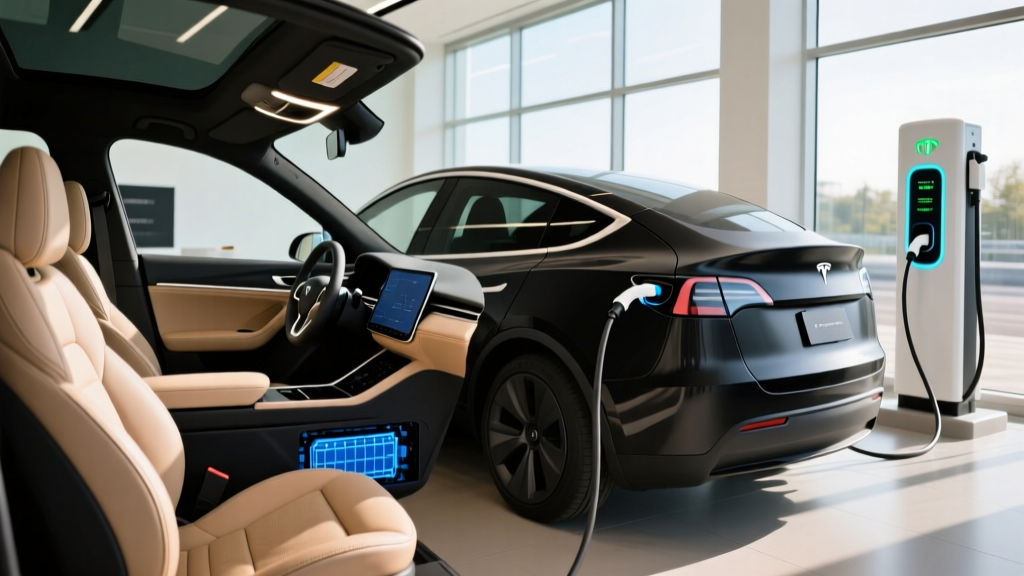
The Juniper refresh brought tangible improvements to the cabin. The dashboard now features ambient lighting strips, ventilated front seats (standard on Long Range), and an updated 15.4-inch center touchscreen running Tesla's latest software. A rear-seat 8-inch touchscreen gives passengers climate and media control — a welcome addition for families.
Passenger and Cargo Dimensions
| Measurement | Value |
|---|---|
| Front Headroom | 40.0 in |
| Front Legroom | 41.8 in |
| Rear Headroom | 38.4 in |
| Rear Legroom | 38.5 in |
| Cargo (seats up) | 30.2 cu ft |
| Cargo (seats folded) | 72.0 cu ft |
| Front Trunk (Frunk) | 4.1 cu ft |
Rear-seat comfort has improved with the Juniper update — the seat cushion is slightly longer, and the recline angle has been adjusted for better thigh support on longer trips. Two adults over six feet tall can sit behind a similarly sized driver without knee contact. The 30.2 cu ft of cargo space behind the second row swallows four carry-on suitcases with room to spare, and the 72.0 cu ft maximum with seats folded rivals many midsize ICE crossovers.
The minimalist interior philosophy remains: no physical buttons on the dash, no traditional instrument cluster. All vehicle information — speed, navigation, media, climate — routes through the central display. This is polarizing. Some owners love the uncluttered aesthetic; others find touchscreen-dependent climate controls distracting while driving. The addition of turn-signal buttons on the steering wheel (replacing the stalk-mounted signals in earlier Juniper prototypes) addresses one of the most common complaints from the initial refresh.
Charging Speeds: DC Fast Charging and Home Level 2
| Charging Level | Power | Speed / Time |
|---|---|---|
| Level 1 (120V household) | ~1.4 kW | ~3–4 mi/hr |
| Level 2 (240V home, 48A) | 11.5 kW | ~44 mi/hr (full charge ~7 hrs) |
| DC Fast Charge (peak) | 250 kW | 10–80% in ~25 min |
| DC Fast Charge (sustained avg) | ~150 kW | Avg ~180 mi in 30 min |
The Model Y Long Range peaks at 250 kW on a V3 or V4 Tesla Supercharger, but — and this is critical for trip planning — that peak is not sustained. The charge curve tapers progressively: you'll see 250 kW briefly between roughly 10–20% state of charge, then the rate drops to approximately 170 kW through the mid-range, and further to under 60 kW above 80%. This is normal lithium-ion battery management to protect cell longevity, but it means the average charging speed over a 10–80% session is closer to 150 kW.
At home on a 240V/48A Level 2 wall connector (Tesla's own unit is approximately $450, plus electrician installation), the onboard charger accepts up to 11.5 kW, adding roughly 44 miles of range per hour. A full charge from 10% to 100% takes about 7 hours — easily accomplished overnight. For most owners, plugging in each evening means starting every day with a full battery, which is the single biggest convenience advantage of EV ownership.
The 2026 Model Y ships with the native NACS charge port, meaning direct access to the full Tesla Supercharger network without adapters. For Electrify America or other CCS-based public networks, you'll need a NACS-to-CCS adapter (sold separately, ~$200–$250), though most Tesla owners rely primarily on Superchargers given the network's reliability.
Pricing, Trims, and Federal Tax Credit Eligibility
| Item | Amount |
|---|---|
| Base MSRP (Long Range AWD) | $48,990 |
| Destination Fee | $1,390 |
| As-Tested (w/ FSD, Red paint, 20" wheels) | ~$58,490 |
| Federal Tax Credit (§30D, if eligible) | Up to $7,500 |
| Effective Price After Max Credit | From ~$42,880 |
The Model Y Long Range starts at $48,990 before destination. As of the 2026 tax year, it qualifies for the full $7,500 federal EV tax credit under IRS §30D, but eligibility depends on several buyer-specific factors:
- MSRP Cap: SUVs must be priced at or below $80,000 MSRP. The Model Y Long Range clears this easily, even with options.
- Income Cap: Modified adjusted gross income (MAGI) must not exceed $150,000 (single), $225,000 (head of household), or $300,000 (joint filers).
- Battery Sourcing: Critical minerals and battery components must meet phased-in domestic-sourcing thresholds. Tesla's supply chain has largely met these requirements for 2026, but always verify current eligibility on IRS.gov before purchasing.
- Point-of-Sale Transfer: Since 2024, you can transfer the credit to the dealer at purchase, reducing your out-of-pocket cost immediately rather than waiting for a tax refund.
If you do not meet the income or sourcing requirements, the effective price remains the full MSRP. Consult a tax professional to confirm your specific eligibility — the rules are subject to legislative change.
Performance, Efficiency, and Driving Impressions
The dual-motor AWD powertrain produces 384 combined horsepower and delivers a 4.8-second 0–60 mph time. That's quick for a family SUV, and the instant torque delivery makes highway merging and city acceleration effortless. The Juniper refresh also brought revised damper tuning that noticeably improves ride quality over the pre-2025 Model Y — road imperfections are absorbed with less crash-through, and the cabin is quieter at highway speeds thanks to improved acoustic glass and additional sound deadening.
Regenerative braking remains strong and predictable. Tesla's one-pedal driving mode allows you to come to a complete stop without touching the brake pedal in most scenarios, which reduces fatigue in stop-and-go traffic. The steering is precise but light, and the low center of gravity (battery pack under the floor) keeps body roll well-controlled in corners.
At 122 MPGe combined (28 kWh/100 mi), the Model Y Long Range is among the most efficient vehicles in its class. For comparison, the Ford Mustang Mach-E Extended Range AWD achieves roughly 101 MPGe combined, and the Hyundai Ioniq 5 AWD lands around 110 MPGe. This efficiency advantage translates directly into lower charging costs — at the national average residential electricity rate of ~$0.17/kWh, a full charge costs roughly $12.75, or about $0.04 per mile.
Tech, Driver Assistance, and Safety
Every Model Y includes Tesla's basic Autopilot suite: adaptive cruise control, lane-centering assist, and automatic emergency braking. The optional Full Self-Driving (Supervised) package ($8,000 one-time or $99/month) adds automated lane changes, navigation-guided on/off-ramp transitions, and traffic-light recognition. However, it is critical to understand that FSD is a SAE Level 2 driver-assistance system — you must remain fully engaged, hands on the wheel, eyes on the road at all times.
The infotainment system remains one of the most responsive in the industry, with fast map rendering, over-the-air updates, and integrated streaming (Netflix, YouTube, Spotify) while parked. The 2026 software adds improved voice commands and a redesigned navigation interface with better Supercharger routing and real-time stall availability.
Safety ratings remain strong. The Model Y earned a 5-star overall rating from NHTSA and top marks from IIHS in crashworthiness categories. Standard active-safety features include automatic emergency braking, blind-spot monitoring, and rear cross-traffic alert.
Pros and Cons
Pros
- Class-leading efficiency (122 MPGe combined)
- 320-mile EPA range covers most road trips comfortably
- Full access to Tesla Supercharger network (native NACS)
- Spacious cargo area (72 cu ft max) with flat load floor
- Juniper refresh significantly improves ride and cabin noise
- Over-the-air updates keep software current
- Strong resale value relative to EV segment average
Cons
- Touchscreen-only controls remain polarizing
- FSD costs $8,000 extra and is still Level 2 only
- Rear visibility is limited (no rear wiper)
- Insurance premiums tend to be above segment average
- No Apple CarPlay or Android Auto integration
- 250 kW peak DC charge rate trails Hyundai/Kia's 350 kW capability
Who Should Buy the 2026 Model Y Long Range?
Choose the Model Y Long Range if: You want a proven, efficient electric SUV with Supercharger access for road trips, strong cargo capacity for a family, and the lowest per-mile energy cost in the segment. It's ideal for daily commuters who can charge at home and take 2–4 longer road trips per year.
Consider alternatives if: You prioritize physical buttons and knobs (look at the Hyundai Ioniq 5), need the fastest possible DC charging (Hyundai/Kia E-GMP platform peaks at 350 kW), require a third row (Kia EV9), or want Apple CarPlay integration (nearly every competitor offers it).
Frequently Asked Questions
What is the real-world range of the 2026 Model Y Long Range?
Expect approximately 270–290 miles on mixed highway driving in moderate temperatures, and 240–260 miles in sustained cold weather (below 32°F). City driving with regenerative braking can push closer to the 320-mile EPA estimate.
How fast does the Model Y Long Range charge?
On a Tesla V3/V4 Supercharger, it peaks at 250 kW and charges from 10–80% in roughly 25 minutes. At home on a 240V Level 2 charger (11.5 kW), it adds about 44 miles per hour and fully charges overnight in ~7 hours.
Does the 2026 Model Y qualify for the $7,500 federal tax credit?
Yes, the Model Y Long Range is currently eligible for the full $7,500 §30D credit, provided the buyer meets income caps ($150K single / $300K joint) and the vehicle's battery sourcing meets current-year thresholds. Verify at IRS.gov and consult a tax professional.
How does the Model Y Long Range compare to the Hyundai Ioniq 5?
The Ioniq 5 offers faster 350 kW DC charging, physical controls, Apple CarPlay, and a slightly lower starting price. The Model Y wins on range (320 vs. ~290 miles for the Ioniq 5 AWD), Supercharger network access, cargo space, and efficiency. Both are strong choices — the decision often comes down to interface preference and charging network priorities.
What is the battery warranty on the Model Y Long Range?
Tesla covers the battery and drive unit for 8 years or 120,000 miles, whichever comes first, with a guaranteed minimum 70% capacity retention over that period. NMC chemistry in Tesla packs has shown degradation of approximately 8–12% over the first 100,000 miles in fleet data.
Is the Model Y Long Range good for towing?
It's rated to tow up to 3,500 pounds, which covers a small utility trailer or a pair of jet skis. However, towing significantly reduces range — expect a 30–40% reduction at highway speeds, bringing effective range to roughly 190–220 miles.