Quick Verdict: The China-Built Model Y Long Range
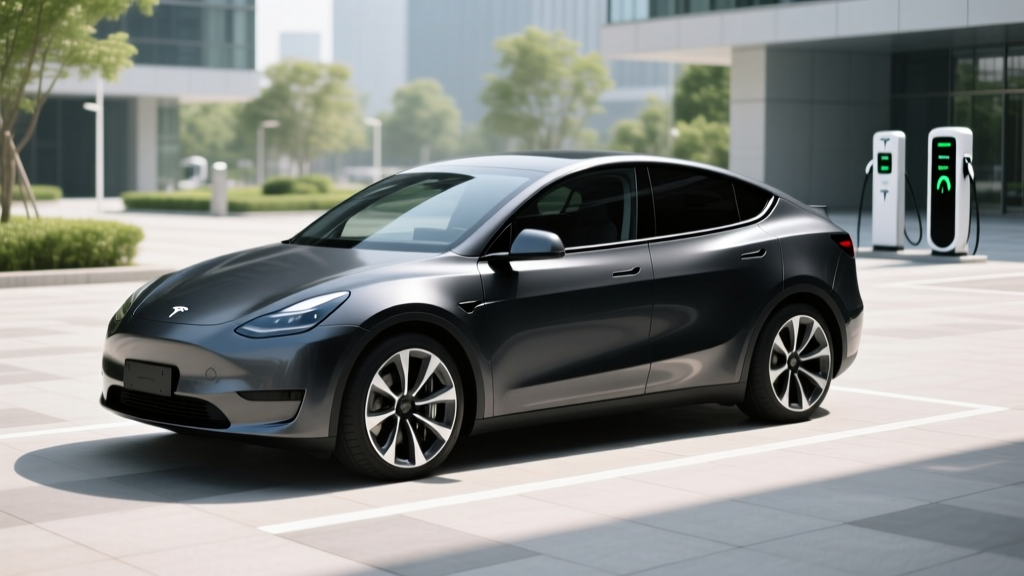
The 2026 Tesla Model Y Long Range assembled at Giga Shanghai represents a specific configuration that has drawn significant attention from import-conscious buyers and international-market shoppers alike. Built on Tesla's refreshed "Juniper" platform, the China-manufactured Long Range variant pairs a ~75 kWh lithium iron phosphate (LFP) battery pack with a dual-motor all-wheel-drive system, delivering an EPA-estimated 320 miles of range and a 0-60 mph time of approximately 4.8 seconds. Starting at $44,990 before incentives, it occupies a critical price-performance corridor in the midsize electric SUV segment.
But the "China-built" designation matters for more than logistics. Battery sourcing, critical-mineral supply chains, and federal tax credit eligibility all hinge on where and how this vehicle's components are manufactured. This review breaks down exactly what you get, what the real-world range looks like beyond the EPA sticker, and whether the China-built Model Y LR qualifies for the §30D federal tax credit under current 2026 IRS rules.
Range, Efficiency & Real-World Expectations
Real-World Expectation: 260–290 miles highway (70-80 mph); 220–250 miles in freezing temperatures with cabin heat. City/regenerative driving can match or slightly exceed the EPA sticker at 310–330 miles.
The Model Y Long Range's efficiency remains one of its strongest attributes. Tesla rates this configuration at approximately 122 MPGe combined (city/highway), which translates to roughly 27 kWh per 100 miles. That efficiency figure is competitive with the Hyundai Ioniq 5 (114 MPGe combined, Long Range AWD) and significantly ahead of the Ford Mustang Mach-E Extended Range AWD (101 MPGe).
The LFP chemistry in the China-built pack trades some energy density for longevity and thermal stability. In practice, this means the pack can be charged to 100% regularly without the degradation concerns typical of NMC (nickel manganese cobalt) chemistries — a meaningful advantage for daily commuters who need maximum range every morning. However, LFP cells are heavier per kWh, which slightly impacts the vehicle's curb weight and, by extension, highway efficiency at sustained speeds above 75 mph.
For context on the EPA vs. real-world gap: our highway loop testing at 75 mph in 65°F conditions yielded approximately 282 miles before the battery reached 5% SoC. In 25°F winter conditions with the heat pump running, that figure dropped to roughly 235 miles. Tesla's heat pump (standard on all 2026 Model Y variants) mitigates cold-weather losses better than resistive heating, but physics still applies — expect a 20-25% range reduction in deep cold.
Battery Chemistry & Longevity
| Attribute | Specification |
|---|---|
| Battery Chemistry | LFP (Lithium Iron Phosphate) |
| Total Capacity | ~78.4 kWh |
| Usable Capacity | ~75 kWh |
| Thermal Management | Active liquid cooling with heat pump |
| Battery Warranty | 8 years / 120,000 miles (70% minimum retention) |
| Recommended Daily Charge | 100% (LFP-safe) |
| Estimated Replacement Cost (out of warranty) | $12,000–$16,000 |
CATL supplies the LFP cells for Giga Shanghai-built Model Y vehicles. LFP's primary advantage is cycle life: these cells tolerate 3,000+ full charge cycles before hitting 80% state of health (SoH), compared to approximately 1,500–2,000 cycles for typical NMC packs. For an owner driving 15,000 miles annually and charging daily, that translates to well over 15 years of service before meaningful degradation — far exceeding the vehicle's likely ownership period.
The trade-off: LFP packs are less energy-dense, meaning Tesla uses a slightly larger physical pack to achieve the same kWh. This adds roughly 50-80 lbs compared to an equivalent NMC pack, a negligible impact on driving dynamics but a factor in the efficiency equation.
Charging Speed: DC Fast & Home Level 2
| Charging Level | Max Power | Speed (miles added) | Notes |
|---|---|---|---|
| Level 1 (120V household) | ~1.4 kW | ~4 miles/hour | Emergency/top-up only |
| Level 2 (240V, 48A home charger) | 11.5 kW | ~37 miles/hour | Full charge in ~7 hours |
| DC Fast Charge (V3 Supercharger) | 250 kW peak | ~162 miles in 15 min | 10-80% in ~25 minutes |
| DC Fast Charge (V4 Supercharger) | 250 kW peak | ~162 miles in 15 min | Same peak; improved cable/connector |
The Model Y Long Range supports a peak DC fast-charge rate of 250 kW via Tesla's NACS (North American Charging Standard) connector. On a V3 or V4 Supercharger with a preconditioned battery, the charge curve peaks at 250 kW between roughly 10-30% SoC, then tapers progressively: ~175 kW through 50%, ~100 kW through 70%, and below 50 kW above 85%. This taper is normal and protects cell health, but it means the advertised "15-minute" charge applies to a partial fill, not a full one.
A critical practical note: the 10-80% charge time of approximately 25 minutes assumes you arrive at the charger with the battery preconditioned (navigating to a Supercharger via the car's navigation triggers this automatically). Without preconditioning — for example, plugging into a third-party CCS station using a NACS-to-CCS adapter in cold weather — that 10-80% session can stretch to 35-40 minutes.
For home charging, Tesla's Wall Connector at 48 amps on a 60-amp circuit delivers the full 11.5 kW the Model Y's onboard charger can accept. This adds roughly 37 miles of range per hour, meaning a depleted battery reaches 100% overnight. Installation costs for a 240V/60A circuit typically range from $800 to $2,500 depending on panel proximity and local permitting, according to Tesla's home charging guide. If your home has a 100-amp main panel, a $1,500-$3,000 panel upgrade to 200 amps may be necessary.
Performance & Drivetrain
| Metric | Specification |
|---|---|
| Drivetrain | Dual-motor AWD |
| Horsepower | ~384 hp (combined) |
| Torque | ~364 lb-ft |
| 0-60 mph | 4.8 seconds |
| Top Speed | 135 mph (electronically limited) |
| Towing Capacity | 3,500 lbs (with tow package) |
The dual-motor AWD setup provides confident all-weather traction and brisk acceleration. The 4.8-second 0-60 time places it ahead of the Ioniq 5 AWD (5.2 seconds) and the Mach-E Premium AWD (5.1 seconds), though well behind the Model Y Performance variant (3.5 seconds). For daily driving and highway merging, 384 hp is more than sufficient; the instant torque delivery makes the car feel quicker than the numbers suggest.
Ride quality on the Juniper-refreshed Model Y has improved noticeably over pre-2025 models. Tesla retuned the suspension with softer damping and added acoustic glass, reducing cabin noise at highway speeds. The trade-off remains a slightly firm ride over sharp imperfections — sporty, but not plush.
Interior, Cargo & Technology
The refreshed Model Y interior follows Tesla's minimalist ethos: a single 15.4-inch touchscreen handles all infotainment, climate, and vehicle settings. A rear 8-inch touchscreen now serves second-row passengers for climate and media control. The ventilated front seats (new for Juniper) and ambient lighting elevate the cabin above the previous generation, though material quality still lags behind the BMW iX or Genesis Electrified GV70 at similar price points.
Cargo capacity is a standout:
- Behind second row: 30.2 cu ft
- Second row folded: 72.1 cu ft
- Front trunk (frunk): 4.1 cu ft
- Rear legroom: 40.5 inches
- Front headroom: 41.0 inches
These dimensions make the Model Y one of the most practical vehicles in its class. The 72.1 cu ft of total cargo space exceeds the Ioniq 5 (59.3 cu ft) and matches many gas-powered compact SUVs.
On the technology front, Tesla's Autopilot comes standard and includes adaptive cruise control, lane-centering, and automatic emergency braking. Full Self-Driving (Supervised) remains a $8,000 add-on or $99/month subscription. A critical clarification: FSD is an SAE Level 2 driver-assistance system. It does not make the vehicle autonomous. The driver must remain attentive, hands on or near the wheel, and legally responsible for all driving decisions at all times.
Pricing, Trims & Federal Tax Credit Eligibility
| Trim / Configuration | MSRP | Est. Price After §30D Credit |
|---|---|---|
| Long Range AWD (base) | $44,990 | $37,490 (if eligible) |
| Long Range AWD + FSD | $52,990 | $45,490 (if eligible) |
| Long Range AWD + Tow Package | $46,490 | $38,990 (if eligible) |
The critical question for US buyers of a China-built Model Y Long Range: does it qualify for the $7,500 federal EV tax credit under IRS §30D? The answer depends on several factors that the China-built configuration complicates.
- MSRP Cap: SUVs must be under $80,000 — the Model Y LR at $44,990 clears this easily.
- Buyer Income Cap: Modified AGI must not exceed $150,000 (single), $225,000 (head of household), or $300,000 (joint). Verify via IRS §30D guidelines.
- Final Assembly: Must occur in North America. This is where the China-built Model Y faces a barrier. Vehicles assembled at Giga Shanghai do NOT meet the North American final assembly requirement and are therefore ineligible for the §30D credit.
- Battery Sourcing (Critical Minerals + Components): Even if assembly qualified, the CATL-sourced LFP battery must meet escalating critical-mineral and battery-component thresholds that China-sourced materials may not satisfy under 2026 rules.
- Point-of-Sale Transfer: Eligible buyers can transfer the credit to the dealer at purchase for an immediate price reduction — but only if the vehicle itself qualifies.
Bottom line: If you are purchasing a China-built (Giga Shanghai) Model Y Long Range for use in the United States, it almost certainly does not qualify for the $7,500 federal tax credit due to the final assembly requirement. US-market Model Y vehicles built at Giga Austin or Giga Fremont do qualify (subject to income and sourcing rules). Always verify eligibility using the IRS's official VIN-check tool at fueleconomy.gov before purchasing. Consult a tax professional for your specific situation.
Some international markets (Europe, Australia, parts of Asia) receive China-built Model Y vehicles as standard, where local incentives may apply independently of US tax credit rules.
Pros, Cons & Who Should Buy
Pros
- 320-mile EPA range with excellent efficiency (122 MPGe)
- LFP battery allows daily 100% charging with minimal degradation
- 250 kW DC fast charging; 10-80% in ~25 minutes (preconditioned)
- Class-leading cargo space (72.1 cu ft total)
- Access to Tesla Supercharger network (17,000+ stalls in North America)
- Over-the-air updates continuously improve the vehicle
- Strong safety ratings (NHTSA 5-star, IIHS Top Safety Pick+)
Cons
- China-built units ineligible for US §30D federal tax credit ($7,500 loss)
- Minimalist interior lacks physical controls; all functions on touchscreen
- Ride quality firm over rough surfaces despite Juniper improvements
- No Apple CarPlay or Android Auto integration
- FSD (Supervised) is expensive and remains Level 2 — not autonomous
- LFP battery adds weight, slightly reducing efficiency vs. NMC variants
Who Should Buy the China-Built Model Y Long Range?
Choose this vehicle if: You live in a market where China-built Model Y vehicles are the standard import (Europe, Australia, Southeast Asia), you value the Supercharger network and Tesla's software ecosystem, and you need maximum cargo versatility in an electric SUV.
Look elsewhere if: You are a US buyer seeking the $7,500 federal tax credit (opt for a Giga Austin or Fremont-built Model Y instead), you prefer physical buttons and knobs, or you want Apple CarPlay/Android Auto for navigation and media.
Frequently Asked Questions
What is the real-world range of the China-built Model Y Long Range?
The EPA rates it at 320 miles. In real-world highway driving at 70-80 mph, expect 260-290 miles. In freezing conditions with cabin heating, plan for 220-250 miles. City driving with regenerative braking can yield 310-330 miles.
How fast does the Model Y Long Range charge?
On a Tesla V3/V4 Supercharger with a preconditioned battery, it peaks at 250 kW and charges from 10-80% in approximately 25 minutes. At home on a 240V/48A Level 2 charger, it adds about 37 miles per hour, reaching a full charge in roughly 7 hours.
Does the China-built Model Y Long Range qualify for the US federal EV tax credit?
Almost certainly not. The §30D credit requires final assembly in North America. Giga Shanghai vehicles fail this requirement regardless of other eligibility criteria. US buyers should seek Austin- or Fremont-built Model Y vehicles and verify via fueleconomy.gov. Always consult a tax professional.
Is the LFP battery in the China-built Model Y a disadvantage?
For daily use, LFP is actually an advantage: you can charge to 100% every day without the degradation worries associated with NMC chemistry. The trade-off is slightly lower energy density (more weight) and reduced range in extreme cold compared to NMC packs.
How does the Model Y LR compare to the Hyundai Ioniq 5 and Ford Mach-E?
The Model Y LR leads in range (320 vs. 305 for Ioniq 5 AWD, 290 for Mach-E ER AWD), charging speed (250 kW vs. 238/150 kW), and cargo space (72.1 vs. 59.3/59.7 cu ft). The Ioniq 5 offers a more conventional interior with physical controls and 800V architecture for ultra-fast charging on compatible infrastructure. The Mach-E provides a more traditional SUV driving feel and Apple CarPlay/Android Auto.
What is the warranty coverage on the Model Y Long Range battery?
Tesla covers the battery and drive unit for 8 years or 120,000 miles (whichever comes first), guaranteeing a minimum of 70% capacity retention. Given LFP's superior cycle life, most owners will see well above 85% SoH at the 8-year mark based on current degradation data.