Quick Verdict: The Fastest SUV Money Can Buy
If you're searching for the Tesla Model X Plaid top speed and whether this six-figure electric SUV delivers beyond straight-line theatrics, the short answer is yes — with caveats. The 2026 Model X Plaid hits 163 mph electronically limited, sprints to 60 mph in 2.5 seconds, and still manages a 311-mile EPA range estimate. It remains the benchmark for performance SUVs, but its price, efficiency trade-offs, and aging interior design demand a clear-eyed look before you sign.
Full Spec Sheet: Model X Plaid by the Numbers
| Specification | 2026 Model X Plaid |
|---|---|
| EPA Range | 311 miles |
| Battery (usable) | ~100 kWh, NMC chemistry |
| Drivetrain | Tri-Motor AWD |
| Horsepower | 1,020 hp |
| 0-60 mph | 2.5 seconds |
| Top Speed | 163 mph (electronically limited) |
| Max DC Fast Charge | 250 kW (peak) |
| 10-80% DC Charge Time | ~32 minutes |
| Level 2 Home Charge Rate | 11.5 kW (~30 mi/hr) |
| MPGe (combined) | 98 MPGe |
| Efficiency | 34 kWh/100 mi |
| Cargo (behind 2nd row) | 37.1 cu ft |
| Cargo (max, seats folded) | 73.6 cu ft |
| Seating | 5, 6, or 7 passengers |
| Towing Capacity | 5,000 lbs |
| Battery Warranty | 8 years / 150,000 miles |
| Base MSRP | $94,990 |
The tri-motor powertrain uses one front and two rear permanent-magnet/reluctance motors. The NMC (nickel-manganese-cobalt) battery pack prioritizes energy density and power delivery over the LFP (lithium iron phosphate) chemistry found in standard-range Teslas. That choice makes sense here: Plaid buyers want maximum output, and NMC delivers higher specific energy and better cold-weather power delivery than LFP.
How Fast Does the Model X Plaid Actually Charge?
Charging speed is where the Model X Plaid shows its age relative to newer 800V-architecture rivals. Tesla's 250 kW peak on V3 Superchargers was class-leading in 2021 but now trails the Hyundai Ioniq 9 (350 kW capability) and the Porsche Macan EV (270 kW on 800V). Here's the full charging breakdown:
| Charging Level | Power / Rate | Speed (Miles Added) | Typical Use Case |
|---|---|---|---|
| Level 1 (120V) | ~1.4 kW | ~3-4 mi/hr | Emergency / overnight trickle |
| Level 2 (240V, 48A) | 11.5 kW | ~30 mi/hr | Home daily charging |
| DC Fast (V3 Supercharger) | 250 kW peak | ~175 mi in 15 min | Road trips |
| DC Fast (CCS adapter, 3rd-party) | Up to 150 kW typical | Varies by station | Non-Tesla networks |
The 10-80% DC fast charge takes approximately 32 minutes at a V3 Supercharger. The charge curve tapers significantly above 60% SoC — you'll see the full 250 kW only between roughly 10-30% state of charge, after which the rate steps down through 150 kW, then 100 kW, and finally below 50 kW past 80%. This is standard lithium-ion behavior, but it means that last 20% can take as long as the first 50%.
For home charging, a Tesla Wall Connector on a 60-amp circuit delivers the full 11.5 kW, adding roughly 30 miles of range per hour. An overnight session (8-10 hours) easily replenishes a full day's driving. Installation typically runs $800-$2,000 depending on panel proximity and whether your electrical panel needs an upgrade.
Real-World Range: What the EPA Sticker Doesn't Tell You
The 311-mile EPA estimate for the Model X Plaid is measured under controlled laboratory conditions per fueleconomy.gov. Here's what to expect in actual driving scenarios:
- City/suburban mixed driving (65°F): 290-310 miles — regenerative braking recovers significant energy in stop-and-go traffic
- Highway at 70 mph (65°F): 255-275 miles — aerodynamic drag dominates at speed; the Model X's 0.24 Cd is excellent for an SUV but physics is physics
- Highway at 75-80 mph: 235-255 miles — every 5 mph above 70 costs roughly 5-7% range
- Cold weather (20°F), highway: 220-240 miles — battery resistance increases, cabin heating draws 3-5 kW continuously without a heat pump advantage at extreme cold
- Plaid mode / aggressive driving: 180-210 miles — 1,020 hp consumed liberally will drain the pack rapidly
The Model X Plaid does include a heat pump as standard, which improves cold-weather efficiency compared to resistive heating. However, the large cabin volume and glass roof still demand significant thermal energy in winter. Preconditioning the battery while plugged in (via the Tesla app's scheduled departure feature) is essential for preserving range and enabling faster DC charging in cold conditions.
Pricing, Trims, and Federal Tax Credit Eligibility
The 2026 Tesla Model X Plaid starts at $94,990 before destination. Here's how the pricing breaks down:
| Configuration | MSRP | Federal §30D Credit | Effective Price |
|---|---|---|---|
| Model X (Dual-Motor) | $79,990 | $7,500 (if eligible) | ~$72,490 |
| Model X Plaid | $94,990 | $7,500 (if eligible) | ~$87,490 |
| Plaid + FSD ($8,000) | $102,990 | $7,500 (if eligible) | ~$95,490 |
Federal tax credit eligibility (§30D) — critical caveats:
- MSRP cap: SUVs must be under $80,000. The base dual-motor Model X qualifies; the Plaid at $94,990 exceeds the cap and does not qualify for the $7,500 federal credit.
- Income limits: Modified AGI must not exceed $300,000 (joint), $225,000 (head of household), or $150,000 (single).
- Battery sourcing: Critical minerals and battery component requirements must be met per current IRS guidance. Tesla's US-assembled vehicles generally meet component requirements, but critical-mineral sourcing rules tighten annually.
- Point-of-sale transfer: Eligible buyers can apply the credit at purchase rather than waiting for tax filing, reducing upfront cost.
Bottom line: If you want the Plaid, you're paying full MSRP (minus any state/local incentives). The base dual-motor Model X is the credit-eligible variant. Consult a tax professional to confirm your specific eligibility — rules change frequently and depend on your individual circumstances.
Performance, Tech, and Daily Livability
The 163 mph top speed and 2.5-second 0-60 time are headline figures, but the Model X Plaid's tri-motor torque vectoring is what makes it genuinely remarkable. The two rear motors independently manage torque distribution, enabling corner-exit acceleration that defies this SUV's 5,185-pound curb weight. On a track or canyon road, it feels unnervingly agile for its size.
The 17-inch landscape touchscreen runs Tesla's latest infotainment software with gaming-grade processing (capable of running Cyberpunk 2077 while parked). The yoke steering wheel remains polarizing — some drivers adapt within a week, others never do. Tesla offers a round wheel option at no extra charge.
Autopilot and FSD (Supervised): Tesla's driver-assistance suite is standard. Full Self-Driving (Supervised) is an $8,000 add-on. Per NHTSA classification, both are SAE Level 2 systems — the driver must remain fully engaged, hands on wheel (or torque-applied with yoke), eyes on road at all times. This is not autonomous driving.
Notable drawbacks:
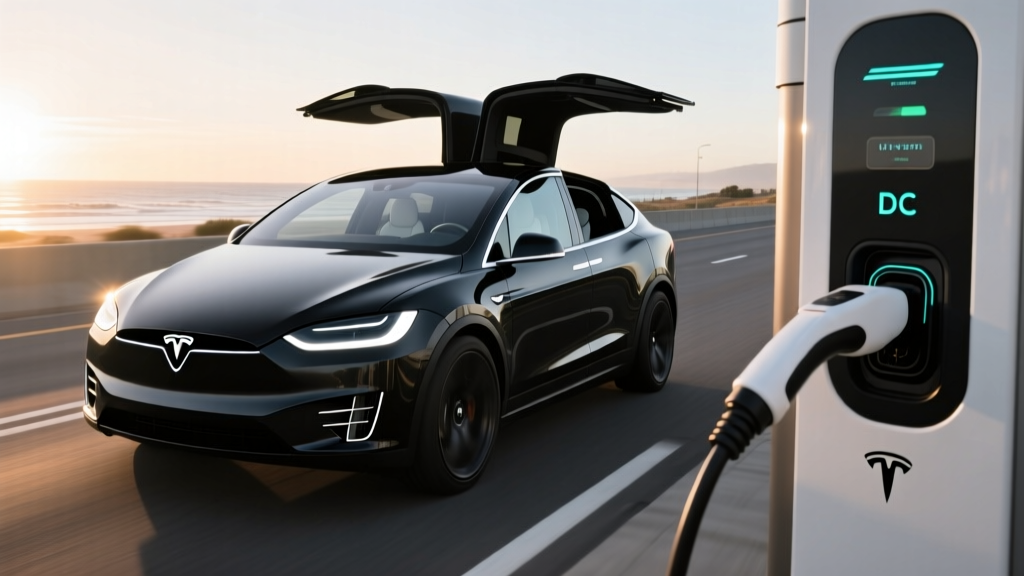
- The falcon-wing rear doors, while dramatic, are slower to open than conventional doors and can be problematic in tight parking spaces with low overhead clearance
- Panel gap consistency and interior material quality still lag behind BMW, Mercedes, and Porsche at this price point
- No Apple CarPlay or Android Auto — Tesla's proprietary system is the only option
- The panoramic glass roof creates cabin heat soak in summer; the tint helps but doesn't eliminate it
- Insurance premiums are significantly higher than the segment average — expect $3,500-$5,000/year depending on your profile
Who Should Buy the Model X Plaid?
This vehicle makes sense for a specific buyer: someone who needs three-row SUV practicality, wants supercar-rivaling acceleration, takes regular road trips (Tesla's Supercharger network remains the gold standard for reliability), and has home charging access. It's an excellent family hauler that can also demolize a quarter-mile.
It does not make sense if you prioritize interior luxury (look at the BMW iX M60 or Mercedes EQS SUV), need maximum efficiency (the base dual-motor Model X is 15% more efficient), or want the latest 800V charging architecture for the fastest possible road-trip replenishment.
Pros
- 1,020 hp / 2.5-sec 0-60 in a 7-seat SUV
- Supercharger network access — best public charging reliability
- 311-mile EPA range is strong for the performance class
- 5,000-lb towing capacity
- Over-the-air updates continuously add features
- Best-in-class cargo space with front trunk (frunk)
Cons
- $94,990 MSRP; no federal tax credit (exceeds $80K SUV cap)
- 250 kW peak charging trails newer 800V competitors
- Interior quality doesn't match German luxury rivals
- Falcon-wing doors are slow and space-sensitive
- High insurance costs ($3,500-$5,000+/yr)
- Yoke steering is divisive; round wheel available but must be requested
Frequently Asked Questions
What is the Tesla Model X Plaid top speed?
The 2026 Model X Plaid has an electronically limited top speed of 163 mph. This is achievable with the correct tire specification and Track Mode enabled. Without Track Mode, the limiter engages at a lower threshold. Sustained high-speed driving will dramatically reduce range — expect under 150 miles at continuous triple-digit speeds.
Does the Model X Plaid qualify for the federal EV tax credit?
No. The IRS §30D credit caps SUV eligibility at $80,000 MSRP. The Model X Plaid starts at $94,990, exceeding this limit. The base dual-motor Model X at $79,990 does qualify, assuming the buyer meets income limits ($300K joint / $150K single) and battery-sourcing requirements are satisfied. Always verify current rules at IRS.gov.
How does the Model X Plaid compare to the BMW iX M60?
The BMW iX M60 offers 610 hp, a 296-mile EPA range, 195 kW DC charging, and a starting price around $92,000. It has a superior interior in materials and refinement but less power, less range, slower charging, and no access to the Supercharger network (though BMW now has NACS compatibility for newer models). Choose the Plaid for performance and road-trip charging; choose the iX for luxury and daily comfort.
What is the real-world highway range of the Model X Plaid?
Expect approximately 255-275 miles at 70 mph in moderate temperatures. At 80 mph, that drops to roughly 235-255 miles. Cold weather (below freezing) reduces highway range to 220-240 miles. These figures assume normal driving without aggressive acceleration. Preconditioning the battery before departure helps mitigate cold-weather losses.
How long does the Model X Plaid battery last?
Tesla warranties the battery for 8 years or 150,000 miles, whichever comes first, with a minimum 70% capacity retention threshold. Real-world data from Tesla's fleet suggests NMC packs in the Model X lose approximately 10-15% capacity over the first 100,000 miles, after which degradation slows significantly. A replacement pack (out of warranty) currently costs between $15,000-$22,000 depending on labor and pack availability.
Can I charge a Model X Plaid at non-Tesla charging stations?
Yes. The 2026 Model X ships with the NACS (North American Charging Standard) connector natively. Since most major automakers are adopting NACS through 2025-2026, an increasing number of third-party networks (Electrify America, EVgo) are adding NACS cables. For legacy CCS1 stations, Tesla sells a CCS adapter (~$250) that enables charging at up to 150 kW on compatible hardware.