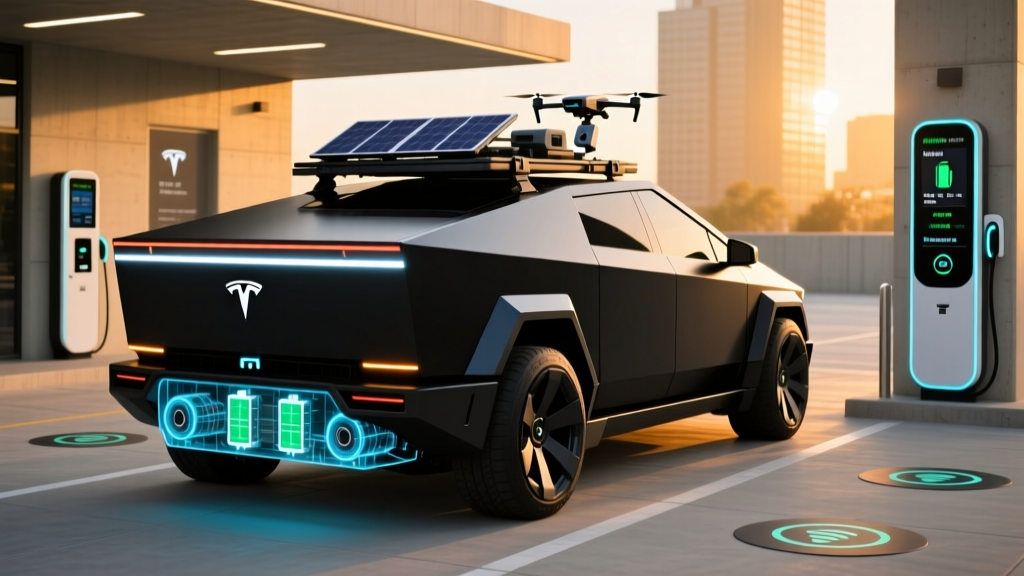
The Modded Cybertruck Phenomenon: Beyond the Stock Stainless Steel
Since the first deliveries rolled out in late 2023, the Tesla Cybertruck has attracted one of the most aggressive aftermarket communities in the EV world. By 2026, the modded Cybertruck scene spans everything from performance ECU tunes and suspension lifts to full-body wraps and auxiliary battery packs. But before you start bolting on parts, you need to understand what you're starting with — the baseline specs, the real-world ownership experience, and how modifications interact with warranty, insurance, and federal tax credit eligibility.
This review covers the 2026 Tesla Cybertruck lineup as a foundation, then explores what the modding community is doing with it, what those modifications cost, and whether they make financial and practical sense.
| Spec | Long Range AWD | All-Wheel Drive | Cyberbeast |
|---|---|---|---|
| EPA Range | 340 mi | 318 mi | 320 mi |
| Battery (usable, est.) | ~123 kWh (NMC) | ~123 kWh (NMC) | ~123 kWh (NMC) |
| Drivetrain | Dual-Motor AWD | Dual-Motor AWD | Tri-Motor AWD |
| Horsepower | 600 hp | 600 hp | 845 hp |
| 0–60 mph | 3.9 sec | 3.9 sec | 2.6 sec |
| Max DC Fast Charge | 250 kW | 250 kW | 250 kW |
| 10–80% DC Time | ~28 min | ~28 min | ~28 min |
| Level 2 Charge Rate | 11.5 kW (~37 mi/hr) | 11.5 kW (~37 mi/hr) | 11.5 kW (~37 mi/hr) |
| Towing Capacity | 11,000 lbs | 11,000 lbs | 11,000 lbs |
| MPGe (combined) | 67 MPGe | 65 MPGe | 63 MPGe |
| Base MSRP | $79,990 | $99,990 | $114,990 |
| Battery Warranty | 8 yr / 120,000 mi | 8 yr / 120,000 mi | 8 yr / 120,000 mi |
Real-World Range: What the Modded Cybertruck Actually Delivers
The EPA posts the Cybertruck Long Range AWD at 340 miles. That number is derived from standardized lab cycles, and as with every EV on the market, real-world results diverge — sometimes sharply — depending on speed, temperature, terrain, and payload.
EPA Sticker: 340 miles (Long Range AWD)
Real-World Expectations:
- Highway (70–80 mph, mild weather): ~260–285 miles — the Cybertruck's angular stainless-steel body produces a drag coefficient around 0.34, which hurts at sustained speed
- City / mixed driving: ~290–320 miles — regenerative braking recovers energy in stop-and-go conditions
- Cold weather (below 30°F): ~210–260 miles — NMC chemistry loses efficiency in the cold, and cabin heating draws heavily even with the heat pump
- While towing (loaded trailer, ~8,000 lbs): ~140–170 miles — towing is where the Cybertruck's range drops most dramatically
For the modded Cybertruck owner, the picture gets more complicated. Larger aftermarket wheels (22-inch or 24-inch), all-terrain tires, roof racks, and lifted suspensions all increase rolling resistance and aerodynamic drag. Owners running 35-inch mud-terrain tires report a 15–20% range reduction compared to stock. A 2-inch suspension lift with aggressive tires can knock 40–50 miles off the EPA figure at highway speeds.
Some aftermarket companies, such as Unplugged Performance and EV West, offer software tunes that optimize torque delivery and regen profiles for modified setups. These can recover 5–10% of lost efficiency but cannot overcome the physics of added weight and drag.
Charging the Cybertruck: Speed, Connectors, and Modded Considerations
The 2026 Cybertruck ships with the NACS (North American Charging Standard) connector natively, meaning full access to the Tesla Supercharger network — now exceeding 25,000 stalls in North America — without an adapter. This remains a significant practical advantage over CCS-equipped competitors that rely on third-party networks like Electrify America or EVgo.
| Charging Level | Power / Rate | Miles Added per Hour | Notes |
|---|---|---|---|
| Level 1 (120V, 15A) | ~1.4 kW | ~4–5 mi/hr | Emergency/trickle only; full charge in days |
| Level 2 (240V, 48A) | 11.5 kW | ~37 mi/hr | Full overnight charge in ~11 hours; recommended home setup |
| DC Fast Charge (Supercharger V3/V4) | Peak 250 kW | ~180–210 mi in 15 min | 10–80% in ~28 min; tapers significantly above 85% |
The Cybertruck's ~123 kWh usable battery (NMC chemistry) means that even at peak 250 kW, you're adding energy to a large pack. The charge curve holds near peak rate between roughly 10% and 45% state of charge, then tapers progressively. From 80% to 100%, the rate drops below 50 kW — this is standard behavior for lithium-ion packs and protects cell longevity.
For modded Cybertruck owners who've added auxiliary loads (winch, light bars, camper-shell HVAC), the stock charging system handles these fine — they draw from the 12V system or a secondary auxiliary battery, not the traction pack. However, if you've added a larger aftermarket battery pack (a rare but existing mod from specialty shops), you'll need to verify that the onboard charger and BMS can accommodate the increased capacity. Most reputable upfitters will reflash the BMS or install a parallel system with its own charge controller.
Performance and Drivetrain: Stock vs. Modded Cybertruck
In stock form, the Cyberbeast's 845 horsepower and 2.6-second 0–60 time make it one of the quickest production trucks ever built. The dual-motor Long Range and AWD trims deliver 600 hp and a 3.9-second sprint — genuinely fast for a vehicle weighing over 6,600 lbs.
The aftermarket has focused on three performance areas:
- Software tunes: Companies like Unplugged Performance and EV Tuning offer ECU maps that adjust throttle response, regen aggressiveness, and torque split. Gains of 30–50 hp are typical on the dual-motor models, with more aggressive maps available for the tri-motor Cyberbeast (claiming 900+ hp). These tunes generally cost $1,500–$3,500.
- Suspension and off-road: 2–3 inch lift kits from brands like Dirty Life, Icon Vehicle Dynamics, and Eibach are popular. Combined with 35-inch all-terrain or mud-terrain tires, they transform the Cybertruck into a credible off-roader. Expect to spend $3,000–$8,000 for a complete suspension and wheel/tire package.
- Exterior and armor: PPF (paint protection film) wraps are nearly universal given the Cybertruck's raw stainless-steel panels, which show fingerprints and can develop surface staining. Full-body PPF runs $4,000–$7,000. Steel or aluminum skid plates, rock sliders, and aftermarket bumpers add protection but also 200–500 lbs of weight, directly impacting range.
Modded Cybertruck builds pushing 900+ hp with off-road suspension exist, but they sacrifice the 340-mile EPA range — expect 220–260 miles in mixed driving on a heavily modified build.
Pricing, Tax Credits, and the Cost of Going Modded
The 2026 Cybertruck starts at $79,990 for the Long Range AWD and climbs to $114,990 for the Cyberbeast. Most buyers add between $5,000 and $15,000 in Tesla factory options (FSD capability, premium interior, armor glass upgrade, Foundation Series packages) before touching the aftermarket.
| Trim | Base MSRP | As-Tested (typical) | §30D Credit Eligibility |
|---|---|---|---|
| Long Range AWD | $79,990 | $84,000–$88,000 | Eligible for up to $7,500 if buyer meets income caps ($150K single / $300K joint) and battery sourcing requirements are met — verify at IRS.gov |
| All-Wheel Drive | $99,990 | $103,000–$108,000 | MSRP exceeds $80,000 truck cap — NOT eligible for §30D federal credit |
| Cyberbeast | $114,990 | $118,000–$125,000 | MSRP exceeds $80,000 truck cap — NOT eligible for §30D federal credit |
This is a critical detail many buyers miss. Under IRS §30D rules, trucks and SUVs have an MSRP cap of $80,000 for new-vehicle credit eligibility. Only the base Long Range AWD, at $79,990, clears this threshold — and only if the buyer's modified adjusted gross income falls below $150,000 (single filer), $225,000 (head of household), or $300,000 (joint). The credit can be applied as a point-of-sale discount through a registered dealer, per current IRS rules. Battery sourcing and critical mineral requirements must also be satisfied; Tesla's supply chain has generally met these, but always verify the specific VIN's eligibility before purchase.
The aftermarket adds another layer of cost. A moderately modded Cybertruck with PPF, lift kit, all-terrain tires, and a performance tune can easily reach $100,000–$130,000 in total investment. Heavily built show or off-road trucks with custom bumpers, winches, camper shells, and auxiliary lighting push past $150,000.
Cargo, Interior, and Daily Usability
The Cybertruck's 6-foot bed (with the tonneau closed) offers roughly 74 cu ft of cargo volume, and the powered retractable tonneau cover is standard. The front trunk (frunk) provides approximately 7 cu ft of sealed storage — useful for charging cables and groceries. Total payload capacity is rated at 2,500 lbs.
Inside, the cabin seats five with a 60/40-split rear bench. Rear legroom measures approximately 38.2 inches — adequate for adults on shorter trips but tighter than a Ford F-150 Lightning's rear seat. The 18.5-inch center touchscreen handles all vehicle functions, climate, navigation, and media. There is no traditional instrument cluster; a secondary 9.4-inch rear touchscreen serves back-seat passengers.
For the modded Cybertruck community, the bed is a blank canvas. Popular modifications include:
- Bed racks and crossbar systems for rooftop tents (Thule, Yakima, and custom fab shops)
- Camp shells from companies like SpaceCamp and Scout, adding enclosed sleeping space
- Integrated air compressor systems mounted in the bed for off-road tire airing
- Powered bed dividers and drawer systems for overlanding gear organization
Tech, ADAS, and What Modifications Can't Touch
The Cybertruck ships with Tesla's latest hardware suite — HW5 (AI5) processor, 8 cameras, and 12 ultrasonic sensors (reintroduced after Tesla's brief vision-only experiment). Autopilot is standard, providing adaptive cruise control and lane centering. Full Self-Driving (Supervised) remains a $8,000 option or $99/month subscription.
SAE Automation Level: Level 2
Both Autopilot and FSD (Supervised) are Level 2 driver-assistance systems. The driver must remain fully attentive, hands on the steering wheel (or providing steering torque), and eyes on the road at all times. The Cybertruck is NOT a self-driving vehicle. No consumer Tesla is. Only Level 4 services like Waymo operate without a human driver, and those are limited to specific geofleets in select cities.
One area where the modded Cybertruck community treads carefully is ADAS calibration. Suspension lifts that change the vehicle's ride height alter the camera angles. Most reputable lift-kit manufacturers include calibration brackets or recommend a service-center recalibration to keep Autopilot functioning correctly. Failing to recalibrate can result in phantom braking, lane-departure errors, or complete ADAS disablement.
Steer-by-wire, a Cybertruck signature feature, is not user-serviceable or moddable. The yoke-style steering wheel and its ratio are locked to Tesla's firmware. Aftermarket steering wheel swaps exist but may interfere with the capacitive touch sensors that confirm driver engagement.
Warranty Implications of Modding Your Cybertruck
Tesla's battery and drive unit warranty covers 8 years or 120,000 miles (whichever comes first), with a guaranteed minimum of 70% capacity retention. The limited vehicle warranty covers 4 years or 50,000 miles.
Modifying your Cybertruck does not automatically void the entire warranty — the Magnuson-Moss Warranty Act protects consumers from blanket denials. However, Tesla can (and does) deny warranty claims on components directly affected by aftermarket modifications. Examples:
- A suspension lift that causes premature drive-shaft wear → axle/driveshaft claim denied
- An aftermarket tune that pushes the motor beyond rated limits → drive unit claim denied
- Auxiliary wiring that shorts and damages the 12V system → electrical claim denied
Software modifications are the highest-risk category. Tesla's over-the-air updates can detect non-stock firmware maps, and the company has been known to flag modified vehicles in its service system. If you plan to keep your Cybertruck under warranty, stick to bolt-on modifications (wheels, tires, suspension, PPF) and avoid ECU tunes unless you're prepared to accept the warranty risk.
Who the Modded Cybertruck Is For — And Who Should Skip It
The modded Cybertruck appeals to a specific buyer profile: someone who wants a high-performance electric truck that doubles as an off-road platform, overlanding base camp, or automotive statement piece. It is not a subtle vehicle, and modifying it amplifies that fact.
Pros
- Massive aftermarket support — lift kits, tunes, armor, camp shells widely available
- NACS-native Supercharger access — best charging network in North America
- 11,000-lb towing and 2,500-lb payload — serious truck capability
- Stainless-steel exoskeleton resists dents; PPF keeps it looking new
- Steer-by-wire and 4-wheel steering give a surprisingly tight turning radius
- 845 hp Cyberbeast is legitimately one of the fastest trucks ever made
- Strong community — active forums, build threads, and meetups
Cons
- Only the base Long Range ($79,990) qualifies for the §30D credit; AWD and Cyberbeast do not
- Real-world highway range drops to ~260 mi stock, ~220 mi modded
- Modifications reduce range significantly — physics is unforgiving on a 6,600-lb brick
- ECU tunes risk warranty denial on the most expensive components (battery, drive units)
- Rear seat legroom is tight for a full-size truck
- Stainless-steel body panels are difficult to repair; collision shops with Cybertruck experience are still limited
- Insurance premiums on modded Cybertrucks can exceed $4,000–$6,000/year
Frequently Asked Questions
What is the real-world range of a modded Cybertruck?
A stock Cybertruck Long Range AWD delivers approximately 260–285 miles on the highway and 290–320 miles in mixed city driving. A modded build with all-terrain tires, a lift kit, and added accessories typically sees 220–260 miles in mixed driving and as low as 180–200 miles at sustained highway speeds. Cold weather compounds these losses by another 15–25%.
How fast does the Cybertruck charge at home and on the road?
On a Level 2 home charger (240V, 48A), the Cybertruck charges at 11.5 kW, adding roughly 37 miles per hour — a full charge takes about 11 hours. On a Tesla Supercharger V3/V4, it peaks at 250 kW and charges from 10% to 80% in approximately 28 minutes. Above 80%, the charge rate tapers sharply to protect the NMC battery cells.
Does the Cybertruck qualify for the federal EV tax credit?
Only the base Long Range AWD at $79,990 MSRP qualifies — and only if the buyer's income is below $150,000 (single) or $300,000 (joint), and the vehicle's battery meets critical-mineral and sourcing requirements per IRS §30D rules. The All-Wheel Drive ($99,990) and Cyberbeast ($114,990) exceed the $80,000 MSRP cap for trucks and are not eligible. Always verify eligibility with a tax professional and check the IRS Clean Vehicle credit page for the latest sourcing requirements.
Is a modded Cybertruck worth it vs. a Ford F-150 Lightning or Rivian R1T?
It depends on your priorities. The F-150 Lightning offers more rear-seat space, a conventional body that's easier to repair, and Pro Power Onboard for job-site use. The Rivian R1T (quad-motor) offers superior off-road capability stock, with less need for aftermarket lifts. The Cybertruck wins on raw acceleration (Cyberbeast's 2.6-sec 0–60), the Supercharger network, and sheer aftermarket attention. If you want a statement vehicle with a thriving modding community, the Cybertruck is the clear choice. If you need practical daily-driver comfort and repairability, the Lightning or R1T may serve better.
What are the biggest risks of modifying a Cybertruck?
The primary risk is warranty denial on battery or drive unit claims if Tesla determines an aftermarket modification caused or contributed to the failure. Software tunes carry the highest risk. Bolt-on modifications (wheels, suspension, PPF, bed accessories) are generally safe. Secondary risks include reduced range (significant with larger tires and lifts), ADAS miscalibration after suspension changes, and elevated insurance premiums.
Can I still use Superchargers with a heavily modded Cybertruck?
Yes. Exterior modifications, suspension lifts, and wheel/tire changes do not affect NACS charging port functionality. The only scenario where Supercharging could be impacted is if an aftermarket modification physically blocks access to the charge port or alters the vehicle's high-voltage system in a way that triggers a BMS fault.
The modded Cybertruck represents one of the most vibrant aftermarket ecosystems in the EV space. Whether you're building an overlanding rig, a quarter-mile monster, or simply protecting your investment with PPF and ceramic coating, the platform supports it. Just go in with eyes open about the range trade-offs, warranty implications, and the reality that no amount of aftermarket tuning can overcome the aerodynamic drag of a stainless-steel wedge at 80 mph.